‘Are you nuts? or something? Isn’t exactly this what the Europeans had been doing all over the world? For the last five centuries? And you attempt to ‘nuance’ it? Aren’t you ashamed of yourself?!?’
Ashamed of what some of my predecessors have done, yes! Also ashamed of what some of my contemporaries are doing. Right now, as opposed to back then.
And since there’s nothing to be done about the past, but to learn from it, and everything to be done about the future, right now, I’d rather have at least some of those statues still standing.
In public squares! Maybe not in the same places, maybe not in the same settings. But still in public! Hiding them in museums would mean taking them out of the limelight. Out of public scrutiny! If we are to learn anything from past mistakes we must focus on them. Putting those statues aside because we feel too strongly about them would only serve those who don’t want to admit mistakes had been perpetrated. Who actually don’t want to own our past.
Those who had promoted Jim Crow legislation had erected the confederate statues as a symbol of their regained public influence. Obliterating the statues won’t make anything suddenly right. The consequences of Jim Crow won’t disappear, as if by magic, along with the statues. They didn’t disappear when the legislation had been abolished and they won’t disappear now. If we want to put the past behind us, we must accomplish what has to be accomplished. We need to make things right, not hide away the prickliest pieces of evidence.
Demolishing statues won’t help any of those living in still segregated neighborhoods. Won’t help the children going to heavily underfunded schools. And so on… Demolishing statues will only help those who will certainly ask, in a few short years, if nothing changes in our hearts and minds:
‘Handicap’ has become a dirty word… Somewhat strange, given the breadth of its meaning. Horses get handicapped in order to even their chances to win a race. Yachts get handicapped so that different makes might participate in the same race… In these situations, its an ‘honor’ to be handicapped…
Then why has this concept, ‘political correctness’, become so ‘popular’?
You might already be familiar with the ‘upfront’ explanation.
“political correctness has reset the standards for civility and respect in people’s day-to-day interactions.”
I’m convinced there was something more. Civility and respect haven’t been invented yesterday. We’ve been polite for quite a while now.
Yeah, only politeness had been invented, and polished, when society was way more hierarchical than in is now. In those times, when a ‘superior’ told somebody ‘you idiot’ that somebody paused to think. The ‘idiot’ could not dismiss what the ‘superior’ had just told him. The ‘idiot’ really had to make amends. He was so busy trying to correct himself that he couldn’t allow himself to feel offended. If anything, he was grateful. The ‘superior’ had made the effort to help the ‘idiot’ improve himself instead of dispatching him altogether. In modern times, even before PC had become fashionable, calling someone’s attention about how idiotic he was behaving only made him angry. Hence dismissive and unresponsive. In an era when all people had become peers, a new ‘manner of speaking’ had to be invented in order for ‘information’ to be made ‘palatable’.
The process had been successful. So successful that the same approach had been used when dealing with other ‘hot’ subjects. Race, gender… ‘inclusion’ in general…
In fact, the process had become too successful for its own good!
Some of the ‘enthusiasts’ have reached the conclusion that ‘everything’ is open for reconsideration. That ‘everything’ should be closely reexamined. According to the ideological lenses worn by the examiners, of course…
Unfortunately, the end result is rather messy.
Instead of facilitating the dialog, the stiffer and stiffer set of ‘appropriate’ ‘rules of engagement’ has almost stifled any transfer of meaningful information.
“Despite this obvious progress, the authors’ research has shown that political correctness is a double-edged sword. While it has helped many employees feel unlimited by their race, gender, or religion, the PC rule book can hinder people’s ability to develop effective relationships across race, gender, and religious lines.”
Ibid.
Not only that people find it harder and harder to understand each-other, ‘things’ themselves become blurry.
Now, do the statues of these two people stand for the same thing? And no, I’m not trying to discern between two villains!
Each of them had done an immense amount of harm and had produced endless suffering. People are still smarting to this day because of what both of them had done. Only there are some differences between them. One had also done some good in his life. While the other had been used, after his death and without his consent, as a symbol. After he had, directly, kept people in slavery he had also been used to further the sufferings of black people.
Are we capable of seeing any of these differences? Or are we too angry to differentiate?
Do you remember why we had invented political correctness in the first place?
Descartes was the first who had introduced a ‘pecking order’ into this mess.
Dubito ergo cogito. Cogito ergo sum.
You’re free to translate this any way you want. Mine goes like this:
My existence is certified only by my doubts.
My existence as a human being, of course. As a conscious human!
The ‘pecking order’ being, as far as I figure it out:
I need to exist, as an animal, in order to become conscious. And I need to gain consciousness in order to learn about my existence.
Complicated? Let me elaborate.
Our understanding of the world is incomplete. First of all, there are so many things we don’t know about.
For example, we have no idea what goes on between Mars and Jupiter. We think we know that there’s no major planet hidden in between those two orbits. No object with an important enough mass to disturb either Mars or Jupiter and no object with an albedo big enough to be noticed. To be noticed by us… Other than that… we have no clue about what’s going on there. In fact, we don’t know much about what’s going on in the middle of our own planet… or on the floor of ‘our’ oceans…
But the fact that we don’t know about their existence doesn’t preclude the actual existence of whatever ‘objects’ and/or organisms might happen to be there.
Secondly, there are so many things we don’t fully understand. Not yet, anyway. We are aware of their existence – because we’ve been confronted with some ‘consequences’ of the aforementioned things, but we haven’t yet figured out, exactly, how those consequences have been produced. For example, we’re still learning about viruses. About their ability to bypass our defenses. About how they infect us. About how we might improve our chances of avoiding/surviving infection.
But the fact that we don’t fully understand them doesn’t preclude us – well, some of us, from believing those viruses to be real.
My point being that ‘existence’ is far wider than ‘reality’. There’s no need for us to know about it for something to exist. But for something to be considered ‘real’, by us, that something needs to exist first.
‘But aren’t you contradicting yourself? In a previous post, you argued that ‘the Flat Earth’ was real?!?’
Confusing, isn’t it? I’m sorry if I misled you. All I was trying to say was that ‘the Flat Earth’, as a concept, is ‘real’. In the sense that so many people discussing it – either for or against, make it real. Those very discussions, a direct consequence of the concept’s very existence – albeit only in the virtual space, give consistency to its reality. Don’t get me wrong. The Earth – as I ‘know’ it, continues to be round. The Earth – that we live on, is not ‘Flat’. The Earth doesn’t exist as a flat object.
We are confronted with two facts here. 1. All that we’ve so far learned about it leads us to the conclusion that the Earth is, more or less, round. 2. There still are people who believe – or pretend to, that the Earth is flat.
The second fact exists. The belief which made it possible is false. As far as we know. As far as the scientific community is convinced. Yet the fact still remains. Those people believing in it provide it with ‘existence’. Those people believing in it make it ‘real’.
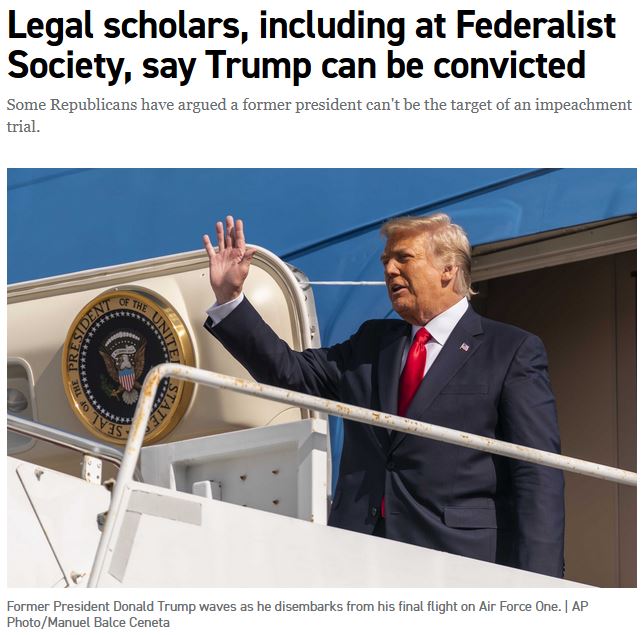
As for the fact finding mission… I wonder! Given the amount of loyalty extended to Trump by Kevin McCarthy, how many years might pass before the facts will be ‘found’?
5?!? And who would be fingered for ‘starting the whole thing’?
Now, will ‘they’ find a constitutional way to set a precedent? That a guy who had so horribly – and tragically, misused the sacred notion of “freedom of expression” has no place in such a powerful position? Or, by failing to do so – for whatever reasons, will ‘they’ leave open the ‘opportunity’ for an even more callous ‘political animal’ to climb into the Oval Office?
Being an engineer, I’m gonna present you with a more straight-forward version than the philosophical one.
For something to be real, it has to have consequences.
‘But…?!?’
No buts! The only thing which classifies something as being real or not is our consciousness. Without it, without our consciousness, the something we’re talking about now – reality itself, would cease to be ‘real’. Without us pondering about it, ‘reality’ would continue to exist, of course! Only it would no longer bear a name… Without us being concerned enough about it, it would ‘disappear’ from our ‘radar’.
‘Yes, but … you just said that something becomes real as soon as it has consequences! We encounter ‘real’ things in each and every moment of our existence. We need air to breathe, water to drink… food to eat. And a solid earth to walk on…’
True enough. Only for all these things to become ‘real’, we first need to notice them!
See how ironic things are? In retrospect, electrons are real. Despite the fact that none of us can actually see them. Or otherwise ‘feel’ them. In any way, shape or form! But until we had gathered enough evidence about their existence…
And now, that our discussion has reached this subject – evidence, I feel the need to mention the fact that Earth is not yet round ‘enough’. That there still are some people actually believing in the notion of the Flat Earth.
‘Are you implying that the Earth might be Flat?!?’
Excellent question, thank you very much! (If I may say something like that myself. Please excuse my boastfulness!)
You see, we are dealing here with two things. Two very different things.
The roundness of the Earth. Which seems to be real. The ‘Flat Earth’. Which is certainly real.
The roundness of the Earth belongs to the realm of science. Which is ‘wrong by definition‘. At least according to Popper… In the sense that the Earth will continue to remain round only till somebody will prove it to be different. Which had happened already… In ‘reality’, the Earth resembles a potato more than anything else! On the famous ‘other side’, the ‘Flat Earth Theory’ belongs to the realm of belief. Which is also real. Not in the ‘direct’ sense – a concept which describes a real ‘reality’, only in the sense that it has certain consequences.
‘The Flat Earth has consequences?!? You admit that the concept – ‘the Flat Earth’, describes something which doesn’t exist yet you pretend that it has consequences?’
Yep!
Can you deny the reality of this whole thing? Six hundred and twenty million hits? In less than point 8 seconds? Can you pretend these are not ‘real consequences’? Can you imagine, for instance, how much energy is spent only to preserve this amount of raw information in the ‘cloud’. How much ‘space’? How much bandwidth is used to transport this ‘fake-ness’ across the ‘globe’!
‘And where does this whole thing lead us? What about the Flat Earth? Is it still a fake?’
Yeah. I’m actually tempted to say ‘obviously’! On the other hand… it’s hard to deny how ‘real’ the whole thing is…
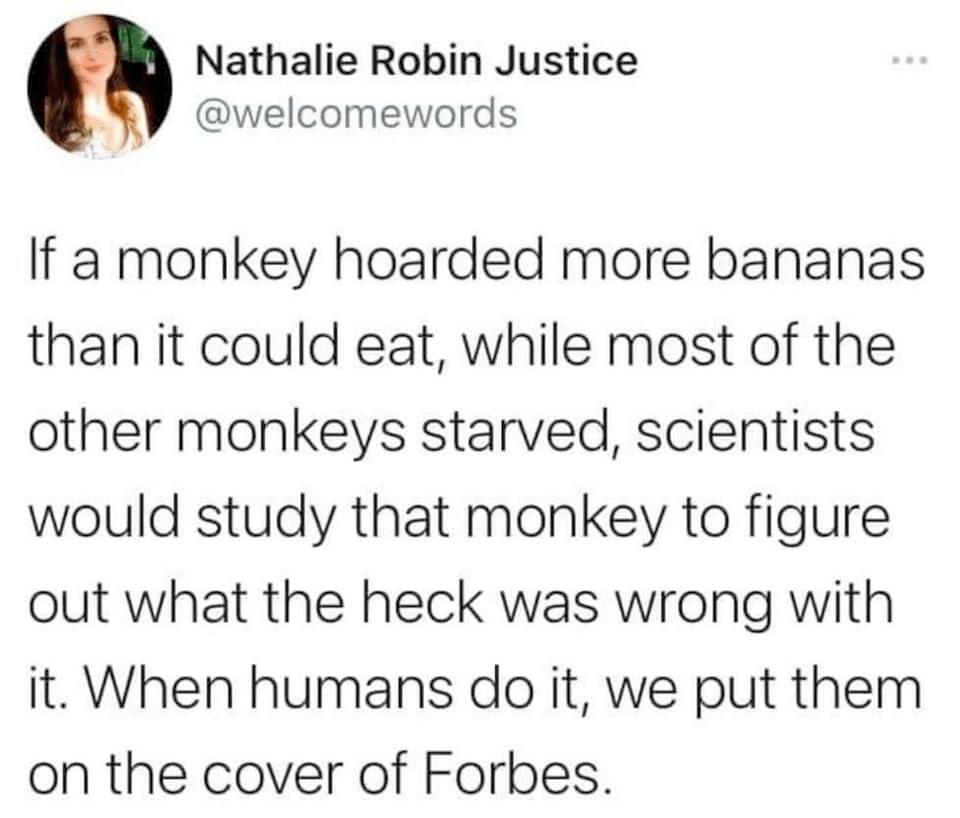
Well… Money doesn’t get spoiled as easily as bananas do…
On further consideration, money can be understood as a tool with many uses. Hoarding, for instance. Bananas, among other things …
And, as with all other tools, the responsibility for its use falls squarely on the user, not on on the tool itself. Tinkering with the tool won’t change that, ever.
My point being that monkeys would also hoard bananas if bananas were hoard-able. There’s nothing wrong with that. For as long as the hoard is meant to feed the hoarder till the next crop, of course.
Hoarding is bad only when done for its own sake.
And this is something for philosophers to study, not for scientists. The teachings of the Chicago School of Economics had been very scientific yet following them was what brought us where we are now. Into a very uncomfortable cul-de-sac…
Blindly following them… mislead precisely because of their scientific nature!
40 years ago, the car manual was about how to adjust the carburetor. Nowadays it starts with a stark warning. “Don’t drink the cooling liquid!” Then it teaches us how to use the infotainment system and how to adjust the electric seats…
In those times, most of us – regardless of what country we lived in, had nothing fancier than a washing machine. And a TV set capable of receiving no more than 12 channels. But we had a lot of time to spend with our friends and relatives. Nowadays, our houses are choke full of appliances designed to make our lives easier… So we break our backs working to pay for this paraphernalia! And we get so tired in the process that when we finally get back home, late at night, we’re so exhausted that we cannot do anything else but watch one of the 200+ channels our cable feeds into the huge TV which dwarfs everything else in the living room.
Meaning that we wrap up most of our days watching yet another mind numbing news-bulletin… which informs us about how bad tomorrow will be… unless we follow whatever advice that channel is determined to ‘sell’ to us!
One of my high-school mates had emigrated to Canada. From Romania. He’s been living there for 25 years now. We keep in touch. A few years ago, he told me:
“We come from their future. I currently experience things which had already happened in Romania.”
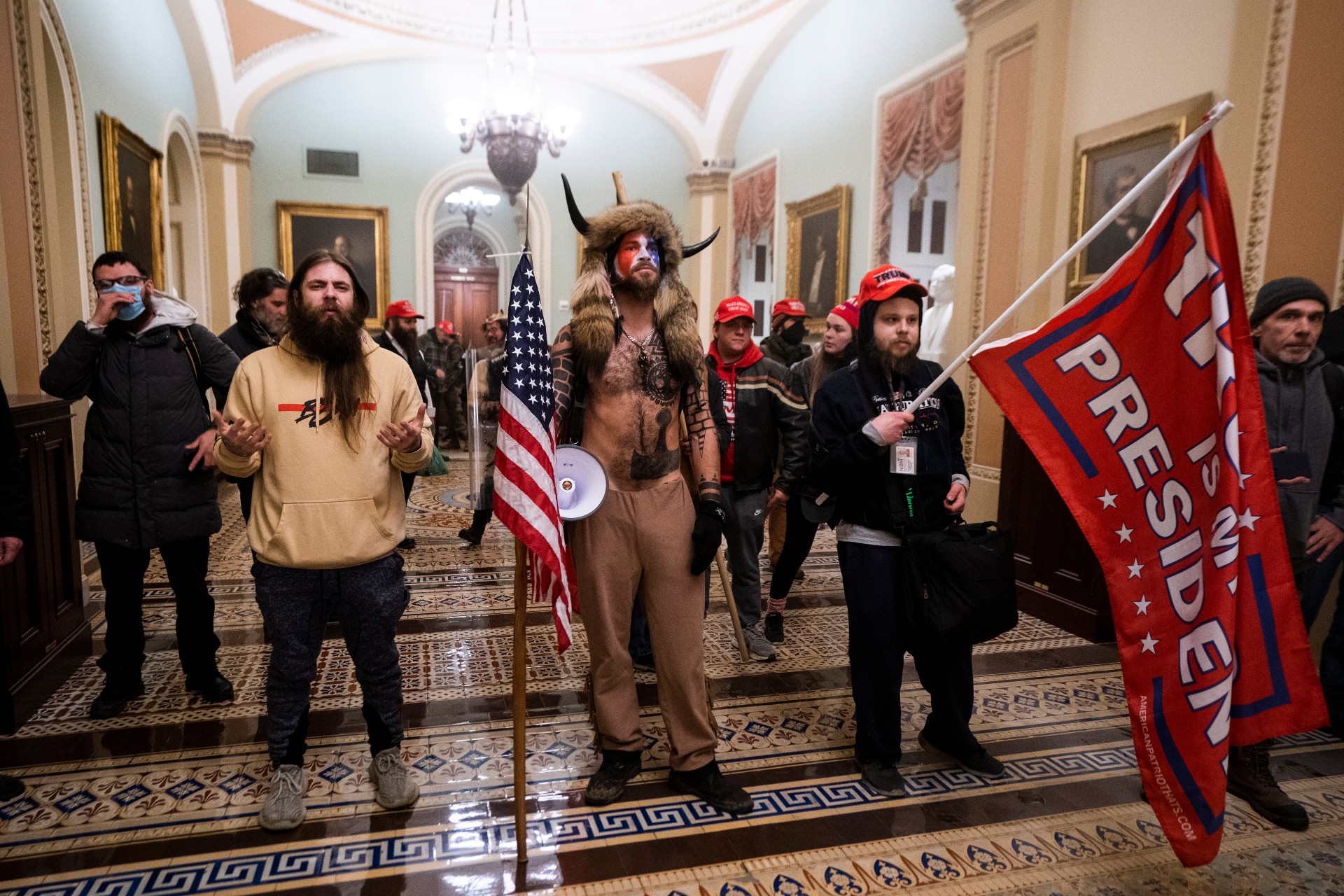
His prophecy had been fulfilled, and then some, yesterday. The sixth of January, 2021.
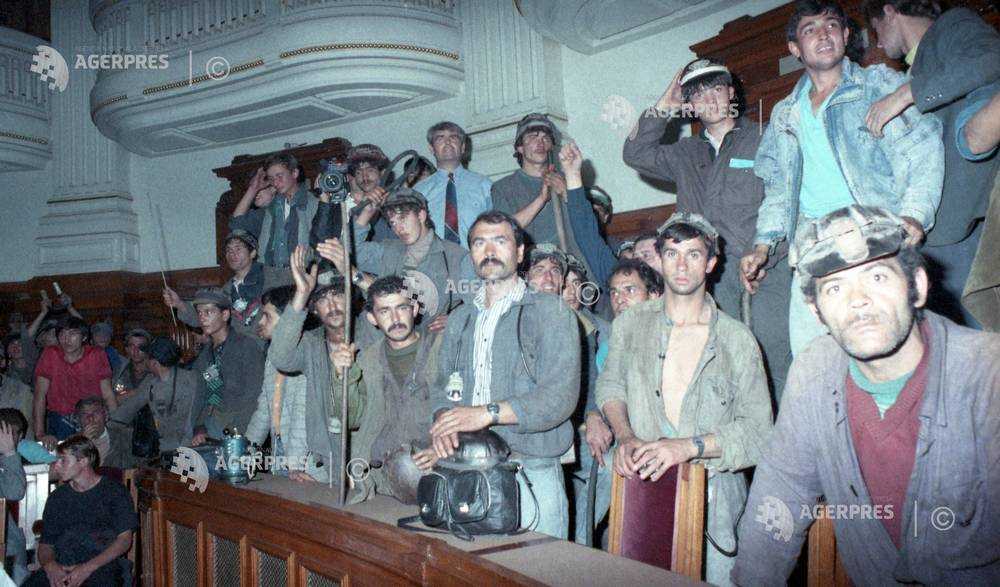
1991, Romanian miners occupying the Romanian Parliament.
The differences between the two instances exist and they are not insignificant.
Both Trump and Iliescu – the Romanian president at that time, had been democratically elected. Both on populist platforms, even if the concept wasn’t as widely used in 1991 as it is now.
Only 1991 wasn’t the first time the miners had come to Bucharest. In 1990 Ion Iliescu – the ‘cripto’ communist leader who had risen to power as a consequence of the 1989 uprising, had ‘thanked’ the miners for quelling a ‘festering’ anti neo-communist protest organized mainly by students. In fact, this had been yet another precedent. ‘Occupy’ Piata Universitatii 1990 versus Occupy ‘Everything’ 2011. In 1991, the miners had, again, ‘occupied’ Bucharest. Again, ‘supposedly’, under their own volition. The then prime minister, Petre Roman, had adopted some very stringent free market reforms. Which had fallen foul of both Iliescu and certain swaths of the population. Hence the miners had not been driven back to Valea Jiului until Petre Roman had been revoked from office.
And 1991 wasn’t the last time the miners had attempted to make themselves noticed… As the old saying goes, it’s harder to quiet down a hornet’s nest than to stir it up!
“How absurd to imagine that something we can make could actually deliver us from problems we could not free ourselves from!” Dr. Allen Ross, Dead Idols or the Living God
According to Abraham Maslow, people’s lives are ‘staged’. During the first four, each individual ‘must’ – ‘inside’ whatever circumstances Mother Luck had granted them, provide for their ‘needs’. Only after they had reached the fifth stage, individuals have the opportunity – but no ‘obligation’ other than that each of them impose upon themselves, to ‘reinvent’ their own personae. Maslow had used ‘self-actualization’ to describe the process.
In religious terms, the whole thing is known as ‘coming to peace with oneself’.
No more ‘absurdity’ here! There’s so much each of us can do in order to move ‘forward’…
‘And where is this famous ‘forward’?!? How are we, individually and/or collectively, to determine which is the ‘good’ direction?!?’
Is our ‘imagination’ good enough to come up with a solution for the “problems we could not free ourselves from”?
Is ‘induction’ a comprehensive enough solution? Or ‘too much of a good thing’ will never fail to become ‘bad for you’?
Confused?
Let me put it another way.
‘One size fits all’. How many times have you been really satisfied by such a ‘solution’? Do you really think an ‘idol’ fashioned by a carpenter – by the most talented carpenter, even, will ever satisfy the needs of at least one blacksmith?
‘But how about the idols fashioned by Plato’s king-priests?’
To answer this question – this excellent question, if I may say so myself, we must turn back to Dr. Allen Ross’ Dead Idols. To the difference between the Dead Idols and the Living God, to be more precise.
‘Criterion for what?’
If you pay close enough attention to what’s written above, you’ll notice that not passing the falsifiability test doesn’t mean than an assertion is false! Far from it, actually! Not passing the falsifiability test – ‘if a claim is compatible with all and any states of affairs’, only means that that claim is both ‘true’ and unscientific! Simultaneously true and not scientific!
‘And what has any of these to do with God?!? With the Living God or with any of the Dead Idols humankind has built for itself? And later discarded?’
I’m afraid you’ll have to come back for the answers. Or, to put it differently, I’ll gladly welcome you back!








 nicichiarasa