The sound of one hand clapping…

While worrying is indeed a waste of time, it is also a very good pointer!
If not the only one…
The only one powerful enough to make us ‘move’!

Worry is a powerful attention grabber. Points us towards the things we feel the need to solve.

What we do after our attention has been pointed… that’s the most important thing!

Continue to worry or start doing things?
Meaningful things…
And the first meaningful thing to do while worrying is to stop.
Now, that the attention grabber had done its thing… to continue would be a waste of energy!

Știi care e diferența dintre nemți și români?

Am auzit ‘povestea’ asta undeva prin 1988.
Adică în secolul trecut și în timpul orâduirii de mult apuse. Cel puțin din punct de vedere formal…

Am tot relatat întâmplarea în diverse situații.
A venit momentul să o consemnez.
Pentru simplul motiv că e din ce în ce mai actuală!
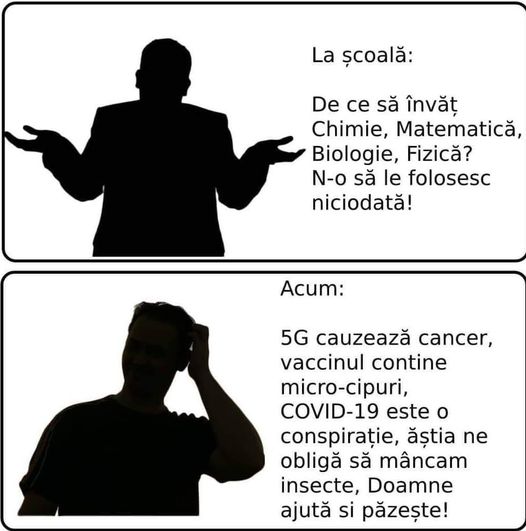
Si ca explicație pentru ilustrația de mai sus. Care a început să mișune pe internet.

Cică un grup de nemți, atunci când văd pe cineva mai deștept decât media, se dau pe lângă el. Îl ajută să facă ce are el de făcut. Și în felul ăsta trăiesc cu toții mai bine.
În felul ăsta trăiesc cu toții din ce în ce mai bine…
Și cică un grup de români, atunci când văd pe cineva mai deștept decât media, se adună în jurul lui. Și-i dau la cap!
‘Ce mă, ăsta se crede mai deștept decât noi?!?’

De ce mi se pare încă actuală?
Cu toate că în România se trăiește mult mai bine decât se trăia pe vremea aia?
Cu toate că în multe locuri din România se trăiește aproape la fel de bine ca în multe locuri din Germania?

Păi tocmai d-aia.
Pentru că prea mulți dintre nemți ‘s-au învățat la prostii’.
OK, o parte dintre români ‘s-au deșteptat’. Mai e mult până departe dar măcar mergem în direcția bună!
Nemții, în schimb, parcă au luat-o înapoi.
Și mi-e frică să nu cumva să ne luam după ei!

You cannot learn
what you think you know.

Epictetus

How many times have you been hit by something you didn’t see coming?

Not very often… for the simple reason that these encounters use to end up badly!
Bent fenders, broken bones…
Hence we pay attention. Or get killed… end of story!

But how many times have you experienced bad consequences, really bad consequences, after misjudging a situation?
After a ‘doesn’t matter’ uttered nonchalantly?

There are no facts, only interpretations.
Friedrich Nietzsche

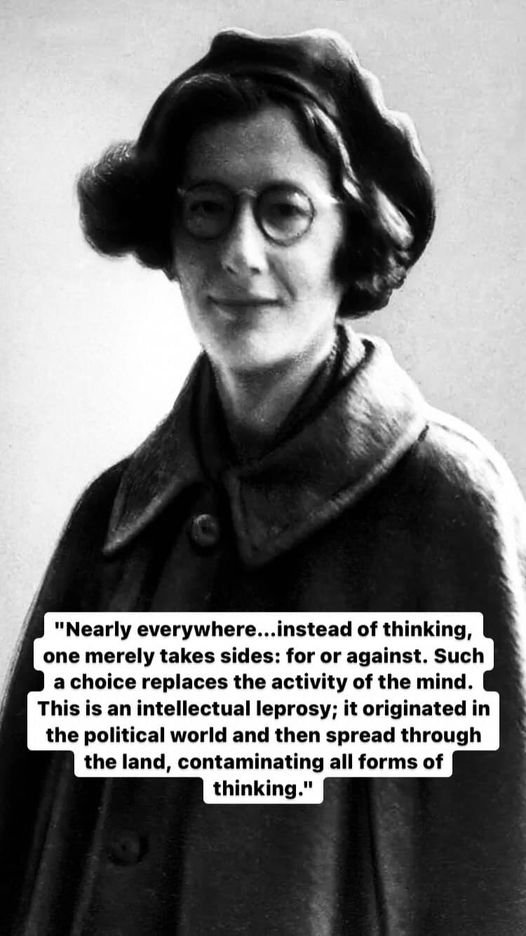
I’m afraid the political world wasn’t where this intellectual leprosy had originally came from.
The political world was only the place where this disease had become ‘viral’.
Where this manner of (not) thinking had been weaponized!

Its origin can be traced back to our intellectual arrogance.
To our conviction that ‘I can be right on my own’. Without any ‘input’ from the outside…
Even in spite of whatever information might reach me from ‘outside’, if that information doesn’t fit my already held convictions. My ideology….

In fact, this belief – ‘I’m entitled to my own convictions’ – is exactly what people on both sides of the divide have in common. Intellectually speaking!
A shared disease… a virus infecting indiscriminately…

What are the errors of Marxism?

Marxism is an ideology.
Ideologies don’t have errors, they are thought templates used to evaluate a certain situation and to determine what to do next. Ideologies are tools.
They can be used properly or improperly.
Sometimes, the best use for certain tools is to be left alone. Particularly when you understand they are useless. If you understand they are useless…
Hence it’s not Marxism which is full of errors, it’s the Marxists who are barking up the wrong tree.

If you really need to put your finger on something, if you need to point out a culprit, I give you Marx.
Yes, Karl Marx is your man.
His analysis was brilliant. His diagnostic was spot on.
Finally, in times when the class struggle nears the decisive hour, the progress of dissolution going on within the ruling class, in fact within the whole range of old society, assumes such a violent, glaring character, that a small section of the ruling class cuts itself adrift, and joins the revolutionary class, the class that holds the future in its hands. Just as, therefore, at an earlier period, a section of the nobility went over to the bourgeoisie, so now a portion of the bourgeoisie goes over to the proletariat, and in particular, a portion of the bourgeois ideologists, who have raised themselves to the level of comprehending theoretically the historical movement as a whole.
His cure – the mandate he gave to the “bourgeois ideologists who have raised themselves to the level of comprehending theoretically the historical movement as a whole”, and whom he called “communists” – was abysmal.

Which tells us Marx’s brilliant analysis wasn’t deep enough. He had noticed a series of facts but he had failed to notice the bigger picture. He had failed to see that all authoritarian regimes had failed. Under their own weight. Inevitably. And he had failed to notice that all democratic regimes had survived, and thrived, for as long as they had managed to preserve their democratic nature.

Hence the Marxist cure, communism, was stillborn.
A tool to be left alone.
The attempt to impose yet another authoritarian regime – with no matter how generous intentions – after the overwhelming experience of all other authoritarian regimes failing abysmally, is nothing but the compelling proof of social and historical blindness.

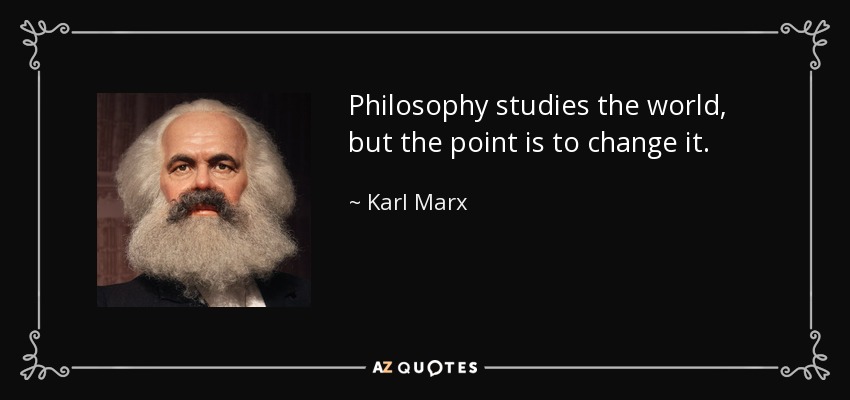
And why start this post by quoting Marx himself?
Because that quote is more than enough. More than enough proof for Marx being a bully.
It’s OK to ‘change the world’ if you own it. If it was yours…
But bearing in mind that there are other people living in the same world… wouldn’t it be nice to ask their opinion about the whole thing? About the changes you want to make? Which changes will dramatically affect the world they live in?!?
They are simpletons? Whose opinions are worthless? Because you said so yourself?

“The lower middle class, the small manufacturer, the shopkeeper, the artisan, the peasant, all these fight against the bourgeoisie, to save from extinction their existence as fractions of the middle class. They are therefore not revolutionary, but conservative. Nay more, they are reactionary, for they try to roll back the wheel of history. If by chance, they are revolutionary, they are only so in view of their impending transfer into the proletariat; they thus defend not their present, but their future interests, they desert their own standpoint to place themselves at that of the proletariat.

The “dangerous class”, [lumpenproletariat] the social scum, that passively rotting mass thrown off by the lowest layers of the old society, may, here and there, be swept into the movement by a proletarian revolution; its conditions of life, however, prepare it far more for the part of a bribed tool of reactionary intrigue.”

As I just said.
Bullly!!!

For everybody, no matter how powerful, crimes are those that others commit….

The powerful are the ones who have the means to evade the consequences but when it comes to ‘who thinks what’, there’s no difference among variously powerful people!

There is an old ‘rule’ which maintains that even a broken watch may be accurate.
From time to time, if it retains its arms…
Twice daily, to be precise!

Same thing is valid for people.
From time to time, each of us will utter something which actually makes sense!

Sort of, anyway…

The catch being that in order to ‘prove’ the temporary accuracy of the broken watch you need one in good working order. Or, alternatively, you need a good understanding of time.

Same thing with Peterson’s uttering.
On the face of it, the phrase is catchy.
In fact, it’s just as useful as a broken watch.
What solace will be felt by the victim of a tough tyrant when that person realizes that no tyrant, however tough, was ever capable of ‘achieving’ anything without the compliance of the weak? Without the compliance of those who had done, in their weakness, what the tyrant had told them to do…

So yes, broken watches are, sometime, accurate.
And yes, Petersen is right to tell us that both tough and weak people can wreak a lot of havoc.

But neither of these two pieces of trivia will be useful to us until we’ll understand it’s up to us to put them to good use. To understand the temporary nature of the accuracy displayed by the broken watch and the fact that no man, however tough, becomes really dangerous unless condoned, or even helped, by ultimately hapless weaklings.

The things we believe
are
what we have in common
with those who promote them.

Well, nobody ‘blindly’ beliefs anything published in the media!
We use our cognitive biases in order to do that.

The media publishes the things we like to hear.
To sell advertising space, to please their sponsors…
While those who actually do this, the journalists, appease their consciences with ‘we have to give them what they want’. ‘Cause we actually do ‘buy’ their stuff…

And we believe the things we read in the kind of press we ‘buy’ because we no longer bother to keep in check our cognitive biases!

Who has anything to gain? From this vicious circle spinning faster and faster?

Nobody, really!
But we all have something to lose.

Everything, actually!

When was the last time you met a dead person who regretted anything?

It is not from the benevolence of the butcher,
the brewer, or the baker, that we expect our dinner,
but from their regard to their own interest.
We address ourselves, not to their humanity
but to their self-love,
and never talk to them of our own necessities
but of their advantages.
Adam Smith, The Wealth of NATIONS, 1776

I’m sure you already know that Adam Smith didn’t invent capitalism. As Marx invented communism and Lenin invented bolshevism.

Adam Smith had done nothing more and nothing less but described what was going on around him. How a bunch of people acting according to their ‘moral sentiment’ took care of business. How individual needs – for meat, beer and bread – were met and how the wealth of nations was built in the process.

“To some people, Gen Z may seem salary ‘obsessed’. In some cases, say experts, it may be hard for older generations to understand why young workers have such an intense focus on pay. “At Gen Z’s age, older people worked 40 hours a week, and made enough money to buy a house and have barbecues on the weekend,” says Corey Seemiller, an educator, researcher and TEDx speaker on Gen Z. “Gen Z works 50 hours a week at their jobs, and another 20 hours a week side hustling, yet still make barely enough to cover rent.””

Do you notice any need being fulfilled, in earnest, in this, new, situation?
OK, things were not that rosy in Smith’s times either. Most people had to work hard, a lot harder than today, to make ends meet. But since Smith and until some 40 years ago things went better. Year after year.
When Smith was writing his books, Regular Joe-s used to live in crowded shacks, usually rented out from their employers. Nowadays, most of those in their 50-ies and 60-ies own the house they live in. Which house has nothing in common with the afore mentioned shack.

So, is this the new kind of progress?
A looking back in anger kind of progress?
Are you even aware of the huge number of people pondering whether capitalism is not as good as advertised – by those who have already enjoyed its spoils? For the simple reason that in the current (no longer) free (enough) market so many people can no longer enjoy the kind of economic well being their grand parents took for granted…

As someone who had experienced both communism and capitalism, the situation is clear.

Ciordeala de azi celebrează poporul român.
Că tot vine ziua națională.
Dacă nu vă recunoașteți în personaj ori nu sunteți popor român,

ori nu vă autoevaluați corespunzător.

Unii dintre noi am avut profesori buni!

Așa că suntem în stare să ne evaluăm corect, asumăndu-ne statutul de ființe mărginite și rămânând în cadrul poporului român.

Și da, mare parte din bulibășeala de astăzi poate fi atribuită dezinteresului popular față de știința rece.
Dezinteres care vine din străfunduri istorice. Vezi zicala „cine are multă carte are și un pic de nebunie”.
Dezinteres încurajat frenetic de o anumită parte a spectrului politic. Vezi insistența neo-liberală cu privire la inutilitatea studiului. În special atunci când vine vorba despre disciplinele umaniste. Vezi insistența cu care sunt sfatuiți tinerii să învețe doar acele deprinderi care pot fi monetizate rapid pe piața muncii…

Colac peste pupăză, să nu uităm contribuția părinților contemporani. Nu intru în amănunte cu privire la motivațiile acestor părinți, cert fiind doar comportamentul acestora.
Își împing copii până la epuizare. Le pretind să aibe doar note de 10 și să exceleze la toate activitățile extrașcolare la care îi înscriu.
Doar că cei mai mulți copii sunt pur și simplu normali! Nu extraordinari, așa cum îi vedem noi – părinții lor.

Care copii normali nu pot satisface așteptările noastre nerealiste.
Care copii normali sunt descurajați de reproșurile noastre continue cu privire la nerealizările lor.
Care copii normali renunță, în cele din urmă.
Demotivați fiind, renuntă la școală, renunță la educație, renunță la a mai citi …

Și devin pradă!