Archives for posts with tag: Self awareness

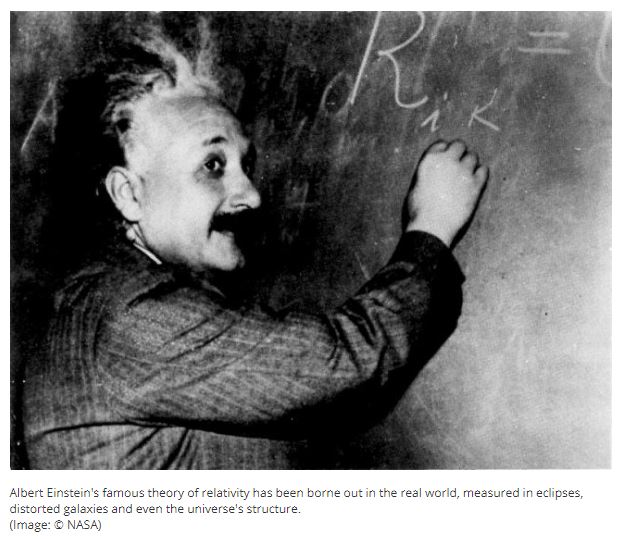
Albert Einstein, a physicist, had noticed that observations are relative to the “frame of reference” where the observer happens to make his observations.

Humberto Maturana, a biologist, has reached the conclusion that consciousness – or ‘self awareness’, as he prefers to call it, is a personal trait which is developed by individuals living in concert.

Blending Einstein’s and Maturana’s ideas, it is easy to ‘see’ that observations made by human individuals depend, simultaneously, on two referential systems. Or frames of reference, in Einstein’s terms.

On the actual, ‘geographic’, ‘place’ where the individual makes their observations.
And on the ‘cultural place’ where the conscience – inner referential system, of the observing individual had been ‘shaped’.

Otherwise put, nobody can see things which are not there. Nor ‘see’ – a.k.a. understand, things which are too ‘distant’ from what that person already ‘knows’. Accepts as being ‘normal’. Feels like being ‘right’.

To make things just a tad ‘clearer’ – ‘nature versus nurture’, we must consider the vagaries of individual ‘biology’. Some people see/hear/smell/feel differently than others. And even ‘think’ differently.

And my point is?

Maturana made it before me. The ‘other’ – the more different, the better, is a source of richness. IF we treat each-other the right way. If we help each-other by ‘concerting’ our observations about what we have in common.
The ‘place’ we observe. Einstein’s referential frame. Where we ‘happen to stand’. Together.

And there’s something else I’d like you to read.

“J.K. Rowling Writes about Her Reasons for Speaking out on Sex and Gender Issues”
https://www.jkrowling.com/opinions/j-k-rowling-writes-about-her-reasons-for-speaking-out-on-sex-and-gender-issues

Everything which has a temporal dimension – movement, transformation or both, incurs costs and produces consequences.

From a rock sliding down a slope to me writing this.

The difference between these two being the simple fact that no rock has ever had any goal.

You see, the rock looses some energy and mass while sliding down. It accelerates at first but since no rock has ever slidden for ever.
Only rocks never do anything on their own. Something has to happen to them first.
They do bear the costs – they wear down, break, etc., yet they don’t mind. For they are not, at all, aware of what’s going on. And, anyway, completely unable to do anything about it. Hence not at all ‘responsible’ about any of the consequences produced by whatever they had been involved in. Happened to them, actually.

Fast forward to me. I’m not only alive – hence reactive to whatever happens to me, but also aware. Aware of my own awareness even.
I notice the costs I have to pay. Hence I try to minimize them.

And here’s the gist of the matter.
My awareness drives me to minimize the costs I incur during my life AND to be very careful about the consequences of my endeavors.

Theoretically, at least…

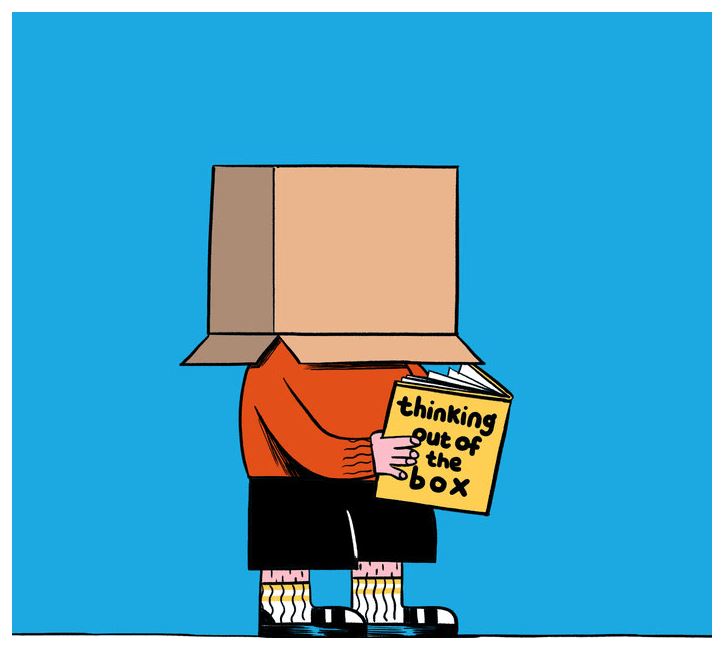
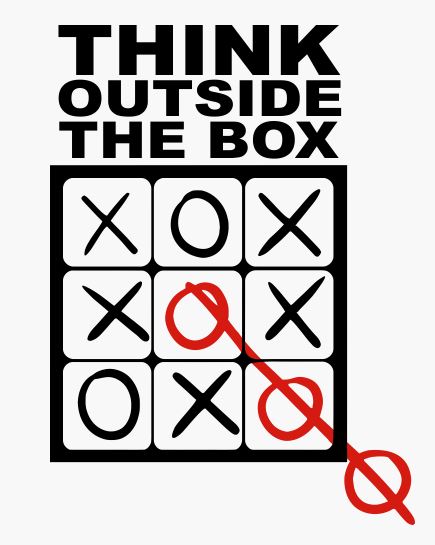
There are a lot of people who prod us to ‘think out of the box’.
And a few who dare to warn us about the perils of pushing it too far…

I’m gonna invite you to the next level.
Instead of sending your imagination to think outside the box – while the rest of you remains comfortably inside, let’s step outside ‘in person’.

Classic thinking outside the box does nothing but enlarges the box. Brings inside a portion of the outside. Moves the walls.
Bringing in a lot of additional clutter in the process.

By stepping outside, physically, you have the opportunity to actually see the problem as an ‘independent’ box. Separated from you and separated from the environment.

How about this for a change in perspective?

This way it will be easier for you to notice, and carefully examine, the links which exist between you and the problem. Between ‘the’ problem and the rest of the problems. Between the problems and the environment. The place where you have to cope with the problems.

The place where you live.

And that, my friend, is your biggest problem.
How to step out of your own life.
In order to make it better.

Humberto Maturana teaches us that human consciousness can be understood as our ability to ‘observe ourselves observing‘.
In other words, consciousness might be reduced to self-awareness.

I’m afraid it’s not enough.
While no individual can be described as conscious if not commanding a certain degree of self-awareness, being able to observe their own observations doesn’t elevate an observer to fully conscious status.

How many of us have ‘enjoyed’ messing up ants or other insects just for the fun of it? When we were teenagers, of course.
OK, we continue to squish the cockroaches we happen to see and to spray our gardens against mosquitoes and other pests.
Only we no longer do it for fun. We employ a ‘healthy’ rationale to justify our actions – cockroaches/mosquitoes are ‘bad for us’.
And we try to do it in a reasonable manner. We don’t soak the entire garden with the most potent insecticide available. Simply because we’ve understood, the hard way, that bees are also important for us.

Otherwise put, it’s not enough for us to be able to keep tabs on what we do, we must also take responsibility for our actions.

After all, we’ve been able to notice that bison ‘engineer’ their own environment.

“Herds of bison milling through Yellowstone National Park may seem aimless to the average visitor, but a new study reveals the animals are hard at work engineering their ecosystem. By rigorously mowing and fertilizing their own patches of grassland, the big herbivores essentially delay spring until late summer.”

Maybe the time is ripe for us to understand that we, humans, have done the very same thing for quite a while now.
The world we live in is, to a certain – but rapidly growing – extent, the consequence of our own decision making.

The faster we learn to accept that, the higher the chances we won’t repeat past mistakes.

Any attempt to learn something, to increase your knowledge about a certain subject, is nothing more and nothing less than an attempt to become intimate with it.

Students have two open roads ahead of them.

One which implies a lot of wooing, patience and a certain degree of self appeasement.
The other asks for a direct, almost blunt, approach.
While the first is more like the student dancing around the subject, the second is akin to a hands on combat.

The results are, obviously, different.
Not exactly different. Only fundamentally.

The difference is very much like the difference between courtship and rape.
The end result might be a child. But…

Same thing with art and science.

It is true that in order to have sex, both partners need to be, at least somewhat, naked.
But there is all the difference in the world between having sex and making love!

The end result is only apparently the same!

A transformation so drastic that somebody needs to have been at both ends of the process in order to accept that what came out was the same thing as what went in.

The Universe has already went through Metamorphosis 0.1 and 1.0.
The ‘Big Bang’ and the apparition of life.

We’re witnessing Metamorphosis 2.0.
Awareness’ coming of age.

Individuals becoming aware not only of their own awareness but also of their place in the order of things.
Communities becoming aware that each of their individuals are paramount. That ‘no one left behind’ is the only thing that keeps the community together.
Individuals understanding that each of them is equally important yet none of them indispensable.

Individuals and communities alike opening their minds to the fact that none of them might exist without the other.

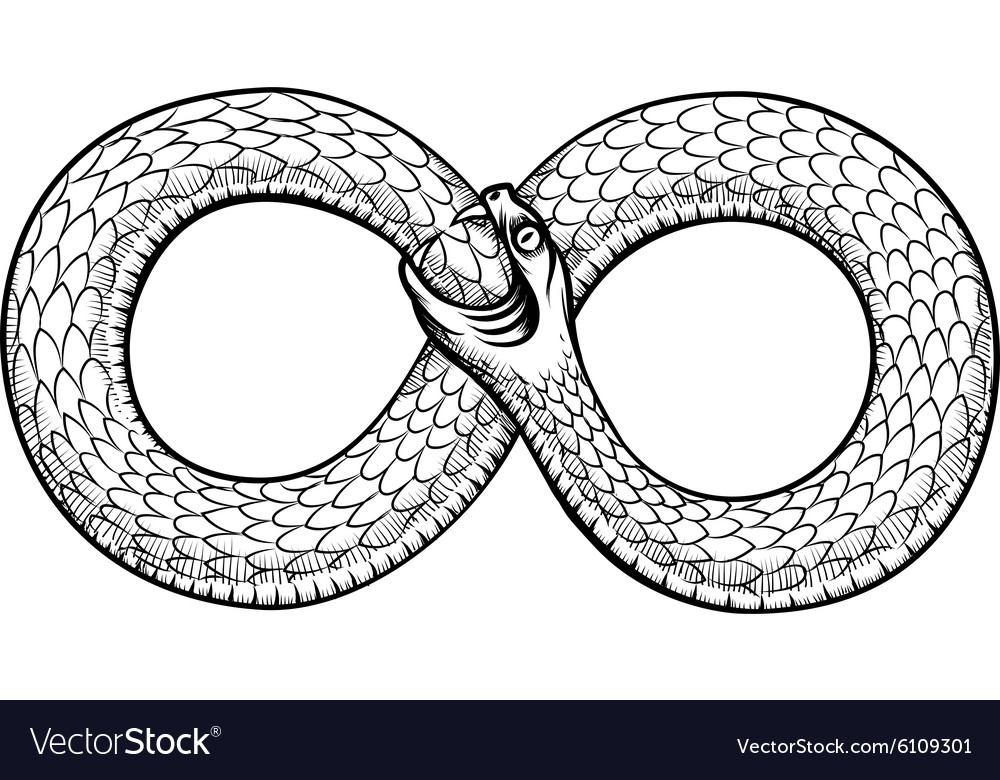
A symbol is a very powerful thing. Because it can ‘hide’ a lot of meaning. As much meaning as we can store/recognize inside it.

And the stronger the symbol, the more we can hide/store/recognize behind it.

“Why do you insist the universe is not a conscious intelligence, when it gives birth to conscious intelligences?”

This quote is attributed by Robert Lanza to Cicero. A Roman who used to think, and write, some 2000 years ago.
I have no idea who Robert Lanza is yet I’m sure most of you have already heard about Cicero.
But we now have Internet. And Google search…

Going back to Cicero’s Universe, I, for one, have never said the universe wasn’t conscious. For all I know, it may very well be.
But I’m sure it isn’t fully conscious. As God is supposed to be. Omniscient and Omnipotent.
Precisely because of the kind of ‘conscious intelligences’ it has given birth to.
Or is being born by?

Let’s assume the Universe is conscious. As in aware of its own awareness – the only kind of consciousness we’re aware of.

As far as we know – ‘know’ as opposed to ‘presume’, consciousness cannot ‘arise’ on its own. Each of our individual consciousnesses have been groomed by those around us. Children who happen to grow up outside ‘normal’ human intercourse never morph into ‘fully’ conscious human beings.
Hence Cicero’s Universe might have become conscious only along one of the following paths:

As a member of the Multi Verse club.
As an AI designed by some entity residing outside the Universe. This situation being the mother of all Oxymorons…
As a meta-consciousness. A web of individual consciousnesses who had evolved/coalesced into a wider, and ‘deeper’, range of awareness. Still limited, of course, but of a somehow different nature than that of the individual awarenesses composing it.

Which brings us back to the symbol I started with.
The Universe digesting itself repeatedly as a continuous attempt to reach its own essence.
Humankind reconsidering recurrent ideas until they actually make sense…

‘Hey, you forgot about two of your own hypotheses … the first and the second…!’

Thanks for the observation.
They slipped off my mind because both are particular cases of the third.
A Multi Verse is nothing but a bigger Universe.
And a combination between an Universe and an Outside Agent is nothing but a Duo Verse. A ‘smaller’ Multi Verse.

Tada!

Universal Grammar (UG) is intended to specify the most general principles of human language. It must provide an explanation for the extraordinary fact that a Japanese child raised in Paris will acquire French, but not Japanese, and a French child raised in Tokyo, Japanese, but not French. Either child may acquire both French and Japanese, of course, but neither will fail to acquire French or Japanese. Linguists and philosophers may have known this in antiquity; they did not say so with any great conviction, and they may not have said so at all. It was left to Chomsky to remark with the full force of his genius that every human language can be acquired by any human being. Universal Grammar, Chomsky concluded, must be a species-specific characteristic of the human race, biologically encoded, genetically transmitted.

The quote comes right out of an article written by David Berlinski and Juan Uriagereka. Never heard of any of them.

Reading that article, I remembered the reason for which I tend to avoid modern philosophers. Or linguists. Hard to discern which is which, anyway…

Let me return to the quote itself.
“An explanation for the extraordinary fact that a Japanese child raised in Paris will acquire French, but not Japanese, and a French child raised in Tokyo, Japanese”.
Read this to anybody who isn’t familiar with the notion of ‘Chomsky’. You’ll get a laugh and a troubled look. ‘What’s so extraordinary here?!? People will always learn whatever language is spoken around them… but only if they come in contact with the ‘exterior’ world!’

Home-school those Japanese/French children in Paris/Tokyo while preventing them from getting in touch with anybody else but their immediate family/trainers and they’ll learn only whatever language(s) their trainers/family will have chosen for them.

As an aside, what does Chomsky mean by ‘French’ and or ‘Japanese’?
‘Genetically’ French/Japanese? What if one parent is French/Japanese and the other German/Korean? What will the child be? Like the father or like the mother?
‘Culturally’ Japanese/French? According to their ‘mother’ tongue?!?
Forget it…

“Universal Grammar, Chomsky concluded, must be a species-specific characteristic of the human race, biologically encoded, genetically transmitted”.

‘Species specific characteristic of the human race’… told you these guys have a lot of humor… or, maybe, they cannot make up their minds…
What are we, humans?!? A species or a race?

OK, let me move forward.
Hidden underneath all this ado, there is a piece/gem of ‘harsh’ reality.
The simple fact that if/when we want to, we are able to understand each-other. To communicate with each-other. To exchange ideas. To trade meaning.
And there is indeed something species-specific about this ability of ours. Nobody else has it… according to our present knowledge about the world, anyway.

‘Nobody else has it’… yeah, right… as if you hadn’t watched, time and time again, two dogs ‘greeting’ each-other in the park.
OK, those dogs were interacting in highly unnatural circumstances. Walked by people, in a people infested environment …
Fact is that all animals have ‘procedures’ for interacting with other animals. Belonging to the same species or belonging to other species. Some of the procedures being inbred while others had been acquired trough learning or training.
Cats, for instance, have an inbred ‘procedure’ for chasing anything which might become a prey but need to be taught by their mothers how to finish the chase. How to kill that prey.
And yes, cats do have a species-specific, biologically encoded and genetically transmitted characteristic which allows them to kill and eat their prey. Or to play with the people who take care of them. They kill and eat using their claws and teeth while they play using their brain. OK, the brain also contributes during the chase… don’t be a nit-pick.

Let me summarize.
So cats have a specific set of tools, teeth and claws, which are ‘coordinated’ by a brain which needs to be taught in order to become fully functional.
And the overall ‘functioning’ of any given cat depends simultaneously on how well their organism works AND the quality of the learning they have been able to amass.

Then where’s the difference between humans and cats?
What is so species-specific in our ability to interact with the world?

I’m exaggerating, of course. We are able to understand each-other far deeper than the other great-apes, our cousins. There is something species-specific in all this.
But only in ‘depth’, not in ‘nature’.
We’ve been able to teach chimps to write. And cats to play with strings instead of catching mice. All three of us ‘share’ the more or less same kind of brain and surprisingly similar anatomies.

What really sets us apart is our learned ability to watch ourselves while doing something. To observe ourselves observing, as Maturana puts it.
And our ability, learned again, to formulate information in a transmittable form. To ‘build’ highly specific messages using rather ‘fungible’ building blocks and in such a manner that those messages might be transmitted from one individual to another. From one generation to another, even.
To make good use of the Universal Grammar noticed by Chomsky.

Can any of this be construed as species-specific? Of course. Without the huge brain we’ve got – or without the ability to articulate sounds, we most likely wouldn’t have been able to reach this stage of our evolution.
But to reduce everything to mere biology … I’m afraid that would be too simplistic.

Consciousness – or self-awareness, opens up huge evolutionary venues. Powered by our very ability to communicate so intensely. To use ‘Universal Grammar’, even without being aware of its existence.
But since both self-awareness and talking depends upon learning them from/with the others… biology is not enough. Necessary, indeed, but not enough.

Not by a long shot.

Most commentators treat Maslow’s as if it were a pyramid. A succession of five receding floors constituting a structure in the three dimensional space.

Something which can exist, and function, on its own.

I see it as a mere triangle. Drawn on a two dimensional surface by Maslow’s imagination and imperfectly reproduced – according to our individual manner of seeing things, on the surface of our consciences.

My point being that each of those levels are nothing more than a set of opportunities.

The first two, which are described as ‘basic needs’ are the stages where we have the opportunity to learn how to drink, eat, manage our immediate environment and our own strength.

And so on.

Basically, it’s what we choose to do in each of those stages which determines whether we graduate to the next one.

OK, sometimes we are dealt with an ’empty set’ situation. There is no food available. Or no water. Use your own imagination.
But since in that situation there is nothing to be done except waiting for something to change – death is a form of change, that situation is of no interest for me. There’s noting to be decided so…

What we choose to do…

All that Maslow is trying to teach us is that our freedom of will might be free but will always be influenced by the situation in which we find ourselves.

When hungry, our attention – hence freedom of thought, will be necessarily drawn to finding food. We will still be relatively free to choose our individual manner of gathering/cooking it but much of our ‘bandwidth’ will be spent trying to fulfill that task.

And so on.

The really interesting stage/floor being, of course, the last one.
Where we’ll continue to feel hungry – from time to time, at least, were we’ll continue to be vulnerable to various potential aggressors, where we’ll continue to depend on friends and associates, were we’ll continue to pay attention to what other people say about us.
But where all those needs will be modulated by our manner of relating to them.
Ascending through the first four floors meant that our understanding of things was modulated by our needs. Reaching the top means that our conscience has finally learned to ‘turn the tables’. To peek on the other side. To trans-cede.

To whatever stage our precedent choices have set for us.
For us to play our freedom.

Ever-since Descartes –  dubito ergo cogito, cogito ergo sum, the western culture had considered that a person becomes truly human only after they actively start looking for answers. Start thinking about their own persona, in a conscious manner.
Otherwise put, we start existing only after we notice our existence.

The corollary of this concept had been ‘rational thinking’. The belief that it is possible to consider something – to emit a judgement about a subject, only after dispassionately examining all available facts – and only the facts, pertinent to the matter.

While the ‘thinkers’ were coining the concept of rationality, the more practical minded had come up with the scientific approach. Gather as much information as possible about the subject you’re interested in, interpret it and come up with a conclusion. But keep an open mind about any new information which might come up and be prepared for your conclusion to be invalidated – or, at least, ‘nuanced’, at any moment.

At first sight, there isn’t much difference between these two approaches. Only at first sight, of course…
Those who consider themselves to be ‘rational’ have a hard time accepting other people’s conclusions while the bona fide ‘scientists’ are actually happy when they are contradicted. ‘My work has been considered important enough for somebody to check it. I’ll just have to make amends and all will  be fine’.

Now, I’m convinced that you’ve all figured out that I’m joking.
There’s no such thing as a fully rational person who denies the facts which happen to contradict their conclusions just as there’s no such thing as a scientist pure enough to actually enjoy being proven wrong.

But I’m not joking when I observe that there are so many people who consider themselves to be rational and who refuse to accept as fact anything which contradicts their beliefs. Who have a ‘scientific’ approach. Who cherry-pick only the facts which confirm their theory and dismiss – as ‘fake-news’, all the rest. Just as many as the scientists who do the same thing.

I wonder who supervises their thinking processes.
Are they truly aware about what’s going on inside their heads?
Or about the consequences?