Archives for posts with tag: opportunity

One man’s junk
is another man’s treasure

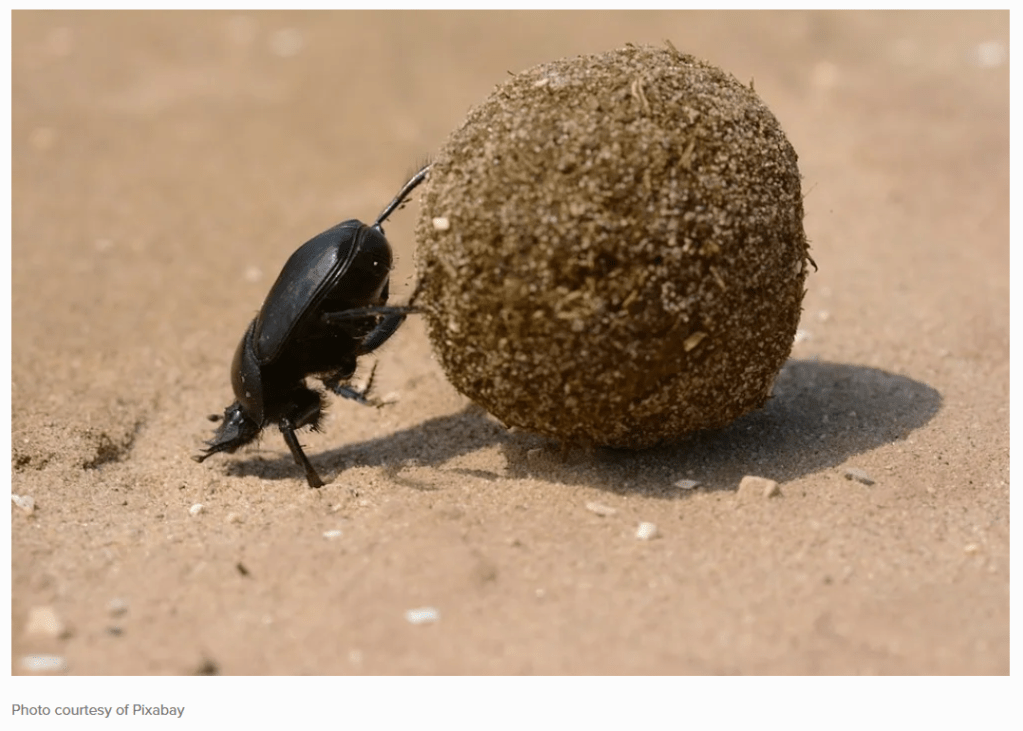
Dung beetle are very industrious.
They don’t think much but are very useful.

And they have been useful for quite a while.
Since long before our ancestors had started to roam the Earth…

My point being that their attempt at taking care of their next generation – their species collective effort to survive – have helped shaping the current version of Earth’s ‘environment’. The current version of the place which we, all of us, call home.

Where we, humans, do our thing. Think!

Think and make differences.

For the dung beetles, poop is both a resource and an opportunity. They need dung in order to ‘nest’ their eggs so whenever they find it they start working.

Dung beetles are very good at using poop. In doing their job they perpetuate their species and they reintegrate poop into the natural order of things. Read here what happened in Australia between man had introduced cows and the ‘same’ man had got wise enough to bring some dung beetles specialized in using that particular kind of poop.
But dung beetles are not able to think. Or to speak. About anything, including their most prized resource. Dung.

We do. We are able to think. And to speak. Among ourselves. And with ourselves…
How else do we do what makes us humans?
How else do we think except by using words? Concepts…

And this is how we get to the gist of today’s post.
The difference between a resource and an opportunity.

It was by thinking that we have identified something as being a resource. That something can be used.
And it was through the same process that we have coined the concept of ‘opportunity’.

We don’t eat everything in sight, right?
We understand the difference…

In fact, we are able to understand.
We have the necessary resources to make the difference!
But we don’t always make good of the opportunity…

“All governments suffer a recurring problem:
Power attracts pathological personalities.
It is not that power corrupts but that it is magnetic to the corruptible.”

Frank Herbert, Chapterhouse:Dune

How can Orson Scott Card be so bigoted, but the Ender’s Game series is about empathy and acceptance of others?

– “Circle of Empathy. If you’re inside the circle, you are worthy of empathy and it applies to you. If you’re outside the circle, you are not worthy of empathy and bigotry towards you doesn’t count because you don’t count. If you’re ever baffled by how one person can be forgiving and accepting towards one group and turn around and be rabid dogs towards another group it’s because in their emotional calculus the second group literally doesn’t count as “deserving”.
Does it make sense? No. Do humans make sense? No.
“”

Card was young when he wrote Ender’s Game and for what it’s worth I think it reflected his real views on the world at the time. He’s since spent decades of his life in a high control cult that has told him constantly that gay people are moral failures.
I think there’s a chance that Card is actually closeted from remarks he’s made on the subject and fear of discovery has made him feel he has to be even more dogmatic on the matter.
I grew up queer in fundamentalist churches. I’m always going to think of people like this as partial victims, even if it would be easier to just hate them. Brainwashing is real. It’s not just something you shrug off because you’re an adult.
I love his Ender series and think it’s beautiful. It doesn’t actually matter to me what he personally believes because his work is saying something else.

Discussion found on Reddit:
https://www.reddit.com/r/books/comments/14mmmu0how_can_orson_scott_card_be_so_bigotted_but_the/?rdt=42921

Alive in a living context.

Try to imagine a single living organism.
Forget about ‘where did it came from’. Forget about ‘what does it drink/eat/breathe’.
Now, does the existence of a single living organism mean that life is present? When attempting to answer this, pretend no observer is present…

‘Life’ is ‘wide’ word. It covers a lot.
From ‘life’ as a phenomenon. That thing studied by biology.
To ‘life’ as an ‘individual experience’. That thing cared for by medicine. Human, veterinary… By the way, how do you call a person who takes care of sick plants?

Am I making any sense here?

My point being that life is both a phenomenon and an experience.
As a phenomenon, life – as we know it – needs a certain environment. And a ‘push to start’.
According to what we presently know, life may appear, on it’s own, in certain conditions. We don’t know, yet, which are those exact conditions. Nor exactly how it happened. Only that it seems possible. And that’s enough for me.
If certain conditions are met, life – as a phenomenon – is possible.

Furthermore, if life as a phenomenon has established itself in a certain environment, life as an experience becomes certain. Each individual organism living in that environment experiences its own life. Regardless of whether a particular organism is aware of its being alive or not.

Shared Awareness

Life, as a phenomenon, is a ‘process’.

Individual organisms become alive. One way or another but always as a ‘continuation’.
Each generation of individual living organisms live by the same rules as the generation before it. Each ‘child’ generation follows in the footsteps of the ‘parent’ generation. A ‘blue print’, a genetic blue-print, is passed over from generation to generation. OK, let’s pretend we haven’t yet learned about genetic variation…
Each individual organism continues to be alive for as long as:
– It remains ‘functionally whole’. A human can continue to live, at least for a while, without any limbs. But not without its head or heart. Well, you understand what I mean.
– It continues to exchange substances with the environment in which it lives. Which means that the individual organism is the entity controlling which substances get inside and which substances are ejected from its interior. OK, we need to breathe so we inhale microorganisms and pollutants ‘on top’ of the air we need to survive – and some of them make it into our blood-stream – but it’s still our lungs which absorb oxygen, eliminate carbon dioxide from the blood and leave nitrogen alone. I’m sure you get my drift.

This ability of even the most basic/primitive individual organisms to interact with the environment – along the rules inscribed in their genetic inheritance – allows us, conscient observers of the phenomenon, to consider that individual organisms, while alive, display a certain degree of awareness. They behave as if being aware of the difference between oxygen and nitrogen. As being aware of the need to breathe. As being aware of the fact that too much carbon dioxide in your blood is something to be avoided… And so on.

Fast forward from bacteria – individual organisms which are able to extract specific nutrients from a broth to, say, chimpanzee. Who are very picky about food. When there is plenty enough to choose from…
There is a certain commonality between these two very different kind of organisms being able to feed themselves, right? And if we, humans, pretend to be aware of (some of) our our actions… how do we name this ability of our fellow living organisms? Their, our?!?, ability to choose?

Together?

“The greatest consequence of the arising of self-consciousness and self-awareness in the constitution of humanness, is that to the extent that we human beings are self-conscious beings we are aware of what we do, and of the possible consequences of what we do to ourselves and to other human and not human beings. Self-awareness and self-consciousness are manners of relational living that as they are lived constitute a relational grounding for all else that is being lived. The self-conscious person lives his or her living in a manner in which a question such as, “are you aware of what you are doing?” always makes sense. The self-conscious person lives his or her being in self-consciousness as if he or she were distinguishing him or herself as an independent entity, and operates comfortably in that way. Yet, if we seriously want to explain how is it that self-consciousness happens under the circumstances that we cannot distinguish in the experience between what we call perception and illusion, and, therefore, that we cannot make any reference to an independent reality, we cannot but Þnd out that it is not possible to do so if we do not accept that languaging is not a system of symbolic communications about entities assumed to exist independently of our distinguishing them, but it is a manner of living together in a recursive flow of co-ordinations of consensual co-ordinations of doings.”
Humberto Maturana, The origin and conservation of self-consciousness, 2005

According to Maturana, self-consciousness is somebody’s ability to observe themselves ‘in the act’. To observe themselves observing. Ability developed alongside other self-conscious ‘agents’ through the use of language.
“It is not possible to understand the nature of self-consciousness without understanding the operation of human beings as living systems that exist as emotional languaging living systems: self-consciousness is a manner of living.” Op. cit.

The way I see it, consciousness – self-awareness in Maturana’s terms – is life 2.0.

Just as there are life as a phenomenon and life as an individual experience, there are also human consciousness – a shared ability – and individual conscience.
Just as there’s no way in which a single living organism might appear ex nihilo – unless some ‘outside agent’ introduces it, there’s no way in which anybody might become aware of their own self by themself.
Life – the phenomenon, once established – opens up a huge field of opportunity. Mere chemicals, entangled, ‘cooperate’ towards maintaining the life of the individual organism inside which they happen to ‘cooperate’. Evolution, the process, makes it possible for new forms of life to appear as the environment is shaped by the formerly living organisms. Or by other naturally occurring phenomena.
Consciousness, our shared ability, opens up the next level of opportunity. The opportunity for each of us, individual self-aware agents, to show/prove our ‘true nature’.

Individually as well as collectively.

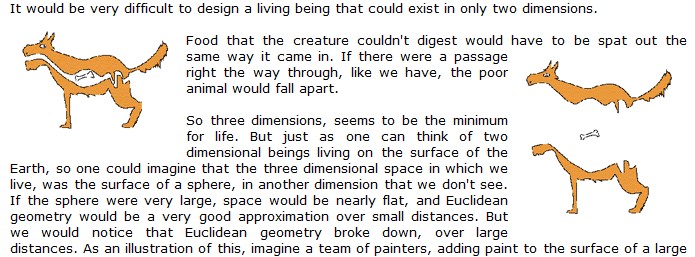
Life needs ‘thickness’.
As suggested in the drawing above, if animals had only two dimensions they would have had to make do without any digestive systems.

Hence we live in a 3 dimensional environment.
But we, the only fully conscious beings on Earth, live ‘on a surface’.
We’ve learned to fly rather late in our evolution. Most of us behave as if able to fully process only two and a half dimensions. We make good use of height and length, the things we ‘face’, but depth is rather tricky for most of us.
OK, we’ve climbed up and down trees and mountains since only ‘god’ knows when but we’re basically runners. And runners run on a surface. Runners run along a mostly linear trajectory which happens mostly on a surface. This whole thing takes place in a three dimensional environment, true, but our ‘running’ nature has left some influences on the way we think.

The most obvious one being the discursive nature of our reasoning. We start from ‘premises’, go along a logical path and end up with conclusions. We very much like the things which fit into a narrative. And we hate going back to reconsider our ways.

Since Einstein has noticed that things were ‘relative’ – to the manner in which we measured them – we have started to add dimensions. To the previously 3 dimensional environment into which we used to live.
The first dimension which had been added was time.
Nowadays, many scientists believe that ‘the universe operates with 10 dimensions but 6 of them are very tiny‘.

I’m not going to contradict them. For the very simple reason that I don’t know – and don’t care – about the other 6. Dimensions. I’m sure that they are out there, somewhere, and that those who have discovered those dimensions knew what they were doing.

What I’m going to do is to propose a new manner of counting. ‘Dimensions’.
Redefine them, first, and only then (re)count.

What do you think about mass? Is is a dimension?
How about energy? ‘White’ (aka ‘visible’), ‘dark‘ … whatever…

Since the ‘jury is still out’…

I’m going to pause the narrative here to make a point.

‘The jury is still out’ means two things.
The obvious and the one which stops us from sleeping at night.
The fact that the jury – us – hasn’t (yet) been able to fulfill the task.

Back to our main thread.

How about we return to our good old 3 dimensional Universe?

Where space is what separates ‘things’, time is what separates ‘events’ and opportunity is what sets the stage for ‘things’ to evolve into ‘events’?

Easier said than done?
In the sense that it’s very easy to put it into words but there’s no mathematics available to describe in ‘absolute’ terms what I’ve just narrated?
They key word hasn’t been mentioned in the phrase above.
There’s no mathematics available yet…
The mathematics used by Einstein to demonstrate his theories wasn’t available to Newton…
Mathematics – a form of artificial language – is invented by those capable to do that as soon as the opportunity arises.
As soon as there’s a need for new ways to express new perceptions of reality.

And no, don’t expect me to come up with new mathematical expressions of anything.
I’m no artist. I have enough trouble expressing my using with mere words.

Since this post is about dimensions, not about my limitations, I’ll end up remembering the three (meta?) dimensions. In a more ‘natural’ order.

Opportunity.

Anything which makes things possible.
Mass – visible and/or dark, energy – visible and/or dark – and anything else which ‘works’ in this sense.
I’m going to make a second – and a lot shorter – ‘transgression’ here and remind you how ‘relative’ things are. How right Einstein was. We speak about visible matter being “normal” and about “dark” (invisible to us) energy/matter having to exist in order for us to be able to make sense of the Universe as we are able to perceive.

Space

Whatever it is that separates, and also harbours, ‘islands of concentrated opportunity’. Mainly ‘mass’ but who knows (yet) what else might be ‘separated/harboured’ by space. Energy – as we know it, is somewhat distributed ‘along’ space rather than ‘separated’ by space.

Time

Whatever it is that separates, and also sequences, events. Happenings.
‘Notable’ ‘intersections’ between matter and energy.
Here, again, we have a difference between matter and energy. While matter seems to ‘survive’ better ‘in time’, energy seems to be more ‘vulnerable’ to the passage of time. Entropy….

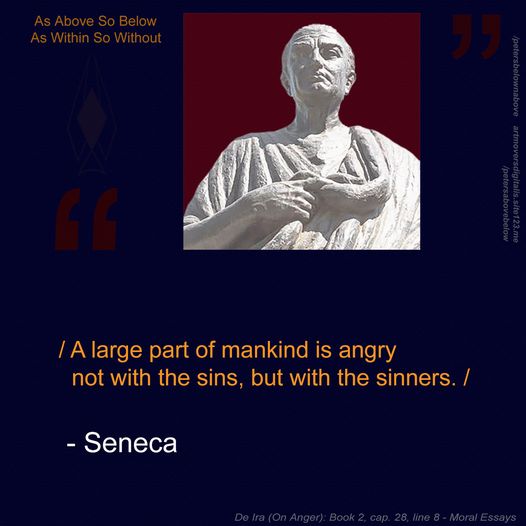
The key word here is ‘anger’.

Had we been less angry, maybe our reaction would have been more ‘efficient’.

Instead of being angry with the sinners, we could try to convince them. Those of them who can be convinced…

After all, a sin is but a possibility. An ‘opportunity’, not a fatality.

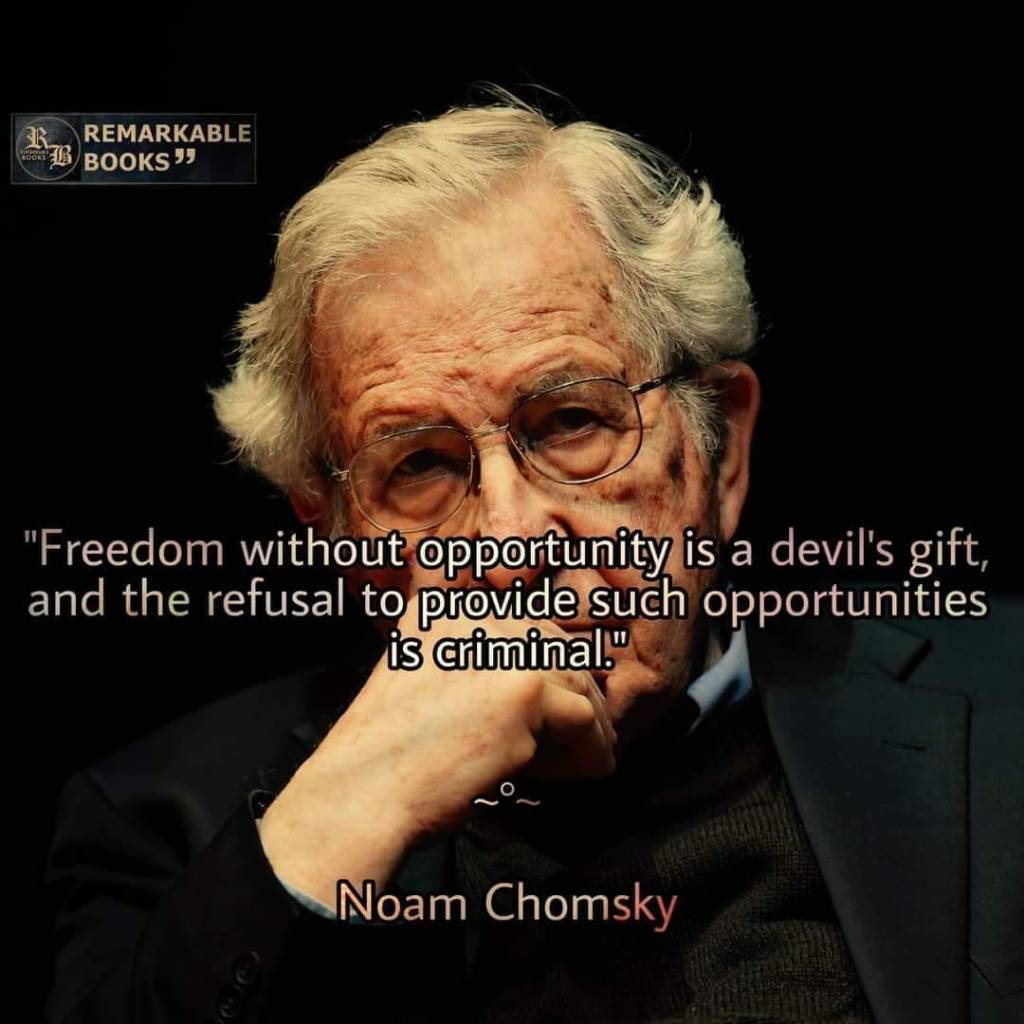
As usual, Chomsky is only half-right.
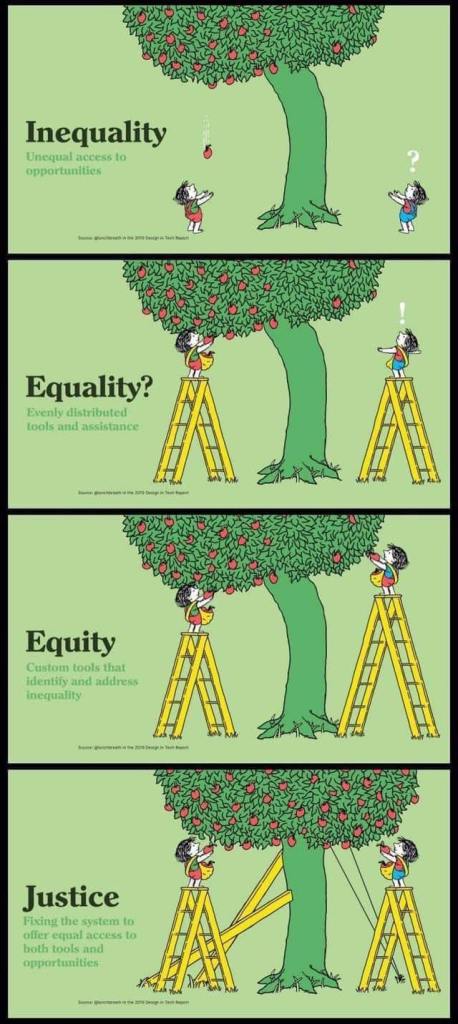
Opportunities shouldn’t be provided. Period!
In fact, nobody should be able to control/provide sizable amounts of opportunity!

On the other hand, making it so that only a small number of people enjoy all the opportunities in the world is, indeed, criminal.
Unsustainable for the longer time frame, actually!

‘On the face of it’, it makes perfect sense.

But why bother?

If I’m on the ‘right’ side, why would I make it easier for the other guy?
If on the ‘wrong’ side, why not just switch sides? Why would I bother to straighten the tree? Against the wishes of those who have a lot to lose in the process?

From the other side of the looking glass, things are a lot simpler.

‘Fiat justitia, ruat caelum’ is a warning, not a behest.

‘Make sure that justice is served, unless you want the heavens to fall on your shoulders’ is what any open minded reader of history makes of this ancient adage…

The fact that we concentrate our attention on what justice means for each of us is a measure of our individualism.
Of our nearsightedness…

Our respective individualities, each and everyone of them, have grown into what they are now in a social context.
None of us can exist for long, let alone protect and develop their individuality, in solitude.

We need the others.
We, each and everyone of us, need to belong. To a community.

To a functional community!
To a community where each individual is cherished.
Where each individual can develop its potential.

Where each individual has the opportunity and the tools to develop their potential.
For his own good, in concert with the main interest of entire community.

Survival.
Things remaining as they should be.

Us toiling here, on the surface of the Earth.
The heavens perched safely up there.

Justice must be served if things are to remain as we, each and all of us, need them to be.

Becoming mature implies giving up a lot of things.

A lot of the erstwhile held convictions.
No matter how they had happened to accure on you.

For instance, growing up means giving up the widely held belief that growing old will, eventually, ‘open up’ your mind.
That living long enough will transform each of us into a wise person.

Living is nothing but an opportunity.
What happens during that time depends heavily on ‘Lady Luck’.
And, of course, on what each of us is able to make of the opportunities presented by the afore mentioned Lady Luck.

In dear memory of Petre Anghel,
my Teacher,
who had passed away before we had the chance to finish discussing this subject.

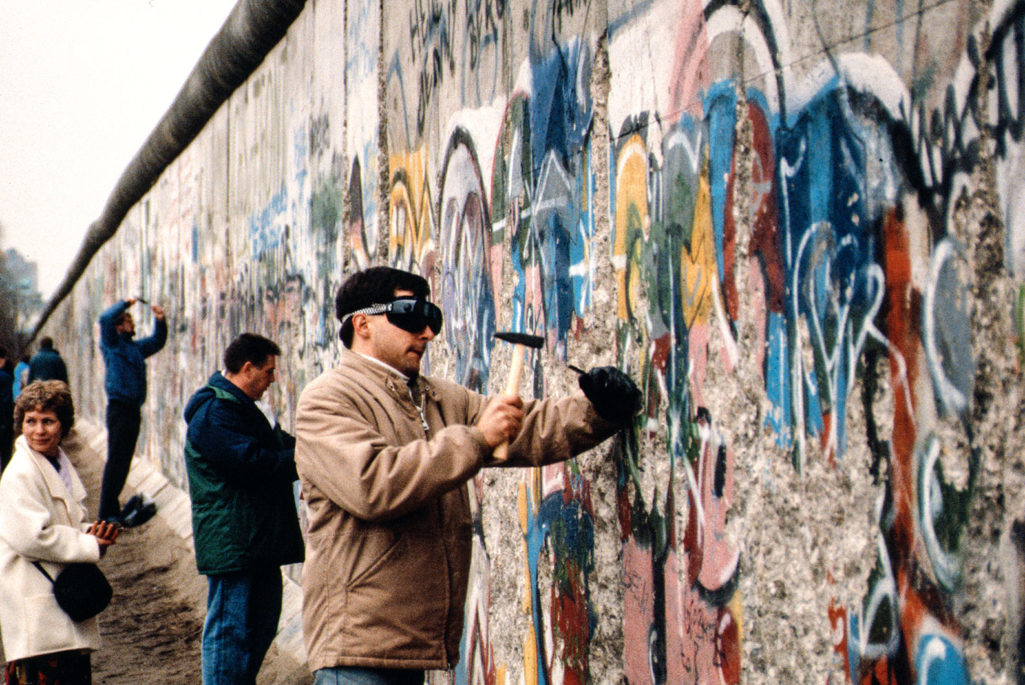
Until thirty one years ago, the Eastern half of Europe was self isolated behind the Iron Curtain. Which had suddenly disappeared in a matter of months.

Nowadays, when SARS-CoV-2 has forced each of us to shelter in place and our nations to self isolate behind the borders, we have not only the opportunity but also the obligation to re-evaluate our take on many of the things we took for granted.

The most important one being our Weltanshauung. The way we see the world.
The fact that we have convinced ourselves – simply because our lives have been good enough, that we’ve been doing things the right way.

Marx’s communists had been convinced that dialectic materialism – supposedly backed up by science and a generous political doctrine, was the way in which humankind was going to built its future.
Not the best way, the only way!
For which reason, no transgression from the official line was allowed.
Solutions were to be found only where the official doctrine mandated that answers might have existed.

Communism had fallen. Mostly from within.
Which has prompted those on the other side of the fence to consider that their vision had been better. Which was obviously true.
Slowly, people on both sides of the previous fence have started to convince themselves that their vision was the only correct one. The only alternative had proven itself to be a failure, didn’t it?
Which seems also true. I know of no better alternative. For us. I know of no alternative which would be more helpful for us. Only the fact that I’m not aware of an alternative doesn’t mean much. The alternative might as well exist. Or not….

And here’s the problem.
Marxism had failed for no other reason than those who followed it behaved as if they were convinced that Marxism was perfect. They were implementing the Marxist doctrine by the letter. Not that its spirit was any good… long discussion. My point being that arrogance was built in the Marxist spirit. Marx had actually given carte blanche to his adepts to impose communism, by force, to the rest of the world.

Unfortunately, the last 30 years had convinced me that many individuals belonging to the dominant culture, to any dominant culture, have a hard time keeping their cool.
Too many of them reach the conclusion that ‘theirs’ is the best way. That all the rest are wrong.
Which conviction has a malignant consequence. It makes them deaf. They no longer consider any other option but theirs.
They no longer hear anything but their inner voice.

For all it may be worth, here’s what I learned about liberty during the last 30 years.

Liberty as breadth.
Liberty is the breadth of the opportunity field where we might search solutions for our problems. But no matter how large that breadth might become, we’re never ‘out of the woods’.
Liberty is but an opportunity, never a guarantee.
We are the ones still responsible for the solutions we pick. For the simple reason that we’re going to bear the brunt of the consequences.

It is easier to search for solutions in a freer environment. Hence better solutions might become available sooner. But it’s still our job to look for them. To experiment. To widen our scope.

Liberty as a form of social interaction.
We can relate to freedom in at least two manners.
As an individual goal – ‘I want to be free’/’I want freedom for my people’, or as a ‘manner of doing business’.
We are free, together, because we respect, and trust, each-other. We are free, together, because generations and generations of us have build a social arrangement based on mutual respect. A social arrangement which includes certain mechanisms which attempt to bring things back on track whenever disturbances appear.
Some of which mechanisms have been put into formal law, while others have remained in the ‘public domain’.

When we put these two visions together, the ‘binocular’ image starts to develop ‘depths’.

A social group may enjoy freedom – a wider opportunity field, only as long as its individual members – all of them, enjoy their individual freedoms. For only as long as all individual members are free to roam the entire opportunity field discovered/maintained by the community.
And as soon as some individual members start to corner portions of the opportunity field for themselves… the whole social mechanism will grind to a halt.

Sooner rather than later.
The more intense the desire of the individual members to increase their ‘own’ individual liberty, the narrower the aggregated opportunity field becomes.
Each of the individuals guarding their plot means each of them staring at their feet. Individuals become more interested in guarding their fences rather than in raising their eyes to the horizon.

People obsessively defending their past will never be ready for the future.
Meanwhile individuals charging ahead with no consideration for the rest of the team will soon find themselves stranded on thin ice. With no one around to help.

All outcome depends on inputs.
When humans are involved, ‘intent’ can be found among inputs.

What do we want, in the present situation?

Basically, to survive! Right?

For as long as possible… as individuals…

The fact that the sum of our individual survivals results in the survival of our species/cultures is a truism. And, maybe, not so important for some of those struggling to survive as individuals.

The point I’m trying to make here being that how we attempt to survive will decisively influence the general outcome.

We might try to survive against the others.
Or we might try to survive with the others. In close – even if ‘distant’, cooperation with the other members of our community/culture/species.

And while surviving we might try to amass whatever we want. Of whatever we’ve always wanted. Doesn’t matter what ‘that’ is. Money, power, prestige… you name it.

Or we might learn something. We might turn Maslow’s Pyramid on its head.
We might use this crises as an opportunity to understand that we’re stronger together.
That cooperation among autonomous individuals generates a lot more chances of survival than attempting to pass through as individuals.
As a lonely individual or as an individual hiding in the middle of a crowd, doesn’t matter.

And we should bear in mind that surviving the crises will be only the first step.
How we do it will shape the stepping stone for how we’ll rebuild our livelihoods.

Smarter people than me are already prepping for the aftermath.
For the opportunities which will have ripened by then.

Which, let’s face it, is a wise thing to do. Most of us would have done it. Prepping for what we fear. And for what we covet.

Also wise would be for us to remember that everything we experience today – the good and the bad of it, together, is the consequence of how we have chosen to use the opportunities opened up by the previous crisis.

And by that before it …