Archives for posts with tag: Marxism

„Mă consider un fel de jurnalist, în măsura în care ceea ce mă interesează este actualitatea, ce se petrece în jurul nostru, ce suntem, ce se întâmplă în lume. Filosofia, până la Nietzsche, avea ca rațiune de a fi eternitatea.
Primul filosof-jurnalist a fost Nietzsche. L-a introdus pe „azi” în câmpul filosofiei. Înainte de el, filosofia cunoștea timpul şi eternitatea. Nietzsche, însă, avea obsesia actualităţii.
Consider că viitorul noi îl facem. Viitorul este felul în care noi reacţionăm la ceea ce se petrece, este modul în care noi transformăm în adevăr o mişcare, o îndoială.
Dacă vrem să fim stăpâni peste viitorul nostru, trebuie să ne punem în mod fundamental problema zilei de azi. Iată de ce, pentru mine, filosofia este un fel de jurnalism radical.”

Michel Foucault

„Stăpâni peste viitorul nostru”…
Dacă nu definim bine termenul – și care o fi „binele” ăsta?!? – s-ar putea să nu ne placă viitorul ăla odată ajunși acolo!

„Stăpâni” adică ‘prin noi înșine’? Fără inputuri venetice?
„Stăpâni” adică unii dintre noi la butoane iar ceilalți ‘după marea mila noastră’? Și ce ne facem dacă ajung ceilalți la butoanele alea?!?
„Stăpâni” adică având atâta încredere în noi înșine încât facem ce ne taie pe noi capul? Doar ce ne taie pe noi capul? Fără să ne mai uităm în jur?
Stăpâni în primul rând peste pulsiunile noastre? Capabili să ne ascultăm între noi înainte de a purcede spre un viitor asumat ca fiind incert? Și cu toate astea încă încrezători că împreună putem răzbi mai ușor decât separați?

Pentru cei cu amintiri încă proaspete de la lecțiile de materialism științific și dialectic – ăsta era numele de cod pentru marxism pe vremea când mă duceam eu la școală – și pentru cei cu nostalgii comuniste am să mai adaug câteva considerații.

Poate că cel mai atrăgător aspect al marxismului a fost, și continuă să fie, ‘certitudinea’. Atât pentru ‘gânditori’ cât și pentru oamenii de rând.
Oamenii de rând au nevoie de siguranță. De siguranța zilei de mâine și de măcar impresia/aparența că îi pasă cuiva de ei.
Gânditorii – fie ei oameni de știință sau filozofi – au nevoie să-și ostoiască disonanța cognitivă. Toți oamenii cu o educație rațională știu foarte bine că realitatea nu poate fi cunoscută. Că toți agenții cunoscători pot dezvolta, chiar și împreună, doar o înțelegere limitată a celor ce se întamplă. Sunt multe explicații cu privire la chestia asta dar putem accepta acest lucru, pe moment, ca pe o axiomă.
Pentru a-și ostoi această disonanță, gânditorii raționali – adică atei sau agnostici – au nevoie – și ei, similar cu teiștii – să se agațe de o ancoră exterioară lor.

Ecce materia!
Materia cu legile ei imuabile… Determinismul de toate nuanțele… Aproape cu nimic diferit de determinarea cu care Zeul își apleacă atenția asupra creației sale.
Aspectul delicat introdus de determinisme – indiferent de natura și originile acestora – este că acestea reduc prea tare disonanța cognitivă. Disponibilitatea omului de a-și păstra mintea liberă. De a mai fi dispus să analizeze variante… după ce a ajuns la o ‘concluzie rațională’!
Indiferent dacă premiza pentru raționamentul dus până la capăt a fost de natură științifică sau de natură divină, raționamentul însuși devine literă de lege. Acesta fiind, de fapt, procesul prin care comportamentul rațional se transformă în comportament raționalizator.
Neajunsul fundamental al oricărui proces rationalizator fiind acela, ați ghicit, că induce cecitate. Adică ‘orbește’. ‘Ia mințile’. Îl face pe om incapabil să se mai adapteze. Individual și în grup.
Devine incapabil să mai genereze variante. Alternative care să-i faciliteze evoluția. Merge înainte indiferent de consecințele faptelor sale. Care fapte/acțiuni au avut la bază niște concluzii raționale, nu? Așa trebuia acționat în momentul ăla! Și ăsta este drumul pe care trebuie mers în continuare.
Ei bine, asta este una dintre semnificațiile conceptului de ‘stăpân’.
Și explicația pentru faptul că orice dictatură, orice ‘stăpânire’ – inclusiv cea comunistă, se termină, inexorabil, în prăpastie.
În disperare.

Mai puțin ‘stăpânirea de sine.’
Disponibilitatea de a ‘întoarce și celălalt obraz’. De a asculta, cu respect și atenție, alte păreri în afară de cea proprie. În afară de părerea deja proprie…
What are the errors of Marxism?

Marxism is an ideology.
Ideologies don’t have errors, they are thought templates used to evaluate a certain situation and to determine what to do next. Ideologies are tools.
They can be used properly or improperly.
Sometimes, the best use for certain tools is to be left alone. Particularly when you understand they are useless. If you understand they are useless…
Hence it’s not Marxism which is full of errors, it’s the Marxists who are barking up the wrong tree.

If you really need to put your finger on something, if you need to point out a culprit, I give you Marx.
Yes, Karl Marx is your man.
His analysis was brilliant. His diagnostic was spot on.
Finally, in times when the class struggle nears the decisive hour, the progress of dissolution going on within the ruling class, in fact within the whole range of old society, assumes such a violent, glaring character, that a small section of the ruling class cuts itself adrift, and joins the revolutionary class, the class that holds the future in its hands. Just as, therefore, at an earlier period, a section of the nobility went over to the bourgeoisie, so now a portion of the bourgeoisie goes over to the proletariat, and in particular, a portion of the bourgeois ideologists, who have raised themselves to the level of comprehending theoretically the historical movement as a whole.
His cure – the mandate he gave to the “bourgeois ideologists who have raised themselves to the level of comprehending theoretically the historical movement as a whole”, and whom he called “communists” – was abysmal.

Which tells us Marx’s brilliant analysis wasn’t deep enough. He had noticed a series of facts but he had failed to notice the bigger picture. He had failed to see that all authoritarian regimes had failed. Under their own weight. Inevitably. And he had failed to notice that all democratic regimes had survived, and thrived, for as long as they had managed to preserve their democratic nature.

Hence the Marxist cure, communism, was stillborn.
A tool to be left alone.
The attempt to impose yet another authoritarian regime – with no matter how generous intentions – after the overwhelming experience of all other authoritarian regimes failing abysmally, is nothing but the compelling proof of social and historical blindness.

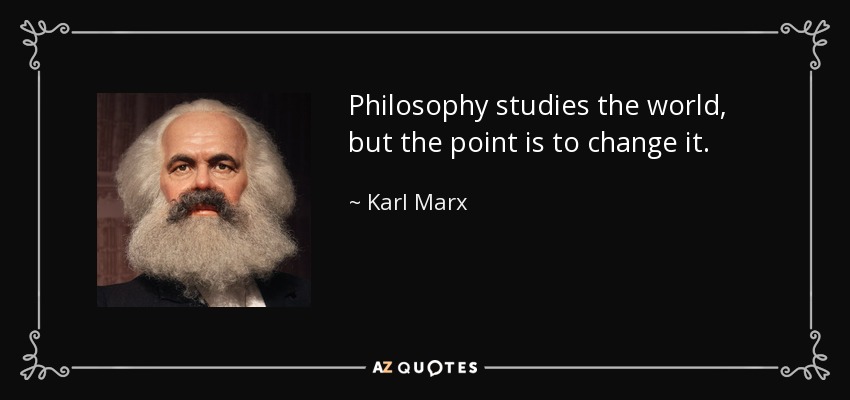
And why start this post by quoting Marx himself?
Because that quote is more than enough. More than enough proof for Marx being a bully.
It’s OK to ‘change the world’ if you own it. If it was yours…
But bearing in mind that there are other people living in the same world… wouldn’t it be nice to ask their opinion about the whole thing? About the changes you want to make? Which changes will dramatically affect the world they live in?!?
They are simpletons? Whose opinions are worthless? Because you said so yourself?

“The lower middle class, the small manufacturer, the shopkeeper, the artisan, the peasant, all these fight against the bourgeoisie, to save from extinction their existence as fractions of the middle class. They are therefore not revolutionary, but conservative. Nay more, they are reactionary, for they try to roll back the wheel of history. If by chance, they are revolutionary, they are only so in view of their impending transfer into the proletariat; they thus defend not their present, but their future interests, they desert their own standpoint to place themselves at that of the proletariat.

The “dangerous class”, [lumpenproletariat] the social scum, that passively rotting mass thrown off by the lowest layers of the old society, may, here and there, be swept into the movement by a proletarian revolution; its conditions of life, however, prepare it far more for the part of a bribed tool of reactionary intrigue.”

As I just said.
Bullly!!!

Why does Marxism still exist when it clearly doesn’t work?

Marxism still works…
Marxism is a dogma. Despite everything pretended by marxists, marxism – as an ideology – is an article of faith. And as long as there are believers who continue to promote a faith, any faith, that faith continues to survive. To work…
On the other hand, there is a non-ideological side of marxism. A pre-ideological component, if you will.
The analysis made by Marx before reaching his conclusion. Before reaching the conclusion that communism is ‘the answer’…
The analysis was correct. Furthermore, even some of his predictions had been right. Our current obsession, induced by Milton Friedman, with profit as the ultimate goal of human activity has led us into an impasse.
But Marx’s solution – to a very accurately defined problem – was an abject failure. Communism was a failure. Each and every time!
But marxism still works… We, some of us, continue to believe according to this ideology…

“Friedrich Engels in a thinker’s pose
The four-meter-tall bronze sculpture of the other philosopher of communism, Friedrich Engels, is a bit smaller than the planned Marx statue in Trier. This Engels monument in his hometown, Wuppertal, was also made by a Chinese artist and offered by the government of China in 2014.”

I grew up under communist rule.
We studied marxism in school.
At some point, I was about 16, the teacher asked us about the relative merits of the different brands of materialism he had mentioned during his classes.
My answer was ‘dialectic materialism is better than all others because those who apply it into practice constantly gouge the consequences of their (political) decisions and fine tune policies accordingly’.
Some 15 years later the communist lager had imploded simply because those who were supposed to act in a dialectic manner had failed to put the principle in practice.
Coming back to the original question, ‘was Marx a determinist’, the answer is yes.
Marx’s dialectics is only a procedure. Meant to help the communists exercise the dictatorship mandated by Marx in the name of the proletariat. And dictatorships are determinist by definition.
Why mandate one if you are not convinced that things can be ruled?
For the long run and in a comprehensive manner?

At the beginning of Part I there’s a list of what we’ve accomplished during this century.
I’m going to remind you now some of the mistakes we’ve made.
Genocide, atomic bomb, global warming, widespread pollution… basically, we’ve turned the tables upon ourselves.

I had the first inkling of what’s going on when I started to compare what’s currently going on in Syria with the Spanish Civil War.
NB, even the name we use for this kind of conflict is an absolute aberration. War is, by definition, the opposite of civility. Why on Earth any of us might consider that war waged between co-nationals can be expected to be more ‘civil’ that the ‘regular brand’…

Spain and Syria have evolved in eerily similar manners. Multiple ethnic groups of multiple religious convictions have been forced by geography to coexist and to evolve together. Each of them had passed through very similar stages, albeit following different time-tables. The whole thing culminated with both of them passing, during the last century, through ‘revolutionary’ episodes. There are two small differences though.
Spain’s ‘revolution’ had taken place at the end of a turbulent period and had produced a dictatorship – Franco’s, while the Syrian one is the consequence of a dictatorship and has not yet yielded a clear result.

And why is any of this of any interest when analyzing the entire century? Except, maybe, that the two atrocious episodes have marked the start and the beginning of the said century?

Well, it’s how the rest of the world have chosen to react in each instance which I find extremely interesting.

First of all, let me remind you the broad picture in both cases.

Spain’s took place shortly after the end of WWI and immediately after the Great Depression. The most important ‘disruptive ferment’ was militant marxism and although not all of those fighting on the side of the revolutionaries adhered to this ideology the presence of the marxists had decisively shaped the reaction of the democratically elected governments of the world. They had chosen to basically stay out of it. Despite the fact that Franco was leading a rebellion and that the Republican Government had been dully elected to office.
At the beginning, France’s first socialist PM, Leon Blum, had assisted the Republicans but recanted shortly afterwards, “under pressure from Stanley Baldwin and Anthony Eden in Britain, and more right-wing members of his own cabinet”. Which, in a way, made some sense. Western Europe was frightened that communism might spread westwards and many of the Spanish Republicans were of communist persuasion. “Baldwin and Blum now called for all countries in Europe not to intervene in the Spanish Civil War. A Non-Intervention Agreement was drawn-up and was eventually signed by 27 countries including the Soviet Union, Germany and Italy. However, Adolf Hitler and Benito Mussolini openly ignored the agreement and sent a large amount of military aid, including troops, to General Francisco Franco and his Nationalist forces.” Stalin also ignored the agreement and send some help to the Republicans but got bored and by 1938 he practically forgot about the whole thing.
In the end, the conflict had been won by the side supported by those seeking revenge for being defeated during WWI – and for the harsh conditions imposed by the Treaty of Versailles.
That had been the ‘institutional’ reaction.
On the popular side, despite the ‘hang-over’ produced by the WWI and the Great Depression, some 60.000 volunteers from all over the world had joined the ‘fight for freedom’. The fact that they were organized by the Comintern didn’t help in the end, on the contrary, but the population at large looked at them with sympathy. Proven by the success enjoyed by the literature and art produced by some of the volunteers/sympathizers.

Guernica


‘We already know that, why are you bothering us?’

“labour-power can appear upon the market as a commodity, only if, and so far as, its possessor, the individual whose labour-power it is, offers it for sale, or sells it, as a commodity”

“labour is not a commodity”

OK, reconcile these two declarations… The first belongs to Marx himself while the second is an integral part of the 1944 Philadelphia Declaration made by the International Labor Organization… And if any of you has any doubts about the ILO thinking not being heavily tainted by Marxism please check this out: “the war against want requires to be carried on with unrelenting vigour within each nation, and by continuous and concerted international effort in which the representatives of workers and employers, enjoying equal status with those of governments, join with them in free discussion and democratic decision with a view to the promotion of the common welfare.” Not exactly the Communist Manifesto itself but too close to it for my comfort.

So is it or is it not?

No it isn’t. Not even Marx ever thought it was.

When Marx speaks of labor power as a commodity he only wants to demonstrate the need for the worker to be free in order for the system to function. For him this is the difference between feudalism – when the peasant (the worker of those times) was heavily dependent on the land owner – and capitalism – where the possesor of the labour power is free to sell ‘his commodity’ to the higher bider – is the existence of the free market where commodities – including ‘labour power’, which is traded as if it was a commodity – are exchanged. And the fact that the market is free also determines individual freedom of both the worker and the capitalist, seller and buyer of the labour power.

But this trading of labour power as if it was a commodity doesn’t transform it into a real commodity.

In fact labour is more a form of communication than anything else.
By labouring the worker transforms something into something else, usually in a way that is not so easily reproduced, not even for low skilled jobs. Had it been possible to automate the working process we would have used exclusively robots or morons. Do you really think a robot or a moron could flip burghers at McDonald’s? Are you sure you’d like that to happen?

Confused?
It’s not that complicated. Marx had an insight – that human history is nothing but the story of the individual man enjoing more and more autonomy – and then blew it. He took it upon himself not only to speed up the history of the mankind but also to lead us (even against our will) where he thought that we should finally arrive (communism). Rather arrogant, don’t you thing?
In time that arrogance seems to have mellowed somewhat (or became more conceited?) but it is still very much alive: ‘the war against want requires to be carried…to the promotion of the common welfare’….

What is that ‘the common welfare’? Can something like that ever be determined? Even in a ‘democratic’ way?!?

Had Marx refrained himself at studying the effects of increased individual autonomy on the workings of the human society he would have been considered the undisputed thinker of the second millennium and we’d have been sparred from witnessing (or experiencing) the horrors of communism…  I know, I know, counter-factual history is not acceptable… just saying…