Archives for posts with tag: Free market

“Give us today our daily bread”

We’ve been around for a while.
300 millennia, according to some. 70 millennia, according to others. Who use a more stringent set of criteria.
Anyway. Homo Sapiens is considered to be 300 000 years old while his nephew, Homo Sapiens Sapiens, is a little younger. Only 70 000 years…

Regardless of age, for most of this time we have been foragers.
OK, even our ancestors had tools. We’ve been around for 300ky while tools have predated us by more than 1my. Yes, our hominin predecessors were the ones to invent tools…

Then what is our contribution? Why are we the ones who are still around?

According to Ernst Mayr – if I interpret correctly – we’ve simply been lucky!
Nothing happened.
No catastrophic event bad enough to extinguish us. And no freshly minted ‘superman’ to take our place.
That question, regarding our contribution, speaks volumes about our infatuation with ourselves.

Hence the paradox.

Very recently, we’ve done something. Used agriculture on a large enough scale to change our way of life.

As foragers, we used to live in a certain way.
As homo economicus, who actively, agentically, produces food – and everything else we need, we’ve crossed yet another barrier. Benchmark? Anyway, we live completely different lives from those experienced by our foraging (fore)fathers. Despite the fact that there’s no biological or psychological difference between us.
Don’t believe me? Take a small child from the African or South American bush, lovingly raise them in a functional family and tell me if you find any difference. Between any of those children and their ‘already civilized’ school-mates. The key concepts here being ‘lovingly raise them in a functional family’ and ‘school mates’. If you understand what I mean…

‘Completely different lives’.
‘OK, I get it. They, the lives, are different. But are they better? Or worse?!?’

Your question, your very pertinent question, is extremely eloquent.
It fully expresses the paradox haunting us.

As foragers, we’ve learned to speak. To carve. To make beautiful tools. To paint…
As foragers, we’ve become human.

As agriculturalists, we live way longer lives. And accomplish way many more things.
Yes, ‘things’.
We speak the same. We paint the same. We carve the same. We even eat more or less the same things. Less of them but there’s nothing really new in our diet. Less diverse, heavily processed in too many instances, but no really new ingredients…
The only two differences between us and our fore-fathers is the length of our lives and the amount of things we end up owning.

So. Are our lives better?

Longer, for certain!
Less painful? Probably. Considering the physical pain…
Happier?

Then what? Give up agriculture? Go back to bare-back foraging?

How about learning from agriculture?
Digesting the concept, not only the produce…

As foragers, we were ‘expandable’. Each of us could do everything. Statistically, speaking… Gathering, hunting, fetching water and wood, you name it. We depended on each other, of course, but none of us was irreplaceable.
As homo economicus we also depend on each other. But differently!
Just remember what happened last week. When nobody knows how/why, yet, the fuel lines of an airplane taking off somewhere in India were switched off.
Or think about what happens when one of your colleagues calls in sick.

Smith, Adam ‘Free Market’ Smith, taught us about ‘the baker, the butcher and the brewer’.
We still have to digest his teachings.

Our daily bread demands a lot of cooperation.
We’re no longer capable to accomplish much individually.
Our longer and way more bountiful lives depend on our ability, and willingness, to cooperate.
Respectfully….
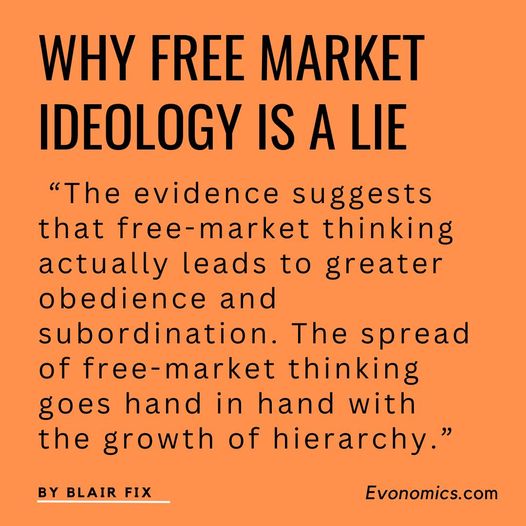
“So the free market, it appears,
is not about freedom. It’s about power.
Free market thinking is successful,
I argue, because it uses the language of freedom
to cloak the accumulation of power.”

Blair Fix

Free market works for only as long as it remains free!

Which is the problem.

Before meddling with the free-market, we need to agree first about freedom. About what we mean when we think/speak about freedom.

Freedom for all versus freedom for only those who happen to fit a certain set of criteria. To be wealthy, in this case.

Functional freedom – as in the kind of freedom which preserves, which remains sustainable over the long run – versus ‘absolute’ freedom. The kind of freedom which leads to anarchy. Which anarchy, necessarily and very shortly, becomes a rigid hierarchy. Then ends up in shambles…

Free market works for only as long as it remains functionally free. Free enough to do its thing.
To provide enough for enough of those contributing to the collective effort to make ends meet.

To understand what Blair Fix has to say, we need to identify the key words in his speech.
“It appears” and “I argue”.
In fact, he tries to convince us to see ‘the world’ as he sees it. He tries to convince us to be ‘on his side’.

He divides ‘the problem’ and then takes sides… which only contributes to the world/market losing its freedom.

As for what ‘evidence suggests’…
It suggests two things.
That yes, the ‘free market’ has, indeed, become an ideology. There are too many people who consider the market should be left to the mercy of the powerful. Who don’t understand how freedom actually works…
The second thing being an evidence. Not a suggestion.
All other markets but the free one work worse.

Our children have to make do
with the consequences of what we’ve cooked up.

The happier amongst us live in states run as liberal democracies.
Most countries on this planet define themselves, constitutionally speaking, as being democratic.
And except for a very few, all the others behave in an apparently capitalistic manner. Some under a free(ish) market and the rest under a ‘mixed’ regime.

Since we’re speaking about the ‘current’ socioeconomic arrangement, which is in flux, we still don’t have a name for it.
We do have a name, though, for the previous one. Feudalism.
And for the one before that. Slavery.
Or, to use a modern term, all the previous regimes might be bundled together as ‘authoritarian-isms’. Regimes where authority flows from top to bottom and where feed back comes only in the form of revolution. Coup d’etat. Dynastic change… and other euphemisms.

History suggests, and those wise enough to notice implement this lesson where ever possible, that all authoritarian regimes crumble under their own weight.
While liberal democracies tend to survive for as long as they maintain their liberal nature. Their freedom!

What’s the difference between liberal and ‘illiberal’ democracies?

“It’s not who votes that counts
but who counts the votes”

Josef Stalin

Now, speaking seriously – as Stalin style ‘popular democracies’ have crumbled more than 30 years ago, following all other ’empires’ which no longer exist, there is a difference between liberal, a.k.a. functional, and make-belief democracy.
People maintaining a liberally democratic regime take their job seriously.
They speak up their minds. Hence the problems become known.
They listen what the others have to say. Hence the people are not only aware of problems as they arise but people also have the opportunity to understand the nature of those problems.
They respect each-other. Hence they treat all problems, affecting all the people, in a fair manner. Thus maintaining the natural stability of the social arrangement.

It goes without saying that in a liberal democracy everybody can vote and each vote is counted…

An illiberal democracy, on the other hand, is where things are more complicated.
The most illiberal situation is that where it doesn’t matter whether people vote or not. The results have been counted beforehand. The latest example being Venezuela 2024.
A more ‘subtle’ picture is offered by, for example, Hungary. As a matter of fact, it was Viktor Orban, the Hungarian “dictator“, the one who had coined the very notion of “illiberal democracy“. A revamped Constitutional Court, some Constitutional Amends, “emaciated checks and balances“, tight controls imposed over the media

What about the ‘capitalist’ part of the current arrangement?
I’m afraid we waddle in confusion here.
We no longer make any distinction between ‘capitalism’ seen as ‘hoarding money as a sport’, and ‘using accumulated fiscal deposits as resources for building something new’. New and useful, of course…

‘Fiscal deposits’ – hoarded fiduciary money – have been around since coins have been minted. And IOU notes have been written. But capitalism, as Adam Smith understood it, wasn’t born yet at that time.

Under authoritarian regimes, having a lot of money does offer some leverage. But no immunity!
Consider what had happened to the Templar Monks when France’s Philip the IV-th coveted their money. Or the fate of the richest Chinese, after he had been perceived as being too cocky by the communist regime…
Whenever ‘capitalism’ takes place in liberally democratic settings, the market can be described as being ‘free’. Each economic agent – buyer or seller – decides in an autonomous manner. Takes their own advice and has to obey nobody’s orders. Has to obey the law but doesn’t have to abide to any whims.

Putting two and two together, for a society to remain functional in the longer run, the most importing thing is the ‘free market’.
The key word here being ‘free’. The meaning attached to the word and the understanding people have about the concept.
There is ‘free’ as in ‘free for all’ and free as in ‘freedom under the law’.
‘Free for all’, also known as ‘the law of the jungle’, inevitably ends up as a ‘dog eat dog’ situation while freedom under the law remains functional for as long as The People bring the law up to speed whenever needed.
The ‘market’ part is a lot simpler.
A ‘place’, an ‘open’ space, where both ideas and wares are exposed and exchanged. Amongst those who come to the market, to the agora, to solve their problems. To fulfill their needs.

As long as that ‘space’ remains free – as in ‘open’ for all – most people are able to make ends meet. The situation remains stable. For everybody to enjoy.
As soon as one ‘operator’ starts to ‘corner the market’ – using any of the already known ‘technologies’, the most popular being the old fashioned lie – the situation becomes potentially dangerous.

Whenever ‘The People’ have a sound understanding of what freedom really means, the bullies are ejected from the system. The ‘antitrust’ legislation is put to work and the budding ‘monopolies’ are dismantled before real harm was done.
If not… If von Papen hadn’t helped Hitler to rise into power and if Chamberlain hadn’t led the free world into submission…
Had we not threaded so lightly when Putin snatched Crimea back in 2014….

https://carnegieendowment.org/posts/2017/03/revisiting-the-2014-annexation-of-crimea?lang=en

“he said abortion bans early in pregnancy went too far,
suggesting Republican candidates needed to be moderate enough on the issue
to “win elections”.”

The point I’m trying to make here being that what candidates say matters.
That we really need to see through their words.
Whether they are interested in solving issues – and which of them – or they simply want to accede to power.

Doesn’t matter? As long as they keep their promises?

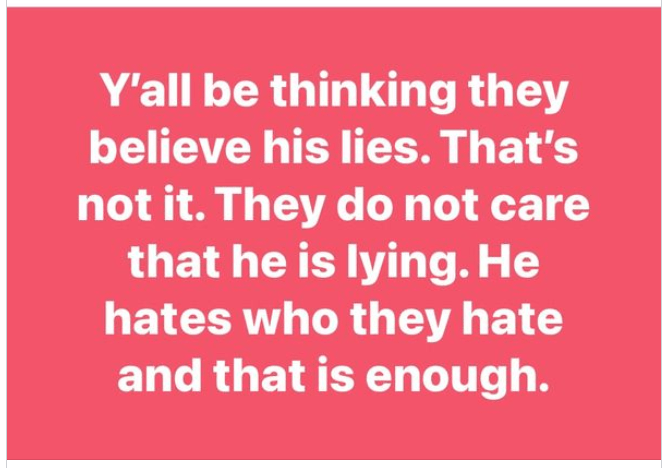
Do you really expect a lying bully to keep up with their words? To fulfill their promises?
Are you comfortable with ‘hiring’ a lying bully to mind the future of your children?

Congress shall make no law respecting an establishment of religion,
or prohibiting the free exercise thereof;
or abridging the freedom of speech, or of the press;
or the right of the people peaceably to assemble,
and to petition the Government for a redress of grievances.

Doesn’t make much sense?
Mentioning ‘God’ on money is the first step towards the establishment of an officially sanctioned religion?

Well…

In my previous post I posited that property, the concept, is the stepping stone for social order.
I’ll add to that a simple observation. Whenever too much property gets hoarded by a too small number of people, the community which had allowed that to happen is in great danger.

Same thing here.
We have religion – a social phenomenon – and religions.

We have a certain understanding of the world, shared by the members of a community – which allows the community, as a whole, to behave in a coherent manner. Not that much different from what happens when people use a common language. They can communicate. Same thing happens with people partaking in a religion. They ‘see’ things in a coherent manner. Hence can coordinate their efforts.

And we have religions…
To reach the ‘certain understanding of the world’ I mentioned before, each community had traveled a road. A particular road through the particular circumstances in which each cultural community – currently known as ‘nation’ – had had to build their culture. Their identity.
Some communities had put together certain scenarios to accompany them along this road. To help them make sense of what was happening to them.
Some communities have used more than one scenario during that journey while others use more scenarios simultaneously.

Sociologically speaking, all that matters is social coherence.
All is well as long as the community conserves its ability to function. To survive.
As long as the individuals who compose that community continue to have a common enough understanding of the world in which they live.

For the simple reason that they, we, live in the same world!
And if we, individually or in small ‘gangs’, start behaving as if the world is different for each of us…

The Founding Fathers had a common understanding of the world. They belonged to the same (functional) religion despite belonging to different ‘denominations’. For them, the First Amendment was about reigning in the powers of the Government. They had realized that a Government able to impose a certain religion – a certain scenario – upon the entire community would eventually bring destitution.
The Founding Fathers could not foresee a situation in which a few of us would deny the practical daily realities of this world. Invoking their particular scenario as an argument… As the supreme argument for refusing to see the reality.

The reality as it is.
And as it is seen by a majority of us.

I mentioned earlier that some communities have changed their scenario along their history.
They did it when they have found new meanings. They have seen new things about the reality and they have integrated those new things into their newer scenario.
By changing the scenario they have actually built a new reality.
Societies which have clung to their scenario to the bitter end… are no longer with us.
Societies which have somehow found it in their collective minds to adapt their scenarios to the reality changed by their own efforts continue to survive. To thrive, even.

“Hoarded by a too small number of people” means controlled by a handful of people.
Sometimes coordinated.
As it happens in any dictatorial regime. It doesn’t matter who formally ‘owns’ something if the use of that something is tightly controlled by somebody else.
Furthermore, a certain ideology may end up having a lot of clout without being imposed by an authority. Nevertheless, the fact that an ideology dominates, for a while, makes it so that the community which allows this to happen to experience a dictatorial regime.
For whatever reason, some people were convinced that witches were real. And burned them at the stake.
For whatever reason, a lot of people continue to believe that communism might be a good thing.
For whatever reason, some people continue to believe that they are entitled to determine whether a woman may or may not abort a fetus.

What is the difference between an ideology and a scenario?
The manner in which people relate to it.

Having been told that they were the children of the same God made it possible for the believers to stick together. To act like brothers. To respect each-other. To invent and implement capitalism and democracy. Both relying on trust. On mutual trust and on the freedom of the market. Both the market where goods and services are traded and the public forum. Where ideas are traded…

Being told that only one particular understanding of a certain text/idea/concept is correct some people remove themselves from the ‘general population’. Which ‘general population’ becomes ‘the others’.

‘The others with whom we don’t have anything in common’.

Quite an untenable situation, given the fact that the world is becoming smaller and smaller.

What are electron spins:
Electrons are able to spin on an axis, like how the earth rotates on an axis, but much faster. Electrons can spin in either a clock-wise or counter-clock-wise direction. The spin on an electron is described by the spin quantum number (ms). The value of ms can be either +12 or -12. The +12 is called spin-up and denoted by a ↑, where the -12 is called spin-down and represented by ↓. Sometimes the spin of electrons will be described as angular momentum.
Each orbital of an atom can be occupied by up to two electrons. The two electrons will have opposite spins. This phenomenon was first described in the Pauli exclusion principle which states that each electron in an atom is described by a unique set of quantum numbers, including ms.”

Political spin, in politics, the attempt to control or influence communication in order to deliver one’s preferred message.
Spin is a pejorative term often used in the context of public relations practitioners and political communicators. It is used to refer to the sophisticated selling of a specific message that is heavily biased in favour of one’s own position and that employs maximum management of the media with the intention of maintaining or exerting control over the situation, often implying deception or manipulation.

Electrons ‘work’ in certain ways. Science has recently figured out some of those ways.
The point being that electrons keep to themselves. One spins in its direction, the other spins in the opposite direction and no more than two electrons fit in the same ‘orbital’.

People’s minds also work in ‘certain’ ways.
Not as ‘rigidly’ as the electrons but still ‘useful’ for those who know how to exploit this phenomenon.

By constantly pestering people with certain messages, you get to convince at least some of them.
You get to divide them into (political) camps.
You get them to fight among themselves instead of cooperating.
You get to lead them into battle.
And after the battle has been won, by no matter which side, you get to lead the winning party. At least for a while, but that is another subject.

And all lies, aka as ‘half truths’/alternative facts, start from something real.
Capitalism, for as long as the people remain awake, works. As advertised.
Socialism, on the other hand, doesn’t. It had failed, abysmally, whenever and wherever it had been experimented.

But there’s a caveat.

‘Capitalism’ is a rather clear-cut concept. Property belongs mainly to the individuals and individuals trust each-other enough to do business among themselves. Usually – but not always – capitalism is associated with ‘free market’ and democracy. With freedom to act – inside the confines of the law – and freedom to speak up.
I’ll say this again! For as long as the people remain awake, the market continues to be free and democracy still functions, capitalism works. Sustainably. But only for as long as the people remain awake…

‘Socialism’ is rather vague. From ‘public’ (instead of private) property associated with central planning of the entire society to softer versions which sometimes pay lip service to democracy. The central idea of ‘socialism’ being that society comes first and the individual is only a cog.
Who wants to be a cog? Those who see no alternative… Those who, once in a certain set of circumstances and exposed to a certain propaganda, succumb to the Sirens’ song.

The point being that in order to impose ‘socialism’ to a society you need to lure (enough of) the people into an ‘altered state of consciousness’. To make them believe a certain set of rules. To make them behave according to that set of rules.

The interesting part, as usual, comes at the end.
There is a ‘social arrangement’ where property remains private but where the people behave in a ‘certain’ manner. As if they have been made to believe a ‘certain’ – as in ‘forcefully unified’ – set of rules.

That social arrangement is just as fragile as ‘socialism’.
Again like socialism, it has already been experimented.
Both had failed. Abysmally. History is our witness.

The ‘other’ always failing social arrangement is usually called ‘fascism’.
In Germany, it has been known under the name of ‘NAZIonal socialismus’.

It is not from the benevolence of the butcher,
the brewer, or the baker, that we expect our dinner,
but from their regard to their own interest.
We address ourselves, not to their humanity
but to their self-love,
and never talk to them of our own necessities
but of their advantages.
Adam Smith, The Wealth of NATIONS, 1776

I’m sure you already know that Adam Smith didn’t invent capitalism. As Marx invented communism and Lenin invented bolshevism.

Adam Smith had done nothing more and nothing less but described what was going on around him. How a bunch of people acting according to their ‘moral sentiment’ took care of business. How individual needs – for meat, beer and bread – were met and how the wealth of nations was built in the process.

“To some people, Gen Z may seem salary ‘obsessed’. In some cases, say experts, it may be hard for older generations to understand why young workers have such an intense focus on pay. “At Gen Z’s age, older people worked 40 hours a week, and made enough money to buy a house and have barbecues on the weekend,” says Corey Seemiller, an educator, researcher and TEDx speaker on Gen Z. “Gen Z works 50 hours a week at their jobs, and another 20 hours a week side hustling, yet still make barely enough to cover rent.””

Do you notice any need being fulfilled, in earnest, in this, new, situation?
OK, things were not that rosy in Smith’s times either. Most people had to work hard, a lot harder than today, to make ends meet. But since Smith and until some 40 years ago things went better. Year after year.
When Smith was writing his books, Regular Joe-s used to live in crowded shacks, usually rented out from their employers. Nowadays, most of those in their 50-ies and 60-ies own the house they live in. Which house has nothing in common with the afore mentioned shack.

So, is this the new kind of progress?
A looking back in anger kind of progress?
Are you even aware of the huge number of people pondering whether capitalism is not as good as advertised – by those who have already enjoyed its spoils? For the simple reason that in the current (no longer) free (enough) market so many people can no longer enjoy the kind of economic well being their grand parents took for granted…

As someone who had experienced both communism and capitalism, the situation is clear.

Socialism implies a lot more centralization than capitalism.
The answer is, like always, included in the question.
While socialism is to be ‘implemented’ – by a ‘central figure’, capitalism is an environment. A place where the deciding agents – the entrepreneurs, ‘make it happen’.

Hence socialism – which is a ‘thing’, to be implemented, not an environment for entrepreneurs to roam ‘free’ – will eventually fail. No matter how well intended the implementor, nor how hard it tries to make it happen.

In capitalism, only the entrepreneurs might fail. When the market is no longer free – oligo or mono poly, the situation closely resembles a socialist one. Things go south. Because the decision making agents are too few and far apart – no longer able to cover all corners, just as their socialist counterparts.

Comparing socialism with capitalism is like pitting an apple against agriculture.

An apple, all apples, will eventually become rotten. No matter how hard one might try to preserve it.
Agriculture, on the other hand, will yield according to the available resources and the effort put in by those involved in it.

https://www.quora.com/If-Socialism-has-always-been-poorly-implemented-why-wasnt-Capitalism

Equality has become ‘the’ thing.
But things are not that simple. Not simple enough to be explained/solved in such a trivial manner.
Equality is a theoretical concept. It doesn’t exist, as such, in nature. Nor in practice.
Two ‘objects’/issues/items are declared, by us, to be equal if the differences between them are smaller than a threshold. Instated, again, by us. Mathematics – a theoretical field by excellence, being the only domain where the difference between two equal ‘objects’ is exactly zero.
On the other hand, societies where people consider themselves to be equal fare better than those where the differences between people are ‘manifest’.
Hence ‘equality’ must be important, right?
‘Societies where people consider themselves to be equal’…
The key word here is “consider”, not “equal “.
In this situation, equality is not only a concept but also a value.

The fact that a functional majority of the people living in those societies consider themselves to be equal creates a certain ‘environment’. A situation where those people actually complement each-other. A society which works as an organism. Not as a shoal of fish nor as a simple herd. A society which works a community.

A single parent can raise children. But two parents do it a lot easier. And, in most cases, better.
A single parent can adopt children. But no single parent, man or woman, is able to give birth to a child without being helped by a member of the ‘opposite sex’.
Societies where people consider men and women to be equal fare a lot better than those entertaining other beliefs. Which doesn’t negate the fact that men and women complement each-other. In a lot more situations than those in which they merely reproduce themselves.
Economies where the market is free fare a lot better than those where the economic decisions are made in a centralized manner. The communist camp – where the economies were run by the party, had crumbled under their own weight. Which strongly suggests that no matter how skilled it may be, a central planner will never be able to balance such a complicated process as a whole society/economy. Monopolistic situations, where decision making became too concentrated, invariably ended up in a pile of mess. Another proof that no decision maker, no matter how skilled/well intended, was ever capable of managing, by itself, a really complicated situation.
What is the real difference between a free market and one where decision making is concentrated in an unsustainably small number of hands? Or heads?
Economic agents are equal? Suppliers are equal among themselves, buyers are equal among themselves and suppliers are equal with buyers?
Or suppliers complement each-other in adequately supplying the market while buyers and suppliers complement each-other in maintaining the market afloat?
Which brings us back to where we have started.
Where people who complement each-other have reached the conclusion they’d better consider their complements as equals. And treat each-other as such.

The common sense definition for an inflationary situation is ‘when too much money chase an inherently limited amount of goods and services’.

The ‘limited amount of goods and services’ part is easy. We live on a finite planet, we have a limited capacity to transform whatever resources we are able to identify into usable goods and services … so…
OK, we can always identify new resources and build new capacity but we cannot do any of this ‘on the spot’. We need time. And, even more importantly, we need to put ourselves to it!

Then ‘who does the chasing’?
After all, money is ‘inert’. It doesn’t do anything if let alone in a drawer. On under the mattress…
In reality, we – buyers and investors, are the true ‘inflationary agents’.
‘But it would be completely stupid to sit on a pile of money when inflation rages! You have to buy something otherwise you’ll loose a lot of value! At least, you need to invest that money…’
This is one of the best examples of a self-fulfilling prophecy!
Indeed. Buying or investing during an inflationary bout is the reasonable thing to do! Yet we need to understand that our actions will, temporarily, exacerbate the very inflation we are trying to ‘tame’.

But where does the excess money come from?!?

Until not so long ago, the sovereign was the only one person who could bring new money to the market.
And their ability to do that was severely curtailed by the amount of bullion available for this task.
In fact, the first major inflationary episode in the second millennium had been fueled by the gold brought back to Europe by the Spanish conquistadors. Which bout of inflation brought about the first major change in the European economic thinking.
“To inspect the country’s soil with the greatest care, and not to leave the agricultural possibilities of a single corner or clod of earth unconsidered… All commodities found in a country, which cannot be used in their natural state, should be worked up within the country… Attention should be given to the population, that it may be as large as the country can support… gold and silver once in the country are under no circumstances to be taken out for any purpose… The inhabitants should make every effort to get along with their domestic products… [Foreign commodities] should be obtained not for gold or silver, but in exchange for other domestic wares… and should be imported in unfinished form, and worked up within the country… Opportunities should be sought night and day for selling the country’s superfluous goods to these foreigners in manufactured form… No importation should be allowed under any circumstances of which there is a sufficient supply of suitable quality at home.” Philip von Hornigk, 1684.

After a while, economy had become ‘complicated’ enough to demand ‘paper money’.
The amount of goods and services produced had become so large – and insufficient bullion was added to the money pool, that prices would have had to shrink if the balance was to be maintained.
Unsustainable! Nobody would have bought anything and everybody would have jealously guarded their precious money while waiting for the prices to fall further. This process is known as ‘deflation’ and is considered even more malign than a decent amount of inflation.
We have to note at this point that ‘paper money’ had been made possible by the advent of the ‘nation’.
This is a rather complicated discussion, for the present purpose it’s enough for me to mention that ‘paper money’ being accepted as ‘tender’ means that the general population has enough trust in the issuer of the bills. That the individual user of the paper money trusts/believes he is part of ‘something bigger’.
In those times, it was the issuer of paper money who practically controlled the amount of money which existed on the market.

Which brings us to the present times.

I’m sure all of you are aware of how “fractional reserve banking” works.

‘Yeah, the banks create money out of nothing!’

Wrong!
For banks to be able to ‘create’ new money, they have to extent credit!
For new money to be created in this way, somebody must walk into a bank with a business proposition.
That somebody might want to buy a house, a car or whatever else. Or that somebody might want to start a business. If that somebody convinces the bank that they is solvent or that their idea is worthy enough, then and only then new money is created!
Money doesn’t appear out of the blue! It is born out of trust. That somebody not only trusts themselves but they are convincing enough to determine the banker to extend that much needed credit!

But wait!
We’ve developed yet another mechanism which churns out money.
The stock market.
After developing the business started with the loaned money, the somebody we’ve been talking about above decides to make an IPO. To sell part of his business to investors. To monetize his initial investment.
Depending on the moment chosen for the IPO – and the economic data in the prospect, the IPO can be a huge success. For ‘somebody’ and for the early buyers. You see, each time the price of the stock goes higher, new money is created. Based more on the ‘market’s expectations’ than anything else…

‘But people who put their money on the financial markets are rational agents! They are experts in their field…’

Yeah, right…
You’re talking about the experts who had put together the collateralized debt obligations debacle…
And many others. Too many others…
Also, you’re talking about the experts who had bought those papers! Who had trusted the expertise of the first batch of ‘specialists’!

Thinkers, from Freud to Kahneman and Ariely, have proven than humans are very good at rationalizing and less so at being truly rational.
That for a market to behave in a reasonable manner, it must preserve its freedom.
That it must be free from ‘bullies’ – individual agents who muster a lot of ‘clout’, and free from any mania.

The 1637 Dutch Tulip Mania is a very good example of what might happen when a market gets obsessed with something.
When too many people – not even a majority, forget about the fact that economy (oikonomia) is about making ends meet and that getting rich may be a nice consequence but is a terrible goal.

‘OK, nice try. But what about inflation?’

We have an inherently limited amount of goods and services.
A relentless mechanism which churns out money.
Meanwhile, some of us obsess about their need to conserve the money denominated portion of their stashed away fortunes.

Inflation is nothing but another mechanism.
Which re-balances the market.
Piece-meal – adjusting for daily changes, in normal times. When things evolve ‘freely’.
Suddenly when the market – the people who ‘man’ the market, find out about ‘the dark side of the moon’.

Until recently – historically speaking, people had two ideologies to choose from.

Conservative and liberal.

The conservatives used to posit ‘law’ as a ‘cage’ which didn’t allow any transgression while the liberals understood ‘law’ as an agreed upon environment which allowed people an individual but orderly pursuit of happiness.

The advent of Marx’s communism changed everything. His promotion of ‘class warfare’ as a legitimate political instrument had effectively muddled that which had previously been considered a clear choice.

After communism proved itself to be an abject failure, the naifs have forgotten about Marx.
Flying under the ideological radar, ‘class warfare’ has metastasized.

Nowadays, Regular Joe is confronted with three ideologies. And to make things worse, their names – attributed and/or assumed, are misleading.

We have a line of thought which uses (natural) ‘law’ as a line of defense against any kind of change. And as a means of bringing back the ‘better yesterday’.

Another line of thought which sees (man made) ‘law’ as an instrument to implement – forcefully, if needed, whatever the ‘implementer’ wants to achieve. One of the most often professed goals being ‘equality’. Close on its heels comes ‘diversity’.

And the ‘classical’ liberals who are squeezed between the previous two.

The state/government – whose job is to keep ‘the playing field’ level and functional, is paralyzed by the first two factions fighting to control it.
The ‘conservatives’ want to use the state/government as a ‘preserving agent’ for what they consider to be their (natural) ‘rights’.
The ‘progressives’ want to use the state/government as an instrument of (forceful, if needed) change towards what they consider to be ‘the common good’.

Meanwhile, the classical liberals – berated by both of the above, have a hard time explaining to a shrinking audience that the state/government is an extremely dangerous instrument if allowed to fall into the hands of ‘single-minded’ operators. That as soon as the freedom of the markets (the economic and, way more importantly, the ideatic ones) is curtailed, everything starts to go south. Fast!

Democracy and the free market have brought us so far.
The freedom of thought/expression and the freedom to act as an honest entrepreneur have been instrumental in us reaching the present state. With the goods and the bads in it.

Each instance in which the state/government had fallen prisoner in the hands of ‘men of state’ with ‘focused vision’, history started to run backwards.
No matter whether that ‘limited vision’ had been focused in the past or on “a certain” future.

Each time this subject comes about I remember about Francis Fukuyama’s The End of History.
About how concentrated he was on the future he considered to be forthcoming.
About how his ‘hard focus’ had prevented him from noticing the sunken part of the iceberg.

https://www.theguardian.com/world/2021/oct/10/texas-abortion-law-jonathan-f-mitchell-profile
https://www.marxists.org/archive/marx/works/download/pdf/Manifesto.pdf

One-Time
Monthly
Yearly

Make a one-time donation

Make a monthly donation

Make a yearly donation

Choose an amount

$5.00
$15.00
$100.00
$5.00
$15.00
$100.00
$5.00
$15.00
$100.00

Or enter a custom amount

$

As much as I love writing, I do have to eat.
And to provide for my family.
Earning money takes time.
If you’d like me to write more, and on a more regular basis, hit the button.
Your contribution will be appreciated!
Another very efficient way to help would be to share my posts.

As much as I love writing, I do have to eat.
And to provide for my family.
Earning money takes time.
If you’d like me to write more, and on a more regular basis, hit the button.
Your contribution will be appreciated!

As much as I love writing, I do have to eat.
And to provide for my family.
Earning money takes time.
If you’d like me to write more, and on a more regular basis, hit the button.
Your contribution will be appreciated!

DonateDonate monthlyDonate yearly