st_2015-12-09_middle-class-03


Middle income or middle class?

The terms “middle income” and “middle class” are often used interchangeably. This is especially true among economists who typically define the middle class in terms of income or consumption. But being middle class can connote more than income, be it a college education, white-collar work, economic security, owning a home, or having certain social and political values. Class could also be a state of mind, that is, it could be a matter of self-identification (Pew Research Center, 2008, 2012).”

OK, so even those who rely heavily on money as an indicator for who belongs to the middle class concede that there are other connotations to the concept.

Let’s consider the situation from a functionalist point of view. As in how the members of  various social strata react to the day to day challenges of the normal life.

‘Day to day’ meaning not only ‘normal’ things – waking up and brushing your teeth – but also things that we wish will never happen, although all of us know they are ‘normal’ occurences. A car accident, a broken leg or even having three children in one go when you were praying for one.

Usually the wealthy take them in one stride, those belonging to the middle class manage to cope – sometimes welcoming some help from their friends, relatives or even insurance company, while the really poor almost certainly sink under the burden. But not always.
Sometimes even the wealthiests loose it when faced with adversities they were not accustomed with while some of the poorest find it in themselves to rise from the ashes.

Then how about setting a slightly different system of ‘classes’: the extremely resilient, the ‘middle class’ and the very fragile?

As a rule of thumb it’s true that a certain amount of wealth does miracles when some resilience is needed so, roughly,  these two classifications look more or less the same, but, on a qualitative rather than quantitative level, we are speaking of two different things here.
When we are speaking of ‘money’ we are dealing mainly in ‘resources’ while when we’re speaking about resilience we have to take into account the attitude of the concerned individuals. It is true that the above mentioned attitude is, more often than not, heavily influenced by the affluence of the respective individuals but the function is hardly a direct one.

Based on these considerations – and on my personal experience of dealing with people, I’m going to propose the following synopsis.

The ‘resilient’ are those convinced they are able to cope, more or less on their own, with almost everything life can throw at them. Unfortunately some of them grow ‘spiritual callouses’, simply because they have never experienced any real hardships.
Or because they have over-compensated after dealing with those hardships, sometimes after succeeding to do so without receiving significant outside help.

The ‘fragile’ are those who, by lack of material resources, spiritual stamina or both,  behave more like leafs driven by the wind than like masters of their own fate – as every human being should.

By now you’ve probably figured out that  ‘my middle class’ is composed of individuals who have a certain degree of resilience but who, on the other hand, are perfectly aware that there are things on this world that they wouldn’t be able to face on their own.

In a sense, possession of money – or other resources, ‘encourages’ an individual to reveal his true nature.
If a person is naturally inclined to grow ‘callouses’ then being ‘insulated’ from the outside world by a thick wad of money will provide him with enough space to let those callouses grow but if his skin is ‘in the game’ then those callouses will be constantly shaven while interacting with his peers.
But if the stakes of the game are very meager – and the insulation provided to the players by their respective possessions is practically nonexistent,  then instead of growing callouses most of the players will be rubbed raw during the intercourse. Mind you, neither  the ‘stakes of the game’ nor the ‘individual possessions’ need to necessarily be of a strictly material nature.

In conclusion, the ‘callously resilient’ will tend to mind to their own – simply because their sensitivity towards the outside world is dampened by their callouses, the ‘fragile’ will tend to mind to their own raw wounds while those belonging to the ‘middle class’ will be the only ones really interested in maintaining the well being of the social organism. The one to which they ‘knowingly’ belong.
Because they are the only ones with enough time/energy/resources on their hands to consider the matter, the real interest to do so and the willingness to put some effort into this endeavour.

pent up anger

As you can very easily infer from the title, I define myself as being an agnostic.
I’m reasonably satisfied with the scientific explanation about how the world came to be but I cannot rule out any intervention from an out-side agent during the process.

Hence my unwillingness to commit myself to any of the extreme positions.

And hence my conundrum.

A significant portion of the theist believers are convinced that God, their God, is behind everything that takes place on the surface of the Earth. And beyond.

All scientific materialists are convinced that everything takes place according to some immutable and implacable ‘natural laws’.

Then how come any of them has enough gumption to contradict any of the others?

How come a religious believer can say to another ‘your God is false’ if he is convinced that nothing in this World can happen without the knowledge and approval of his own one? Isn’t this a form of censorship towards his own God?
How come a religious believer can say to an atheist ‘you are going to rot in Hell’?
Last time I checked all Gods were very jealous, all religious teachings I know are clear about this: ‘You do your job and let Me do the judging.’ Then how come so many zealots feel free to usurp the place of their Gods and pass judgement on their peers?

How come so many of the atheists feel free to poke fun at the believers?
According to their own creed, religion is a natural thing. It does exist, isn’t it?
And by its mere existence it necessarily observes the very natural laws the atheists so staunchly defend. As if any of them needs any defense, let alone to be imposed upon the others…

When are we going to accept that religion, any of them, is nothing but an environment, not a yoke?
Just a place with some rules, not some kind of a prison?
That the final responsibility for our acts belongs to us, regardless of any God watching or not over our fates?

Here on Earth, anyway.

661211-_uy447_ss447_


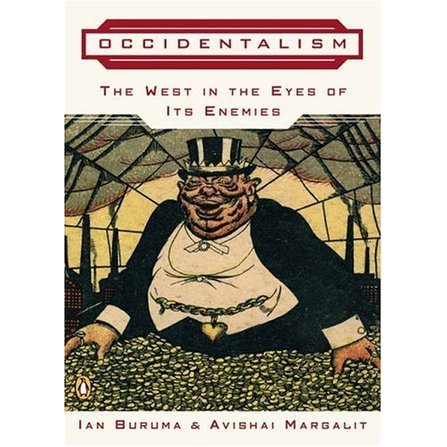
Just finished reading about the West as an object of hate.

Next in line is a book about the Orient as an object of study.

51k6n6ma-nl

Bearing in mind the fact that the Occident is still very much hated by a significant number of people residing in the Eastern part of the World it seems that we, the Westerners, have  been rather poor students of the Orient.

Or that some of us don’t give a damn about the long term consequences of their actions?

“To understand is not to excuse, just as to forgive is not to forget, but without understanding those who hate the West, we cannot hope to stop them from destroying humanity.”

I’d say these are very wise words which constitute an excellent starting point.
Towards the end of their book Ian Buruma and Avishai Margalit argue that “despite Christian fundamentalists speaking of a crusade, the West is not at war with Islam. In fact the fiercest battles will be fought inside the Islamic World.” (translation belongs to me, I have a Romanian version of the book)
How about us, in the West, helping the ‘right’ side in an innovative way?
By giving them an example.
By mending our own ways, before telling others to mend theirs!

God thanks

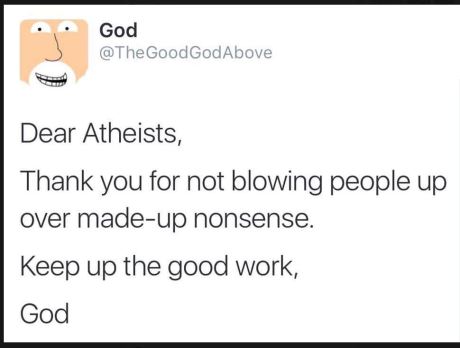
I recently shared this meme, originally posted on FB by Black Atheists.

The broad spectrum of the commentaries made on this subject enticed me to elaborate on it.

There are people who blow people up under religious pretenses and people who blow people up under their own ‘rationale’.

This meme can be interpreted as God praising those who do not use his name when committing heinous crimes.

Who do not misinterpret religious teachings to fit their callously narrow goals.
Who do not make up self-serving nonsense simply because they have enough sleigh of mind and an audience who, for various reasons, is willing to believe anything that might provide some psychological comfort.
Who do not use religious pretexts when horribly mistreating others.

And don’t get me wrong. God doesn’t praise them for what they’re doing – there is nothing to be praised there.

He praises them for what they are not doing.

Using false pretenses, that is.

It depends on the meanings we attach to these two concepts.

Yanis Varoufakis, Greece’s ex finance minister, is convinced that ‘Capitalism will eat democracy – unless we speak up.

Since he has some experience in this matter I’ll follow his line of thinking – for a while.

His point being that you can have successful capitalism in undemocratic societies – like Singapore and China – and that effective power has slowly shifted from the political sphere of the society to the economic one – which is undemocratic by definition.

Can’t say he’s entirely wrong, can we?

But we can say he’s somewhat confused…
So, he mentions Lee Kuan Yew’s Singapore and China as capitalistic success stories and then says that  the political sphere is gradually falling  under the yoke of the economic one… Well, last time I looked, in China the state was still in full control of everything that moved and the state was firmly in the hands of the politicians. Same thing was happenning during Yew’s tenure as Singapore’s good willed dictator.

Unfortunately there is some truth in his words when we look at what’s going on on the both sides of the Atlantic and that’s why I’m going to examine whether we have the same kind of capitalism in both situations.

By Google-ing the word I got two definitions for the concept.

The first definition that was offered by the search engine came from Oxford Dictionaries, “An economic and political system in which a country’s trade and industry are controlled by private owners for profit, rather than by the state” and the second one came from Merriam Webster: capitalism is “an economic system characterized by private or corporate ownership of capital goods, by investments that are determined by private decision, and by prices, production, and the distribution of goods that are determined mainly by competition in a free market“.

Putting them together we have private ownership, private decision, free market and profit as a goal.

Are these enough to describe a reasonably well functioning economic system?
I’m afraid not.

Let me give you some examples.
The French state has a controlling interest in Renault and the land of Bavaria quite a sizeable one in VW. Renault is in good shape and VW was too, until very recently. So private ownership is not an absolute necessity.
In the US we had quite an interesting situation. Two out of the three big car manufacturers  had to be bailed out by the state. All three were privately owned so we must look somewhere else: the Ford family still has a powerful word in the management of the single one which didn’t had to be bailed out. In Europe the best run auto company seems to be BMW – again controlled by a single family, the Quandt’s. It seems that it helps a lot if those who call the shots have a long time interest in the well being of the company versus the situation in which the top management has (short time) profit as the single/obsessive target.
Coming back to Renault and VW, they can be compared to Singapore, China and, maybe, Spain. Singapore was able to develop a ‘capitalistic’ economy despite it being an authoritarian society simply because Lee Kuan Yew was a very special kind of ‘dictator’ – one that not only cared sincerely for the greater good of his people but also didn’t loose his head during his long stage at the helm. A similar thing happened in Spain – Franco was the sole dictator who had made preparations for a democratic evolution after his demise, while China had to wait for another good-willed dictator to grab the power – Deng Xiao Ping – before it could steer towards the present course. No other authoritarian regimes but these two have ever managed to replicate this feat – we still have to wait a little before pronouncing Vietnam as the third, and very few other publicly owned companies fare so good as Renault does.

So, we have rather strong evidence suggesting that ‘skin in the game‘ trumps blind insistence on short time profit and that a free, democratic, society offers greater chances for economic development than a authoritarian one. In fact the politicians that need periodic confirmation from the people they govern do have some skin in the game while the authoritarians are in a position that is somehow equivalent to that of the CEO’s of the huge corporations whose stock owners are so disspersed that practically don’t count much – the members of the board practically slap each-other on the back and are able to do practically what they want with the companies. Look what happened at GM, Chrysler and, for example, ENRON.

But how free should be that society in order for capitalism to thrive?

Could it be so free that a guy could come from the street and claim your house as being his own? No?

So we need a free but orderly society. One where private property changes hands only when its owner says so – or has previously entered into a contract which stipulates that in certain conditions that transfer has to take place.

Meaning that in order to have a functioning capitalist society we need not only private ownership but also private owners who have enough trust in each other to start making business together.

You see, the feudal lords of the Dark Ages did have a lot of private property but capitalism couldn’t take hold in earnest as long as the (absolute) monarch could strip a man of his property and give it to somebody else. They couldn’t enter into (longish time) contracts because the era was dominated by huge uncertainties regarding various aspects of the social and economic life.

In fact it is exactly this well tempered freedom that is the crux of functional capitalism. Enough freedom so that everybody could feel confident that he is his own master but tempered by rules enforced in a pwerfully enough manner to give everybody sufficient trust that most contracts will be executed faithfully.

In this sense for capitalism to work properly we need to have a market that is free in more dimensions that one.

It has to be free from political intrusion in the sense that the government should leave it alone as a rule of thumb but also that the same government should keep it free from becoming cornered by a single group of interests.
In fact there is no difference from a market that is run by a governmental agency or by a monopolistic corporation – no matter if the latter is private. As soon as decision making becomes concentrated in too few hands mistakes starts happening. And their effect accumulate until the system finally collapse. Or is dismantled by some ‘exasperated’ more powerful agency – as Standard Oil and  ‘Ma Bell’ were dismantled by the US government. Which, by doing so, created the premises for  the huge development of those two respective markets – oil and communications.

Only this freedom of the markets can seldom be preserved by an authoritarian regime. Yew’s Singapore and contemporary China are exceptions, not the rule. Most authoritarian regimes cannot resist temptation and start meddling in the economic life of their countries. By doing so, they introduce a lot of ‘noise’ into the system. Eventually, this noise drowns the useful signals and ‘blinds’ the decision makers.

Same thing happens – and here Varoufakis has a valid point – when economic agents become so powerful that they can dominate the policy makers. The politicians can no longer preserve a balanced stance towards the economy and give in to ‘special interests’. This way the markets loose their freedom, with all the malign consequences that come with this situation. Among them, the lack of trust that slowly creeps in the souls of those who have to do business in the no longer free markets. Which lack of trust is very bad for all those involved.

And another thing about which Varoufakis is absolutely right. A lot of money are not being moved through the ‘front doors’. Not that they are not invested at all but because they are kept somewhat hidden they do not contribute as much to the well being of the world economy as they could/should.

2.1 $ trillion have been accumulated, as of  October 2015, in off shore accounts by the top 500 American companies in order to avoid taxes and
Between $21 an $32 trillion have been hiding in 2012 in various offshore jurisdictions.

Why is that? Simply because those who are called to decide about these money do not ‘trust’ that by bringing these money home and by investing them there, after paying the taxes, will be able to generate profits equivalent to those produced by leaving them off shore?

So what should we do? Tell them ‘democratically’, by electing somebody who is crazy enough to implement such a measure, to bring them home? Or even  confiscate them, one way or another?

I’m afraid that here I part again ways with Mr. Varoufakis. And with Aristotle: the way I see it democracy is not ‘the constitution in which the free and the poor, being in majority, control government‘. That would be ‘mob rule’.
A truly democratic process starts before the vote. When every stakeholder can make its point known to those who are going to cast a ballot so they’ll be able to do that having a reasonably clear understanding about what’s going on.

Frankly I’d rather rephrase Varoufakis’ message. ‘Corporatism has a tendency to disembowel democracy and transform it into ‘mob rule’ – the situation where the poor are no longer that free simply because they are convinced through ‘unholy’ methods to vote one way or another.

What can be done? Explain, loud and clear, that if jobs disappear the same thing will happen with the aggregate demand?
Explain that by giving their workers as little money as they can in reality the results are way worse than if the wages were as high as the companies could afford?
Ford didn’t give his workers more money because he loved them but simply because he had understood that in the long run he would be better off himself by doing this, you know!

grandson of sweetie pie

Grandson of TV’s Miss Sweetie Pie gunned down in St. Louis. (AP)

“St. Louis police say they found Andre Montgomery dead at a home Monday night. A second man was taken to a hospital in critical condition with gunshot wounds.
Police say that after someone shot Montgomery, the second man ran upstairs to help him. A third man who was in the home saw the second man carrying a gun and shot that man because he feared for his safety.”

So.
A guy invites some people in his home.
Judging by the way in which they interact they don’t know, or at least don’t trust, each-other.

Somebody – not necessarily from among the invited guests, shots the host.
Somebody else – presumably alerted by the noise, draws a gun and hurries to assist the victim.
A third person, fearing “for his safety”, draws his gun and shots the good Samaritan, simply because he was carrying a weapon.

Is there anything to be learned from here?

OK, by somehow removing all privately owned firearms in America, personal safety, on average, would be somewhat improved. But since something like that would be very unlikely to happen let’s concentrate on something more plausible.

How about taking grater care about who enters your home?

And something else.
Ever since reading about this I cannot stop thinking about the similarity between cars and guns.

Both are tools and both are dangerous. Yet almost everybody has the right to buy one.

But no-one is entitled to use a car without a license while so many people advocate that everybody should be allowed to carry guns, everywhere.

37 000 people dead and 2.35 million people injured or disabled as a consequence of road accidents. Per year.

32 000 people dead by fire arms. Per same year. 60% of them being suicides while roughly 34% are classified as homicides.
On top of this another 67 000 people are injured, per year, by fire arms.

Some could say that there is not any significant difference between the two situations and, as a consequence, a carry permit would not change much.
Are you sure about that?

Currently most guns do not follow their owners when they leave their houses – for various reasons. This is why I’m afraid that if more and more people would chose to carry their weapons, things would become a lot more complicated.

Not because people are bad or ill intended.

Simply because most ‘civilians’ are not trained to asses dangerous situations in an effective manner nor the necessary skills to use their weapons safely.

You see, defending your home – everybody else but you and your family becomes an enemy in this scenario, is very different from trying to help in a complex setting. When people might freak out at the sight of yet another gun.

That’s why not all those who own a gun should ‘drive’ them around without a license.

After all, how safe would you feel when driving in a country where no driver’s license is necessary and where DUI is not forbidden?

cz0qnrnwaaibsy2

First, some very condensed history.

Humankind evolved in Africa and then migrated around the word.

During its African childhood Man had never encountered Winter. OK, he did have to face barren desserts, dry seasons, inundations,  wild-fires, earthquakes, you name it…but none of these even comes close to watching the light of the day becoming shorter and shorter, the weather becoming colder and colder and the food becoming scarcer and scarcer.

Remember, at that time Man was a hunter-gatherer who had no notion of stashing food or any interest in astronomy. Simply because there is no real scope for hoarding large reserves of food in Equatorial Africa and no real scope for astronomy since at the Equator there are no seasons to speak of.

Now, try to imagine the horror experienced by the migrants who had climbed the Anatolian plateau for the first time and, after a while, felt the snow melting on their faces and the frost biting at their bare feet. All this while the sun kept sinking lower and lower towards the horizon.

Was it possible that those migrants did start thinking about the end of the world?

Were they pondering on whether they had entered the realm of a strange god who was trying to get rid of them by cooling the entire (or at least the ‘visible’) Earth and by making the food extremely scarce?

Did they try to placate that god? Through prayers and offerings?
Was that the very reason for which Abraham came back to Canaan after having “tarried for seven years at Harran“?

Were they extremely elated when noticing that the light of the day was becoming longer and longer? Did they throw a party to thank that God for listening to their prayers, soon after noticing that the winter solstice had passed – even before knowing what a solstice was?

And this is why in most cultures that have developed in the temperate regions of the Earth people celebrate, under various guises, the rebirth of the world that takes place right after the winter solstice.

That is why, after a while, Christians have started to celebrate Christmas on the 25th of December.

But, if you remember, those migrants didn’t take the whole thing as a gift but as a trade.
They prayed, made offerings and the God kept his side of the bargain.
Same thing here. Christ had to offer himself so that the world could be redeemed.

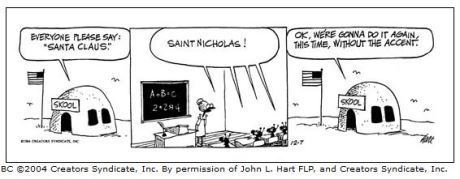
In time another habit had evolved. When I was a small child, even in communist Romania, Saint Nicholas was serious business. People used to eschew any formal links between Saint Nicholas – presented as an opportunity to educate the children – and Christmas. That’s why Saint Nicholas was tolerated by the authorities – and we, the kids, could discuss openly at school the presents that had miraculously appeared during the night in our socks, carefully prepared the evening before, while Santa Claus had disappeared altogether – having been replaced by a Santa-Freeze who came on the New Year’s Eve instead of during the Christmas Night.
And now I’m wondering how many of you remember that Saint Nicholas brought presents only to the good children and that those who misbehaved during the year got either a rod or a few lumps of coal instead of the candy so keenly expected by everybody.

In fact Saint Nicholas is way closer to reality than Santa Claus. He doesn’t give anything for free.
Not that he doesn’t love us.
He really does and that’s why he doesn’t indulge us with undeserved gifts.
So that we don’t become frustrated later in life when we’ll have to work, hard, for any whim we might have. Not to mention the effort to feed our belies, clothe our backs and make sure our children make it safely to adulthood.

That’s why I think it’s time for us to cut the crap. Santa Claus might be a nice gimmick for the big retailers who came up with the whole concept.
But look at what he brought to the rest of us.

saint nicholas

Yeah, I know.
“If I couldn’t have the nice childhood I dreamed about at least my children should have it.”
Only ‘nice childhood’ is one thing while ‘spoiled rotten’ is quite another one.

And ‘spoiled rotten’ can be achieved along many routes.

One of them being the one described above. Hard working parents, who consciously spoil their children, trying to compensate, through their kids, the hardships  experienced during their childhood.
Another one being followed by the parents who are so busy that they basically don’t get to know their children. And who try to compensate the time not spent with their kids by showering them with gifts. The end result being the same.

After the children have become young adults, with no marketable skills, no exercise at self control and after never trying hard at anything, the shit hits the fan:
‘We have done our best yet we’ve raised a couple of ‘good for nothing’ bummers!’

Well, your ‘best’ wasn’t good enough and, mostly, it’s your fault. Not theirs!

Just as most of our ancestors didn’t need to till the soil before migrating to the Middle East – simply because they had enough to eat even without having to work/plan hard for it, our children won’t develop the necessary skills nor the necessary mindset if we insulate them from the right stimuli. In fact, if we insulate them from the real world.

After all, our ancestors might have been ‘the children of the Humankind’ while ours are simply ‘children’ but, in the end, ‘children are children’.

“When the last tree has been cut down, the last fish caught, the last river poisoned, only then will we realize that one cannot eat money.”

Some people attribute this quote to the Apache Leader known as Geronimo.

Quoteinvestigator.com says it is highly probable that it belongs to a guy called Alanis Obomsawin.

But what is more important?
Who said it or what we make of it?

Dede Suryana

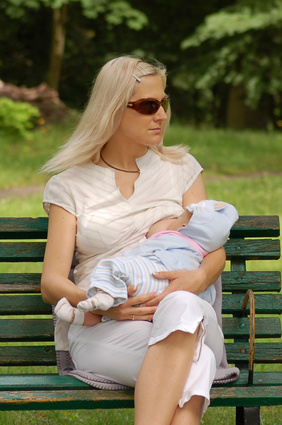
Mother breast feeding a baby

How come some people are absolutely disgusted
whenever something like this takes place in their presence

while most are perfectly OK with

Eating burghers

oliver_hardy___zenobia[1]

Intensitatea reactiilor cu care a fost primita decizia CCR cu privire la modul in care sunt puse in aplicare mandatele de urmarire tehnica imi readuce in minte cuvintele ‘strabunilor’ nostri:

“Fiat justitia, ruat caelum!”

Traducerea cea mai raspandita fiind: ‘Faca-se dreptate, chiar de-ar fi sa cada cerul’.

Mai pe romaneste, aceasta varianta ii indeamna pe cei cu putere de decizie in domeniu sa nu se lase influentati de alte considerente in afara de idea de justitie si nici de alte argumente in afara celor ce au strict de a face cu cauza in sine.

O interpretare formulata in stil moralist ar putea suna: ‘Judecatorule, sa cumva sa-ti fie frica atunci cand imparti justitia. Fii drept, indiferent de pericolele care te pasc pe tine, personal.’

O alta, draga aparatorilor drepturilor omului: ‘Dreptatea individului nu trebuie, in nici un caz, sa fie pusa mai prejos de interesele comunitatii’. Vezi si varianta anglo-saxona: ‘Mai bine sa scape 100 de vinovati decat sa fie pedepsit, pe nedrept, un inocent’.

Cu ceva vreme in urma mi-a trecut prin minte o alta abordare:

‘Faceti cu adevarat dreptate, tocmai ca sa nu va cada cerul in cap’!

De fapt nu e mare diferenta fata de variantele de mai sus.

Pana la urma chiar si cei mai idealisti dintre noi sunt de acord ca idea de justitie a pornit tocmai de la viata de zi cu zi. In care ne-am convins, cu totii, ca nici o colectivitate umana nu functioneaza cu adevarat bine atata vreme cat membrii ei, toti membrii ei, nu se se simt in largul lor.

Atunci cand unii incep sa fure ceilalti incep sa isi piarda increderea in semenii lor. Relatiile dintre membrii societatii se deterioreaza foarte mult, ba chiar ajung sa se blocheze.
Atunci cand unii incep sa se foloseasca de forta pentru a-si impune punctul de vedere – de la talharie pana la dictatura armata – indivizii obisnuiti, indiferent de tabara din care se intampla sa faca fata, sufera o serie de transformari care, insumate, conduc la o degradare marcata a intregii societati. A se vedea soarta comunitatilor de pirati, a societatilor dominate de Mafie sau a dictaturilor – de orice coloratura.

Daca stam bine sa ne gandim, balanta justitiei nu cantareste doar meritele relative ale celor doua parti supuse judecatii ci si efectele produse de modul in care este administrat actul de justitie asupra intregii comunitati.