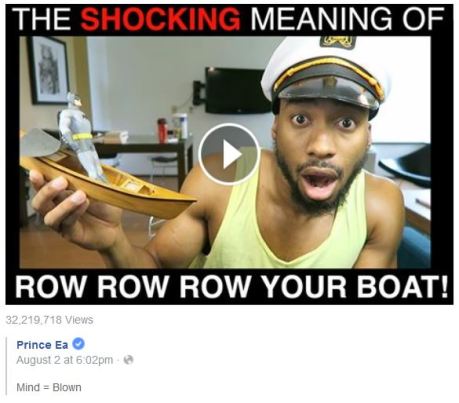
row your boat

While discussing with a FB friend the last video posted by Price Ea – you can watch it by clicking on the picture above – something hit me.

We were exchanging ideas about how much control each of us has over his own life when I realized that our very insistence on using precisely this term is what causes a lot of trouble.

The notion of control divides the world in two.
The controller and the controlled.

And since we are social animals, things become very quickly very complicated.

Being ‘animals’ means we that we have ‘animalic’ needs. Air to breathe, water to drink, food to eat, shelter from the elements… The first floors of Maslow’s pyramid, as you surely remember.
Being ‘social animals’ means that we not only depend on having access to enough physical space and resources but also on the cooperation of the people who happen to be in our vicinity.

The control hypothesis ‘leads’ us into a competition for both space and authority above those around us.
Our world becomes divided into what ever space we already control and the rest. Meaning the (yet) uncontrolled areas from where it is very possible that a challenger might spring up anytime so that the controller must somehow extent his control over those areas as well, as soon as possible.
Our neighbors become divided into our ‘slaves’ and our direct competitors. Who have to be, sooner or later, subdued into slaves – lest they do the same thing unto us.

In conclusion, the ‘control hypothesis’ sees the world as a constantly busy battlefield where each of the dwellers is in constant conflict with everybody else.

Luckily, even the most perfunctory  glance down the history teaches us that human success is more about cooperation than about conflict.

Only the conspiracy theorists believe that most wars are started by business people trying to sell their wares to the warring parties. The reasonable business people know that while a certain amount of tension is good for their business – tension sells guns, among other things – an actual war exhausts both parties and destroys solvent demand.
While it is possible that some callous business people or political actors might try to foment war, for various reasons, that doesn’t mean they are behaving reasonably.

Which brings us to the alternate hypothesis.

How about we replace the concept of ‘control’ with the idea of ‘autonomy’?

How about we give up the ‘tiresome’ notion of control and replace it with the peaceful concept of cooperation?

Since we have already figured out that we depend on both those around us and on whatever resources we can identify, how about we enroll the cooperation of as many of the like minded that surround us as possible and search together for those resources?
Instead of each of us simultaneously trying to run faster than everybody else and to hold back as many as possible – the true meaning of generalized conflict?

Which brings me to the notion of ‘autonomy’.
Being autonomous means being engaged in a special kind of relationship. It means being part of a flexible structure. One that is strong enough to resist but flexible enough to allow a variable amount of leeway for each of its components.
The very concept of autonomy recognizes the mutual dependency that exists between the autonomous members of the said structure and also the fact that the very strength of the structure comes from each of the members being able to solve problems on his own.

Autonomously, that is.
Drawing resources from the structure, sometimes enrolling the negotiated cooperation of some other members but, on the whole, most of the problems get to be resolved ‘under the radar’. To the great benefit of the entire structure.
The vast majority of the structure not even noticing the huge numbers of situations that get solved this way.

Compare this situation to the one described in the first scenario, the one where everybody fights, openly or covertly, with every body else and tell me what you prefer.

“Control” or “Autonomy”?

An all out incessant war for ultimate control or a continuous process of negotiation?


quote-we-learn-from-history-that-we-learn-nothing-from-history-george-bernard-shaw-52-49-23

Funny, isn’t it?

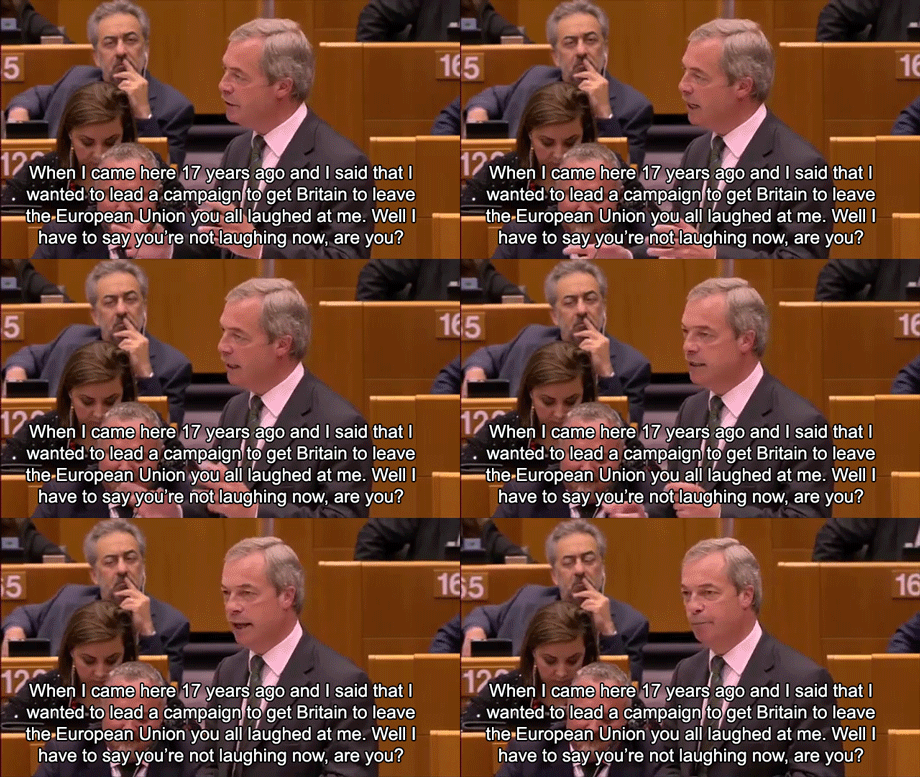
Or yet another reminder that constantly cracking jokes about everything and everybody is not exactly the best thing to do… Let’s compare the relative importance of the British Empire during Shaw’s coming of age – the period when he developed his habit of cracking jokes about everything, no matter how serious the subject, with the fact that Scotland is seriously planning a second independence referendum.

Or let me remind you of another Brit who enjoys cracking annoying jokes:

3727584669

Not funny anymore?

OK, let me try another tack.

What if

caaf122f196e61ec72335fd6ee6b0981

Could it be that the problem resides with us?

That this is basically a matter of what we do with whatever (history) has been passed to us by our forefathers? That what has been passed to us does have its own importance but that we can’t do very much about it?
History can only be rewritten but never changed…
We, on the other hand, can and should learn to deal with the dynamics of this world.


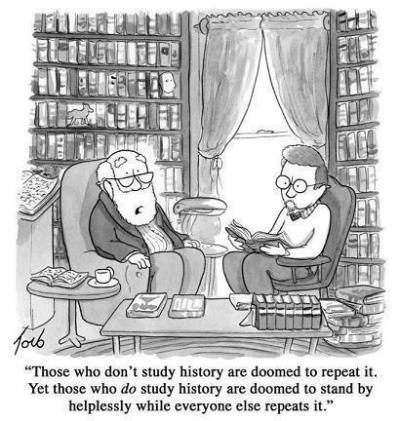
learning_from_history

How come ‘those who do study history are doomed to stand by helplessly while everyone else repeats it’?

Could it be that some of the ‘students of history’ are doing something wrong?
Misunderstand the very lessons they try to impose on the others?

Cracking annoying jokes about the matters at hand instead of honestly helping others to reach intellectual autonomy and then respectfully allowing them to develop their own interpretations of things?


I hear a lot of people discussing about the need to choose ‘the lesser evil’.

Otherwise the ‘greater evil will prevail’ they warn us.

I’m afraid that those who fall into this trap actually validate the idea that ‘evil is acceptable’.
Every time this subject comes up I keep remembering the joke about an older man asking a young lady:
‘Would you sleep with me if I gave you a million bucks?’.
‘Well, I’m not that kind of girl… but you know, that’s an awful lot of money… I could help my old parents… I could go back to school… OK…”
‘But what if I gave you $100?’
‘I told you I’m not a hooker!’
‘That’s already been settled. All that’s left for us to do now is to negotiate the price.’
Same thing with ‘choosing the lesser evil’. Once you’ve  accepted that evil is inevitable … you’re sure to get some. And keep getting it until you quit playing their game.
That doesn’t mean we schould quit voting all together. It would send the wrong message. Even if you don’t go to the voting booth because you are disgusted by the available options the ‘analysts’ interpret your stance as ‘they’re so despondent that they don’t care anymore about their own fate. They they don’t have enough energy left in them to protest so no need to change anything. Or, maybe, things might be allowed to become even a little worse. For them, of course.’
What we need to do is vote what we really like, even if that candidate doesn’t stand the slightest chance. This way the intention of the voter is absolutely clear – ‘I want exactly this’.
If there is no acceptable option, we can always check the ‘non of the above’ box – if available – or take the necessary steps to annul your vote – the specifics depend on local rules and regulations. Again, this sends a rather clear message. ‘I refuse to play into your hands and accept that evil is inevitable’.

bullshit

I’m not a Trump fan. How could I be? Just look at his face!

On the other hand….

“I call it the law of the instrument, and it may be formulated as follows: Give a small boy a hammer, and he will find that everything he encounters needs pounding.” Abraham Kaplan

Or, in this case, convince a journalist of something and he will ‘dress’ the facts to fit his new conviction.

As I said before, I don’t like Trump.
If I didn’t have a lot of trust in the overall resilience of the American democratic system I would be scouring for a big enough rock to hide behind if/when he might ascend to power.
Unfortunately the present most likely alternative isn’t any better.

But that’s another topic.

Let me go back to the present one.

What we have here is a news/opinion outlet which has a clear political option.
OK, I can live with that. I have some opinions of my own and I love to argue and defend them. In private as well as in public.

But I do believe that the quality of the arguments used in a debate are of paramount importance.

Let me analyze the four I mentioned above.

“Within 20 seconds at a press conference on Wednesday, actual Republican presidential candidate Donald Trump went from suggesting that Russian President Vladimir Putin had once called President Barack Obama the n-word to saying he hopes Putin likes him.”

The apparent implication here being that Trump has trouble maintaining logical consistency inside a rather short discourse and that he is rather gullible – “For the record, there is literally zero evidence that Putin ever called Obama the n-word. It’s hard to say where Trump got this idea, but he has a long history of naively restating things he heard from one person — even random people on Twitter.

Hard to argue against this, specially since there is ample video testimony that he really said it.

a shocked again trump

Well… after actually hearing him, things are not so clear anymore.

“Putin has said things over the last year that are really bad things. He mentioned the n-word one time,” Trump said from his resort in Doral, Florida.
“I was shocked to hear him mention the n-word. You know what the n-word is, right?” Trump continued. “He has a total lack of respect for President Obama.”
Putin doesn’t like Obama, Trump told reporters.
“I think he’s going to respect your president if I’m elected, and I hope he likes me,” Trump said.
Earlier in the news conference, Trump claimed he had never met the Russian leader.”

Not a trace of either ‘gullibility’ nor of any logical fracture here. So why not call Trump for what he really is – a callous manipulator – instead of using convoluted makeshift allegations?

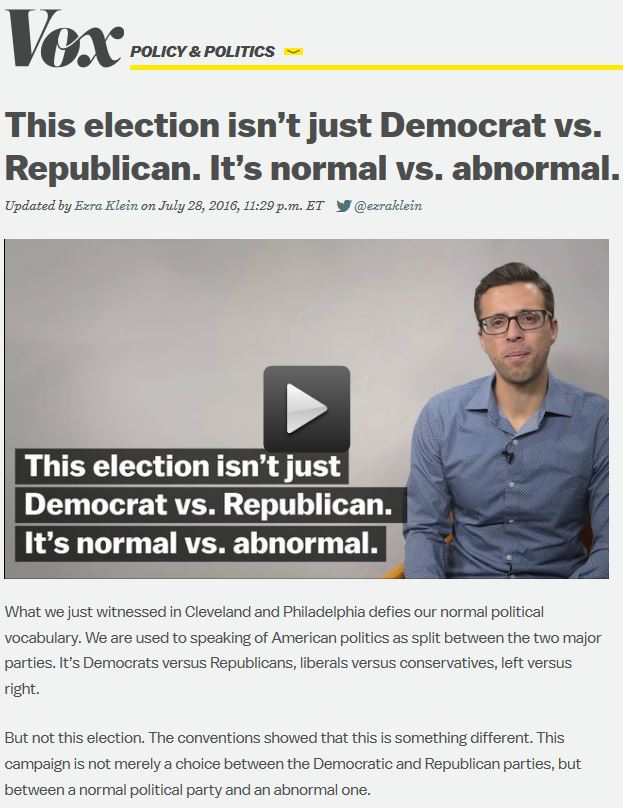
normal versus anormal

Absolutely impossible not to agree with everything written here, right?
No matter what side any of us belongs to…but wait!

“The Democratic Party’s convention was a normal political party’s convention. …”
“The Republican Party’s convention was not a normal political party’s convention….”

A new cleavage in American politics: normal versus abnormal

America’s main political cleavage is between the Democratic and Republican parties. That split has meant different things at different times, but in recent decades it primarily tracks an ideological disagreement: Democrats are the party of liberal policies; Republicans are the party of conservative policies.

But in this year’s presidential election, the difference is more fundamental than that: The Democratic Party is a normal political party that has nominated a normal presidential candidate, and the Republican Party has become an abnormal political party that has nominated an abnormal presidential candidate.

No, I’m not going to take sides here. Not only because I’m not an American citizen so I’m not entitled to vote. But simply because Democracy relies mostly on mutual respect. You cannot refuse to the other party the very right to exist yet still call yourself a democrat. Pretending that your opponent is ‘abnormal’ means that you’re convinced that your opponent should not exist at all.

The way I see it ‘America’s main political cleavage is indeed between normal versus abnormal’ only it seems that both the  Democratic and Republican conventions, if not the parties themselves, belong to the realm of the ‘abnormal’.

But wait, things are getting even more juicier.

When women speak, people tend to mentally turn up the volume

Women, and women leaders in particular, often get criticized more for how they say something than for what they actually say. They have to walk a difficult line of being assertive but not too aggressive, likable but not too much of a pushover.

Even though women are interrupted more often and talk less than men, people still think women talk more. People get annoyed by verbal tics like “vocal fry” and “upspeak” when women use them, but often don’t even notice it when men do.

The same mental amplification process makes people see an assertive woman as “aggressive,” which gets in the way of women’s personal and professional advancement. Women are much more likely to be perceived as “abrasive” and get negative performance reviews as a result — which puts them in a double bind when they try to “lean in” and assertively negotiate salaries.

These kinds of implicit biases are sexist, but having them doesn’t make someone “a sexist” — or if it does, it makes all of us sexists. It doesn’t matter how smart you are or whether you are a man or a woman; everyone has some implicit biases against women.

And that may be one reason why this is the first time a woman has ever won a major party’s nomination.

OK, so what should people do? Vote for Hillary Clinton simply because she’s a woman?

And no, I don’t have any implicit biases against anybody. I cannot vouch for anybody else but I cannot see myself as ‘abnormal’ so I expect there are others in my situation.
Hence I strongly believe that candidates should be evalued ‘all around’, without any biases based on their gender.

Or race.
Hey Trump, this one is specially for you.

barack is not the cause

I’m afraid that Dara Lind, the author of the article I just quoted above, has got her ‘butterfly’ wrong.
It’s not Obama that inadvertently caused any hurricane.
Do you remember the intensity of the birther campaign that had swept across America both before and after Obama was elected President?

And while it’s clear that Trump was one of the most vocal ‘birthers’  do you know who started the whole thing?

“You know who started the birther movement? Do you know who questioned his birth certificate, one of the first?” Trump asked.

“Hillary Clinton, she’s the one who started it. She started it years before it was brought up by me.”

Trump said he no longer talks about the issue because it always breeds controversy but promised to “raise it against” Clinton in a general election.

OK, we don’t have to take Trump’s word on this, even if he’s quite an authority on the subject – given his passion about the issue.

The last quote is from an article published on the CNN site. Click on it if you want more specifics.
OK, so where does all these leave us?
Scratching our heads while trying to figure out what went wrong around the ‘deep well of anxiety about America losing its culture and values’?
Or rather staring at those who drew from deep within this well and used the proceedings to stoke people’s emotions in order manipulate them? One way or the other?
It seems the he wasn’t the only one. Wannabe presidential candidate and ‘racial provocateur’.
So why keep on hoping that by choosing the ‘lesser evil’ we’ll ever reach the ‘light at the end of the tunnel’?
Why keep on trying to manipulate people one way or another instead of finally calling both ’emperors’ for what they are?

1 – A wealthy and immensely powerful earthly ruler decides that his only child, a boy, should be protected from having any contact with the misery predominant under his dominion.
His efforts are successful, for a while, but at some point the young lad finds out that he was living in a bubble and rebels – as all young people do at some point.
The young man, like all mythological heroes before and after him, embarks on an initiation voyage during which he not only comes of age but also discovers a way out of the erstwhile inescapable cycle that keeps us human beings immersed in apparently endless suffering.
The not so young anymore prince shares his findings to those who recognize him as their guru and fades into the endless folds of time…

2 – Unable to find a way to bring himself happiness to his subjects a powerful ruler decides to sacrifice his own son in order to achieve this self imposed task.
For his son to experience unblemished bliss – so that he would be familiar with the feeling towards which he was meant to lead the inhabitants of the kingdom – the king raises him completely isolated from the vagaries experienced by the commoners.
When the young prince is considered mature enough, he is ‘accidentally’ led to find out the dire reality that is haunting both the king and his subjects.
As expected of him, the lad refuses to return to the comforts of the gilded nest and embarks on the task he was raised to fulfill.
After a labored voyage that somewhat mirrored his erstwhile existence our hero eventually solves the problem entrusted to him by his father.
The story ends with the hero taking the trouble to share his findings with those who bother to listen to him.

3 – Unable to convince his contemporaries of what he had understood about this world an otherwise skilled storyteller concocted a rather convoluted narrative about an young prince who accidentally found out about how much misery existed – and still does – in the world. Impressed by the horrible fate of his subjects the soon to become hero starts looking for a way to deliver his people from their sufferance. After a long struggle, mainly with himself, he found out that in order escape the cycle of suffering a man must. above all. make peace with himself. By refraining from making excesses of any kind and by first considering the thoughts that cross his head and only then putting them into practice.
After refining his story in the shade of the proverbial fig tree our story teller started sharing his teachings to anybody wise enough to lend him an ear.

So, is there anything to be learned from these stories?

For starters, no one can be saved from suffering against his will or without him being aware of what’s going on.
Secondly that there is no such thing as a ‘one size fits all’ solution to be put in practice by a benevolent ‘deus ex machina’. Had this been possible the generous and caring ruler would have solved the problem without having to sacrifice his own son in the first place.
Thirdly, is no way lastly and less evident than the first two, ‘salvation’ is a collective effort. Besides the fact that in all three versions the ‘hero’/story-teller who finds the way feels an irrepressible urge to share his findings we have to consider that none of the above at no moment delved in a complete void. Each of them was raised/conducted their search in circumstances shaped by those living in their close proximity.

“The bodhisattva ideal is central to the Mahayana Buddhist tradition as the individual who seeks enlightenment both for him- or herself and for others. Compassion, an empathetic sharing of the sufferings of others, is the bodhisattva’s greatest characteristic. It is shown in the following incident from the Vimalakirti Sutra which concerns a prominent lay follower of the Buddha who had fallen ill. When questioned about his illness, Vimalakirti replied, “Because the beings are ill, the bodhisattva is ill. The sickness of the bodhisattva arises from his great compassion.”

Contrary to what one might think at first glance, Buddhism is not about a selfish quest for individual escape. Buddha himself couldn’t leave this valley of tears without first sharing his newly acquired understandings with those around him.

As amply, but not readily evident, proven by all three variations, becoming aware of, and cherishing, one’s own individuality is an absolute must for all who seek deliverance but reaching that stage is only a necessary step towards the understanding that deliverance can only be achieved by carefully balancing one’s own ego against ‘the need to belong’ which allows us to cooperate towards our common goal:

Survival as an opportunity to reach deliverance.

takes-a-village-quote

I’ve spent the first 30 years of my life under communist rule.

One of their many ‘mantras’ was: ‘Children are the future of mankind’.

Communist rule had brought about so much happiness in Romania that people had stopped making children.
Concerned about the future the communists had decreed that from then on abortion was to be considered a crime – after it was freely available until that time,  October 1, 1966.
As a consequence more than 10 000 women died after botched abortion attempts – all other methods for birth control had been banned also.
Add to those deaths the individuals, mostly youngsters, killed while attempting to flee communism by sneaking across the borders.

But there was one good thing that communist rule had brought to the people. Not that much because the communists really cared about the fate of the individuals but because they needed skilled laborers in order to put their plans into practice.

Schooling was free.
You could learn as much as you wanted without having to pay a dime.
One had to pass some exams, positions were limited for higher education, but if you were smart enough and diligent enough you could go really high. Specially in the area that is currently known as ‘STEM’. ‘Humanities’ were somewhat off limits, because one could get ‘funny’ ideas when delving too deep in that area but STEM was OK.

Fast forward to our days.

Half of my University mates – I have a MSc in Mechanical Engineering – have emigrated right after Ceausescu was toppled while political power in Romania has fallen under the constant grip of a small coterie which doesn’t really care about what’s going on and/or has not enough intellectual flexibility to understand that we are currently running towards a dead end.

In the end the ‘good’ thing has proved to be a poisoned apple. By tuning the schooling system towards their own goals the communists had created many generations of  superb engineers – who were welcomed by the ‘greedy capitalists’ – but also had completely discouraged independent thinking – the kind needed to breed honest politicians and effective public figures, if you can accept those concepts as anything more than empty words.

Gazing over the borders I became even more despondent.

Forget, for a minute, about child pornography, sweat-shops and so on. These are absolutely horrible but we might console ourselves with the thought that those who are involved in them are either mentally disturbed or blinded by greed.

But something like this?

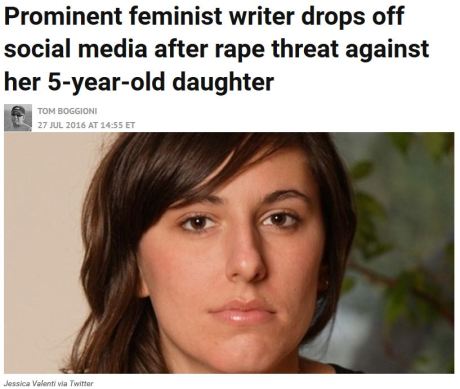
rape threats

Supposedly a feminist writer is followed by either like-minded people or opponents of her ideas only both categories belong to the wider category of ‘intellectuals’ – people concerned with ideas, human rights, philosophical thinking, etc., etc….
In this context to threat a mother that you are planning to rape her child is way above anything that was imaginable until this moment.
It’s as if being able of sophisticated thinking is no longer one of the venues towards becoming a better person – by simply being able to understand how much pain is produced by evil or careless behaviour.

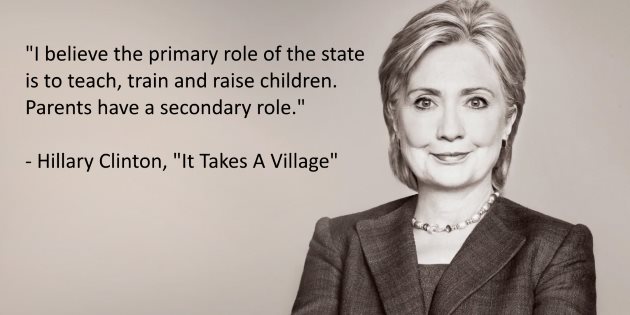
Then I came across the meme at the top of my post.

I must confess that I don’t like her. For various reasons that do not fit here. Enough to say that while watching the DNC 2016 I had the distinct impression of being transported back in time to one of the congresses organized by the Romanian Communist Party.
Because of my dislike of her I had the tendency to believe that she had actually wrote that.

trust-but-verify-quote-2

So I did that.

false

“While it’s true that Hillary Clinton published a book in 1996 called It Takes a Village: And Other Lessons Children Teach Us, it does not include the above-displayed quote, and Clinton (a parent herself) has not said at any point that she believes that children should be raised by the state with parents taking a secondary role.


OK, some of you will tell me that Snopes is leaning towards the left and that you cannot always trust its findings.

I can agree with that. Sometimes you should not believe your own eyes, let alone what you read over the Internet.

But my argument still stands.
What has happened to us?
Why are we so willing to involve even our children in our political lies? It doesn’t matter here who lied – Snopes or those who ‘cooked’ this meme…

What are politics for if not for securing a future for our children?

What kind of future can be build on lies?
On this kind of lies and on this kind of threats…

When are we going to understand that the state which side-lines the parents is a fascist one – fascism and communism are close authoritarian cousins, that no one can survive for long outside a community and that the community, as a whole and each of its members, fare better if all its members have a real chance to develop their potential?

Education and health care should not be treated as ‘individual rights’.
It is obvious to the naked eye that societies who take good care of their members while simultaneously respect their freedom fare better than those who let their members fend for themselves without helping them train for today’s job market and without extending them any safety net.
We keep saying that we need better skilled individuals and do nothing about it. We keep saying that in a free market there are risks that have to be taken yet we step back when a risk taker who happened to have failed, honestly, asks for our help.

OK, I understand. The communists dissuaded their children from studying ‘humanities’. Simply because they might have started to ask the very same questions that I’m asking today.

But what happened to the rest of the world?

Who is thinking about the future, beyond planning for future cash-flows (extremely unreliable in the first place), anyway?

The scientists act on the assumption that their efforts to un-peel the  ‘onion’ will eventually bear fruit and that ‘the truth’ will eventually be found crouching behind the proverbial ‘last skin’.

The artists keep torturing their souls hoping that theirs will be the one blessed with enough sensitivity to feel the ‘ultimate’ experience and with enough talent to be able to communicate it to the rest of us.

The mystics keep entertaining the proverbially faithful ‘grain of hope’ that their soul will be blessed by their Maker with some ‘insider’ knowledge and with enough stamina to make the revelation known to the rest of the flock.

Meanwhile the rest of us, the ‘regulars’, keep altering the ‘onion’ – otherwise known as ‘The Reality’, sometimes beyond recognition.

Let me elaborate.

As of now it seems that there are a hard core reality – the one feverishly pursued by all those mentioned at the start of my post, a multitude of partial images of what that reality looks to each of us – the ones made up by each of us when trying to make sense of our perceptions about the (hard core) reality, usually without being aware that what we look at is a window dressing composed of the numerous patches pinned by by each of us on the original while acting according to what each if us perceived to be (the image of) the ‘reality’.

And it’s exactly this overgrowth that constantly changes the object of perception at which each each of us stares continuously and tries not only to understand it but alto to adapt to it. Constantly forgetting that our efforts not only adapt us to the (perceived) reality but also alter the reality itself, not only the image we perceive of it.

But hold on. I haven’t mentioned the really interesting part yet.
All of the above constitute the ‘innocent’ side of the whole thing. The natural process that would take place if all of us would act ‘up-front’.

In reality some of us have ‘ulterior’ motives.
Some of us consider that their understanding of the world is not only better than that of everybody else but also that they are entitled to act based on that understanding. Without asking permission from and sometimes even against the wishes of those who will bear the brunt of the consequences brought forth by those actions.

That’s why the ‘patches’ pinned by these callous people fit a lot less to the real reality than those attached by the honest ones among us.

And that’s the catch.
The ‘distance’ between the reality of a fact and our perception/action about it produces a certain ‘energy’. If the distance is small the energy corresponding to it is manageable. People can adjust to it and absorb its consequences.
But sometimes the distance is larger than what can be comfortably absorbed and this leads to the formation of social scars. And if successive ‘distanced’ patches are applied without enough healing time in between, then, eventually, wide ‘gaps’ will have to be dealt with.

And since ‘wide’ produces a lot of ‘energy’ and ‘a lot of energy’ leads to massive upheavals…

This ‘lack’ of philosophers can be explained in two ways.

Nobody = among those with enough ‘brain power’ – cares enough any longer about finding the raison d’etre for which we toil on this Earth.

Not enough of the regular people find this subject interesting enough to keep alight the flame of the discussion.

The consequence being that freak ‘intellectual monsters’ have occupied the front stage and drive the ‘unsettled’ among us to utter insanity.

nuts

My take on the matter being that we live in a different world that we used to.
One where both the explanations mentioned above hold almost equal sway.

Thinkers do not touch the subject with the same vigor as a couple of centuries ago because knowledge has become vast enough so that very few people dare to look from one (putative) end to the other.
Commoners do not care much about the subject because they have become rather complacent. Day to day life no longer poses the same challenges as it used to, to the tune that most people, including the not so well of, do not feel such an ‘urgency’ about tomorrow as the one felt by our forefathers.

What we have is a total lack of workable ‘world visions’.

Usually in time of crises new ideas were presented to the public, some of them took roots, and the (local) world enjoyed a fresh start.

For instance when the Athenian democracy reached its crises point Plato came up with a whole concept that influenced the thinking of Europe for the next two and a half millennia.
I’m not going to discuss here the ups and downs of his teachings but the very fact that enough people followed them, and that his ideas survived for so long, means that there was something there. In the ‘cooperation’ between the philosopher and his followers.

The last inflection point happened sometimes in the XIX-ht and XX-ht centuries. Darwin, Hegel, Schopenhauer, Marx (the philosopher and the sociologist, not the political activist), Adam Smith, Durkheim, Max Weber, Einstein, Popper, Kuhn, Maturana…

Now?
Zilch!

Not that people do not think anymore.

Take Nicholas Nassim Taleb for instance. Or Jared Diamonds, Robert Prechter and Neagu Djuvara – to name but four of who shine on my radar!
Yes, each of them had their relative moment of glory but not any near of what each of them really deserved!
Maybe because none of them had actually engaged in an all out effort to redefine human understanding?

Have we become lazy?
This lazy?!?

other countries are laughing at us

Paul Noth, The New Yorker Cartoon

The US is the most religious of the civilized nations.
Yet so many Americans believe that “greed is good” despite greed being scorned by all major religions.
Most of those who do believe that quote Adam Smith when asked about the foundations of their creed:

“It is not from the benevolence of the butcher, the brewer, or the baker, that we expect our dinner, but from their regard to their own interest.”

Unfortunately they don’t take the time to read some more of Smith’s work.

A puppy fawns upon its dam, and a spaniel endeavours by a thousand attractions to engage the attention of its master who is at dinner, when it wants to be fed by him. Man sometimes uses the same arts with his brethren, and when he has no other means of engaging them to act according to his inclinations, endeavours by every servile and fawning attention to obtain their good will. He has not time, however, to do this upon every occasion. In civilised society he stands at all times in need of the cooperation and assistance of great multitudes, while his whole life is scarce sufficient to gain the friendship of a few persons. In almost every other race of animals each individual, when it is grown up to maturity, is entirely independent, and in its natural state has occasion for the assistance  of no other living creature. But man has almost constant occasion for the help of his brethren, and it is in vain for him to expect it from their benevolence only. He will be more likely to prevail if he can interest their self-love in his favour, and shew them that it is for their own advantage to do for him what he requires of them. Whoever offers to another a bargain of any kind, proposes to do this. Give me that which I want, and you shall have this which you want, is the meaning of every such offer; and it is in this manner that we obtain from one another the far greater part of those good offices which we stand in need of. It is not from the benevolence of the butcher, the brewer, or the baker, that we expect our dinner, but from their regard to their own interest. We address ourselves, not to their humanity but to their self-love, and never talk to them of our own necessities but of their advantages. Nobody but a beggar chuses to depend chiefly upon the benevolence of his fellow-citizens. Even a beggar does not depend upon it entirely. The charity of well-disposed people, indeed, supplies him with the whole fund of his subsistence. But though this principle ultimately provides him with all the necessaries of life which he has occasion for, it neither does nor can provide him with them as he has occasion for them.
The greater part of his occasional wants are supplied in the same manner as those of other people, by treaty, by barter, and by purchase. With the money which one man gives him he purchases food. The old cloaths which another bestows upon him he exchanges for other old cloaths which suit him better, or for lodging, or for food, or for money, with which he can buy either food, cloaths, or lodging, as he has occasion.


Had they done their homework they would have had the chance to figure out that Smith was the first to understand that in order to fulfill their self interest people must treat each-other with respect. Otherwise trade would be impossible.
And what kind of division of labor could have been developed among people who despised each-other? Could anyone eat or wear something that had ever been close to, let alone been made by, a pariah – the actual meaning of the word being “untouchable”, a person that soils everything they touch?


The US is the biggest economy in the world. It has enjoyed that status for more than a century now. During that time many American corporations have built huge portfolios abroad and some of them do more business outside the US than inside the borders.


This very week the Republican Party has nominated its presidential candidate. This guy, Donald J. Trump, has managed, in the last six short months, to aggravate almost everybody on this planet. Mexicans, Chinese, the whole Islam… and more than half the American population – he is perceived unfavorably by 59.2% of ‘his’ potential constituents.
Traditionally, the GOP was biased towards businesses and the business people – and fittingly so. So much so actually that G. W. Bush has thrown the traditionally Republican fiscal prudence overboard during his first mandate. Not only that he had reduced taxes but also embarked on a massive spending spree.
During the convention that nominated Trump as candidate Gov. Scott Walker, one of Trump’s most enthusiast supporters, mentioned:


You deserve better! Because America deserves better.

The well connected in Washington are standing behind Hillary Clinton because Hillary Clinton is one of them. They want more of the same.
Donald Trump is standing with the American People.
We want a leader who is not afraid to take on the mess in Washington.


Why is it so hard to figure out that ‘the well connected in Washington’ – exactly those who control those huge American businesses abroad – are doing everything in their power to get rid of Trump? Even if that means backing such an unpalatable candidate as Hillary Clinton? We should not forget that her behavior as Foreign Secretary – in what concerns her manner of dealing with her e-mails – proves a total lack of respect towards rules and regulations.

And what does Gov. Walker mean by ‘the well connected in Washington’? By every measure Donald Trump is one of them. So much so that he gleefully admits it.


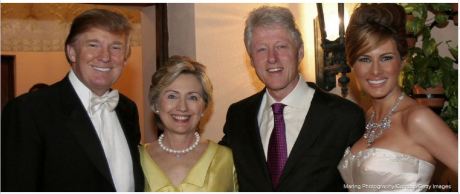
“Hillary Clinton, I said be at my wedding, and she came to my wedding,” the reality-star-turned-politician said at the first GOP presidential debate in Cleveland. “She had no choice because I gave to a foundation.”

trump wedding

Finally, but not last, we have the problem of the ‘failed presidencies’.

Quite a sizeable number of Americans are undecided whether Carter or Obama were the worst American Presidents ever.

The rest of the world remembers Carter as the guy who successfully brokered the Camp David deal while Obama continues to enjoy a good reputation abroad, despite the huge number of drones that were used during his mandate over foreign territories and despite  his failure to shut down Guantanamo, as he had promised.


Had America been a small country, equivalent to Switzerland, for instance, all these would have been of very little importance.
Since the US is not only the biggest economy of the world but also the most powerful nation on Earth, people all over the planet are keeping their fingers crossed about what’s going on there.


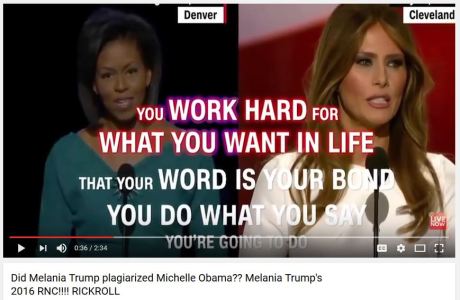
trumped up plagiarism

I’m not naive enough to argue that the most powerful man on Earth must also be a very honest one and that not even the slightest shadow must be allowed to tarnish his public image.

After all even his followers portray him as an effective leader who gets things done, not as a virgin knight riding a white horse. Otherwise the ’eminent domain’ incident and all subsequent ones would have already scuttled his political career.

Recent developments show that at least some Americans have started to figure out the real danger posed by his ‘management style’:

It’s an embarrassing screw up; clearly the passages were lifted, and a half-assed attempt was made to vary them by changing a word or two. Sad thing is, Melania actually did a good job in the delivery. This didn’t have to happen.

It just offers more evidence that Trump can’t/won’t hire competent people. He’s ultimately responsible here. With him as President, we’d probably be subject to these kind of embarrassments on a daily basis. Seems he either hires people who are in way over their head, or hires smart people and then refuses to listen to them. What kind of cabinet would he pick as President? It really doesn’t matter; he probably wouldn’t heed their advice anyway

Unfortunately they also prove that there are some people who don’t give up on him so easily:

Michelle Obama did not write “her” speech. A team of paid political speechwriters did. THAT is Trump’s point with having his wife repeat those words.

PS.
Just read about another possible interpretation of what had happened.

The sentences were probably planted there to make Melania’s speech go viral and drive the left wing crazy.

Very plausible hypothesis, given Trump’s modus operandi, and suggesting that Trump may entertain an even more disparaging opinion on his followers than the one he has already expressed:

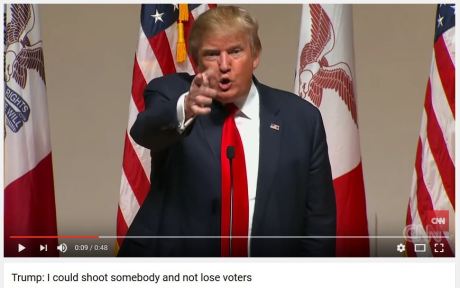
““I could stand in the middle of Fifth Avenue and shoot somebody and I wouldn’t lose any voters,” he said.”

‘I can make my wife do some dirty work for me and still not loose any voters’.

shooting trump