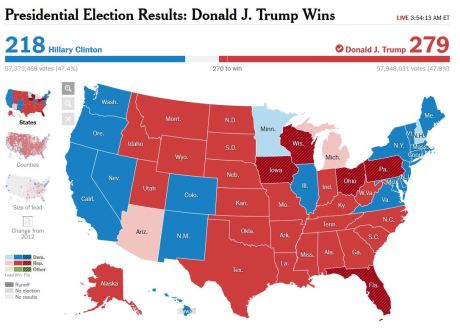
What can we make of it?

Momentous as it was the result was no landslide.
Only a little less than 120 million people bothered to vote – out of the 250 million or so who are old enough to do it – and most of them, 47.7% vs 47.5, have chosen the ‘looser’.

Actually I don’t like the notion of anybody winning – or loosing, for that matter, a democratic election but that’s a different subject. Stay tuned, I’ll probably cover it soon.

Then Trump is no Hitler, as some have feared.
Even if he is riding a similar wave of popular discontent like the one used by Hitler to rise to power, and uses the same political tricks, Trump is nothing more than the ultimate opportunist.
Check his body language.Turn off the sound and just watch him.

the-most-corrupt
While Hitler was a mad ideologue absolutely convinced of his own righteousness Trump’s only conviction is that he ‘deserves’ as much as he can ‘grab’.
Now, that I’ve mentioned ‘ideology’, in this respect it is Clinton who belongs to this category – people who conscientiously use an elaborated ideology as a compass to find their bearings and as a ‘looking glass’ to read the fine print on the maps they try to navigate. But this is a subject I’ll have to come back to at a little later.

No landslide but still momentous.

A lot of people who had not bothered to vote before have come out in droves.

Trump, the business man, and the Republican Party – which now controls both Houses of the Congress, cannot afford to forget this.
Also, they must not forget about the other half, the one which had chosen to remain silent, on Tuesday, of the electorate.
The fact that they didn’t vote, then, doesn’t mean that they didn’t have any opinion.
And they are simply too many to be discarded.

“How come we haven’t seen this coming?”

I keep hearing these laments from my fellow sociologists.

Well, the raw data was all there. Compiled in the opinion polls result sheets, only that we could not interpret them right.
Trump had felt it in his gut – and acted on this hunch, but we had not been able to see it coming despite our ‘scientific’ methods and hugely accurate number crunching machines.

Which brings me to the main topic of this post.

What happened these days is yet another proof that the math used by the number-crunchers is nothing but a (very accurate) language and that ‘science’ is nothing but a (meta) tool that can be used to make sense of various aspects of the surrounding reality.
The results obtained, by us, through the use of this tool and expressed with the help of that language depend primarily on our skills and intelligence and only secondarily on the quality of the tools used in the process and on the precision of the language used to present them.
Not to mention the fact that it was us who developed the tool and formulated the language…

I ‘warned’ you I’ll come back to ‘ideology’.
This is yet another tool. As I mentioned before, we, all of us, use it as a compass with which we try to find our way through the world and as a magnifying glass with which we try to make sense of what’s happening to us.

‘But you just said we’re using science ‘to make sense of various aspects of the surrounding reality’?!?’

Well… we’re using both.
Whenever confronted with anything new we have to make a snap decision. Try to assimilate it with something we already know or investigate it.
It is our personal ideology which kicks in first and tells us what to do. And each time that we choose to look in our mental drawers for something that might fit in the new situation we remain in the ideological realm and continue to use ideology as a light beacon – what happens to be inside that beacon is brought to our attention while everything else doesn’t exist for us.
Only if we choose to investigate, science kicks in. But not even then we are not entirely free from ideology. Each time that the investigative process leads us to anything which contradicts something that had been already ‘filed’ in our ideological cupboards we find ourselves in a huge dilemma. How to proceed from there on. Continue to trust the scientific method or revert to the safety of the already settled?

This is why individual responsibility is hugely important.
And why no one should ever consider that he is the sole repository of the entire truth.

This is why we need to be constantly reminded about the limited nature of our understanding.
And the democratic process has been proven, time and time again, invaluable in this respect.
As long as it was allowed to proceed freely and it was conducted with respect towards all members of the community involved.


trump-nbc-favorability-trump

trump-temperament-nbc

1478656414_trump_treatment_of_women

womens-votes

evangelicals-votes

white_catholics-votes

clinton-honesty-nbc

whether-to-continue

direction-of-the-country

trump-wins

New York Times, Elections 2016

Like always, the dispirited enough to stay at home have given a carte blanche to the  desperate enough to ‘jump into the unknown’!

And no, this is not exclusively about the ordinary voters!
They’ve already sent plenty messages stating clearly that they’ve had enough.
But those whose job was to make things work had chosen not to hear.
Then, when it had become plenty obvious that the boil had been festering for long enough, most of them had stepped aside – leaving at the forefront of the ‘operating table’ a ‘surgeon’ whose long resume was anything but capable of generating trust and a ‘willing’ and ‘enthusiastic’ ‘wannabe’ with no experience.

And now they are trying desperately to find an ‘honorable way out’…


the-final-countdown


“We’re leaving together,
But still it’s farewell.
And maybe we’ll come back
To earth, who can tell?
I guess there is no one to blame
We’re leaving ground (leaving ground)
Will things ever be the same again?

It’s the final countdown.
The final countdown.”

the-final-countdown-2

the-most-corrupt

“Clinton is the most corrupt person ever to seek the Presidency… she is protected by a rigged system” said the paragon of free trade who attempted to use eminent domain in order to evict an old lady from her house so that he could spare a few hundred thousand bucks… and who later bragged about ‘women allowing him to “grab them by the pussy” simply because of his status’.

His competitor, whose slogan reads “Stronger Together”, is a former Secretary of State who has been accused  by both the State Department and the FBI of ‘gross negligence’ and ‘extreme carelessness’ towards important matters of national interest.

89797467_emailclinton

“Mrs Clinton failed to comply with rules on record-keeping, the inspector general found, and used private email for official business without approval.”

So, one of them thinks the system is rigged only when it cannot be twisted to suit his own interests while the other believes ‘togetherness’ can be build around someone who completely disregards the existing rules…

I’ve been asking myself, for some time now, ‘what’s going on there‘?
How come so many intelligent people have allowed themselves to be sucked in this extremely dirty game of deception?

In fact the answers are so obvious that I’ve lost interest in them.
(“The 2016 presidential election has seen a strange flip-flop with respect to conservative and liberal voters. In many ways, even though Trump is the nominee on the right, he is running to the left of Hillary on many issues. Hillary represents the status quo mainstream, usually denoted as the Republican nominee position, while Trump is the obvious “change agent” of the election. Both Hillary and Bill Clinton have been seen by many government officials as being more conservative than liberal, even though they use the Democratic platform to advance their hold on power.”)

But what consequences will arise from this mess?

Is Putin going to be the sole real beneficiary of this electoral process?
Because, regardless of the outcome of the vote, America has made such a fool of herself that she has already lost much of the huge respect the rest of the world had for her?

But what if, again regardless of the immediate outcome, enough Americans will eventually wake up from their slumber and bring things back on their right track?

Don’t count America out just yet.
Hitler and the Japanese militarists  have been only a few of those who had fallen into this trap…

On the other hand too many trips to ‘the brink’ are not ‘good for your health’. The Western part of the Roman Empire had fallen apart in almost similar conditions while its Eastern half had been able to post-pone  its own agony only by becoming a dictatorship.


quote-the-philosophers-have-only-interpreted-the-world-in-various-ways-the-point-however-is-to-change-karl-marx-250986

Change it into what? And on what grounds?

I had spent the first 30 years of my life under communist rule and I’ve witnessed, first hand, the debacle produced by a bunch of people trying to transform the world according to their own liking. And it’s not only that they had brought a lot of misery to an awful lot of people but they also brought it upon their own heads. They, and their families, have been indeed living a lot better than the rest of the people but a lot worse than the ordinary people living in the free world. Not to mention the fact that many of them ended up really bad, some of them at the hands of their own insatiable, Minotaur-like, leaders and some others during and immediately after the regime change.

I’m writing this post after watching Jon Haidt’s excellent lecture “Two incompatible sacred values in American universities“, delivered at Duke’s Departement of Political Science on October 6, 2016.

The point of Haidt’s conference being that each university should clearly declare its ‘telos’ as belonging to one of these two clear cut options:

the-point-of-a-university_dxo

Don’t bother to search the quote attributed to John Stuart Mill.

It is only an interpretation belonging to Haidt himself, who had inferred it from one of Mill’s famous quotes excerpted from  “On Liberty”:
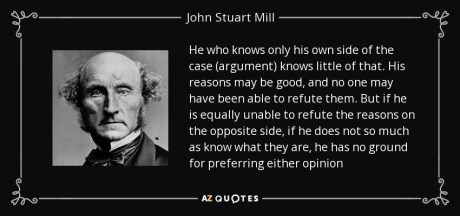
quote-he-who-knows-only-his-own-side-of-the-case-argument-knows-little-of-that-his-reasons-john-stuart-mill-125-0-0981

So, what should it be?

Change or Truth?

Before proceeding any further I strongly suggest that you take some time and listen to Haidt’s excellent arguments.

Now I’d like to discuss a little about ‘Change’ and ‘Truth’.

What both Marx and Haidt have in mind when they speak about ‘change’ is both ‘purposeful’ and ‘centralized’.
When they say ‘change’ they mean an ‘effort towards increased social justice’, effort whose parameters would be determined by the wise men (and women) delving in the depths of the University’s libraries and which would be implemented without fail, preferably with a sanction from the higher authority.

I had already mentioned, at the beginning of my post, where such ‘change’ would lead anyone  attempting to put it into practice.
And Haidt gives us an excellent explanation for why anybody who will ever attempt such a thing would eventually fail. (I told you to watch his conference…It may be long but every minute of it is packed with very interesting things!)

So why is Haidt challenging us to make this choice instead of giving us a clearer piece of advice?

Well… maybe you should ask him that… I’d hate to believe that he, in his own words, ‘has become afraid of that too many of his students might feel that he is so distanced from what is generally accepted that too few of them would follow him’.

So what should we do?
Some of us should embark on a ‘sterile’ search for the (absolute) truth and then, after eventually finding it, nurse it quietly in our lap but refrain from an even minutely more drastic action while others should attempt to implement change based on already ‘over the hill’ principles?

I’m afraid that would be a dangerous road to follow.

There is no such thing as an ‘absolute’ truth that might be nursed in our lap and even if there was such a thing we are not able to find it – individually or even as a group. There’s plenty evidence about that in Haidt’s discourse.
And then what would be the use of the whole enterprise if we are not planning to use the results of our quest, whatever those might be?

And here lies the crux of the matter.

I’m sure Haidt knows what I’m going to tell you now and I’m very sorry that most of your teachers have never mentioned at class this very interesting story.

Marx was not the first revolutionary thinker of his time.
OK, you already know that. There were a certain number of French intellectuals whose writings have set the stage for the 1789 Revolution.
What is less known is that John Stuart Mill himself had been groomed by his father “as the future leader of this radical movement”, whose aim was supposed to be “social reform based on utilitarianism” with the goal of attaining “the greatest happiness of the greatest number“.

The only difference between James Mill (the father) and Karl Marx being that Mill didn’t advocate the the forceful confiscation of the ‘means of production’.
Otherwise both were faithfully following Plato’s dictum:
Until philosophers are kings, or the kings and princes of this world have the spirit and power of philosophy, and political greatness and wisdom meet in one, and those commoner natures who pursue either to the exclusion of the other are compelled to stand aside, cities will never have rest from their evils, –nor the human race, as I believe, –and then only will this our State have a possibility of life and behold the light of day. Such was the thought, my dear Glaucon, which I would fain have uttered if it had not seemed too extravagant; for to be convinced that in no other State can there be happiness private or public is indeed a hard thing“.

Well, the problem with this line of thought is that it doesn’t work.
Again, Haidt has already presented a solid case about this and I’m not going to re-count his arguments.

So, since there is no such thing as an absolute truth to be discovered, one way or another, and no priest-kings on any white stallions that might come to our rescue, what shall we do?

Simple.
Follow Haidt’s, and John Stuart Mill’s, advice and take it one small step further.

The point of a university is to understand the world because only if you commit to truth, I believe, can you actually achieve justice.

We need to understand, and accept, two things:
Change has to be allowed to come naturally, not pushed forward simply because we are momentarily convinced that ‘The Truth’ had downed on us,
And that (social)justice is a process which has to be implemented on an ‘as needed’ basis, not an independent goal?

In fact Mill’s personal destiny is eloquent enough for what happens when somebody tries to breed a ‘perfect’ Priest-King.
“But in 1826, Mill began to suffer from a severe depression, which he attributed to his excessive analytical training and the resulting impairment of his emotional capacities. Reading the romantic poetry of Wordsworth and Coleridge helped Mill to overcome this mental crisis. It also inspired him to form a more complex view on human flourishing than the Benthamite utilitarianism of his father’s generation, with its dogmatic rationalism and unidimensional concept of pleasure.”

And this is why Haidt is absolutely right when he tells us that we need to expose ourselves to a lot more than what we are already familiar, and comfortable, with.
And this is why Heidegger kept warning us that truth as conformity between our words, or even our understanding, and the reality of the fact that we try to understand, and describe to others, is a Fata Morgana which consistently eludes us and that the only way to get any closer to her is ‘unhidennes’.

In this sense there is nothing better than an open mind, both towards our innermost thoughts and to the people living, and thinking, around us.

A mind open enough as to be able to simultaneously attempt to implement whatever changes become necessary in the light of the newly discovered truths AND accept the possibility that those ‘newly discovered truths’ might be incomplete or even altogether false.

Does all this seem rather schizophrenic?

Then let me rephrase the question I started with.

What’s the use of ever trying to understand anything if we’re not going, ever, to change our behavior as a consequence of anything we might come to figure out and on what basis is anyone to attempt any change if he never tried to understand anything above what he already knew long before he even started to think about any change?

As I was ready to close this post I stumbled upon the thought that maybe Haidt meant to apply in the academic world a principle that has been proved invaluable in the political life.

‘Separation of powers’.

Some universities would busy themselves with finding ‘the truth’ while others would attempt to find ways to put ‘it’ into practice.

Leaving aside the fact that this would smack too much of Marxism for my taste I’ll have to remind you that the separation of powers has become necessary in the political realm only because the government has an effective monopoly on power and we need to make it so that it cannot abuse this situation.

No university has any monopoly on truth and/or change.
Furthermore, not even the Academia, as a system, has been able to implement such a monopoly. Not for lack of trying, but that’s another subject.

So, instead of acquiescing to such efforts – by accepting certain universities as official ‘truth seekers’ and others as ‘path finders’/’change implementers’, we’d better ask each and all of them to clean up their acts.

And open up their collective minds.


OK, then please someone explain to me what the heck is going on here.

“Other researchers have pointed out the correlation between education rates and declining female health outcomes. The most shocking study, published in August 2012 by the journal Health Affairs, found that life expectancy for white female high-school dropouts has fallen dramatically over the past 18 years. These women are now expected to die five years earlier than the generation before them—a radical decline that is virtually unheard of in the world of modern medicine.”

femalemortalityratesmaplg

(Health Affairs/The Population Institute, University of Wisconsin)

“…women in parts of the country have been left behind, and in some cases, they are dying younger than they were a generation before.”

swing-states-20161


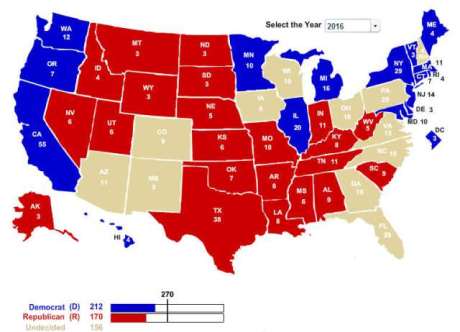
This map shows the probable number of votes each parties candidate would win in the Electoral College if the meeting of the College were held today.  If you live in a red state on the map above you probably do not have to vote for anyone for the office of POTUS but you should vote for a candidate for all  the other offices on the ballot.  – Abyssum

ballancing-act

As long as we haven’t yet managed to find alternative energy sources to cover all our needs we still need to transport oil and natural gas from one place to another.
How we do this is the result of the continuous struggle between the ‘tree huggers’ and the ‘global warming deniers’.
north-dakota-protest1
Without the tree huggers our planet would be a lot dirtier that it already is
shutterstock-133485692jpg-0443e596dea017ff
while without the ‘deniers’ it would offer us a life a lot less comfortable than the one with which we have already been accustomed.
uncomfortable
It’s our job – yes, ‘ours’, the ones whose asses are still comfortably glued to the proverbial fence – to maintain a reasonable equilibrium.
vaideeni_interior

If you are not aware of at least some of the many ‘forces’ which attempt to control your mind, at least in part, you are just as ‘out of your mind’ as those who believe their minds are successfully and consistently controlled by outside agents.

And those who are convinced they are in control of other people’s minds.

Da, craca de sub picioare nu se taie cu fierăstrăul ci cu grație.
Cu multă grație și cu joc de gleznă.

Găsesc azi dimineață pe FB un ‘reportaj’ sui-generis.
Într-un microbuz Satu-Mare – Cluj-Napoca cățiva călători se laudă cu isprăvile lor.

O doamnă ‘respectabilă’ povestește unei cunoștințe cu care nu s-a mai întălnit demult cum și câtă șpagă a dat medicului psihiatru care scos-o (doar?) atât de nebună încât să poată ieși la pensie înainte de termen iar un tânăr plin de ‘energie’ îi relatează unui prieten că era atât de beat când a ‘luat sala’ încât polițistul care îl supraveghea – și care fusese „arvunit” doar să-i șoptească răspunsurile corecte – a fost nevoit să ‘ia problema în mână’ și să apese el însuși  tastele calculatorului. (La ‘traseu’, tânărul nostru nu ar mai fi avut nevoie de ajutor, conducea deja ‘printre sate’ de câțiva anișori, tot cu complicitatea poliției).

OK, și de ce vă plictisesc eu cu toate astea? Fiecare dintre noi știe cel puțin câteva povești echivalente, nimic de aici nu reprezintă vreo noutate… Nici măcar relatarea amănuntului că restul călătorilor, spectatori fără vină ai spovedaniilor ad-hoc, dădeau din cap aprobator/amuzați – sau poate doar plictisiți, aici depindem exclusiv de starea de spirit și de punctul de vedere al ‘raportorului’…

Ei bine, partea interesantă abia acum începe.
Sau, mai bine spus, prima frază cu adevărat semnificativă din articolul respectiv – care, de fapt, nu era ‘reportaj’ ci o filipică masochistă la adresa noastră, a tuturor – este abia antepenultima:

„Poporul ăsta are o minoritate conștientă, educată și preocupată de moralitate și onestitate care reprezintă doar 5, maxim 10% din volumul total al locuitorilor, pe când corpul majoritar al nației este putred, ignorant și captiv exclusiv în primele două etaje ale piramidei lui Maslow, cu rare evadări absolut întâmplătoare la al treilea nivel.”

Ei bine, de mult nu am mai fost în prezența unei atât de intense combinații de semi-doctism agresiv cu un defetism atât de coroziv încât, dacă ar fi fost autentic, ar fi dizolvat demult ‘flaconul’ în care este purtat prin lume.

Dar asta nu e totul.

„Talpa țării e inimaginabil de nespălată și perforată purulent de cuiele ruginite pe care și le bate singură, iar modelul Dragnea, infractorul condamnat definitiv care continuă să își taie felii din ciolanul național, este, din perspectiva majorității, doar un ”băeat dăștept, care se descurcă, fiindcă e bazat, frățioare!” Corupția nu este o problemă națională, decât în măsura în care indivizii de la etajul de jos îi invidiază pe marii bandiți ai poporului și doresc doar să le ia locul și să le preia avantajele abuziv acordate.”

Acuma, că m-am calmat – nici nu știți cât de mult te liniștește efortul de a scrie cu diacritice dacă nu faci chestia asta în mod curent, să o luăm metodic.

„Poporul ăsta are o minoritate conștientă, educată și preocupată de moralitate și onestitate care reprezintă doar 5, maxim 10% din volumul total al locuitorilor”.
Așa o fi, n-am date cu care să contrazic această afirmație. Și, de fapt, nici nu știu vre-un alt popor (de ‘filozofi’) unde să existe o ‘minoritate mai mare de 10%’ care să fie „preocupată” de chestii din astea ‘eterice’. Nota bene, vorbesc aici de oamenii „preocupați” și nu de cei care respectă, în mod normal, în viața de zi cu zi, normele de morală general acceptate de comunitatea din care fac parte.

„… pe când corpul majoritar al nației este putred, ignorant … ”

Hait!
Prima mea reacție a fost să-mi iau valiza și pașaportul și să mă îndrept, în pas vioi, către primul punct de trecere al frontierei – cel de la Aeroportul Internațional Otopeni.
Noroc că am mai avut răbdare să citesc și ultima frază – „În ziua când o să aflați că am plecat definitiv de aici, vă veți aminti poate de acest articol și veți înțelege de ce.” – de unde mi-am dat seama că situația nu e încă chiar atât de ‘groasă’ – dacă nici Doru Șupeală, autorul acestor rânduri nu a plecat încă… pot să termin mai întâi ce am început să scriu…

Și totuși!
Așa putred și ignorant cum e ‘corpul asta majoritar’, am reușit să supraviețuim unor condiții geo-politice nu foarte prielnice și unor tentative destul de bine organizate de a fi furați cu țară cu tot.
Nici macar nu am pus botul la tentativele de a fi învrajbiți unul împotriva celuilalt, pe indiferent ce motive.

S-ar putea ca explicația, și soluția, să fie în altă parte.

Toată lumea, înclusiv ‘ignoranții’ din corpul majoritar, stie ca Mihai Eminescu a fost un poet de geniu. Puțini știu, si din păcate printre ignoranții în domeniu se numără foarte mulți dintre ‘minoritarii’ ce se bat cu cărămida cinstei in piept, că Eminescu a fost și un foarte pătrunzător sociolog. Dincolo de exagerările sale ‘poetice’, teoria lui cu privire la ‘patura superpusă’ și la rolul pe care aceasta îl joacă în cadrul ‘statului organic’ precede cu câteva decenii bune teoria echivalentă a lui Pareto cu privire la circulația elitelor precum și teoria complementară a lui Maslow, cea cu privire la ierarhia nevoilor umane – invocată de altfel și de Doru Șupeală.

Coborând cu picioarele pe pământ, aici unde ‘corpul majoritar, putred, ignorant și „captiv exclusiv în primele două etaje ale piramidei lui Maslow”‘ este nevoit să ‘se descurce’, constatăm că situația este mult mai nuanțată decât ne este prezentată de către manicheiști (masochiști?).

‘Majoritarii cei putrezi’ se revoltă periodic – de fiecare dată când le ajunge cuțitul la os.
Fizic, ca în Decembrie ’89, sau atunci când nu mai pot suporta fariseismul celor aflați, temporar, în ‘fruntea bucatelor’ – așa cum s-a întâmplat după tragedia de la Colectiv.
După care se întorc ‘liniștiți’ la casele lor, punându-și, pentru a câta oară?, speranța în ‘noua patură superpusă’ – ‘poate că de data asta…’

Poate că o fi vorba aici de o oarecare doză de naivitate.
Cu siguranță că este vorba și de o mare doză de oportunism. Prea mulți dintre noi – inclusiv foarte mulți dintre cei ‘5, maxim 10% din volumul total al locuitorilor’ care sunt preocupați de moralitate și onestitate – își calcă pe inimă atunci când se simt la ananghie și copiază comportamentul aberant promovat de prea mulți dintre cei care fac parte din patura super-pusă.

Și uite-așa, cătinel, am reușit să punem degetul pe rană.

„…comportamentul aberant promovat de prea mulți dintre cei care fac parte din patura super-pusă.”

Șpaga, de exemplu, este comportament aberant doar atunci când o dai – sau o iei – ca să te îmbogațești.
Frizerii, profesorii, și chiar doctorii, care nu ar putea să traiască decent fără ‘suplimentele’ care le sunt oferite benevol de către cei care beneficiază de serviciile lor se comportă de-a dreptul normal. Acțiunile lor sunt justificate atât de ‘piramida’ lui Maslow – după cum bine, dar incomplet, arăta Doru Șupeală – precum și de ‘obiceiul pământului’ – norma socială dominantă în societate, normă exemplificată și promovată, de facto, de chiar pătura super-pusă.

‘Păi dacă toți șmecherii ăia de la televizor fac chestii din astea tot timpul, de ce n-aș face și eu?’

Iar ‘șmecherii aia de la televizor’ nu sunt doar ‘clienții’ DNA-ului.

Cei care se duc la biserică știu ca preoții își cumpără parohiile, cei care iau parte, oricât de tangențial, la o campanie electorală știu ca lucrurile nu sunt chiar atât de curate pe cât ar trebui să fie iar oamenii care trăiesc în viața reală știu că și printre cei care predică ‘abstinența premaritală’ mai sunt câte unii care ‘calcă alături’:

“Să ieşim din ipocrizie. Dacă există corupţie, singur statul nu poate fi corupt, are un partener. Statul nu poate fi singur neperformant. Are un partener şi acesta este economia privată”, a susţinut preşedintele Băsescu. El a subliniat că asumarea responsabilităţii trebuie făcută de ambele părţi.

Și atunci?
De ce să dăm vina exclusiv pe ‘corpul majoritar’? Care, în fond, se comportă cât se poate de ‘rațional’. Dau șpagă doar atunci când este absolută nevoie, fură mai ales de la ‘stat’ și în nici un caz tot timpul…. Până la urmă marea majoritate, chiar și cei mai ‘hoți’ dintre noi, respectăm cea mai mare parte a normelor, aproape tot timpul.
Nu prea aduce chiar a ‘putreziciune ignorantă’…

O fi mai ușor să dăm vina pe ‘ceilalți’ – indiferent de cât de mulți or fi ei, cel puțin atâta vreme cât rămân ‘ignoranți cu privire la ce le punem cârcă’ – numai că acțiunea asta are rezultate foarte limitate. Ne simțim noi eliberați de responsabilitate și atât.
Iar cand ‘ignoranții’ vor pricepe ce le-am pus în cârcă s-ar putea ca eforturile noastre să devină contraproductive, dacă nu chiar sinucigașe de-adreptul.

Problemele noastre iși vor găsi rezolvarea abia atunci când vom înțelege întreaga semnificație a proverbului despre ‘peștele care se-mpute de la cap dar se curață de la coadă’.
La pești e simplu. Iei un cuțit și îi cureți. Dacă merită. Sau îi arunci, dacă sunt prea ‘împuțiți’ ca să mai merite efortul.
Când avem de a face cu o întreagă societate, chestia devine mult mai complicată.

Cel care își asumă cuțitul, și care pretinde că vrea să facă curățenie, face parte, și el, din acea societate. Până nu își asumă contribuția lui la starea în care se află întregul organism nu merită încrederea celorlalți.

Câtă vreme va incerca să paseze celorlalți întrega răspundere pentru ce s-a întâmplat până atunci e clar cum are de gând să folosească cuțitul, dacă acesta va ajunge vreo-data pe mâna lui.

Atenție!
Asta nu însemnă că acel cuțit trebuie încredințat primului care își pune cenușă în cap!
Penitența este o condiție necesară dar nici pe departe suficientă.
Pentru asta avem la dispoziție partea a doua a proverbului, cea referitoare la ‘coadă’.
OK, ai greșit, ți-ai recunoscut partea de vină, ți-ai cerut scuze și acum vrei să participi la efortul de curățire a obștii. Foarte bine!

Dar ai făcut mai întăi ordine la tine în batătură?
Ai pus lucrurile la loc, așa cum erau înainte de a fi căzut tu ‘în greșeală’?

stephenhawkinghistory_web_1024

“We spend a great deal of time studying history, which, let’s face it, is mostly the history of stupidity.” (Stephen Hawking speaking at the Cambridge University)

Really?

First of all what we call ‘history’ is not what had happened but a story comprising the subjects some of us had chosen to write about, in the manner they saw fit to do it.

Secondly, until very recently most people had a very vague – and heavily biased – idea about what had happened in their past.
Only in the last two hundred years or so a very small number of people have started to study what had happened in their past in a value neutral manner and, unfortunately, their efforts are still being disparaged by many and ignored by a vast majority.

Coming back to Hawking’s words, I must admit that we, as a species, have done indeed a lot of stupid things.
But, as a whole, the sum of our deeds is far from being negative.

After all… we’re still here, aren’t we?

And, despite the huge amount of misery that is still being experienced by a lot of us, we are doing better than our great parents used to do.

So it is hard for me to agree with Hawking on this subject.

He is right about one thing though.
We are currently doing a very stupid thing indeed.
Our ancestors had the excuse that historical information was very scarce.
This is no longer the case.
While they could have claimed ‘innocence’ when re-enacting an error that had already been committed we no longer have that luxury. We should have known better since it is a lot easier for us to learn than it was for our great-parents.
We really need to stop ignoring the lessons we have at our disposal.

And there’s something else which further complicates the situation.
We have become so powerful that our mistakes can have far worse repercussions than any of our ancestors ever had.

So while I don’t think our history is that full of ‘stupidy’ as Hawking believes it to be I share his concerns about the stupid things we may be making in the future if we don’t wake up and start learning from the stupid enough mistakes we have  already done.

As I said before, we make our own history.
We do the things that will constitute tomorrow’s history and we write the story of things that constitute our past.
Let’s not do, nor write, a ‘stupid’ one.

Unfortunately, sometimes essential meaning is lost not only ‘in translation’ but also during ‘interpretation’.

While reading an excellent article about Zineb el Rhazoui, a Charlie Hebdo survivor, I encountered the notion that “Islamophobia is not an opinion: it is an offense.

Come again?!?

Is it possible that anybody might be offended by someone who’s being afraid? Regardless of that fear being reasonable or not?

Since that notion was said to have been promoted by Collective against Islamophia in France I checked their site, hoping to understand what they mean by that.

“For the CCIF, Islamophobia has a clear definition:
It consists of all acts of rejection, discrimination or violence against institutions or individuals on the basis of their real or perceived belonging to the Muslim faith.”
OK, so they are not offended as much by the fear itself but by the heinous actions some people take against people belonging to the Muslim faith, on the basis of the real or faked fears felt by the perpetrators.
But this is far from being OK.
What these guys are doing is confounding people’s minds.
They keep preaching that ‘Islamophobia is bad’ to people who are very naturally afraid of the actions perpetrated by some wackos who pretend to be Muslim.
This doesn’t make any sense.
It’s like saying that people living in a seismic area should not be afraid of earthquakes. And instead of building their houses in a certain manner they should go to the shrink and treat their unreasonable fears.
If some people who pretend to be Muslim behave in a totally unacceptable manner it is not reasonable to expect that all Muslim will behave in the same way but after so many bad things that have been committed by people pretending to belong to the Muslim faith it would be unreasonable not to try to understand what is going on.
On the other hand those who strongly disagree with the CCIF, Zineb el Rhazoui among others, make the mistake of deepening the confusion instead of calling the bluff for what it is:
“This is very dangerous because it has even entered the dictionary as hostility towards Islam and Muslims. Yet criticism of an idea, of Islam or of a religion cannot be characterized as an offense or a crime. I was born and lived under the Islam of Morocco and live in France and I have the right criticize religion and this dictatorship of Islamophobia that says I have no right to criticize! If we criticize Christianity it doesn’t mean we are Christianophobes or racist towards the ‘Christian race.’”
In real life criticism is one thing while violence – verbal violence, even – and rejection are completely different things.
Confounding these two categories is feeding the very monster who is menacing all of us – militant intollerance.
The article about el Rhazoui also mentions her latest book: “Destroy Islamic Fascism“.
I don’t agree with all the ideas excerpted there but there’s one which should grab the attention of all Muslims who describe themselves as being moderate:
“As for mainstream or moderate Muslim clerics, El Rhazoui tells Women in the World that during the Burkini debate in France not one Imam stood up and said “Hey, wait a minute, you can be Muslim and wear a [regular] bathing suit.””
She also says that ““The Muslim religion has its place in the modern world if it submits itself fully to the laws that rule humanity today: universal principles of equality between men and women, sexual and individual freedom, and equality for all, no matter your creed or religion. Until Islam has admitted this and accepted that the freedom of men and women is superior to it, Islam will not be acceptable.””
I’m afraid there’s a small problem with this.
A religion exists only as long as it has followers and inasmuch as those who belong to it choose to make of it.
It is not ‘Islam’ that has to ‘admit’ anything but the Muslim people themselves.
In this sense it is counterproductive for us, the free thinkers of the world, to peruse the Quran in search of violent episodes and then use them to demonstrate that ‘Islam is not a religion of peace’.
What we need to do, if we want to destroy the Fascism which happens to be of Islamic nature, is to win more and more Muslims to our side.
Making fun of their main Book and of their Prophet won’t achieve that. On the contrary.
On the other hand, giving in to even the most unreasonable things in the name of ‘tolerance’ isn’t helping either.
The Federal Court of Canada ruled in February 2015 that the policy requirement for women to remove their niqabs during their oath swearing at Citizenship Ceremonies is unlawful, as it interferes with a citizenship judge’s duty to allow candidates for citizenship the greatest possible freedom in the religious solemnization or the solemn affirmation of the oath. The Minister of Citizenship and Immigration filed a notice of appeal to challenge this decision at the Federal Court of Appeal and the lower court’s decision is not in effect until the appeal has been decided by the Court.  As a result, women who wish to swear a citizenship oath may not do so with their faces covered.
What kind of oath is that which is pledged by a faceless person?
How strong is that person’s adherence to our value regarding ‘openness and transparency’ and how willing is that person – or her husband/father/mother/sibling who makes her wear a niqab, presumably against her will – to respect and promote our notion of gender equality?
PS I
And how about replacing ‘Islamophobia’ with ‘anti-islamism’?
PS II
Why is it that the spelling checker suggested me that I should write ‘anti-Islamism’ while ‘antisemitism’ is not usually written using a capital s?