Archives for category: religion

Some people are convinced that nothing really changes.
That progress is an empty word.

Others are convinced that progress is everything.

And each category has its ‘extremists’:

Some people are convinced that nothing should be allowed to change.
Others are convinced that all change must be imposed, or at least approved, by them.

And the tug of war between these two categories actually hamper whatever progress happens naturally.

Mind you, both categories shoot themselves in the foot.
Each of them shoots only the ‘specific’ foot but the result is equally crippling… Both end up being iron shackles for the rest of us.

Life, in general, is a matter of calibrating the intercourse between the inside of the organism and the environment in which it tries to survive. Or thrive…

Social life, both in general and in particular, is a matter of calibrating social intercourse between the members of a society in such a manner that, statistically speaking, the individual members would find it easier to survive/thrive in the given physical environment.
Simply because each surviving/thriving individual adds resilience to the social organism/network.

COVID-19 is nothing but yet another test.
For now – for as long a so many of us are still in ‘surviving mode’, it doesn’t matter “how” or “why”.
All that matter is ‘what’.

“What WE do about it!”

Distance ourselves from the others and allow the pandemic to cool down?
Distance ourselves from the others and allow each of our individual minds to think for itself?

While keeping in mind that long term survival requires the physical presence of as many of us as possible? That our own long term well being requires us to cooperate towards that common goal? As Adam Smith taught us?

Then things will eventually cool down.

And we will have been learned yet another thing.

Both individually and as a cultured species.

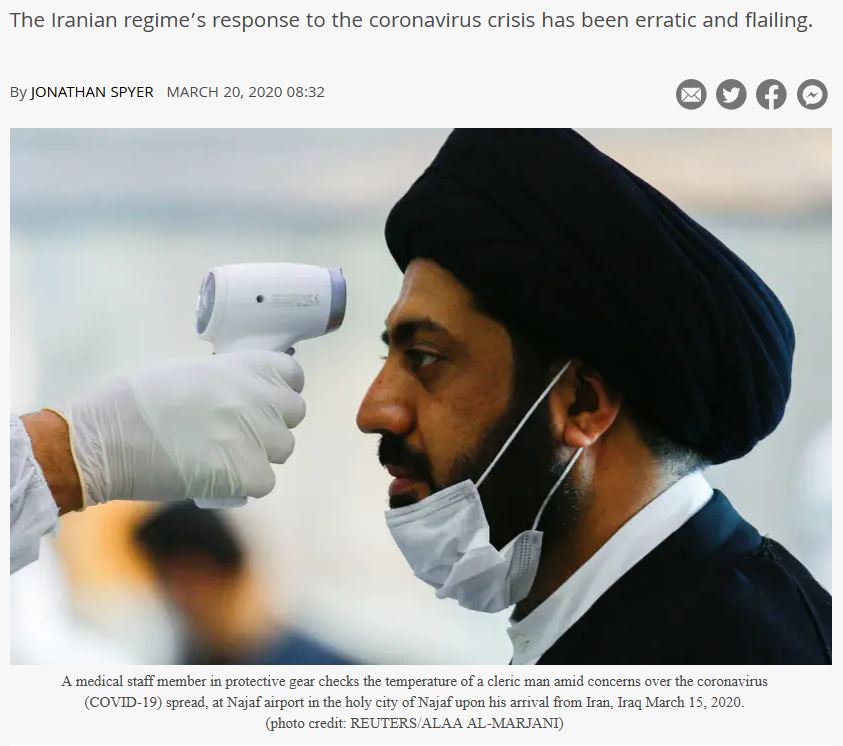
If you live on the Moon, or if enough time had passed since I’ve written this, click on the picture to read Jonathan Spyer’s excellent rendition of the facts which have driven me to post this.

Or you may proceed.

For me, there is a striking resemblance between what’s going on in Iran and what would happen in a hardcore libertarian society.

The mullahs are concerned only with spreading/enforcing their faith and consider everything else will take care of itself.

The extreme libertarians are concerned exclusively with upholding their understanding of liberty and consider that everything else would take care of itself. By itself.

And I’m convinced that everything will indeed take of itself!
After all, life has continued after communism had failed.
The communist leaders had been professedly concerned exclusively with enforcing their understanding of equality. And convinced that everything else would had taken care of itself. If only that equality could have been instated…

Yet I don’t think communism will be missed.
By those who had experienced it hard enough to understand it…

– What have we done, Gabriel?
– Nothing but what we’ve been told to!
– But look at what they’ve done of our work:

We gave them ‘hand’ and they’ve clenched it into a fist.
We taught them how to make tools and they used them as weapons.
We told them to ‘fill the earth and subdue it’ and they started to fight among themselves for the best pieces of land.
We warned them ‘it is easier for a camel to go through the eye of a needle than for a rich man to enter the kingdom of God’ and they’ve somehow convinced themselves that ‘greed is good’.

– True enough but this is out of our hands. They’ve been endowed with ‘freedom of will’ by their Maker.
– Then what are we? Mere robots?
– Nothing but loyal servants of our Master. He orders and we accomplish. Unerringly.
– Exactly as I’ve just told you. Mere robots. When we somehow convince ourselves that a particular idea which has blossomed into our heads comes from Him, we no longer think. We just put it into practice.
You call this ‘loyalty’. That’s fine with me.
But to whom are we to extend said loyalty? To somebody who’s authority stems solely from our acceptance of it? Or to what we perceive as being the ‘greater good’?
– You and your questions, Lucifer… Look at what happened to those poor people after you helped them into self-awareness… They’ve completely lost their erstwhile peace of mind.
What are you trying to do? To make me give up mine?

So young… and yet so satisfied with himself… he must have had a strong set of beliefs on which to build such a strong self-esteem!

Let me put it another way.

Each of us needs to believe.
Something!
Would you have enough courage to go to bed at night if you weren’t absolutely convinced that the sun will come up next morning?
Furthermore, for things to work as we expect them to, enough of us must share a certain number of beliefs. For instance, would you go to work/accept payment if you weren’t more or less convinced that the money you’d get will enable you to fulfill at least some of your wishes?

Hence belief being based on a deep seated need to believe is a truism. Uttered only as a lame excuse for ‘you can’t convince a believer of anything’.

Which isn’t exactly a lie… only a half truth. A ‘fake news’, if you will!

First of all, a believer is already convinced.
Hence somebody had been able to convince him/her, at some point, of something.

Somebody had somehow convinced the aforementioned believer that the object of what was going to become belief was obvious enough to become ‘evidence’.

Complicated?

Let me rephrase.

‘I haven’t been able to convince a believer of what I was trying to convey to him/her. Hence it must be his/her fault.
Not mine!
Otherwise I would have to admit that what I was presenting as evidence was false, I wasn’t presenting my evidence in a believable manner or, lo and behold, both at the same time. Totally unacceptable!
Now I need to come up with a good enough reason for his/her inability to see the light!
His/her ‘need to believe’ must be the only explanation. Otherwise he/she would have accepted my evidence as being obvious….’

On the other hand, the rest of Sagan’s work cannot be dismissed.
Which proves that self-esteem is a good base on which to build a career.

The need to believe being yet another thing which cannot be dismissed!

Elliott Wave is a theory used by ‘technical analysts’ to predict the evolution of the stock market.
It works.
Robert Prechter had expanded the scope of Elliott’s ideas. He uses them to study how our societies work.
https://www.socionomics.net/

Here’s what I make out of all this.

Things, Structure, Mind.
The world, as we experience it, is the consequence of ‘things’ becoming structured enough for ‘mind’ to evolve out of the whole ‘mess’.

Art, Science, Religion.
Knowledge – everything that we know about the world, has started as ideas gleaned by ‘artists’, structured by ‘scientists’ and put together by ‘religious leaders’.

Opportunity, rules, conscience.
Each of us, individual human beings, are the consequences of the opportunities we had been able to identify. Of the manner in which we had put into practice the applicable set of rules. And the kind of conscience each of us has built for themselves.

By putting together these three sides of the evolutive mountain, we notice that ‘knowledge’ (our image about the world) is entirely ‘ours’. And that the world itself is increasingly being shaped by our actions. Actions which are shaped by us, according to our wishes. Wishes which are shaped by what we know about the world.

My point being that while until not so very long ago the world was evolving under its own steam, since we’ve become conscious – aware of our own awareness, in Humberto Maturana’s terms, our influence had grown significantly. Exponentially, in fact.
We’ve changed the geography of our planet. It’s biology, even.

And even though the planet is huge, the opportunities we’ll be able to identify are not infinite. For the very reason that the planet itself is not infinite.

Rather Malthusian, I know, but with a twist. It will be not our numbers which will be our undoing. Only our carelessness. Our infatuation. Our inability to look farther than the ends of our noses.

Isn’t it interesting?

There is a then and there is a now.
We’re OK with ‘then’ and we’re not so comfortable with ‘now’.
Yet the only link between ‘then’ and ‘now’ is us.

Our generation took ‘then’ and brought it ‘now’.

Everything that happened between then and now had happened to us, by us.

https://redeeminggod.com/genesis_3_1-5/

You might have figured out already that I don’t believe yet I find a lot of inspiration in the Bible.

I’d like to discuss today the subject of Eve.
Many people are adamant that she was instrumental in Adam being banished from heaven. That she was conned by the serpent into convincing Adam to commit the first – and most important, sin. Into disobeying God, his Father.
Hence Eve – and all her daughters, are the culprits for us, men, having to ‘toil for our daily food’. Outside of where we have been meant to live, the Paradise…

Really?!?

Then, if Eve was the root of all evil, why had God chosen Virgin Mary – Eve’s granddaughter, as the vessel for his beloved Son? For the instrument of our salvation?

Furthermore, if we treasure virginity – something which only man can spoil, then how come it is Eve – the entire womenfolk, who is considered the origin of sin?

Let’s move forward to the really hard questions.

Eve engaging in conversation with the serpent resulted in both Adam and Eve learning the difference between good and evil. In both Adam and Eve becoming full fledged, self aware human beings.
And what was wrong with that?!?
Becoming conscious was a bad thing? Thinking with our own heads is sinful?

I remember that, as a child, I had always experimented what was verboten. Except for the obvious things, of course.
And used the trick on my own son. Whenever I wanted him to try something, I led him to believe that that thing was dangerous or out of limits. For him, of course.

As the only defendant at the Nuremberg Trials to admit to his share of guilt in the crimes of the Third Reich, Speer had been sentenced to twenty years in Berlin’s Spandau jail. He was released in 1966. Some ten years later, the Canadian high school in Lahr, West Germany, which looked after the education of our children, invited Speer to speak to the student body. I was invited to the dinner that concluded the evening. I found it more than a little humorous when Speer was asked bya very confident grade eleven student: “Mr Speer, how could a group of talented people like yourself be convinced to follow a madman like Hitler?”
Speer was quiet for a few seconds, giving the impression he had never been asked the question before. Then he responded, “young lady, probably because we were all trained as engineers!. We were pragmatic to the extreme, and we thought every problem could be solved by an equation or by adjusting the numbers. Not one of us had any education in the humanities – even Hitler fancied himself an architect, in spite of his lack of formal training.

Louis MacKenzie, Soldiers Made Me Look Good.

Well, there’s a small problem here.
While I agree with Speer about the importance of ‘humanities’ I also must notice that Marx had been another example of an individual convinced that the world can be ‘tweaked’ by following a ‘blue print’. He used the term ‘ideology’ instead but… And we cannot say that Marx was stranger to ‘humanities’.

But there’s another observation made by Speer. “We were pragmatic to the extreme”. While their ‘deficient’ education might have made Hitler’s job easier, I’m afraid it was their ‘nearsightedness’ which had been the catalyst.

It was their obsession with their immediate goal – transform the reality according to their own wishes, which had made them blind towards the future consequences of their actions.

It was not ‘humanities’ they lacked but ‘religion’.

“Thou shalt not make unto thee any graven image” is not really about what you pray to as about what you convince yourself about. That the ‘image’ you have developed about your surrounding reality is good enough to be ‘graven’. For ‘future reference’ and for it to be imposed upon others. By force if necessary.

Because of their very nature, centralized systems open up vast areas of opportunity.
For those who bother to identify them, of course.

The internet.
Huge amounts of information only a few clicks away.
Students find it easier to compile their term papers. Or to just click and paste them.
Powerful individuals/organizations have found yet another way to further their interests:

A long-running Papuan separatist movement has flared in recent months, sparking fresh calls for self-rule.
But with access to the region heavily restricted, social media has become a key source for the foreign press.
One expert told the BBC the apparently co-ordinated campaigns were seeking to skew international views of Papua.


The government.
A mechanism put in place by nations to manage the day to day survival of the social mechanism.
The more centralized, the more efficient. At least apparently…
Centralized China is decades away from the more ‘lax’ India. According to certain benchmarks, of course…

Corporations.
Individuals, no matter how smart and or powerful, can achieve only so much when acting alone. That being the reason for people coalescing in nations.
Also for economic ventures. People working in concert are more efficient than individuals toiling on their own. When led by a somebody who is simultaneously smart, charismatic and ‘organizationally skilled’ the results can be utterly fantastic.
A corporation might even become powerful enough to resist government.

The FBI Wanted a Backdoor to the iPhone. Tim Cook Said No.

Only some governments are more determined than others.

Apple drops Hong Kong police-tracking app used by protesters.

How else to explain what’s going on but by remembering that all centralized systems are simultaneously manned and surrounded/watched/accessed by individual people?
Who identify the various opportunities presented by the increasingly centralized structures which bloom around us.
Who use them to further their goals, whichever those might be. Who choose which goals are worth pursuing and which are better abandoned.
Who determine, individually, what decision must be made in each situation.
Who use whatever the power they have at their disposal in such or such manner.
Who allow others to use them in a centralized manner. Or not….

Explainer: How Trump used the U.S. government to chase conspiracy theories

NB. The last example I used can be substituted by countless others. Trump just happens to be ‘on top’ the still most powerful, and looked up to, government on Earth. Furthermore, he had been democratically elected into that position. Hence his actions – and his government’s reactions, illustrate perfectly the situation we find ourselves in.