Archives for category: politics

050c31042a04e93467298c7458c219af4cbcc6-wm

For some time now I’ve been wondering how come so many people who define themselves as being Christians – “Again I tell you, it is easier for a camel to go through the eye of a needle than for a rich person to enter the kingdom of God.“, Matt 19:24 – are so passionately defending the very concept of (private)”property”.

Could it be that Marx was right after all: “Private property is the result of alienated labor.” ?!? And so many of us have been wrong for so long?

“The right to private property is the social-political principle that adult human beings may not be prohibited or prevented by anyone from acquiring, holding and trading (with willing parties) valued items not already owned by others. Such a right is, thus, unalienable and, if in fact justified, is supposed to enjoy respect and legal protection in a just human community.”

Trying to understand the source of this dichotomy I adopted a two pronged strategy. First I looked up the word itself and then I tried to deepen my understanding of the entire concept.

It’s absolutely obvious that ‘property’ comes from ‘proper’.
‘Proper’, in its turn, has two basic meanings: ‘fit for use‘ and ‘pertaining to one individual‘. The first one has evolved into ‘propriety’, “the state or quality of being correct and proper” while the second has become ‘property’, “thing owned“.

So, do all these etymological arguments make it any easier for us to accept that respecting each others’ right to private property is what introduced a certain degree of functionality in the human society?

‘But aren’t you contradicting yourself?
At the beginning of your post you suggested that ‘property’ might not be as good as advertised and now you say that the ‘right to private property’ is ‘good for you’?
Will you make up your mind, for Christ’s sake?’

Now, that I’ve reached the conceptual stage of my analyses, I must bring to your attention the fact that a right is nothing but an opportunity while each (piece of) property is a thing – even those  which are not of a ‘substantial’ nature. ‘Intellectual property’, for instance, is a ‘measurable thing’ even if you cannot put your finger on it while the ‘right to intellectual (or any other kind of) property’ is (an infinite) something which patiently waits for (a rightful) somebody to make (proper) use of it.

Maybe this is what Christ tried to tell us in the first place. That it’s not property itself that stands between us and our salvation but our (improper) attitude towards it. That it’s not the object of our property that is the problem but how we make use of our right to private property.
After all Christ told the “young rich man” “If you would be perfect, go, sell what you possess and give to the poor, and you will have treasure in heaven; and come, follow me.” (Matt 19:21). ‘Go sell, give and THEN follow me’, not ‘come help me ABOLISH the very right to private property’, as Marx used to preach to his followers.

To understand the difference between what Christ and Marx said about this subject let’s see how these two relate to the notion of ‘Man’.

In Christ’s book God took a lump of dirt and ‘made Man in His own image’ while in Marx’s narrow materialistic vision “it is not the consciousness of men that determines their existence, but, on the contrary, their social existence that determines their consciousness.”

Basically both of them start with the same ‘materiel’ – the mundane ‘star dust’ that Mendeleev distributed throughout his table – but what a difference at the end of the ‘assembly line’!
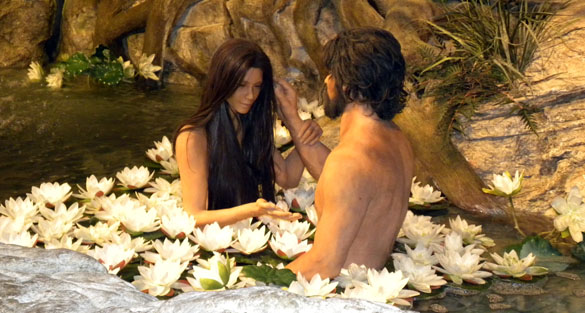
adamevebefore

Being made ‘in His Own image’ not only means that all Men (and Women) are created equal but also that each of them shares in His Divine Nature. Hence the origin of our free will, of our ability (‘right’, opportunity) to be saved. Compare this to how Marx described the human society:
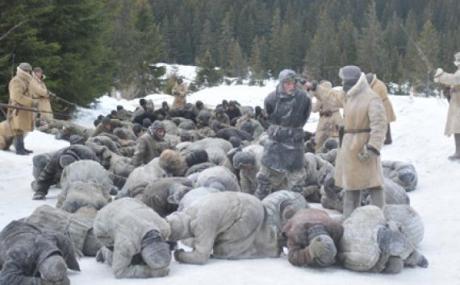
“The Communists, therefore, are on the one hand, practically, the most advanced and resolute section of the working-class parties of every country, that section which pushes forward all others; on the other hand, theoretically, they have over the great mass of the proletariat the advantage of clearly understanding the line of march, the conditions, and the ultimate general results of the proletarian movement.

The immediate aim of the Communists is the same as that of all other proletarian parties: formation of the proletariat into a class, overthrow of the bourgeois supremacy, conquest of political power by the proletariat.

The theoretical conclusions of the Communists are in no way based on ideas or principles that have been invented, or discovered, by this or that would-be universal reformer.

They merely express, in general terms, actual relations springing from an existing class struggle, from a historical movement going on under our very eyes. The abolition of existing property relations is not at all a distinctive feature of communism.”

articlefiles-mv003370610000-96750_bd

As somebody who has lived for 30 years under communist rule let me translate this from ‘Newspeak‘ into plain English:
‘History suggests that those who figure out the inner workings of this world  have, from time to time, the opportunity to take over the show. Now is one of those moments. The ‘fat cats’ have been so greedy lately that the regular people are growling under the very heavy yoke that has been placed on their shoulders.  That’s why we have the opportunity to unsettle the ‘old’ from their positions and to plant our fat asses in their comfortable chairs.
And the first thing we must do in order to achieve that goal is to abolish the right to private property. People are so fed up with what was going on lately that they’ll go along. They have grown to hate so much the ‘greedy plutocrats’ that most of them won’t notice that in the (revolutionary) process they’ll lose the very last shrouds of personal autonomy they still have. Without the right to dispose of the results of their own labor they’ll be at our mercy’.

Who was right between the two?

Well… Both, unfortunately.

The communists did run the show, at least for a while. And we all know to which results.
On the other hand it seems that in the longer run miss-using the right to private property is indeed a powerful drawback. The already too long sequence of economic crises caused, ultimately, by nothing else but our own greed has indeed given birth to a generalized state of psychological malaise.

I don’t know about what’s gonna happen in the next world – or if it exists at all – but I’m sure that if we don’t learn, fast, how to use, properly, the right to private property things will become too hot for our own good in this one.

The only one we are sure about.

Further reading.
During my research for this post I found this very interesting take on the same subject:

“Zwolinksi argues that libertarians are right to support private property, but also that private property is more complicated than we sometimes think.”

unless fully prepared to deal with all the consequences of getting that something.

putin-on-bear-obama-in-tutu

dkyyy1lzegpux28x_o_eminem-be-careful-what-you-wish-for-cover-by-cruthe

Click here and read all the lyrics. Carefully. Twice!


ltcm

As a teenager I’ve been reading a lot of detective novels. It was then that I learned the phrase that gives the title of this post.

“In fact, the phrase, which is occasionally used in its loose English translation ‘look for the woman’, expresses the idea that the source of any given problem involving a man is liable to be a woman. That isn’t to say that the woman herself was necessarily the direct cause of the problem, as in Shakespeare’s Macbeth for instance, but that a man has behaved stupidly or out of character in order to impress a woman or gain her favour.”

It seems that nowadays people have given up chasing women and started to ‘follow the money’ trek.

Russia says Turkey ‘shot down plane for IS oil’.

The secret bribes of big tobacco.

Coruption in sport: Nebiolo named in ISL bribes scandal.

FIFA: A timeline of corruption.

Volkswagen: The scandal explained.

Cash, visas and talks: key points of EU-Turkey pact on refugees.

Some people might say that corruption has reached an unacceptable level.
Right and wrong. Right in the sense that corruption has indeed reached an unacceptable level and wrong in the sense that NO amount of corruption is ever acceptable, but this is beyond the point of this post.

To some other people the recent developments might suggest that there is no way out of the current situation, where corruption “is no longer a practice but has become a pervasive culture”.

On the contrary. The fact that more and more corruption cases are continuously brought to the surface is not, in any way, a proof that corruption has reached new ‘heights’ but a powerful suggestion that more and more people have become fed up with this phenomenon and no longer disposed to turn a blind eye to what is happening in their presence.

enron

lashes1-copy-300x210
If we want to understand what’s going on there we have realize that we are dealing with a absolute dictatorship which uses Islam as a crutch, exactly as the soviet style dictators in the so called ‘popular democracies’ were using ‘scientific materialism’ – their term for the communist doctrine.
The job of the Saudi ‘justices’ is to maintain ‘the order’ as they see fit – the kingdom as it is and the Saudi family in power, not at all to dispense justice as we know it.
In order to do that they use, ‘creativelly’, the most powerfull tool they have at their disposal: the faith shared by the majority of the inhabitants of the kindom.
It even doesn’t matter for them that in the process they are ruining any chance of a decent life for the majority of their conationals.
At first their only goal was to retain the graces of the ruling family – just as minions everywhere behave in the presence of a powerfull figure.
In time things have evolved in a malignant manner. I’m afraid that nowadays the House of Saud itself has become the prisoner of the erstwhile minions, just as every dictator eventually becomes the prisoner of his guards.

“The best laid schemes o’ mice an’ men / Gang aft agley”
(The best laid schemes of mice and men / Often go awry.)
Burns, To a Mouse.

Robert Burns destroyed the burrow of a mouse while plowing his piece of land and, feeling sorry for the misery he had brought to the animal, asked for forgiveness by writing a poem.

How many of those who wheel and deal in this world have ever apologised in earnest after making a mistake?

Then how come we, those who bear the brunt of their mistakes, still look up to them? As if they were Gods?

I happened to stumble upon this image on somebody’s FB wall.
gore2bvidal

And then it hit me.

Waging war is simple.
Even winning one is relatively simple if one has enough resources.
Winning the peace afterwards is the real challenge.
America did very good jobs at winning the peace after WWII and the Korean War but very poor ones afterwards.
Here’s Gore Vidal elaborating on the subject:
gore vidal

Somebody shared a picture on FB and I finally understood the strange relationship between the American People and their Government.

“One of the things taken out of the curriculum was civics,” Zappa went on to explain. “Civics was a class that used to be required before you could graduate from high school. You were taught what was in the U.S. Constitution. And after all the student rebellions in the Sixties, civics was banished from the student curriculum and was replaced by something called social studies. Here we live in a country that has a fabulous constitution and all these guarantees, a contract between the citizens and the government – nobody knows what’s in it…And so, if you don’t know what your rights are, how can you stand up for them? And furthermore, if you don’t know what’s in the document, how can you care if someone is shredding it?”

The quote belongs to, obviously, Frank Zappa. I found it in an article written by Kevin Courrier and published in CriticsAtLarge.com.

What grabbed my attention was not the fact that a musician is so passionate about politics but the huge confusion that sits at the bottom of his political weltanschauung.
The American Constitution, any constitution for that matter, is not at all a contract between the government and the people but a contract that binds together the citizens that inhabit a country. The government, any government, is ulterior to the signing of that contract so it cannot be a part of that contract.

OK, I can understand how that confusion came to be only I cannot understand how it could survive for so long.
For more than two centuries, that is.
As we all know the US were, at first, British colonies. For the last nine centuries or so Britain was run more or less according to Magna Charta – which is indeed a sort of contract between the Monarchy and the British people. But that is valid for Britain. It is the Great Britain that traces its ‘essence’ back to the idea of a divinely sanctioned Monarch who owned, entirelly, the whole country and who autocratically ruled over all the aspects of its life. And that at a certain point in history the Monarch agreed to sign a contract with his subjects, promising to treat them fairly.

But at an ulterior point in the history of the British Empire the American people had decided that they didn’t want anymore to be subjected to any worldly authority so they had sent the British Governor packing. From there on the essence of the American state was no longer the persona of the Monarch but ‘We, the People’.

That’s why the American Government is, by right, nothing more than an employee of the American People while the British one is a servant – or an employee – of the Monarch.

Let me put it a little differently. America is like a huge corporation while the citizens are its shareholders. The people own the country and the Government who runs it is the Board of Trustees. The people are the employers and the members of the government are the employees.
In Britain the Monarch is the ‘owner’, the people are ‘tenants’ and the government is the administrator of the whole business. The government is employed by the owner and payed by the tenants – who have a say because they are paying the rent, otherwise known as ‘taxes’.

Then how come, two hundred years after the Constitution that settles the conditions of ‘incorporation’ was adopted so many Americans still see the Government as being different from the ‘people’? Could it be that Zappa is right? That too few people have understood that “this nation, under God, shall have a new birth of freedom—and that government of the people, by the people, for the people, shall not perish from the earth.”?

I know, I know… These words are not from the American Constitution – they are widely attributed to Lincoln. But they describe perfectly its spirit, even if some people accuse Lincoln for being a dictator – because he didn’t allow the South to seccede, as if this decision was his to make… You see, the confusion is deep indeed. When people are passionate about something they tend to pick up from the entire picture only the pixels that fit their view of the world…

We the People of the United States, in Order to form a more perfect Union, establish Justice, insure domestic Tranquility, provide for the common defense, promote the general Welfare, and secure the Blessings of Liberty to ourselves and our Posterity, do ordain and establish this Constitution for the United States of America.”

Then why so many of the ‘we the people’ still believe that the constitution is a contract between them and their Government?
Or maybe Zappa was (half) right after-all? Civics should indeed be brought back …

PS
Coming back to ‘Government of the people, by the people, for the people’ some people attribute these words to John Wycliffe and still others to Thomas Cooper.

Basically, “anarchy” is about everybody for himself. And damn everybody else – even though most forget about this part.

While “secession” is mostly about someone trying to carve a ‘piece of the action’ for himself – and some people (naively?) following him. Maybe hoping that the new ruler would prove to be better than the old one?

The current spate of dissent on this subject has been spurred by this guy, Angus Deaton, being presented with The Sveriges Riksbank Prize in Economic Sciences in Memory of Alfred Nobel

“A Nobel prize in economics implies that the human world operates much like the physical world: that it can be described and understood in neutral terms, and that it lends itself to modelling, like chemical reactions or the movement of the stars. It creates the impression that economists are not in the business of constructing inherently imperfect theories, but of discovering timeless truths.”

I’m afraid that the author had been so disgusted by the obvious mistakes that have been committed by so many of the supposedly reputable economists of this world that he has become amenable to throwing out the baby along with the bath water.

First of all we must remember that “Science is wrong. By definition.” All theories are imperfect and there is no such thing as ‘timeless truths’.
Ever since Karl Popper introduced the idea of ‘falsifiability’ as the litmus test for determining if any piece of information has any scientific value and Berger & Luckmann noticed “The Social Construction of Reality” it had become apparent both that science is being updated constantly – hence always ‘wrong’, or at least incomplete – and that people are ‘doing science’ on purpose – hence any discussion about reality being ‘described and understood in neutral terms’ is unrealistic, to say the least.

Coming back to Popper, Hermann Bondi had declared that ‘There is no more to science than its method, and there is no more to its method than Popper has said.’
True enough but as any ‘scientific declaration’ this is highly ‘updatable’.

In fact Science is, above all, a human enterprise. It’s a human that picks up – or devises – which method to use in a certain situation when he wants to find out something about a certain subject. Furthermore that method is applied by human individuals, not by robots. The same as those who had chosen it or by others, doesn’t make much difference. And, at the end of the cycle, some other people will evaluate – and sometimes try to replicate – the results.

So the mere fact that a certain set of results could not have been replicated by a certain team of evaluators doesn’t mean that much, by itself. This has been silently acknowledged by Andrew C. Chang and Philip Li in a paper published by the Federal Reserve in 2015: “Is Economics Research Replicable? Sixty Published Papers from Thirteen Journals Say ”Usually Not””. The couple admitted they needed some help from the original authors to replicate the results in a few instances and in some-others they didn’t have access to the same computer software as the first publishers.

But the most interesting fact is that in no instance the authors have been able to positively determine that the results published in any of the analyzed papers are inconsistent with the data presented by the original authors and/with the method invoked. In all instances when they failed to replicate the original results that happened because the original authors didn’t present at all the initial sets of data, they were incomplete or the method/sofware used to  process that data was incomplete, altogether missing or proprietary. And all this despite in some cases the papers being published by journals specifically requesting that all data/methods/software being made available at the moment of publication.

In this situation I find the conclusion reached as being both correct and highly objectionable. And above all lacking any scientific value.
“Because we successfully replicate less than half of the papers in our sample even with assistance from the authors, we conclude that economics research is usually not replicable.”

Yes, it seems that too many papers published by presumably reputable journals are not replicable. But that is due exclusively to the journals themselves not observing their own rules or by some of the authors acting less than ‘over the table’. This phenomenon has nothing to do with ‘economics’ being less of a science than, say, physics and everything to do with humans being… well… human!

Let me go back to where I started, to Joris Luyendijk claim that “Don’t let the Nobel prize fool you. Economics is not a science.”
The author ‘illustrates’ his claim by remembering the infamous LTCM – a hedge fund set up by, among others, a couple of economists who had received a … you guessed it… a ‘Nobel prize for economics’ less than a year before the hedge fund went bust. Kind of ironic, isn’t it?
But the problem remains. The fact that LTCM went bust doesn’t prove anything except the fact that its management was completely inadequate.
The point is that trying to assert that ‘economics’ is not a science only because some guys used a couple of economic theories and failed, abysmally, is akin to claiming that physics is not a proper science because no weather bulletin is 100 percent accurate. Or that biology is not a full blown science because medicine has not yet found a cure for cancer. Or to claim that chemistry is bogus simply because Big Pharma is ripping us off.

At the end of their paper Chang and Li offer some very pertinent advice about how things could be vastly improved. Their main idea being that everything must be ‘above the table’ – both the raw data and the method/software used to process it must be made available for whomever wants to replicate the results. In fact this exactly what science, real science, is about. People have to be able to check thoroughly whatever the proponents of a theory are trying to ‘peddle’. This is the only way for a theory to be proved true or false. Or incomplete so further research might be declared necessary.

Similarly, at the end of his article Joris Luyendijk points his finger at the real culprit.
In reality economics, as a space where people try to gather information, is different from, say physics, only because we, the people, approach them with different attitudes.
Time has taught us, repeatedly, that every-time we’ve tried to deny the obvious we ended up with a bloody nose. The problem is that not all of us are, yet, able to recognize the obvious.
No one in his right mind will pretend, nowadays, that the Earth is flat. Meanwhile some people still pretend that vaccines may induce autism. They don’t. But some of the ‘anti-Vaxxers’ continue to pretend this even after a study partly funded by themselves demonstrated that there is no link between the two.

As suggested by Luyendijk and demonstrated by these examples the real culprit for what is going on, not only in the economic field, is our arrogance.
Arrogance that has led to the survival of what is known as ‘tehnocratic thinking’ despite more and more people learning of the role ideology plays in our decision making.

After all what can be more arrogant than pretending that you have ‘scientific reasons’ for what you do, despite the obvious fact that every one of us acts according to his own ideology?

I’m not going to pretend now that there are good and bad ideologies. I obviously think they can be classified but I cannot pretend that my classification is the correct one.
But I can pretend, and you should too, along with Joris Luyendijk, Andrew C Chang and Philip Li, that each of us should honestly state its point of view along with his opinion when ever discussing something.

After all each of us having an ideology is a reality while pretending that any of us can act as if it doesn’t is a rather pathetic lie.

To conclude I’ll have to keep the promise I’ve made at the beginning of all this and ‘update’ Bondi’s statement about Popper:
‘There is no more to science than its method and there is no more to its method than Popper has said’ but we should always bear in mind that science is exclusively ‘performed’ by human individuals.


Somebody on FB has captioned this image as ‘socialism for dummies’.

I’m afraid he hasn’t got a clue about what real world socialism is truly about.

What we see here is pure and unadulterated stupidity.
We could have been speaking of socialism if the guy wielding the saw would have taken command of the situation, climbed up the ladder, took it up with him and left the other two jerks looking up at him and wondering what had happened to them.

That would have been a bona fide socialist exploit!