The malicious has made an option. Had chosen. Willingly! And, supposedly – according to the hypothesis being discussed here, knowingly.
The ‘stupid’ just stays put. Until the relevant information penetrates his ‘thick skull’. It’s not his fault that those who attempt to convince him are not skillful enough.
And if the ‘stupid’ happens to be in a ‘powerful’ position… (hence his inability to understand fast enough is liable to produce considerable damage) who needs to be chastised?
The ‘stupid’ himself? Who presumably ‘doesn’t have a clue’ about what’s going on? The malicious who had made the whole situation possible? The ‘lazy bystandards’? Who had allowed this to happen? Out of carelessness?
Or those who are liable to suffer the consequences? Who had understood what was going on but…
On the other hand… Could Dietrich Bonhoefer – a renowned pastor and theologian, utter such ‘simplistic’ words? So callous?
I’m not exactly old. Only old enough to continue to check my email. From time to time…
For reasons outside my knowledge, this morning I’d found – in the ‘promotions’ section’ a link to a ‘common sense with Bari Weiss’ article. The title was apealing, the name rang a bell – even though I had no idea about who the person was, so I read it.
My reaction was intense enough to start writing. Not before looking her up…
The point being that she is basically right. Enabling is a powerful phenomenon. But she is also basically wrong.
Powerfull it might be, only enabling is not necessarily malignant. As she implies.
Enabling is done by people with means. Powerfull and or resourcefull enough for their actions to be effective. What the enablers choose to enable… is something else.
And the consequences of enabling depend on the enablers’ choices!
Things might come up right. Or wrong.
The kind of enabling curently predominant in America has been detrimental to the society at large. Leading to the enablers becoming irrelevant. Just as Weiss advertised. Trump has been supplanted by those who had occupied the Capitol – after being enabled by him, while on the other side of the political divide things aren’t going any better. Cultural cancellation isn’t going to end up well.
But enabling can lead to different outcomes. Depending, of course, on what is being enabled.
Take Germany, for instance. Yes, nobody knows who its President is. Only the country, as a whole, functions far better than many of those whose Presidents are on everybody’s lips. Simply because the German enablers had chosen to enable the ‘right’ kind of behaviors.
“First day of class. The law school teacher entered the room and asked a student sitting in the first row: ‘What’s your name?’ ‘Nelson.’ ‘Get out of my class and never come back!’ Everyone was scared and outraged but no one dared to speak up. ‘Very well!’ said the professor after Nelson had left. ‘Let’s start!’ ‘What do we have laws for?’ The students were scared but they tentatively answered the questions. ‘So that order may be maintained?’ ‘No!’ ‘For us to fulfill?’ ‘No!’ ‘So that trespassers might be punished?’ ‘No!’ ‘For justice to be made?’ ‘Finally! And what is justice?’ The students were already pissed off but they continued. ‘When human rights are upheld?’ ‘Not bad. Elaborate!’ ‘To differentiate good from bad?’ ‘Then was I right to throw Nelson out?’ Silence. ‘I want an answer!’ ‘No…’ ‘You might say and injustice had been committed?’ ‘Yes…’ ‘Then why nobody did anything about it?’ ‘What do we want laws for if we don’t have the will to uphold them? Each and everyone of you needs to speak up whenever you witness injustice being done! All of you! Always!’ ‘Go bring Nelson back! After all, he’s the real teacher. I’m nothing but a student here!’ ‘We should all learn that whenever we don’t defend our rights, our dignity vanishes.’ ‘That dignity is not negotiable’!” I’ve just read this on somebody’s FB wall. And a couple of comments. “‘But why did you have to throw Nelson out?!? Couldn’t you have simply explained your point? Lousy teacher… you just enjoyed playing God!’ ‘There is a small difference between explaining ‘something’ to somebody and making the same somebody actually feel that ‘something’. The same difference which exists between a lump of clay and the same lump of clay after God had breathed soul into it’.“
There’s an entire literature discussing which animals – besides us, humans, are able to use tools. Most authors also make a clear distinction between the animals which just pick an object and transform it into a tool by using it as such and the animals which actually transform the future tool according to the intended use.
The difference between using a twig ‘as it was found’ and sharpening it first with the teeth.
This morning, watching some birds while having my breakfast, I just realized that the vast majority of them are superb tool makers. Them birds, I mean. Not just the heavily publicized Caledonian Crows….
I repeat. Most of them. Most of them are superb tool makers.
Most birds are nest builders. In fact, they not only build houses, of sorts. They are building uteri. Or uteruses, if you prefer this spelling. Places where eggs are laid and cared for.
This book represents Djuvara’s thesis for his 1974 Doctorat d’Etat.
There are two main ideas which are to be pointed out here. A first one hidden under the distinction he identifies between ‘culture’ and ‘civilization’. The second being the bread and butter of his thesis. That civilizations are initiated in one place, diffused/exported for a while and then replaced – or led further, depending on how one chooses to interpret the facts, by people until then living somewhere on the fringes of the civilization they are replacing/refurbishing.
Nothing really new, right? ‘Cyclical History’ wasn’t invented yesterday. And certainly not by Neagu Djuvara.
Well, Djuvara’s ideas – like everybody else’s, are nothing but ‘overgrowth’. Things which sprung in people’s minds ‘on top’ of what those people had already learned. Found out. Or, of course, both.
In a sense, what I’ve said in the previous sentence is the very condensed abstract of Djuvara’s second ‘main idea’. The first, the ‘hidden’ one, – again, in an extremely abridged version, being that ‘history, as a narrative, is nothing more and nothing less than what historians choose to make of the facts they had learned about’.
Too blunt? Well, first and foremost, I’m an engineer. Not a fancy pen-pusher…
OK. Let’s go further. I’m going to illustrate, briefly, Djuvara’s main thesis by presenting his version of what had happened in Europe. What had started as an European phenomenon, more precisely.
The Roman civilization had grown at the periphery of the Ancient Greece. And, eventually, took over more ‘space’ than the Ancient Greeks. The Russian civilization had grown at the periphery of the Byzantine/Orthodox one and eventually took over. Or, at least, attempted to… The Holy Roman Empire of German Nation ‘recycled’ – or, at least, attempted to, the ‘ancient’ values and traditions. Great Britain had grown at the periphery of Europe until it took over the whole world. At least for a while… The US, which had started as a British colony, had grown into the most powerful nation known to man.
‘OK, I understand what you meant by trailers and trailblazers. Some of those who trail might end up trailblazing. Do you want to add anything? Is there an actual point to your post?’
Yep. As they say about the market, ‘past performance is no guarantee about the future’. The fact that things have happened as they did is no guarantee that they’ll keep unfolding in the same manner.
In a sense, Fukuyama was right, after all… Even if not in the sense he thought it!
According to “The end of history” people – all over the World, had realized the relative merits of ‘liberal democracy’ and ‘capitalism’. Which were going to be put in practice, effectively marking ‘the end of history’. Thirty years past that moment, it seems that things aren’t going in that direction.
I’m I contradicting myself? Who’s right, after all? Djuvara? Since history doesn’t seem to have stopped? Or Fukuyama, but for some other reason? Than the one advertised by him?
‘History, as a narrative, is nothing more and nothing less than what historians choose to make of the facts they had learned about’
Then, if history is ‘man made’, what about the future?
Can we really make it? Predict it?
‘Make it’, for sure! If not us, then who?!?
‘Predict it’… that’s something totally different!
There are signs, though.
First of all, Djuvara had described something which can be compared with fire burning in a savannah. It starts in one place, burns for a while… and then starts up some place else. Until now, no fire – no fire known to man, had burned any savannah so thoroughly that nothing was left for a ‘second’ fire.
Secondly, Fukuyama said that history will end when all humankind will sync. When all ‘civilizations’ will be run according to the same paradigm. According to the liberal democratic and capitalist paradigm, in Fukuyama’s vision. We’re still far from that. Only there is one paradigm which is willing to play that role! To fill those shoes…
The ‘greed is good’ paradigm! Or, if you don’t like to think in ‘monetary’ terms, the ‘my version is the only right one’ paradigm.
The problem being that these two work in concert. They are two facets of something called ‘intellectual arrogance’.
I’ll come back to this notion sometime in the future. Now I’ll end up telling that there’s not much left of the ‘savannah’.
When things were unfolding as Djuvara described them, the planet itself was more or less ‘virgin’. Unexploited. Unoccupied. Human culture used to be diverse. Ideas were developing. Traded. From one place to the other. From one culture to the other.
Nowadays, much of the planet – our home, is occupied by the, more or less, same civilization. And by an increasingly similar culture.
Nothing inherently good nor bad here, mind you!
If we still have no definitive history, then the future hasn’t been written yet. It’s up to us to choose the right trail. For no other reason than the fact that there are very few trails left for us to burn!
Attempting to value individualism over collectivism is similar to trying to establish which came first, the chicken or the egg.
Having experienced both – collectivism and individualism put in practice as political principles, I have noticed that neither extreme is capable of working in a sustainable manner.
Communist regimes had fallen one after another. Fascist regimes did the very same thing. Pirate republics could never resist for long.
Coming back to what is happening in the US, I’m afraid very few people are aware of how much collective thinking had been embedded in the American Psyche. The good kind of collective thinking… Americans go to church. A place where you go to to be together, not alone. Americans used to help each-other. Charity used to be a big thing. Slowly, it had become a dirty word. And so on.
Individuals can not exist on their own. They need each other to survive. And to thrive. Collectives can not last for long unless the individuals who constitute them do respect each-other. Help each-other maintain and develop their individuality.
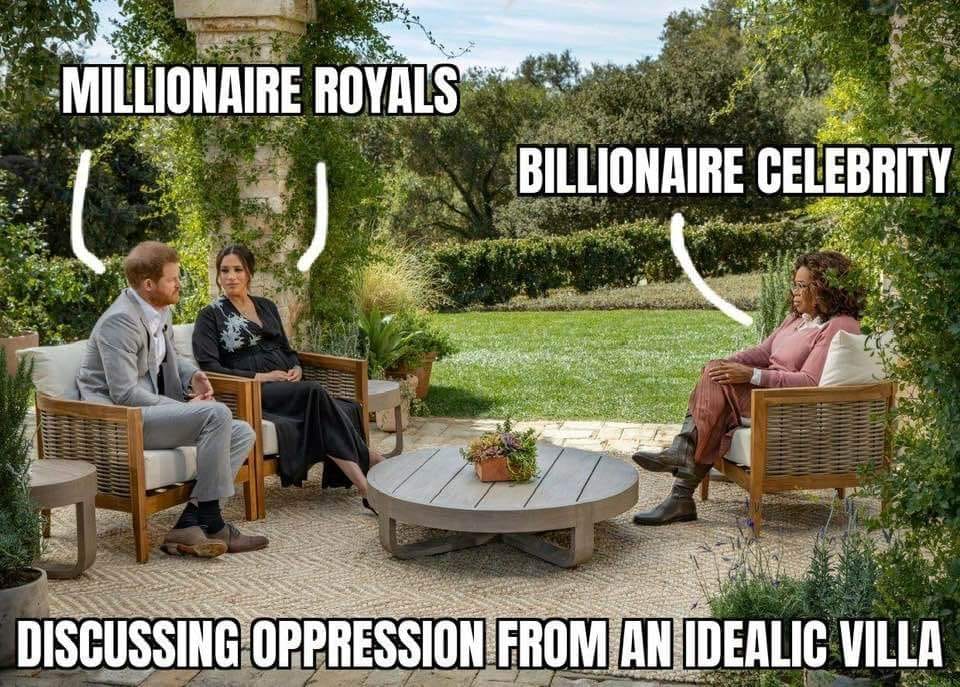
Meghan and Harry had a chat with Oprah. Which had eventually been broadcasted on TV. Basically, there was nothing new nor really interesting there. For me, anyway. Yet there’s a lot of reaction.
I don’t really care about the reason for which the royals have treated Markle the way they did. About the reason which convinced the couple to speak up. The individual reasons for those who comment on the internet to do it as each of them had chosen to do it.
There are two points I need to make here.
The fact that they are rich and famous doesn’t change the fact that the oppression they’re speaking about is real….Maybe they experience it differently… maybe they have it easier when speaking about it… but opression continues to be dealt. Among us, by people like us.
And, secondly but just as important, those three weren’t discussing about mere oppression. They were talking about racist oppression!
Could this be the reason for so many people taking issues on this subject?
I fully agree with Sowell but the fact that Sowell is right doesn’t change the fact that we’re the ones responsible for present day racism.
Imagine having a festering boil. On your ass, for good measure. You may take to the doctor, for treatment. Or you may wait, hoping your organism will be strong enough to heal itself. This being your call. Nobody else but you has anything to say about this situation. Let’s say you have chosen to go to the hospital. Once there, the matter has gotten somewhat ‘out of your hands’. You still have the last word but the doctor calls the more important shots. Pun indended, of course. He can simply open up the boil, put you on a course of antibiotics and send you home. He might decide to check you up and see whether the boil is a symptom of something deeper. He might attempt to rip you off by ordering, all at once, a host of complex tests and of fancy treatments. Or all at once. Cut up your boil, set you on a course of antibiotics, order a decent set of tests and still rip you off. ‘Is there a point to all these?’ Yep! How the ‘good’ doctor will choose to treat you is the consequence of how you have chosen him. And of how the community you belong to had chosen to organise its health system. But the more consequential decision, whether to go to the doctor in the first place, is yours. I’m not going to analyse the factors you have to balance – we’d go back to how the community you belong to had chosen to organise its health system. I’m only going to parade the possible outcomes. A nice scar on your butt and a decent tab for you – or for your insurer, to pick up on your way out. Acompanied, hopefully, by an otherwise clean bill of health. A nice scar, and a clean bill of health, accompanied by an outrageous invoice. These being the ‘good’ outcomes. The doctor might find out, after reading the test results, that you also have, say, a blood disease. One perfectly treatable by modern medicine. But which would have easily killed you if you had waited much longer. The doctor might also find out, after reading the test results, that the boil is the symptom of an incurable disease. One which will kill you for sure. Only now you’ll die in the relative comfort of the available paliative treatment you can afford. Or you might choose to nurse your boil at home. Get out fine. And a lot cheaper! Die of an apparently unrelated disease six months later. Or pass out because of a sepsis which had eventually became untreatable. Due to your own prevarications…. ‘And what has the boil on my ass to do with Covid?!?’ Covid is a boil on our collective ass. We might decide to treat it ‘on the go’, hoping that on the ‘other side’ our lives will return to normal. Or we might decide to use it as an opportunity! An opportunity to clean up our act….
I still have to find, only I’ve lost patience, an explanation for what had ‘fed’ Trump. Trump as social phenomenon…
For too long, a small group in our nation’s capital has reaped the rewards of government while the people have borne the cost. Washington flourished but the people did not share in its wealth. Politicians prospered but the jobs left and the factories closed.
Trump has made himself famous. Among others, for imparting new meaning to the concept of ‘fake-news’. And for using “alternative facts” to introduce us to an ‘alternative reality’. His…
Only his reality did have something in common with that faced by many of his fellow Americans.
Oops! Suddenly, Trump’s ‘alternative’ reality – part of it, at least, has become one with that experienced by “we, the People”. By a majority of them, anyway.
What made so many people – dispirited, undoubtedly, believe that a self professed pussy grabber and proud member of the Washington establishment would solve their real-life problems… by ‘draining’ the very ‘swamp’ in which he had grown to his present stature … that’s something for other people to explain.
My point being that Trump’s behavior had very closely followed that of Goethe’s Apprentice Sorcerer. He had used his uncanny knack of playing hide-and-seek with reality to climb into the Oval Office only to be fired after one mandate. To be the first American President who had survived two impeachments. And the second one who had witnessed – more or less unmoved, the untimely demise of half a million Americans due to disease
But the first who had done that during a mostly peaceful mandate. Pandemic, true enough, but otherwise peaceful.
NB. The ‘Spanish Flu’ pandemic, which had happened during Woodrow Wilson’s mandate, had caused the death of 675 000 Americans. Only that had occurred just after a world war, when viruses hadn’t yet been discovered and man hadn’t yet walked on the Moon.
What will happen next?
Who knows… Goethe’s poem had a relatively happy ending because a master sorcerer was at hand. Who had solved the problem with a swift gesture of his powerful wand.
No such easy solution is available now. But one thing has become clear. Again…
Two things, actually. Too many dispirited people eventually become a powerful – and highly unstable, ‘Petri dish’. Where all kinds of ‘social experiments’ might ‘spontaneously’ explode. And playing with people’s passions might take you places. But will, almost always, end up badly.
‘Are you nuts? or something? Isn’t exactly this what the Europeans had been doing all over the world? For the last five centuries? And you attempt to ‘nuance’ it? Aren’t you ashamed of yourself?!?’
Ashamed of what some of my predecessors have done, yes! Also ashamed of what some of my contemporaries are doing. Right now, as opposed to back then.
And since there’s nothing to be done about the past, but to learn from it, and everything to be done about the future, right now, I’d rather have at least some of those statues still standing.
In public squares! Maybe not in the same places, maybe not in the same settings. But still in public! Hiding them in museums would mean taking them out of the limelight. Out of public scrutiny! If we are to learn anything from past mistakes we must focus on them. Putting those statues aside because we feel too strongly about them would only serve those who don’t want to admit mistakes had been perpetrated. Who actually don’t want to own our past.
Those who had promoted Jim Crow legislation had erected the confederate statues as a symbol of their regained public influence. Obliterating the statues won’t make anything suddenly right. The consequences of Jim Crow won’t disappear, as if by magic, along with the statues. They didn’t disappear when the legislation had been abolished and they won’t disappear now. If we want to put the past behind us, we must accomplish what has to be accomplished. We need to make things right, not hide away the prickliest pieces of evidence.
Demolishing statues won’t help any of those living in still segregated neighborhoods. Won’t help the children going to heavily underfunded schools. And so on… Demolishing statues will only help those who will certainly ask, in a few short years, if nothing changes in our hearts and minds: