Archives for category: limited rationality

That makes a lot of sense, doesn’t it?

What would we be without ‘our values’?
How could we judge things/people and evaluate situations without being guided by them?

But what if the ‘objects of our judgement’ do not belong to the same value system as we do?

What then?

I’m writing this immediately after reading a FB post. A female teacher, who ‘tries to be vegan’, has rather abruptly informed one of her female students “I don’t eat animals”, right after she had finished boasting about hunting a deer with her father. The student’s face ‘fell of’ and the teacher was wondering whether the Principal will chastise her.

So.
Is ‘not eating animals’ a value?
What is a value, after all? And do we go on affirming our values on every occasion?

By Google-ing ‘value’ one gets “principles or standards of behaviour; one’s judgement of what is important in life.”they internalize their parents’ rules and values””
It seems that a value is something extremely personal, ‘one’s judgement of what is important in life’, but also something that is learned from somebody else, “they internalize their parents’ rules and values”…

In this situation it would it be safe to say that a value is something which is simultaneously considered important by both a group and the individual members of that group?

Doesn’t make much sense? Except from an ‘arithmetical’ point of view?

Well… Let me give you an example.
Europe used to be a Christian continent.
Not anymore. A considerable number of Europeans no longer belong to any church and a lot of them do not consider anymore that God is their Maker.
But, on the whole, most Europeans still consider Christianity to be a ‘value’. Because they understand the role played by Christianity in the development of humankind, because there still are a lot of people who share this faith… the really important thing here being that very few Europeans would purposefully deface a Christian symbol, even when/if nobody would ever find out who did it. And this is valid even for the majority of the hard-core atheists.
At the same time, very few Europeans would – even among the believers – dream of imposing their creed, by force, on other people.

So what is the real value here? ‘Faith in God’ or ‘Live and let live’?

Actually I’m convinced that there is a direct connection between these two.

The Old Testament teaches us that ‘God made Man in his own image.’
It is very simple to make another step forward and understand that those who had written this believed that all men (or at least all those who shared their values) were equals among them (simply because they had been cast in the same ‘mould’) and, at the same time, that each of them shared at least a spark of divinity (the mould having a divine origin).
Europeans shared this value for two millennia.
No wonder that at some point it had morphed into what we now call ‘the human rights’ – a very similar concept/value, which produces the same social consequences: ‘Live and let live’.

Then how come some of the Christians felt very comfortable when using the sword as an argument to convert ‘the pagans’ to the only ‘true religion’?

Well… an alternative definition for ‘value’ could be ‘a certain conviction, reached out rather as a consequence of a specific set of circumstances than as a rationally deliberated conclusion, and shared by the members of the group living under those circumstances’.
According to this hypothetical definition the functional role of a value would be to ‘make it easier’ for each of those people. The ‘shared’ value would constitute a communication medium among the members of the community and a standard/guide for each of the individuals.

The problem with all this, as proven all along the human history, being that from time to time people act as if ‘values’ are ‘castles to be defended’. Or even ‘banners which have to be implanted on conquered soil’. Remember the Christians who used the sword to baptize pagans? Or the pyre to cleanse the souls of the sinful witches and those of the wicked heretics?

What happened in those moments with ‘Live and let live’? What drove those people to forget that ‘the others’ were also made ‘in His image’?

Or, in our days, how come there are so many people who consider that it’s OK to practically insult others while professing their own ‘values’. Which are not so widely shared as they would like them to be.

The strangest thing of all being that this very insistence, which sometimes becomes bullying, constitutes one of the reasons for which some of those values have such a hard time being accepted by ‘the others’.

“There are known knowns. These are things we know that we know. There are known unknowns. That is to say, there are things that we know we don’t know. But there are also unknown unknowns. There are things we don’t know we don’t know.”

Donald Rumsfeld (b.1932)

“Of all things the measure is man, of the things that are, that [or “how”] they are, and of things that are not, that [or “how”] they are not.”

Protagoras of Abdera (c.485 – 415 BCE)

“Making (political) decisions requires judgement and skill. It should, Plato urges, be left to the experts.”

Plato (c.425 – 348/347 BCE, ‘translated’ by Johnatan Wolff in
An Introduction to Political Philosophy, 2006)

“The Prime Mover causes the movement of other things, not as an efficient cause, but as a final cause. In other words, it does not start off the movement by giving it some kind of push, but it is the purpose, or end, or the teleology, of the movement. This is important for Aristotle, because he thought that an effective cause, giving a push, would be affected itself by the act of pushing. Aristotle believed the prime mover causes things to move by attraction in much the same way that a saucer of milk attracts a cat. The milk attracts the cat but cannot be said to be changed in the process! “

Aristotle (384 – 322 BCE)

“Give me a place to stand and I’ll move the Earth”

Archimedes (c.287 – 212 BCE)

“For every action there is an equal and opposite re-action”

Sir Isaac Newton (1642 – 1727)

“As many more individuals of each species are born than can possibly survive; and as, consequently, there is a frequently recurring struggle for existence, it follows that any being, if it vary however slightly in any manner profitable to itself, under the complex and sometimes varying conditions of life, will have a better chance of surviving, and thus be naturally selected. From the strong principle of inheritance, any selected variety will tend to propagate its new and modified form”

Charles Darwin (1809 – 1882)

“The Communists, therefore, are on the one hand, practically, the most advanced and resolute section of the working-class parties of every country, that section which pushes forward all others; on the other hand, theoretically, they have over the great mass of the proletariat the advantage of clearly understanding the line of march, the conditions, and the ultimate general results of the proletarian movement.

The theoretical conclusions of the Communists are in no way based on ideas or principles that have been invented, or discovered, by this or that would-be universal reformer.
They merely express, in general terms, actual relations springing from an existing class struggle, from a historical movement going on under our very eyes.”
Karl Marx (1818 – 1883)

“Einstein deduced that there is no fixed frame of reference in the universe. Everything is moving relative to everything else….
… space has three dimensions, and the fourth dimension is time.
Space-time can be thought as a grid or fabric. The presence of mass distorts space-time.”

Albert Einstein (1879 – 1955)

“”Heidegger’s analysis of Plato attempts to show that a transformation occurs in the nature of truth in Plato’s philosophy, as a consequence of which Being is subordinated to the correct perception of beings. This subordination, Heidegger maintains, characterizes the history of Western philosophy as metaphysics.
The allegory of the cave is, for Heidegger, an illustration of the nature and process of paideia. At each level of ascent — within the cave to the light, and out of the cave to the sun — the individual experiences a painful blinding. Each stage requires an adjustment and transformation in vision. This transformation in vision expresses the turning of the soul from what is disclosed in one region to what is disclosed within another. This is paideia, according to Heidegger. The relationship of paideia, in this new sense, to alétheia is not apparent because, as Heidegger sees it, we have not only misunderstood the nature of education but, more importantly, have misconceived the nature of alétheia by conceiving it as “truth.” If paideia is a transition from one abode to another, affected by the soul’s receptivity to what is disclosed within each region, then alétheia is disclosure itself: “At first truth meant what was wrested from a concealment. Truth, then, is just such a perpetual wresting-away in this manner of uncovering.
Heidegger indicates that what “truth” means is not so much a correspondence as it is a disclosure.”

Martin Heidegger (1889-1976)

“The depth of the uncertainty principle is realized when we ask the question; is our knowledge of reality unlimited? The answer is no, because the uncertainty principle states that there is a built-in uncertainty, indeterminacy, unpredictability to Nature.“

Werner Heisenberg (1901 – 1976)

“Contrary to the tenets of classical economics, Simon maintained that individuals do not seek to maximise their benefit from a particular course of action (since they cannot assimilate and digest all the information that would be needed to do such a thing). Not only can they not get access to all the information required, but even if they could, their minds would be unable to process it properly. The human mind necessarily restricts itself. It is, as Simon put it, bounded by “cognitive limits”.

Herbert Simon (1916-2001)

‘Evolution is not as much about the survival of the fittest as it is about the demise of the unfit’

Ernst Mayr, (1904 – 2005, What Evolution Is)

“We human beings can reflect on ourselves, on what we do as well as on what we do not do, on what we imagine and on what we do not imagine, that is, we are self-conscious beings. Yet, how do we do this has been, and still is a mystery for many philosophers, scientists, and mystics that reflect on the matter. So, the search for an explanation continues, with some people hoping to Þnd some unique entity, different from what we connote or intend to connote as we speak of our self, that by itself may provide us (that which we are without it?) with this ability. Others look for some property of the operation of our brain that realises in us the ability that we call our self-consciousness. The old dilemma entailed in these and other different attitudes can be stated as follows: Is our operation as self-conscious beings a property of our brain, the gift of some external agent, or does it consist in some particular manner of our operation as organisms in our interactions?”

Humberto Maturana (b. 1928)

” “Consider a turkey that is fed every day,” Taleb writes. “Every single feeding will firm up the bird’s belief that it is the general rule of life to be fed every day by friendly members of the human race ‘looking out for its best interests,’ as a politician would say.

“On the afternoon of the Wednesday before Thanksgiving, something unexpected will happen to the turkey. It will incur a revision of belief.” “

Nassim Nicholas Taleb (b. 1960)

It seems rather obvious that humankind has ‘consistently’ oscillated between two opposing views on things.

Some of us are convinced that the (whole) truth can be achieved (and that ‘they’ had already done that) while others have reasons to believe that while ‘individual efforts’ are indeed the source of everything that exists, the final results of those efforts are always being shaped/conditioned/reacted to by the medium where they are exerted and by those who bear the consequences.

Coming back to Rumsfeld’s words it seems that the most important (dangerous?) category is, contrary to our first impression, the (presumptive) ‘known – known’.
We cannot do anything about the unknown-unknowns, except for preparing ourselves in a ‘general manner’, and we can always ‘dig up’ something fresh about the known-unknowns but it seems that nothing can convince us that what we consider to be the known-known is but a thin layer of ice floating on a very deep lake.

So the real question that awaits our response is ‘What are we going to do, now that so many have told us what’s been going on?’

Quite a lot of things are currently going on on our Earth.
Many of them have a planetary importance and some of them make it into the news bulletins.
The manner in which they are selected by the editors speaks volumes about our, collective, mind set.

So let’s see what BBC, one of the most important news outlets, deemed as being important enough to make the cut this early morning – September 8, 2016.

news

US elections, Technology, A peek into how the Chinese Government manages its country, A little ‘human touch’ – an Australian family caving in to mental illness, A short but heated discussion about ‘ugly buildings’…

An so on…

The Middle East Crises is buried somewhere in “More World News” but still only two clicks away from the main page while if you want to find out more about the “Worst SE Asia Haze for 20 Years” you have to specifically search for it despite BBC itself wondering, only three short days ago: “Could air pollution cause brain damage?”

OK, but what about those ‘damned phones’?

So don’t you find it rather strange that ‘Apple’s new IPhone ditches headphone socket‘ makes it to the ‘first page’?


Abraham Maslow, the initiator of ‘humanistic psychology’, has been described as being “concerned with questions such as, “Why don’t more people self-actualize if their basic needs are met?” and basically why don’t people try to reach their full potential.”

“To over simplify the matter somewhat it is as if Freud supplied to us the sick half of psychology and we must now fill it out with the healthy half. Perhaps this health psychology will give us more possibility for controlling and improving our lives and for making ourselves better people. Perhaps this will be more fruitful than asking “how to get unsick”. (A. Maslow, Toward a Psychology of Being,)

In a sense Maslow follows in the footsteps of J.J. Rousseau.

“Although, in this state [civil society], he deprives himself of some advantages which he got from nature, he gains in return others so great, his faculties are so stimulated and developed, his ideas so extended, his feelings so ennobled, and his whole soul so uplifted, that, did not the abuses of this new condition often degrade him below that which he left, he would be bound to bless continually the happy moment which took him from it for ever, and, instead of a stupid and unimaginative animal, made him an intelligent being and a man” (J.J. Rousseau, The Social Contract)

In more than one sense.

Both consider that society presents its members with almost endless opportunities for self em-betterment, both wonder how come so few make good use of those opportunities and both have been accused of things they have never done.

Rousseau has been falsely accused of being the father of the ‘Noble Sauvage’ – and the quote above proves his complete innocence, ‘stupid and unimaginative animals’ can be mistaken for ‘noble savages’ only by those ‘abused’ by their ‘new condition’ – while Maslow’s detractors – who have failed to scientifically validate all aspects of ‘the hierarchy of needs’ – are questioning the scientific nature of Maslow’s ideas instead of reconsidering their own positions. (The truth being that Maslow had stated upfront that “I yield to the temptation to present it (his notion of a ‘Psychology of Health’, which includes the concept of ‘self-actualization’) publicly even before it is checked and confirmed, and before it can be called reliable scientific knowledge“)

Unfortunately it is rather obvious that while Maslow has successfully detailed what it takes for an individual to ‘ripen’ into the situation of being able to ‘reconsider its own self’, he failed to reach as far as Rousseau was able to. While the latter deplored the fact that ‘the abuses of his new condition often degrade him below that which he left’ the first blindly entertained the notion that self-actualization is necessarily a positive process.

I’ll use only two examples to illustrate my theory, even if by doing so I’m presenting myself as a target for the ‘science-nazi’.
First take a glance at those who founded/were involved in running LTCM. All of them had very respectable careers behind them at that moment. Why did they feel the need to get involved in such a risky business? For those of you unfamiliar with the financial world LTCM was a hedge fund which had to be bailed out in 1998 after losing $4.6 billion, a huge amount of money for those times.
Then tell me what drove Bernard Madoff, an already very successful ‘operator’ in the financial market  to transform the wealth management branch of his company into a huge Ponzi scheme that eventually lost some $18 billion of actual money ($65  billion if the fabricated gains are added to the total)? Not to mention the fact that he involved his family into the daily operation of his company, leading to his brother being sentenced to 10 years in prison and one of his sons committing suicide… – the other one died of lymphoma a few years after Madoff had been incarcerated.

Could it be that this ‘self-actualization’ business depends on two things, the character of the individual involved and the kind of interaction that exists between him and the community of which he is a member? Meaning that if the ties are weak the character of the individual becomes the dominant factor?

And since nobody’s perfect…

“It is not power that corrupts but fear. Fear of losing power corrupts those who wield it and fear of the scourge of power corrupts those who are subject to it.” (Aung San Suu Kyi, Freedom from Fear)

But also

“All governments suffer a recurring problem: Power attracts pathological personalities. It is not that power corrupts but that it is magnetic to the corruptible.” Frank Herbert, Chapterhouse: Dune

I’ll end up saying that it’s not the governments that have a ‘recurring problem’ but the peoples themselves. By definition governments come and go, it’s the peoples that stay behind and must suffer the consequences of ‘self-actualizations’ went wrong.

At some point some of our ancestors figured that saving for tomorrow some of today’s bounty might increase the chances of survival for those who consistently practiced the habit.

Probably this happened in the temperate regions, where’s a marked difference between seasons and where the cool winters make it easier to store food.

And this is how thrift has become a commendable behavior.

Flash forward to the Enlightenment.

Drawing heavily from the Christian tradition prevalent in that cultural area – ‘God made Man in His own likeness’ – the ‘enlightened’ thinkers of the era determined that ‘Men were (created) equal’ – since all of them bore a certain likeness to the same standard.

Hence they must enjoy equal rights too. Including the right of pursuing happiness.

Go ahead. Click that link and read all about it. The guy writes a lot better than I’ll ever be able to. He even has an PhD on the subject.

The only problem is that he’s got it upside down. Using logic as a flash light to flush out happiness is like raping a woman in order to help her experience an orgasm.

But there’s another way to get there.

Csickszentmihalyi, who also has an PhD in psychology, noticed that people are a lot more likely to experience happiness by doing things and enjoying the results of their work than when trying to reach happiness ‘directly’. Even if he still uses the same term, “pursuit of happiness“, his approach is completely different from the one I mentioned first.

In this second scenario, happiness is no longer a goal per se but simply an indication that we are on the right track.

Towards what?

I simply don’t know.

I started with what our ancestors figured out. Imagine, for a moment, what those guys felt when a handful of them were gathered around a fire inside a cave, in the middle of February, munching on some fried meat that had been ‘preserved’ sometime in the autumn, specially when the north-easterly winds were howling outside. Was it happiness?

Again, I don’t know.
But please consider this: Did those guys stash wood, smoke hams and gather berries all autumn so that they might enjoy some moments of happiness in February or they did it in an attempt to survive the winter?

So why do we keep speaking about ‘gratification‘?
What’s the real difference between ‘instant’ and ‘delayed’ gratification? As long as we continue to see it as ‘the ultimate goal’?
A junkie who stretches his stash of dope for longer is any wiser than his mate who ‘enjoys’ his in one go?

last day 1

last day 2

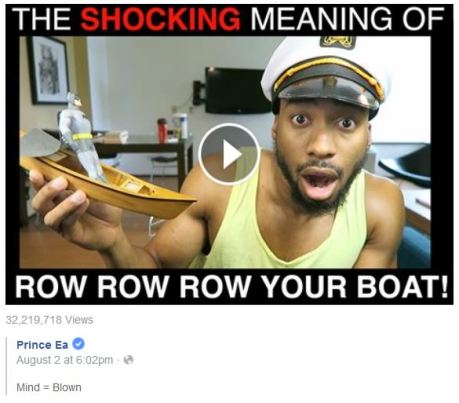
row your boat

While discussing with a FB friend the last video posted by Price Ea – you can watch it by clicking on the picture above – something hit me.

We were exchanging ideas about how much control each of us has over his own life when I realized that our very insistence on using precisely this term is what causes a lot of trouble.

The notion of control divides the world in two.
The controller and the controlled.

And since we are social animals, things become very quickly very complicated.

Being ‘animals’ means we that we have ‘animalic’ needs. Air to breathe, water to drink, food to eat, shelter from the elements… The first floors of Maslow’s pyramid, as you surely remember.
Being ‘social animals’ means that we not only depend on having access to enough physical space and resources but also on the cooperation of the people who happen to be in our vicinity.

The control hypothesis ‘leads’ us into a competition for both space and authority above those around us.
Our world becomes divided into what ever space we already control and the rest. Meaning the (yet) uncontrolled areas from where it is very possible that a challenger might spring up anytime so that the controller must somehow extent his control over those areas as well, as soon as possible.
Our neighbors become divided into our ‘slaves’ and our direct competitors. Who have to be, sooner or later, subdued into slaves – lest they do the same thing unto us.

In conclusion, the ‘control hypothesis’ sees the world as a constantly busy battlefield where each of the dwellers is in constant conflict with everybody else.

Luckily, even the most perfunctory  glance down the history teaches us that human success is more about cooperation than about conflict.

Only the conspiracy theorists believe that most wars are started by business people trying to sell their wares to the warring parties. The reasonable business people know that while a certain amount of tension is good for their business – tension sells guns, among other things – an actual war exhausts both parties and destroys solvent demand.
While it is possible that some callous business people or political actors might try to foment war, for various reasons, that doesn’t mean they are behaving reasonably.

Which brings us to the alternate hypothesis.

How about we replace the concept of ‘control’ with the idea of ‘autonomy’?

How about we give up the ‘tiresome’ notion of control and replace it with the peaceful concept of cooperation?

Since we have already figured out that we depend on both those around us and on whatever resources we can identify, how about we enroll the cooperation of as many of the like minded that surround us as possible and search together for those resources?
Instead of each of us simultaneously trying to run faster than everybody else and to hold back as many as possible – the true meaning of generalized conflict?

Which brings me to the notion of ‘autonomy’.
Being autonomous means being engaged in a special kind of relationship. It means being part of a flexible structure. One that is strong enough to resist but flexible enough to allow a variable amount of leeway for each of its components.
The very concept of autonomy recognizes the mutual dependency that exists between the autonomous members of the said structure and also the fact that the very strength of the structure comes from each of the members being able to solve problems on his own.

Autonomously, that is.
Drawing resources from the structure, sometimes enrolling the negotiated cooperation of some other members but, on the whole, most of the problems get to be resolved ‘under the radar’. To the great benefit of the entire structure.
The vast majority of the structure not even noticing the huge numbers of situations that get solved this way.

Compare this situation to the one described in the first scenario, the one where everybody fights, openly or covertly, with every body else and tell me what you prefer.

“Control” or “Autonomy”?

An all out incessant war for ultimate control or a continuous process of negotiation?


quote-we-learn-from-history-that-we-learn-nothing-from-history-george-bernard-shaw-52-49-23

Funny, isn’t it?

Or yet another reminder that constantly cracking jokes about everything and everybody is not exactly the best thing to do… Let’s compare the relative importance of the British Empire during Shaw’s coming of age – the period when he developed his habit of cracking jokes about everything, no matter how serious the subject, with the fact that Scotland is seriously planning a second independence referendum.

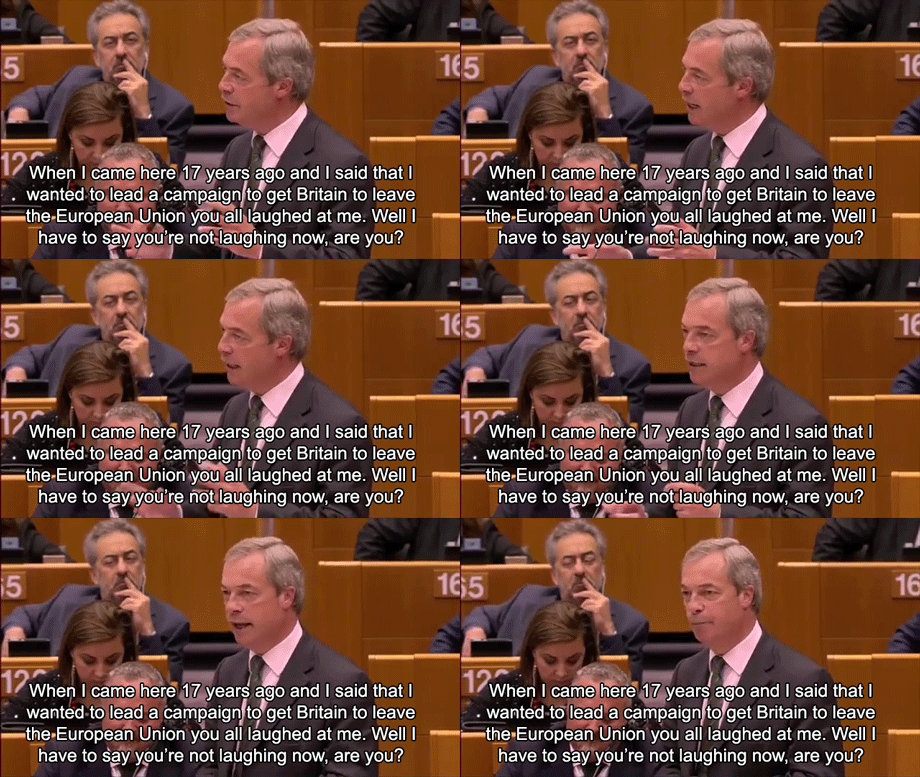
Or let me remind you of another Brit who enjoys cracking annoying jokes:

3727584669

Not funny anymore?

OK, let me try another tack.

What if

caaf122f196e61ec72335fd6ee6b0981

Could it be that the problem resides with us?

That this is basically a matter of what we do with whatever (history) has been passed to us by our forefathers? That what has been passed to us does have its own importance but that we can’t do very much about it?
History can only be rewritten but never changed…
We, on the other hand, can and should learn to deal with the dynamics of this world.


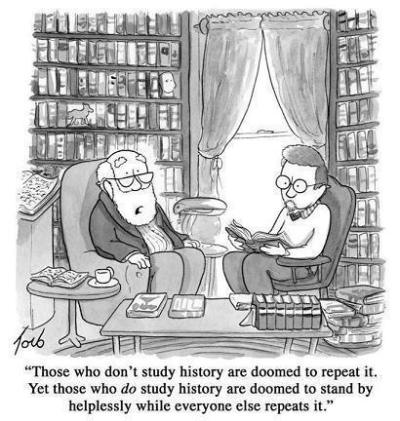
learning_from_history

How come ‘those who do study history are doomed to stand by helplessly while everyone else repeats it’?

Could it be that some of the ‘students of history’ are doing something wrong?
Misunderstand the very lessons they try to impose on the others?

Cracking annoying jokes about the matters at hand instead of honestly helping others to reach intellectual autonomy and then respectfully allowing them to develop their own interpretations of things?


I hear a lot of people discussing about the need to choose ‘the lesser evil’.

Otherwise the ‘greater evil will prevail’ they warn us.

I’m afraid that those who fall into this trap actually validate the idea that ‘evil is acceptable’.
Every time this subject comes up I keep remembering the joke about an older man asking a young lady:
‘Would you sleep with me if I gave you a million bucks?’.
‘Well, I’m not that kind of girl… but you know, that’s an awful lot of money… I could help my old parents… I could go back to school… OK…”
‘But what if I gave you $100?’
‘I told you I’m not a hooker!’
‘That’s already been settled. All that’s left for us to do now is to negotiate the price.’
Same thing with ‘choosing the lesser evil’. Once you’ve  accepted that evil is inevitable … you’re sure to get some. And keep getting it until you quit playing their game.
That doesn’t mean we schould quit voting all together. It would send the wrong message. Even if you don’t go to the voting booth because you are disgusted by the available options the ‘analysts’ interpret your stance as ‘they’re so despondent that they don’t care anymore about their own fate. They they don’t have enough energy left in them to protest so no need to change anything. Or, maybe, things might be allowed to become even a little worse. For them, of course.’
What we need to do is vote what we really like, even if that candidate doesn’t stand the slightest chance. This way the intention of the voter is absolutely clear – ‘I want exactly this’.
If there is no acceptable option, we can always check the ‘non of the above’ box – if available – or take the necessary steps to annul your vote – the specifics depend on local rules and regulations. Again, this sends a rather clear message. ‘I refuse to play into your hands and accept that evil is inevitable’.

bullshit

I’m not a Trump fan. How could I be? Just look at his face!

On the other hand….

“I call it the law of the instrument, and it may be formulated as follows: Give a small boy a hammer, and he will find that everything he encounters needs pounding.” Abraham Kaplan

Or, in this case, convince a journalist of something and he will ‘dress’ the facts to fit his new conviction.

As I said before, I don’t like Trump.
If I didn’t have a lot of trust in the overall resilience of the American democratic system I would be scouring for a big enough rock to hide behind if/when he might ascend to power.
Unfortunately the present most likely alternative isn’t any better.

But that’s another topic.

Let me go back to the present one.

What we have here is a news/opinion outlet which has a clear political option.
OK, I can live with that. I have some opinions of my own and I love to argue and defend them. In private as well as in public.

But I do believe that the quality of the arguments used in a debate are of paramount importance.

Let me analyze the four I mentioned above.

“Within 20 seconds at a press conference on Wednesday, actual Republican presidential candidate Donald Trump went from suggesting that Russian President Vladimir Putin had once called President Barack Obama the n-word to saying he hopes Putin likes him.”

The apparent implication here being that Trump has trouble maintaining logical consistency inside a rather short discourse and that he is rather gullible – “For the record, there is literally zero evidence that Putin ever called Obama the n-word. It’s hard to say where Trump got this idea, but he has a long history of naively restating things he heard from one person — even random people on Twitter.”

Hard to argue against this, specially since there is ample video testimony that he really said it.

a shocked again trump

Well… after actually hearing him, things are not so clear anymore.

“Putin has said things over the last year that are really bad things. He mentioned the n-word one time,” Trump said from his resort in Doral, Florida.
“I was shocked to hear him mention the n-word. You know what the n-word is, right?” Trump continued. “He has a total lack of respect for President Obama.”
Putin doesn’t like Obama, Trump told reporters.
“I think he’s going to respect your president if I’m elected, and I hope he likes me,” Trump said.
Earlier in the news conference, Trump claimed he had never met the Russian leader.”

Not a trace of either ‘gullibility’ nor of any logical fracture here. So why not call Trump for what he really is – a callous manipulator – instead of using convoluted makeshift allegations?

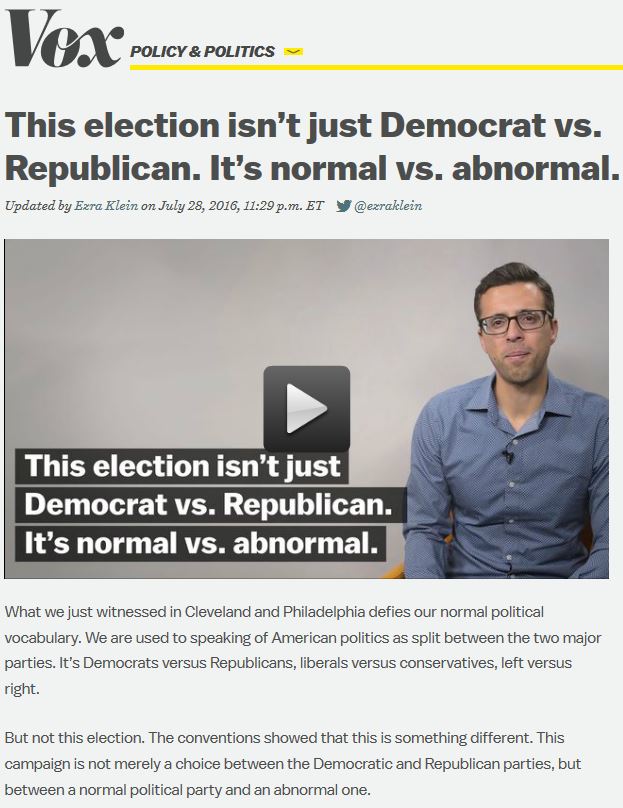
normal versus anormal

Absolutely impossible not to agree with everything written here, right?
No matter what side any of us belongs to…but wait!

“The Democratic Party’s convention was a normal political party’s convention. …”
“The Republican Party’s convention was not a normal political party’s convention….”

A new cleavage in American politics: normal versus abnormal

America’s main political cleavage is between the Democratic and Republican parties. That split has meant different things at different times, but in recent decades it primarily tracks an ideological disagreement: Democrats are the party of liberal policies; Republicans are the party of conservative policies.

But in this year’s presidential election, the difference is more fundamental than that: The Democratic Party is a normal political party that has nominated a normal presidential candidate, and the Republican Party has become an abnormal political party that has nominated an abnormal presidential candidate.

No, I’m not going to take sides here. Not only because I’m not an American citizen so I’m not entitled to vote. But simply because Democracy relies mostly on mutual respect. You cannot refuse to the other party the very right to exist yet still call yourself a democrat. Pretending that your opponent is ‘abnormal’ means that you’re convinced that your opponent should not exist at all.

The way I see it ‘America’s main political cleavage is indeed between normal versus abnormal’ only it seems that both the  Democratic and Republican conventions, if not the parties themselves, belong to the realm of the ‘abnormal’.

But wait, things are getting even more juicier.

When women speak, people tend to mentally turn up the volume

Women, and women leaders in particular, often get criticized more for how they say something than for what they actually say. They have to walk a difficult line of being assertive but not too aggressive, likable but not too much of a pushover.

Even though women are interrupted more often and talk less than men, people still think women talk more. People get annoyed by verbal tics like “vocal fry” and “upspeak” when women use them, but often don’t even notice it when men do.

The same mental amplification process makes people see an assertive woman as “aggressive,” which gets in the way of women’s personal and professional advancement. Women are much more likely to be perceived as “abrasive” and get negative performance reviews as a result — which puts them in a double bind when they try to “lean in” and assertively negotiate salaries.

These kinds of implicit biases are sexist, but having them doesn’t make someone “a sexist” — or if it does, it makes all of us sexists. It doesn’t matter how smart you are or whether you are a man or a woman; everyone has some implicit biases against women.

And that may be one reason why this is the first time a woman has ever won a major party’s nomination.

OK, so what should people do? Vote for Hillary Clinton simply because she’s a woman?

And no, I don’t have any implicit biases against anybody. I cannot vouch for anybody else but I cannot see myself as ‘abnormal’ so I expect there are others in my situation.
Hence I strongly believe that candidates should be evalued ‘all around’, without any biases based on their gender.

Or race.
Hey Trump, this one is specially for you.

barack is not the cause

I’m afraid that Dara Lind, the author of the article I just quoted above, has got her ‘butterfly’ wrong.
It’s not Obama that inadvertently caused any hurricane.
Do you remember the intensity of the birther campaign that had swept across America both before and after Obama was elected President?

And while it’s clear that Trump was one of the most vocal ‘birthers’  do you know who started the whole thing?

“You know who started the birther movement? Do you know who questioned his birth certificate, one of the first?” Trump asked.

“Hillary Clinton, she’s the one who started it. She started it years before it was brought up by me.”

Trump said he no longer talks about the issue because it always breeds controversy but promised to “raise it against” Clinton in a general election.

OK, we don’t have to take Trump’s word on this, even if he’s quite an authority on the subject – given his passion about the issue.

The last quote is from an article published on the CNN site. Click on it if you want more specifics.
OK, so where does all these leave us?
Scratching our heads while trying to figure out what went wrong around the ‘deep well of anxiety about America losing its culture and values’?
Or rather staring at those who drew from deep within this well and used the proceedings to stoke people’s emotions in order manipulate them? One way or the other?
It seems the he wasn’t the only one. Wannabe presidential candidate and ‘racial provocateur’.
So why keep on hoping that by choosing the ‘lesser evil’ we’ll ever reach the ‘light at the end of the tunnel’?
Why keep on trying to manipulate people one way or another instead of finally calling both ’emperors’ for what they are?

1 – A wealthy and immensely powerful earthly ruler decides that his only child, a boy, should be protected from having any contact with the misery predominant under his dominion.
His efforts are successful, for a while, but at some point the young lad finds out that he was living in a bubble and rebels – as all young people do at some point.
The young man, like all mythological heroes before and after him, embarks on an initiation voyage during which he not only comes of age but also discovers a way out of the erstwhile inescapable cycle that keeps us human beings immersed in apparently endless suffering.
The not so young anymore prince shares his findings to those who recognize him as their guru and fades into the endless folds of time…

2 – Unable to find a way to bring himself happiness to his subjects a powerful ruler decides to sacrifice his own son in order to achieve this self imposed task.
For his son to experience unblemished bliss – so that he would be familiar with the feeling towards which he was meant to lead the inhabitants of the kingdom – the king raises him completely isolated from the vagaries experienced by the commoners.
When the young prince is considered mature enough, he is ‘accidentally’ led to find out the dire reality that is haunting both the king and his subjects.
As expected of him, the lad refuses to return to the comforts of the gilded nest and embarks on the task he was raised to fulfill.
After a labored voyage that somewhat mirrored his erstwhile existence our hero eventually solves the problem entrusted to him by his father.
The story ends with the hero taking the trouble to share his findings with those who bother to listen to him.

3 – Unable to convince his contemporaries of what he had understood about this world an otherwise skilled storyteller concocted a rather convoluted narrative about an young prince who accidentally found out about how much misery existed – and still does – in the world. Impressed by the horrible fate of his subjects the soon to become hero starts looking for a way to deliver his people from their sufferance. After a long struggle, mainly with himself, he found out that in order escape the cycle of suffering a man must. above all. make peace with himself. By refraining from making excesses of any kind and by first considering the thoughts that cross his head and only then putting them into practice.
After refining his story in the shade of the proverbial fig tree our story teller started sharing his teachings to anybody wise enough to lend him an ear.

So, is there anything to be learned from these stories?

For starters, no one can be saved from suffering against his will or without him being aware of what’s going on.
Secondly that there is no such thing as a ‘one size fits all’ solution to be put in practice by a benevolent ‘deus ex machina’. Had this been possible the generous and caring ruler would have solved the problem without having to sacrifice his own son in the first place.
Thirdly, is no way lastly and less evident than the first two, ‘salvation’ is a collective effort. Besides the fact that in all three versions the ‘hero’/story-teller who finds the way feels an irrepressible urge to share his findings we have to consider that none of the above at no moment delved in a complete void. Each of them was raised/conducted their search in circumstances shaped by those living in their close proximity.

“The bodhisattva ideal is central to the Mahayana Buddhist tradition as the individual who seeks enlightenment both for him- or herself and for others. Compassion, an empathetic sharing of the sufferings of others, is the bodhisattva’s greatest characteristic. It is shown in the following incident from the Vimalakirti Sutra which concerns a prominent lay follower of the Buddha who had fallen ill. When questioned about his illness, Vimalakirti replied, “Because the beings are ill, the bodhisattva is ill. The sickness of the bodhisattva arises from his great compassion.”

Contrary to what one might think at first glance, Buddhism is not about a selfish quest for individual escape. Buddha himself couldn’t leave this valley of tears without first sharing his newly acquired understandings with those around him.

As amply, but not readily evident, proven by all three variations, becoming aware of, and cherishing, one’s own individuality is an absolute must for all who seek deliverance but reaching that stage is only a necessary step towards the understanding that deliverance can only be achieved by carefully balancing one’s own ego against ‘the need to belong’ which allows us to cooperate towards our common goal:

Survival as an opportunity to reach deliverance.