Archives for category: limited rationality


quote-the-philosophers-have-only-interpreted-the-world-in-various-ways-the-point-however-is-to-change-karl-marx-250986

Change it into what? And on what grounds?

I had spent the first 30 years of my life under communist rule and I’ve witnessed, first hand, the debacle produced by a bunch of people trying to transform the world according to their own liking. And it’s not only that they had brought a lot of misery to an awful lot of people but they also brought it upon their own heads. They, and their families, have been indeed living a lot better than the rest of the people but a lot worse than the ordinary people living in the free world. Not to mention the fact that many of them ended up really bad, some of them at the hands of their own insatiable, Minotaur-like, leaders and some others during and immediately after the regime change.

I’m writing this post after watching Jon Haidt’s excellent lecture “Two incompatible sacred values in American universities“, delivered at Duke’s Departement of Political Science on October 6, 2016.

The point of Haidt’s conference being that each university should clearly declare its ‘telos’ as belonging to one of these two clear cut options:

the-point-of-a-university_dxo

Don’t bother to search the quote attributed to John Stuart Mill.

It is only an interpretation belonging to Haidt himself, who had inferred it from one of Mill’s famous quotes excerpted from  “On Liberty”:
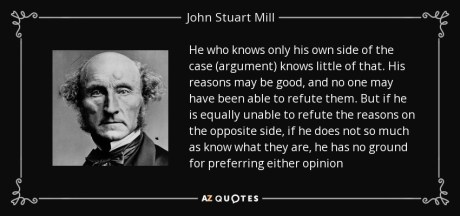
quote-he-who-knows-only-his-own-side-of-the-case-argument-knows-little-of-that-his-reasons-john-stuart-mill-125-0-0981

So, what should it be?

Change or Truth?

Before proceeding any further I strongly suggest that you take some time and listen to Haidt’s excellent arguments.

Now I’d like to discuss a little about ‘Change’ and ‘Truth’.

What both Marx and Haidt have in mind when they speak about ‘change’ is both ‘purposeful’ and ‘centralized’.
When they say ‘change’ they mean an ‘effort towards increased social justice’, effort whose parameters would be determined by the wise men (and women) delving in the depths of the University’s libraries and which would be implemented without fail, preferably with a sanction from the higher authority.

I had already mentioned, at the beginning of my post, where such ‘change’ would lead anyone  attempting to put it into practice.
And Haidt gives us an excellent explanation for why anybody who will ever attempt such a thing would eventually fail. (I told you to watch his conference…It may be long but every minute of it is packed with very interesting things!)

So why is Haidt challenging us to make this choice instead of giving us a clearer piece of advice?

Well… maybe you should ask him that… I’d hate to believe that he, in his own words, ‘has become afraid of that too many of his students might feel that he is so distanced from what is generally accepted that too few of them would follow him’.

So what should we do?
Some of us should embark on a ‘sterile’ search for the (absolute) truth and then, after eventually finding it, nurse it quietly in our lap but refrain from an even minutely more drastic action while others should attempt to implement change based on already ‘over the hill’ principles?

I’m afraid that would be a dangerous road to follow.

There is no such thing as an ‘absolute’ truth that might be nursed in our lap and even if there was such a thing we are not able to find it – individually or even as a group. There’s plenty evidence about that in Haidt’s discourse.
And then what would be the use of the whole enterprise if we are not planning to use the results of our quest, whatever those might be?

And here lies the crux of the matter.

I’m sure Haidt knows what I’m going to tell you now and I’m very sorry that most of your teachers have never mentioned at class this very interesting story.

Marx was not the first revolutionary thinker of his time.
OK, you already know that. There were a certain number of French intellectuals whose writings have set the stage for the 1789 Revolution.
What is less known is that John Stuart Mill himself had been groomed by his father “as the future leader of this radical movement”, whose aim was supposed to be “social reform based on utilitarianism” with the goal of attaining “the greatest happiness of the greatest number“.

The only difference between James Mill (the father) and Karl Marx being that Mill didn’t advocate the the forceful confiscation of the ‘means of production’.
Otherwise both were faithfully following Plato’s dictum:
“Until philosophers are kings, or the kings and princes of this world have the spirit and power of philosophy, and political greatness and wisdom meet in one, and those commoner natures who pursue either to the exclusion of the other are compelled to stand aside, cities will never have rest from their evils, –nor the human race, as I believe, –and then only will this our State have a possibility of life and behold the light of day. Such was the thought, my dear Glaucon, which I would fain have uttered if it had not seemed too extravagant; for to be convinced that in no other State can there be happiness private or public is indeed a hard thing“.

Well, the problem with this line of thought is that it doesn’t work.
Again, Haidt has already presented a solid case about this and I’m not going to re-count his arguments.

So, since there is no such thing as an absolute truth to be discovered, one way or another, and no priest-kings on any white stallions that might come to our rescue, what shall we do?

Simple.
Follow Haidt’s, and John Stuart Mill’s, advice and take it one small step further.

“The point of a university is to understand the world because only if you commit to truth, I believe, can you actually achieve justice.”

We need to understand, and accept, two things:
Change has to be allowed to come naturally, not pushed forward simply because we are momentarily convinced that ‘The Truth’ had downed on us,
And that (social)justice is a process which has to be implemented on an ‘as needed’ basis, not an independent goal?

In fact Mill’s personal destiny is eloquent enough for what happens when somebody tries to breed a ‘perfect’ Priest-King.
“But in 1826, Mill began to suffer from a severe depression, which he attributed to his excessive analytical training and the resulting impairment of his emotional capacities. Reading the romantic poetry of Wordsworth and Coleridge helped Mill to overcome this mental crisis. It also inspired him to form a more complex view on human flourishing than the Benthamite utilitarianism of his father’s generation, with its dogmatic rationalism and unidimensional concept of pleasure.”

And this is why Haidt is absolutely right when he tells us that we need to expose ourselves to a lot more than what we are already familiar, and comfortable, with.
And this is why Heidegger kept warning us that truth as conformity between our words, or even our understanding, and the reality of the fact that we try to understand, and describe to others, is a Fata Morgana which consistently eludes us and that the only way to get any closer to her is ‘unhidennes’.

In this sense there is nothing better than an open mind, both towards our innermost thoughts and to the people living, and thinking, around us.

A mind open enough as to be able to simultaneously attempt to implement whatever changes become necessary in the light of the newly discovered truths AND accept the possibility that those ‘newly discovered truths’ might be incomplete or even altogether false.

Does all this seem rather schizophrenic?

Then let me rephrase the question I started with.

What’s the use of ever trying to understand anything if we’re not going, ever, to change our behavior as a consequence of anything we might come to figure out and on what basis is anyone to attempt any change if he never tried to understand anything above what he already knew long before he even started to think about any change?

As I was ready to close this post I stumbled upon the thought that maybe Haidt meant to apply in the academic world a principle that has been proved invaluable in the political life.

‘Separation of powers’.

Some universities would busy themselves with finding ‘the truth’ while others would attempt to find ways to put ‘it’ into practice.

Leaving aside the fact that this would smack too much of Marxism for my taste I’ll have to remind you that the separation of powers has become necessary in the political realm only because the government has an effective monopoly on power and we need to make it so that it cannot abuse this situation.

No university has any monopoly on truth and/or change.
Furthermore, not even the Academia, as a system, has been able to implement such a monopoly. Not for lack of trying, but that’s another subject.

So, instead of acquiescing to such efforts – by accepting certain universities as official ‘truth seekers’ and others as ‘path finders’/’change implementers’, we’d better ask each and all of them to clean up their acts.

And open up their collective minds.


OK, then please someone explain to me what the heck is going on here.

“Other researchers have pointed out the correlation between education rates and declining female health outcomes. The most shocking study, published in August 2012 by the journal Health Affairs, found that life expectancy for white female high-school dropouts has fallen dramatically over the past 18 years. These women are now expected to die five years earlier than the generation before them—a radical decline that is virtually unheard of in the world of modern medicine.”

femalemortalityratesmaplg

(Health Affairs/The Population Institute, University of Wisconsin)

“…women in parts of the country have been left behind, and in some cases, they are dying younger than they were a generation before.”

swing-states-20161


“This map shows the probable number of votes each parties candidate would win in the Electoral College if the meeting of the College were held today.  If you live in a red state on the map above you probably do not have to vote for anyone for the office of POTUS but you should vote for a candidate for all  the other offices on the ballot.  – Abyssum“

If you are not aware of at least some of the many ‘forces’ which attempt to control your mind, at least in part, you are just as ‘out of your mind’ as those who believe their minds are successfully and consistently controlled by outside agents.

And those who are convinced they are in control of other people’s minds.

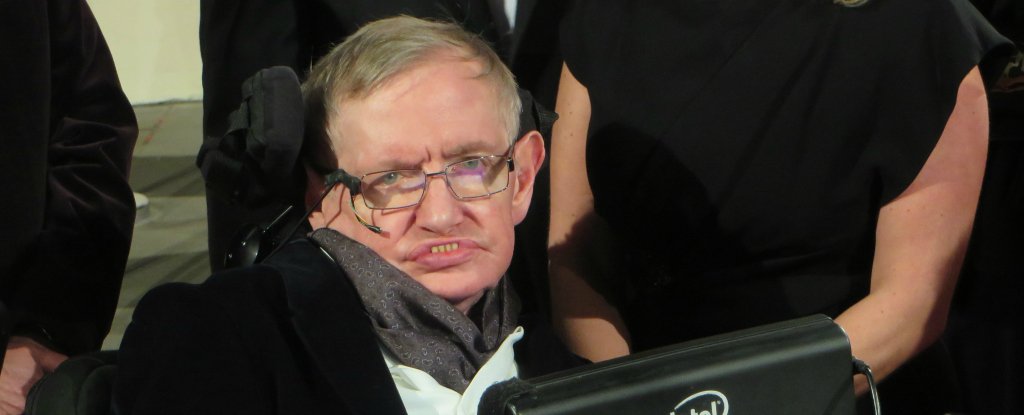
stephenhawkinghistory_web_1024

“We spend a great deal of time studying history, which, let’s face it, is mostly the history of stupidity.” (Stephen Hawking speaking at the Cambridge University)

Really?

First of all what we call ‘history’ is not what had happened but a story comprising the subjects some of us had chosen to write about, in the manner they saw fit to do it.

Secondly, until very recently most people had a very vague – and heavily biased – idea about what had happened in their past.
Only in the last two hundred years or so a very small number of people have started to study what had happened in their past in a value neutral manner and, unfortunately, their efforts are still being disparaged by many and ignored by a vast majority.

Coming back to Hawking’s words, I must admit that we, as a species, have done indeed a lot of stupid things.
But, as a whole, the sum of our deeds is far from being negative.

After all… we’re still here, aren’t we?

And, despite the huge amount of misery that is still being experienced by a lot of us, we are doing better than our great parents used to do.

So it is hard for me to agree with Hawking on this subject.

He is right about one thing though.
We are currently doing a very stupid thing indeed.
Our ancestors had the excuse that historical information was very scarce.
This is no longer the case.
While they could have claimed ‘innocence’ when re-enacting an error that had already been committed we no longer have that luxury. We should have known better since it is a lot easier for us to learn than it was for our great-parents.
We really need to stop ignoring the lessons we have at our disposal.

And there’s something else which further complicates the situation.
We have become so powerful that our mistakes can have far worse repercussions than any of our ancestors ever had.

So while I don’t think our history is that full of ‘stupidy’ as Hawking believes it to be I share his concerns about the stupid things we may be making in the future if we don’t wake up and start learning from the stupid enough mistakes we have  already done.

As I said before, we make our own history.
We do the things that will constitute tomorrow’s history and we write the story of things that constitute our past.
Let’s not do, nor write, a ‘stupid’ one.

Just stumbled upon this joke:

“One day, all the human body parts started arguing about who was on top… The mouth said, ”I should be on top because, without me, you wouldn’t be able to eat.” Then the stomach said, ”Ya but if it weren’t for me, you wouldn’t be able to digest and transfer all the minerals and vitamins throughout the body, I should be on top.” Then the heart said, ”I should be on top because I’m the one who takes the blood from point A to point B. Without me, the body would die.” Then the brain said, ” Well, without me, you wouldn’t be able to move, eat, digest or allow circulation of blood, so I should be on top.” Now, the asshole was beginning to get annoyed, ”You know, I should be on top because I can just shut my hole and then shit will accumulate and block the digestive track and screw all of you up.” It was chaos, everyone was yelling and fighting. Finally, the asshole got fed up, ”That’s it, I’m fed up, I’m shutting up my hole.”

So for a few days, the body couldn’t shit and the brain had trouble moving, the stomach digesting, the mouth eating and the blood flow going, everyone was begging the asshole to open up, The brain said, ”Please open up, you made your point, your on top, just open up.” The asshole smiled, ”So everyone agrees that I’m on top?” ”YES” everyone shouted. ”OK!” so the asshole opened up and the body could shit again. The moral of this story is, you have to be an asshole to be on top…“

Isn’t this interesting?

A bunch of guys are too thick to understand that they cannot live one without the others and to learn what mutual respect really means, one of them decides to teach the group a well deserved lesson and it is he who ends up being considered an ass-hole…

On the other hand… there are so many examples of ass-holes who end up ‘on top’ simply because they are the ones willing to do anything in order to get there – not caring at all if their actions hurt everybody else who happens to be around… AND because those who end up being hurt don’t see it coming or are too lazy, too thick or both at the same time, to do anything about it…

donald-trump-andy-borowitz

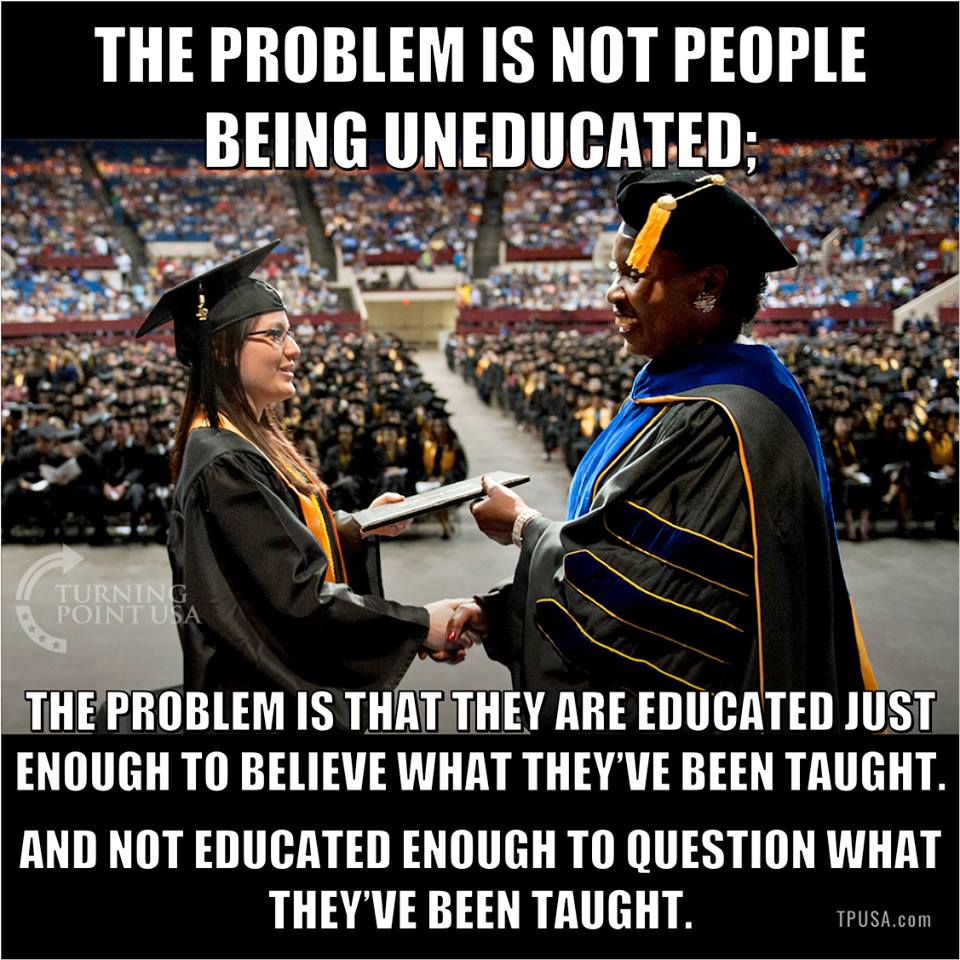
Besides the fact that calling someone an “ignorant” is a very ‘Trump’ thing to do in the first place, what if the real problem is that we have allowed ‘it’ to become a ‘system’ in the first place?

This way, after the process of learning and teaching has become a ‘system’, the ‘open market’ for ideas has become a very well – actually very badly – controlled oligopoly.
Learning means seeing and understanding the world around us. Teaching means passing around, and forward, the above mentioned knowledge and the meaning we’ve made out of it. Which ‘passed around knowledge and meaning’ shapes the way the ‘students’ go further. Deepen the knowledge and build future meaning.
In fact the very breadth of our species future depends on how past learned knowledge and built meaning had been passed around.
And what we have today, the current ‘social unease’, is the product of the manner in which we have been taught to see the world. Of the meaning we find in it.

Trump, as a social phenomenon, is nothing but yet another symptom of the current ‘malaise’. The incapacity of the contemporary society to make room for everybody is, simply put, a consequence of  information no longer flowing freely around. Of information being, tighter and tighter, controlled by the ‘system’.
The simple fact that Trump, if elected, has promised to put his stamp on the ‘system’ only proves this point…

Coming back to the ‘system’, the only way to fix it is to open it up, widely. If we continue to allow ‘it’ to divide us into ‘insiders’ and ‘outsiders’ (read ‘properly educated’ and ‘ignorant’) we will actually perpetuate ‘the problem’.

chded7au4aadm5

Specially after more of his antics have came to light…

I couldn’t find any current data so I’ll have to make do with what the Atlantic had published a month ago.

trumps-base

So, a little over 12% of his votes come from college, or higher, educated women while the total is no less than 48%.

Now, would you care to guess which of these women will continue to disregard his being ‘automatically attracted to beautiful’ and keep rooting for him?

Would you even consider Hillary Clinton as a likely candidate?

“Even though she found the job distasteful, Rodham mounted what she felt was her strongest possible defense of Taylor. As Newsday reporter Thrush wrote in 2008, “Her approach, then and now, was to immerse herself in even unpleasant tasks with a will to win.””

At that time Clinton had been ordered by a judge to defend a rapist – which all practicing lawyers can expect to be asked to do.
“Once she no longer had a choice in the matter, Clinton said in a 2014 interview that she had a professional obligation to give Taylor the strongest possible defense.

“I had a professional duty to represent my client to the best of my ability, which I did,” she said.

Gibson (the prosecutor who tried the case)  recalled that the young lawyer worked overtime on the case in hopes of impressing the court, which might them help establish the reputation of her new legal aid clinc.”

Further more:
“Despite her discomfort with the case, Clinton aggressively defended her client. In an affidavit to the court, she said a child psychologist had told her that children “from disorganized families,” such as the victim, “tend to exaggerate or romanticize sexual experiences.” “

In this sense is it possible that even a college educated woman, like Hillary Rodham Clinton, might vote for somebody like Trump, simply because she might consider other things to be more important than his bragging about ‘grabbing beautiful women, who allow him to do it because he is a “star”, by their pussies’?

OK, you’ll tell me that in the voting booth each of us should behave in a ‘personal’ rather than a ‘professional’ manner.

I’ll up the ante and ask you what kind of person is able to efface his/her personal self so efficiently, simply in order to ‘help establish his/her professional reputation’?

Or accept a gleeful ‘pussy grabber’ as the most powerful person on Earth?

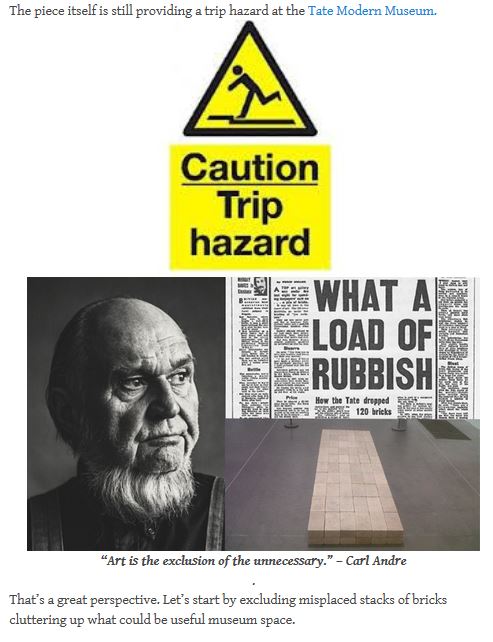
Some 50 years ago Carl Andre displayed 6 stacks of bricks on the floor of the Tibor de Nagy art gallery in New York.

None of them was sold so the artist “returned all but 200 of the bricks to the brickyard to get his money back”.

They were remade in 1969, from a different kind of bricks – the factory had closed in the meantime, and one of them was bought, in 1976, by London’s Tate Gallery for $12.000 – the equivalent of $50.000 in today’s money.

Equivalent VIII 1966 by Carl Andre born 1935

Not without creating a lot of controversy.

what-a-lot-of-rubbish


Which ‘tripped’ me into writing the present comment.

I’m not going to discuss Andre’s art or philosophy. It’s so obvious that you can actually trip on it.

What’s bewildering me is the intensity with which some people contest the things they don’t even understand.
OK, each of us have the right to express ourselves. To criticize everything.

But why do it so aggressively?

What if we are the ones who don’t have a clue?

Who ‘are as thick as a brick‘, instead of as “Thick as a Brick” as we consider ourselves?

Could it be that it’s our own unwillingness to see which has allowed the ‘(thick as) thieves’ to bring the ‘Conspiracy of Fools‘ upon our heads?

After someone opened up our eyes, that is!

“-Radio DJ: If you’re sick of being broke, for $108.3, which month has 28 days?
-All of them.
-Woman: I actually know this one! Uh, February?
-Radio DJ: We have a winner!
-Idiots.”

You never saw it this way, did you?
Neither did I.
Not before watching the first episode of Scorpion, anyway.
No excuse to continue to do so afterwards, now that we’ve been told.
For an additional training session, click here.
The whole point being ‘what’s the use of having geniuses among us if we don’t pay proper attention to what they have to say to us?’

“It is as irrational to reject all conspiracy theories as it is to accept them.”

Nassim Nicholas Taleb

Conspiracy theories are similar to religious superstitions.
They offer comfort to the emotionally insecure and create a meeting ground for the like minded.

Unlike full grown religions they lack a proper structure but that doesn’t mean their main ideas are not used for propaganda purposes, just as all religious dogmas have been. And still are….

Another difference between conspiracy theories and religions is that while both have been produced by human minds some of the conspiracy theories had been proven true while the most that can be said about religions is that they had been useful …

But what is a conspiracy theory and what does Utopia have to do with anything?

“Conspiracy theories as a general category are not necessarily wrong. In fact as the cases of Watergate and the Iran-Contra affair illustrate, small groups of powerful individuals do occasionally seek to affect the course of history, and with some non-trivial degree of success. Moreover, the available, competing explanations—both official and otherwise—occasionally represent dueling conspiracy theories, as we will see in the case of the Oklahoma City bombing…[but] there is no a priori method for distinguishing warranted conspiracy theories (say, those explaining Watergate) from those which are unwarranted (say, theories about extraterrestrials abducting humans).” (Brian Keely, Of Conspiracy Theories)

According to this definition a conspiracy theory is a ‘shape-shifter’. The notion covers both the true and the bogus ones while it can be used both ‘admiratively’ and disparagingly.
Again, just as it happens with religion, the mind set of those who consider each of them is of paramount importance.

Meanwhile ‘Utopia’ is, yet again, another creation of the human mind.
While religions and conspiracy theories are shared mental constructions that try to explain something which already exists Utopia is a shared mental construction which describes the ‘ideal’ state of  something that already exists and is perceived by those who experience it as being ‘perfectible’.

The link between all these being that the only two roads that lead to Utopia are, of course, ‘religion’ and ‘conspiracy theories’.

Am I being too harsh?

Utopia, “an imagined place or state of things in which everything is perfect“, is a word coined by Sir Thomas More “for his 1516 book Utopia, describing a fictional island society in the Atlantic Ocean.“. It “comes from the Greek: οὐ (“not”) and τόπος (“place”) and means “no-place“, and strictly describes any non-existent society ‘described in considerable detail’.”

Now why would a reasonable person attempt to reach a ‘no-place’ unless conned into it by a ‘conspiration’? No matter how desirable that ‘place’ might be…

The way I see it this is yet another argument that rationality is not at all the perfect ‘balancing’ tool some of us believe it to be. In fact we are not ‘rational’ at all but ‘rationalizers’. Since it is impossible to gather and analyze all pertinent information before making a decision we try to convince ourselves, and others, that the decision we are about to make (or have already taken) is the right one. In order to do that we marshal all arguments we can find that confirm our hypothesis and we (honestly?) try to water-down those who are contrary to our views.

Until our coveted utopia becomes a real-life dystopia…