We’ve arrived at a very interesting point in our evolution as a cultural species.
Having more or less solved our existential problems – food, shelter, companionship, we’re hard at work towards building ‘self esteem’.
Putting it in Abraham Maslow’s terms, a good portion of the humankind – most of those active on the internet, the netizens, have reached the ‘self-actualization’ stage.
The problem being that we’re so preoccupied with ‘expressing our true selves’ that almost nobody listens anymore. Truly listens…
The kind of listening needed when we try to learn something. To understand what’s going on.
As opposed to the listening used when educating somebody.
When attempting to learn, we listen opening our minds. We let information in and structure it afterwards. When educating people, our listening is focused. We take information in with the sole goal of detecting dissent – in order to stifle it, and openings to exploit in our quest to implant our opinion about the world in the minds of our ‘targets’.
Take a breath. And exhale carefully not to inflate another bubble. There are already a lot of them waiting to burst.
In fact no, science teaches us nothing! Science cannot teach, at all. Simply because science is not a teacher.
At individual level, science is an attitude. A mind open enough to accept its own fallibility. To accept the fact that, sooner rather than later, it will fail. To accept the fact that the image it constantly generates during its interaction with the surrounding world is, at best, incomplete. To accept the fact that the understanding it has reached during its existence is, and will remain forever, a work in progress.
At the social level, science is a way of conducting business. Based on ‘trust but verify’. A scientifically minded community trusts its individual members to be honest in their efforts but verify their work because – as mentioned above, each of us will, sooner rather than later, fail. Hence, by aggregating their efforts, a scientifically minded community will eventually paint a still imperfect image but one closer to the reality than any of those belonging to its individual members.
In order for the community to be able to continuously improve their ‘work in progress’ each, or at least, enough of its members need to preserve their scientific mental attitude. Their intellectual humility. As soon as too many of the individuals reach the conclusion that their image of the world is the only correct one – and they start not only to bow towards it but also to convince others to join them, things start going south.
Who among us is perfect? Perfect enough to be sure?
And why had been chosen an adulterous woman as the main character for this lesson? Because adultery is a sin which cannot be committed in solitude? Only in cooperation with ‘the other’? As a relationship? Where each member contributes to the shared doom?
Do you see how similar science and sin are?
Both start ‘individually’ and are put in practice ‘together’. Both are initiated as individual pulsions and put in practice as choices.
I’ve started this post by mentioning science. The scientists among us have reached the conclusion that there was no need for a God to start the process of which we are the alleged pinnacle. That evolution was enough to drive the whole thing. I tend to agree. On the other hand, history – yet another branch of science, has produced enough evidence to prove that God had a tremendous contribution to the present state of civilization.
Not God himself but the image of God we have created for ourselves. The Image we’ve been bowing to for some time now.
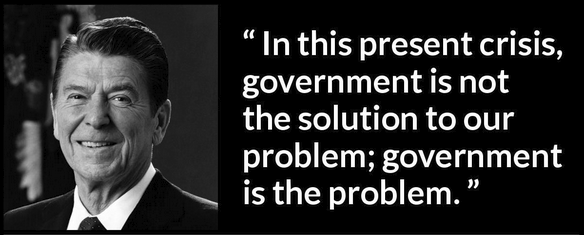
I’ve always been fascinated by quotes which are ambiguous enough to be simultaneously wrong and right.
In this situation, the ambiguity comes from ‘government’ covering three ‘patches of ground’.
‘Method of running a place/country’. (Self)Organized versus chaotic. ‘System in place’ which is used in running a country. A particular group of people who man, at any given moment, the above mentioned ‘system in place’.
Now, which of the three meanings was at the top of Reagan’s mind when he was uttering those ‘famous’ words?
The way I see it, government ‘as a manner of running things’ is a very powerful method. Which had served us rather well, on aggregate. Only it is not fail-proof. Or, more exactly, fool-proof. Government as a ‘system in place’ is a work in progress. We’ve been improving it since we’ve invented government as an alternative to chaos. Only we need to be very careful. As a man made system it will always be far from perfect. It has not been perfect in the past and, no matter how much effort we’ll put into it, it will always remain perfectible. Finally, government as ‘the team temporarily in charge’ ‘suffers’ mainly from being composed of humans. Hence both corruptible and attracted to power. Hence liable to do everything to maintain their positions.
‘Liable to do everything to remain in power’. Which means that it’s our job to keep them on the straight and narrow. We, The People, are the first to experience the consequences of their decisions. Hence we, all of us, are those who need to keep Government – ‘the team in charge’, on a short leash. If they want to remain in power, they need to keep us ‘alive’. They need to keep the system in shape. Working good enough for the vast majority, not for just a few of us. For a few of them, to be more precise.
Otherwise ‘government as a manner of keeping chaos at bay’ would have failed.
War has been the subject of many books. From war novels to ‘how to’ treaties. When the subject is mentioned, two stand up high. Sun Zu’s “The Art of War” and Clausewitz’s “On War“.
I’m not going to discuss the relative merits of the two treaties. Only to point out a few parallels. The authors had been involved in wars. Wars between states inhabited by more or less the same people. Sharing more or less the same culture. Wars which had ended when the warring parties had coalesced into what we call nations. China and Germany, respectively.
Yet we currently refer to those two treaties when we consider war between totally different nations/cultures.
Furthermore, we consider those two as being the pinnacles of strategic thinking. In a sense, that would be right. After all, both had been written by the winners of those respective wars.
But what happened next?
What major war had China won after becoming an united nation? WWII? When her enemy had been first beaten to a pulp, literally, by the US? What major war had Germany won after becoming an united nation? The one against France in 1870? OK. And afterwards?
And what is the real meaning of ‘Si vis pacem, parabellum’?
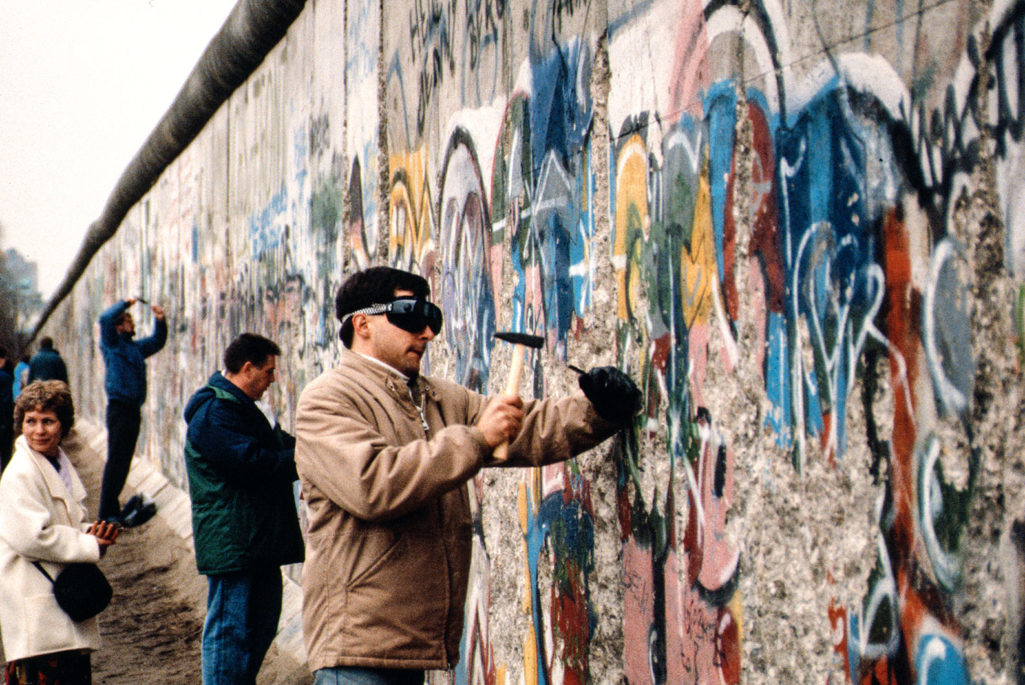
Until thirty one years ago, the Eastern half of Europe was self isolated behind the Iron Curtain. Which had suddenly disappeared in a matter of months.
Nowadays, when SARS-CoV-2 has forced each of us to shelter in place and our nations to self isolate behind the borders, we have not only the opportunity but also the obligation to re-evaluate our take on many of the things we took for granted.
The most important one being our Weltanshauung. The way we see the world. The fact that we have convinced ourselves – simply because our lives have been good enough, that we’ve been doing things the right way.
Marx’s communists had been convinced that dialectic materialism – supposedly backed up by science and a generous political doctrine, was the way in which humankind was going to built its future. Not the best way, the only way! For which reason, no transgression from the official line was allowed. Solutions were to be found only where the official doctrine mandated that answers might have existed.
Communism had fallen. Mostly from within. Which has prompted those on the other side of the fence to consider that their vision had been better. Which was obviously true. Slowly, people on both sides of the previous fence have started to convince themselves that their vision was the only correct one. The only alternative had proven itself to be a failure, didn’t it? Which seems also true. I know of no better alternative. For us. I know of no alternative which would be more helpful for us. Only the fact that I’m not aware of an alternative doesn’t mean much. The alternative might as well exist. Or not….
And here’s the problem. Marxism had failed for no other reason than those who followed it behaved as if they were convinced that Marxism was perfect. They were implementing the Marxist doctrine by the letter. Not that its spirit was any good… long discussion. My point being that arrogance was built in the Marxist spirit. Marx had actually given carte blanche to his adepts to impose communism, by force, to the rest of the world.
Unfortunately, the last 30 years had convinced me that many individuals belonging to the dominant culture, to any dominant culture, have a hard time keeping their cool. Too many of them reach the conclusion that ‘theirs’ is the best way. That all the rest are wrong. Which conviction has a malignant consequence. It makes them deaf. They no longer consider any other option but theirs. They no longer hear anything but their inner voice.
For all it may be worth, here’s what I learned about liberty during the last 30 years.
Liberty as breadth. Liberty is the breadth of the opportunity field where we might search solutions for our problems. But no matter how large that breadth might become, we’re never ‘out of the woods’. Liberty is but an opportunity, never a guarantee. We are the ones still responsible for the solutions we pick. For the simple reason that we’re going to bear the brunt of the consequences.
It is easier to search for solutions in a freer environment. Hence better solutions might become available sooner. But it’s still our job to look for them. To experiment. To widen our scope.
Liberty as a form of social interaction. We can relate to freedom in at least two manners. As an individual goal – ‘I want to be free’/’I want freedom for my people’, or as a ‘manner of doing business’. We are free, together, because we respect, and trust, each-other. We are free, together, because generations and generations of us have build a social arrangement based on mutual respect. A social arrangement which includes certain mechanisms which attempt to bring things back on track whenever disturbances appear. Some of which mechanisms have been put into formal law, while others have remained in the ‘public domain’.
When we put these two visions together, the ‘binocular’ image starts to develop ‘depths’.
A social group may enjoy freedom – a wider opportunity field, only as long as its individual members – all of them, enjoy their individual freedoms. For only as long as all individual members are free to roam the entire opportunity field discovered/maintained by the community. And as soon as some individual members start to corner portions of the opportunity field for themselves… the whole social mechanism will grind to a halt.
Sooner rather than later. The more intense the desire of the individual members to increase their ‘own’ individual liberty, the narrower the aggregated opportunity field becomes. Each of the individuals guarding their plot means each of them staring at their feet. Individuals become more interested in guarding their fences rather than in raising their eyes to the horizon.
People obsessively defending their past will never be ready for the future. Meanwhile individuals charging ahead with no consideration for the rest of the team will soon find themselves stranded on thin ice. With no one around to help.
Then what? Stop talking? Or assume personal responsibility for everything that leaves your lips?
As soon as a person achieves a certain level of self-awareness, they realize there’s more in life than mere survival. As soon as their consciences bloom – in concert with the accrued influence exercised by the ‘environment’, individuals set goals for themselves. Which goals become integral part of the ‘ongoing project’. Of the self-actualizing conscience. Achieving, or failing, each of those goals leaves an indelible mark on the conscience itself. On the manner in which each individual relates to their environment. Since achieving is far more ‘satisfying’ than failing, conscience is naturally biased towards ‘achieving’. If the ‘environment’ ‘allows’ it, the bias becomes more and more ‘slanted’. The messages used by the individuals – by their conscience, to be more precise, will increasingly serve the purpose of achieving goals rather than the purpose of ‘honest communication’.
As soon as a person achieves a certain level of self-awareness, that conscience wants to survive. Mind you, not the person but the conscience.
‘?!? Conscience cannot exist without the mind/body which supports it….’
OK, tell that to people who believe their souls are going places after their mortal bodies expire. Then try to demonstrate to yourself, honestly, that those people are wrong. That there’s no chance for their belief to be ‘true’.
But metaphysics are hard. Let me give you a far lighter example. Smoking. Or drinking. Driving fast. Eating that extra piece of chocolate… Don’t tell me you never did anything ‘foolish’. That you never lied to yourself: ‘This cannot happen to me. Chances are so small that … Only this time….’
‘But otherwise nobody would ever be able to ‘leave their houses’. We’d be all completely paralyzed with fear…’
Yeap! That’s exactly what I mean. Conscience needs to lie to herself in order to remain functional. Otherwise she would not allow the physical body who sustains her to assume any risk. They would both suffocate.
Regulations don’t really work unless they reflect the mindset of the majority…
And here’s how it works.
The rule about driving on the ‘right’ side of the road is observed without much need for enforcement. Because the consequences are clear. And consistent, unless you drive a tank.
People had the same problem with condoms. Until HIV came along… Nowadays very few people engage in casual sex without one.
Give us time and … if SARS-CoV 2 will be around for long enough…
SARS-CoV 2 lock-downs have intensified the already heated discussion about ‘rights’. About “our rights”. Which have to be defended “at all costs”.
The way I see it, rights can be evaluated from two directions. As ‘gifts’. Either gifted to us by ‘higher authorities’ or conquered for us by our ancestors. Or as ‘procedures’. Elaborated in time by society and coined into law by our wise predecessors. Who had duly noticed that societies which respect certain rights work way better than those who don’t.
After all, societies are nothing but meta-organisms. Which, like all other organisms, function for only as long as the components interact according to certain, and very specific, rules. The ‘better’ the rules, the better the organism works.
In this sense, ‘rights’ are the code we use when interacting among ourselves. The rules we use when cooperating towards the well being of the society.
You don’t care about the society? Only about ‘your rights’?
OK, but if the society, as a whole, doesn’t work properly, who’s going to respect ‘your rights’? Who’s going to help you when a bully will try to snatch ‘your rights’ away from you? And bullies trying to separate you from ‘your rights’ are the most certain occurrence whenever societies cease to function properly. Whenever the individual members of a society no longer respect each-other enough to collectively uphold their rights. Their rights.
“Friedrich Engels in a thinker’s pose The four-meter-tall bronze sculpture of the other philosopher of communism, Friedrich Engels, is a bit smaller than the planned Marx statue in Trier. This Engels monument in his hometown, Wuppertal, was also made by a Chinese artist and offered by the government of China in 2014.”
I grew up under communist rule. We studied marxism in school. At some point, I was about 16, the teacher asked us about the relative merits of the different brands of materialism he had mentioned during his classes. My answer was ‘dialectic materialism is better than all others because those who apply it into practice constantly gouge the consequences of their (political) decisions and fine tune policies accordingly’. Some 15 years later the communist lager had imploded simply because those who were supposed to act in a dialectic manner had failed to put the principle in practice. Coming back to the original question, ‘was Marx a determinist’, the answer is yes. Marx’s dialectics is only a procedure. Meant to help the communists exercise the dictatorship mandated by Marx in the name of the proletariat. And dictatorships are determinist by definition. Why mandate one if you are not convinced that things can be ruled? For the long run and in a comprehensive manner?
I’m not pointing fingers here. I just try to convince you how hard it is to make the right decisions. ‘Going forward’ as opposed to ‘looking back’. I just try to convince as many of you as possible to stop for a moment and think about it. As dispassionately as possible.
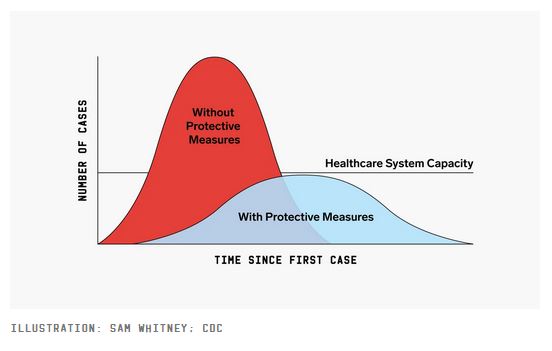
We’ve also been told that we need to flatten the curve. That our systems were not prepared enough for the onslaught that was going to happen.
Some people continued ‘as they were’ while others tried to ‘flatten the curve’.
For a while. Now, after some time, people from both categories have started to entertain second thoughts.
Trying to figure out what’s going on here, I’ve asked my self a couple of questions.
Who had chosen to go on as usual and who had chosen to distance themselves from the rest of the society?
‘Go on as usual’ first: – Those who don’t trust the government. – Those who are convinced nothing can happen to them. – Those who felt they had no alternative. Who live paycheck to paycheck or who provide essential services to the society. Like healthcare for instance. Or those who bake our daily bread. Pump the water we drink. Tend the generators who lighten our bulbs and power the computer I use to write this post.
Now those who attempt to ‘flatten the curve’: – People who tend to trust the authorities. – Those who understand they should really protect themselves. Who are older and/or already sick. – Those can work from home. – And people who are otherwise fine but afford to distance themselves from the fray. Those who have enough resources to do it.
Am I imagining things or the picture is already a lot clearer?
And the other question now. Why the second thoughts?
Because things have unfolded more or less as the government said they were going to. Because things have started to happen. If not to them, directly, at least to some of those living around them. Because there still is no alternative in sight. And because there is nothing much to convince them that their efforts are appreciated by the rest of the society.
Because the government might have been right to tell them to ‘lie down’. But because the same government has failed to do enough in the meantime. Not to mention what it had failed to do before. Because staying put allows you to start thinking. ‘What next? For how long can we go on like this?’
So. What next? What are we doing to convince those who actually keep us going to continue doing so? What are we doing to convince those who have chosen to restrict their lives to a barren minimum that their efforts are worth it?
What are we doing to convince everybody that there will be a life worth living at the end of all this?






 nicichiarasa