Archives for category: freedom

Each of us tries to deliver themselves from the misery of this world.

We attempt that at the intersection of three realities.

The ‘hard’, the ‘virtual’ and the ‘socially constructed’.

The ‘hard’ one is what Marx called ‘the objective reality’. Whatever exists outside our individual minds. Whatever doesn’t need any confirmation from any of us.
For instance, a rock can very well lay on the bottom of the sea without any conscious agent being aware of its existence. No one might ever become aware of its existence but that actually doesn’t matter. Same thing goes for a man made piece of furniture. The original craftsman might die, the owner also,  and the ‘thing’ might be forgotten in a warehouse – or attic – without its existence, ‘in the hard reality’, being jeopardized in any way.

The ‘virtual’ one is whatever each of us makes of what happens around them. It consists of three, separate yet interdependent, ‘ingredients’. The ‘perceived’ realities, the ‘intended’ realities and the ‘engines’ that make all of them possible – our conscious selves.
I’m speaking of ‘realities’ because each of us is different from all others – hence ‘sees’ slightly differently from all others, cannot inhabit the same place in space – hence ‘sees’ the world from a slightly different perspective, doesn’t have the same goals – hence entertains different intentions.

The ‘socially constructed one’ comprises the aggregate consequences of our efforts. Intended and unintended. Known to us and unknown by us.  Belonging both to the physical and metaphysical realms. As in both the Egyptian pyramids and language being parts of the socially constructed reality.

Please note that the first and third ones are ‘objective’ in Marx’s terms while the second in purely subjective.
It is also worth noting that the ‘hard’ reality is not immune to our efforts and that the ‘socially constructed one’ becomes ‘harder’ with the passage of time. The pyramids dotting the banks of the Nile constitute a very good example of our ability to change the ‘hard’ reality while the Catholic Church – one institution among many – is a good example of a metaphysical construct resilient enough to survive for two millennia.

Another very interesting ‘social construction’ is the concept of liberty.

I find it very interesting because it is simultaneously ‘objective’ and ‘subjective’, ‘natural’ as well as ‘man-made’.
It is objective in the sense that it continues to exist no matter how many individuals subject themselves to abject spiritual slavery.
It is subjective in the sense that each of us understands freedom in their own way.
It is ‘man made’ in the sense that we have coined the concept and minted the words used to describe it.
Yet it is ‘natural’ since we all are made of flesh and blood and need to breath in order to stay alive. And yes, it is us who have invented the dog-collar and the leash we use to restrain the liberty of our dogs. Exactly because it is natural for them to try to be as free as possible.

Since this is but a blog post I’ll fast forward to what I had in mind for today.

The free market.

Which is, evidently, a socially constructed institution.
Supposedly, a place which miraculously transforms “private vices” into “publick benefits“.

Well, I’m afraid that those who have convinced themselves that ‘greed is good’ have understood nothing of Bernard Mandeville’s stark warning.

A market may be fueled by ‘greed’, or even by (evil)’vices’, but it is the freedom of those who partake in that market which keeps everything in check.

The communist centrally planned economies were also fueled by individual lust for power. They failed simply because no small group of people is smart enough to master such complicated matters nor humble enough to see/accept its limitations.

The very same lack of freedom has produced the financial crises of 2008.

‘Greed is good’ is nothing but a rationalization of the current obsession with monetary rewards over the very shortest time frame coupled with a blatant disregard for the longer term consequences of our actions.

And as any drug addict can confirm – whenever they are not ‘feeling high’, entertaining any obsession means loosing one’s freedom.

In reality, actually free markets are fueled by trust, not by greed.
And (self)governed by the fact that each participant is free to define/pursue its own interest and react to anything that is happening inside the market’.
Unfortunately, current markets are no longer free. Not that much because of governmental intervention but mainly because too many of the participants are blindly chasing the same narrowly defined ‘interest’.

“But man has almost constant occasion for the help of his brethren, and it is in vain for him to expect it from their benevolence only. He will be more likely to prevail if he can interest their self-love in his favour, and show them that it is for their own advantage to do for him what he requires of them. Whoever offers to another a bargain of any kind, proposes to do this. Give me that which I want, and you shall have this which you want, is the meaning of every such offer; and it is in this manner that we obtain from one another the far greater part of those good offices which we stand in need of. It is not from the benevolence of the butcher, the brewer, or the baker that we expect our dinner, but from their regard to their own interest. We address ourselves, not to their humanity but to their self-love, and never talk to them of our own necessities but of their advantages.”

Smith’s words could not have been any clearer. Each of the participants to the free market wants something different from the market and each of the participants trusts the others to provide those different somethings – as long as the buyers can satisfy the sellers, of course. Nobody gets robbed while everybody gets whatever specific things they had come for.
In modern terms this would have been described as an ‘everybody wins’ situation.

Compare this with the contemporary mantra.
‘Profit maximization’.
Everybody chasing the proverbial ‘fast buck’
‘Enjoy the moment’ & ‘forget about tomorrow’.

And we continue to kid ourselves about the ‘freedom’ of our markets…

Even funnier is how we have twisted Mandeville’s warning to fit our own narrative.

“Millions endeavouring to supply
Each other’s Lust and Vanity …
Thus every Part was full of Vice,
Yet the whole Mass a Paradise …
The bees, however, are not satisfied to have their viciousness mixed with their prosperity. All the cheats and hypocrites declaim about the state of their country’s morals and pray the gods for honesty. This raises the indignation of Jove, who unexpectedly grants the hive its wish.
BUT, Oh ye Gods! What Consternation,
How vast and sudden was th’ Alteration!
As Pride and Luxury decrease,
So by degrees they leave the Seas.
All Arts and Crafts neglected lie;
Content, the Bane of Industry,
Makes ’em admire their homely Store,
And neither seek nor covet more.

In this way, through the loss of their vices, the hive at the same time lost all its greatness.

Now comes the moral:
THEN leave Complaints: Fools only strive
To make a Great an Honest Hive.
T’ enjoy the World’s Conveniencies,
Be fam’d in War, yet live in Ease,
Without great Vices, is a vain
Eutopia seated in the Brain.

Fraud, Luxury and Pride must live,
While we the Benefits receive. …
So Vice is beneficial found,
When it’s by Justice lopt and bound;
Nay, where the People would be great,
As necessary to the State,
As Hunger is to make ’em eat.

Apparently, Mandeville’s verses do not make much sense.
Why would a hive which had successfully purged itself off all vices find itself in a far worse situation after the cleansing?

Let’s first try to understand what those vices were.

Millions endeavouring to supply
Each other’s Lust and Vanity …
Thus every Part was full of Vice

Let me remind you of the fact that Mandeville had lived, and written, during the same period when the Puritans were trying to impose their strict moral code on the rest of the British society. And for the Puritans any attempt, made by ‘millions’, to supply ‘each other’s lust and vanity’ (a.k.a. various personal needs and fancies) was ‘vicious’ in itself.

The point of the whole thing being that it was not the absence of vices which had brought down the hive but the obtuse single-mindedness with which the vices had been banned. A line of thought very much the same with Durkheim’s ‘normality of crime‘.

And not very much different from our current obsession with (short time) profit!


For a long time the Jewish people have written down their thoughts about the world.
At some point, about two thousands years ago, Jesus and his followers reinterpreted those ideas so new books had to be written on the same subject.
Another four centuries later the Councils of Hippo (393 AD) and Carthage ( 397) determined which of those books were to be included in what is currently known as the Bible.

The versions being circulated since were written in Latin, Hebrew, ancient Greek, Aramaic, ancient Armenian, etc.

By 1500 almost nobody but some of the priests were able to read any of them.

So Luther had decided he had to translate it. Into German.

And changed the world.

“Luther’s Bible introduced mass media, unified a nation, and set the standard for future translations.”

Since then, because modern languages are a work in progress, the Bible has been practically rewritten many times over.

Here are three versions of how Cain and Abel were born. Genesis 4:1-2.

And Adam knew Eve his wife; and she conceived, and bare Cain, and said, I have gotten a man from the Lord.

And she again bare his brother Abel. And Abel was a keeper of sheep, but Cain was a tiller of the ground.”

King James Version

Now Adam knew Eve his wife, and she conceived and bore Cain, saying, “I have gotten[a] a man with the help of the Lord.” And again, she bore his brother Abel. Now Abel was a keeper of sheep, and Cain a worker of the ground.

English Standard Version

“Adam made love to his wife Eve, and she became pregnant and gave birth to Cain. She said, “With the help of the Lord I have brought forth a man.” Later she gave birth to his brother Abel.

Now Abel kept flocks, and Cain worked the soil.”

New International Version

What next? I’ve counted 106 different versions, all written in English, on a Wikipedia page…

Luther had translated it because almost no one living in his times was able to read it by themselves.
Nowadays it seems that anybody who cares about the matter, writes their own!

I was under the impression that religion was meant to bring us together…

The Tower of Babel

11 Now the whole world had one language and a common speech. As people moved eastward,[a] they found a plain in Shinar[b] and settled there.

They said to each other, “Come, let’s make bricks and bake them thoroughly.” They used brick instead of stone, and tar for mortar. Then they said, “Come, let us build ourselves a city, with a tower that reaches to the heavens, so that we may make a name for ourselves; otherwise we will be scattered over the face of the whole earth.”

But the Lord came down to see the city and the tower the people were building. The Lord said, “If as one people speaking the same language they have begun to do this, then nothing they plan to do will be impossible for them. Come, let us go down and confuse their language so they will not understand each other.”

So the Lord scattered them from there over all the earth, and they stopped building the city. That is why it was called Babel[c]—because there the Lord confused the language of the whole world. From there the Lord scattered them over the face of the whole earth.”

Who is scattering us now?
Why are we doing this to ourselves?

No matter what opinion each of us entertains about ‘alternate reality’, fact is that none of us is able to grasp all relevant aspects of even the most basic concepts.

Growing under a communist regime I had learned, very quickly, to keep my mouth shut.

Like all authoritarian regimes, communism eventually crumbled.
Mostly under the pressure that had been built from within and which could not be accurately measured, simply because people were conditioned to keep their mouths shut.

Nowadays technology makes it possible for some of us to ‘look’ ‘beyond’ what most understand by ‘freedom of expression’.

… anxiety and action shouldn’t be based only on what could happen in theory as much as what’s likely to happen in practice — and how much it will affect you.

Some people are afraid of sharks. While the prospect of being eaten by a giant fish is vivid and terrifying, it’s also unlikely, old chum. In fact, the drive to the beach is far more dangerous than the swim once you get there.

Likewise, avoid getting hacked. But more important, start taking action on the bigger risk: The stuff publicly posted on social sites.

Alternate meaning of ‘freedom of expression’?

‘You are free to express yourself and I am free to use whatever information you have chosen to share’!

Actually it makes a lot of sense.

Let’s imagine, for instance, that my son comes home and tells us he is going to marry someone.
Twenty short years ago my wife would have phoned her best friend and told her about it. In two days the news would had traveled around and feed back would had poured in, specially if we were living in a small community. We would had been informed about all past indiscretions attributed to our son’s intended spouse, as long as any had ever surfaced.
Nowadays, being technological savvy, my wife would google the name first, even before phoning her best friend – if she wasn’t already privy of ‘enough’ indiscretions, of course.

Would it make any sense to blame the public authorities who do the same thing? Or the private agents who, in their attempt to fulfill their jobs, use whatever information is publicly available about each of us?
My question should have a special meaning for those of you who live in democratic countries – where the public authorities execute whatever mandate you have entrusted them with, and under an economic regime governed by the (more or less) free market – meaning that all ‘private’ agents need at least some support from their stakeholders (yes, that’s you!) in order to remain economically viable.

I’ll come back to this subject.

Meanwhile you can learn more about it by reading the article that spurred my rantings:

“Anything you post can and will be used against you”

Just click on the title.

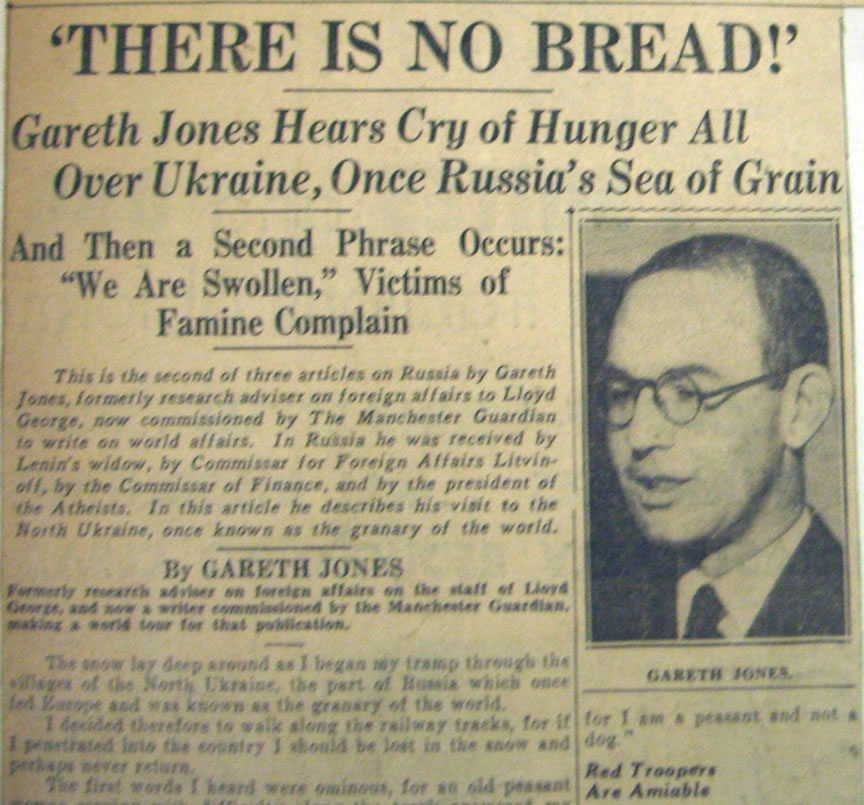
Theoretically it means “from each according to their abilities, to each according to their needs”.

Practically it looks like this.

famine-in-ucraine

In fact real life communism still is, and always was, about a whole country kow-towing to a dictator who pretends to care for nothing else but for the welfare of the people. His people!

The point being that each resource allocation game needs a referee. Otherwise all rational people would take as much as they could carry from the communal reserve – because it is free – and bring back as little as possible, hence nothing if not coerced to – because it implies some effort.

OK, any reasonable five years old would tell you that the communal reserve would very soon become empty if things would go like this – hence that presumably ‘rational’ behavior would be anything but – only it would be very rational to at least try, wouldn’t it? For how long it would work, no matter how short that interval…

And something else.
You are most likely familiar with ‘bad money drives out good’. There have been a lot of examples to prove this, one of them being Christ driving the money changers out of the Temple.
Some of you might not be familiar with how money worked in those days so here is it.
A coin was a simple ‘slab’ of precious metal, of somewhat constant weight, approximately round, which had been ‘stamped’ with the face of the local ruler. At first, in the minting shop, all coins belonging to the same edition were more or less of the same weight. But, since the edges of the coins were not ridged, ‘smart’ people started to ‘shave’ the coins.
And, after the first guy had started to shave them, each individual who got a coin would have been foolish not to shave it, just a little bit. Maybe the next guy would be foolish enough to accept it, after being shaved. To contest it the recipient would have had to go to the money changers and pay for their expertise. And this is how the coins became smaller and smaller…
Only the priests at the temple didn’t want to be fooled. So they hired some money-changers to vet the coins the believers brought to the Temple. The very money-changers that Christ had driven away. “God doesn’t need this kind of guardians. If we keep them here it would mean that we expect people to cheat. Even here, at the Temple. And if we expect them to cheat, they will surely do so!”

Only some people do cheat. And since some cheat, the rest will have to do something about it. Either make cheating the rule, which would lead nowhere, or make it so hard to cheat as to become impractical. Hence the ridges at the edges of the modern coins. Which can no longer be shaved because the ridges would make it obvious.

Coming back to our ‘communal reserve’ you would have to employ a guardian to make it sure that no one would take any more than they really need and that everyone periodically brings back stuff according to their abilities.
But how would that guardian determine what are the real needs and the real abilities of each of those individual members of the community?
And, even more importantly, what would stop the guardian from taking the whole ‘communal’ reserve into his private possession? As in acting like a communist dictator? Simply because ‘he needs it’?

The only alternative that worked was the free market. That where you sold your abilities and where you could buy things to fulfill your needs. Where prices were set at the meeting point between ask and demand.
But the same principle, bad money drive out the good, acts even here.
‘Smart’ people try to organize ‘monopolies’. Which, basically, is the same thing as they attempting to become the owners of the ‘communal reserve’.

This whole thing looks like an intractable vicious circle?
Take heart, that’s what ‘reeds’ are for.
We invented those, when we realized that we needed them, didn’t we?

reeded-coins

You still wondering what to use in order to transform that vicious circle into a virtuous one?
How about individual freedom coupled with a healthy dose of mutual respect?

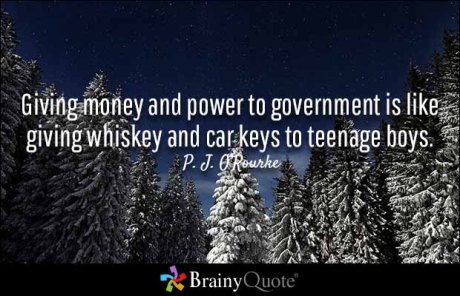
teenager-government

Why am I am trying to make any sense of something said by a comedian?

orourke-trump

Because he’s right?

With a twist, of course!

While ‘government’, all of them, tend indeed to behave like ‘teenage boys’ their actual behavior depends very much on their up-bringing and on the amount of supervising their stakeholders/parents invest in them.

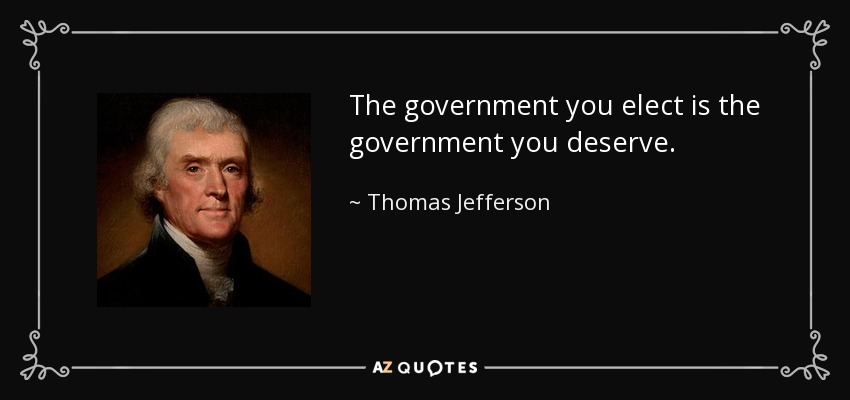
Which brings us to

the-government-you-deserve

Now all that is left for us to do – for ‘all’ of us, that is, including ‘the Government’ – is to remember that the individuals who make up the government also belong to the people. They cannot be essentially different from the people itself and they will, eventually, share the same fate as the rest of us.

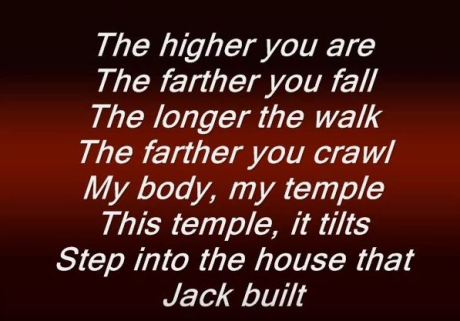
Or even worse.

the-higher-you-are

The House Jack Built, Metallica


donald-trump-grab-them-by-the-pussy-cartoon

Or is it the (unforeseen?) consequence of some very ‘intelligent design‘?

Some people believe that “racial prejudice” is “the natural human inclination … to identity (sic) with members of one’s own tribe, race or ethnic group” and “Post-racial multiculturalism is the exact but equally extreme and insane opposite of Nazi racial ideology“.

Compare this to “Religion, which should foster sisterhood and brotherhood, which should encourage tolerance, respect, compassion, peace, reconciliation, caring and sharing, has far too frequently — perversely — done the opposite. Religion has fueled alienation and conflict and has exacerbated intolerance and injustice and oppression. Some of the ghastliest atrocities have happened and are happening in the name of religion. It need not be so if we can learn the obvious: that no religion can hope to have a monopoly on God, on goodness and virtue and truth“.

What’s going on here?

Where does all this ‘confusion’ come from?

Let me start from the ‘bottom’ of it.

“No religion can hope to have a monopoly on God, on goodness and virtue and truth”.

While I fully agree with Desmond Tutu on the gist of his words I must contradict him on something very important.

Religions cannot hope at all. About anything. Anyway you look at them. No matter which definition you use, religion – all of them – is something that people do together. A common effort.
It is the individuals who are the actual doers. Who love and hate. Or hope, in this case.
Who pretend that their religion is the only true one. Or understand, as Desmond Tutu did, that each religion is yet another manifestation of God.

“Religion has fueled alienation and conflict and has exacerbated intolerance and injustice and oppression.”

Again, it was individual ‘religious’ people who have done all of those things, not religion per se.
All sacred texts have been written by human people. I can even accept that the first manuscript of each religion was directly inspired by God. Only each of them have been copied a thousand times over. And heavily editated.
Then came the individual human people who have read those texts, interpreted them, passed them on and acted upon those interpretations. Upon their convictions, actually.

And this is how “Some of the ghastliest atrocities have happened and are happening in the name of religion”. Not because of ‘religion’ but ‘in the name of religion’.
Simply as a consequence of how certain people have chosen to interpret/use religious teachings.

And not only ‘religious’ teachings.

People are able to interpret – and use in their own (perceived) advantage, every bit of information that comes their way. And now, that we have started to understand more and more about how our brain is working, the manners in which we use that information have become more and more ‘convoluted’.

“Post-racial multiculturalism … began as an understandable overreaction to Nazi racial ideology…before being consolidated by academics into an instrument of socio-political intimidation, rewards, punishments, manipulation and control, a modern, secular replacement for the power-political role of medieval church ideology.”

So.
It was the academics/priests who have done the damage. Not their religion nor the information they had at their disposal.

But why?
How come people whose religions – all of them do this – are adamant about ‘respect your neighbor’ become involved in wars?  Sometimes even in ‘religious’ wars ….
How come academics, whose very job are to teach their students to think autonomously, use their ‘rank’ in order to subdue ‘their’ file?

Could the religious warriors have something in common with the intransigent academics?

How them sharing the unbreakable conviction that they own the truth?
Forged inside the ‘echo-chambers’ where they have grouped themselves according to their specific beliefs? (No matter whether those beliefs are of a religious or ‘rational’ nature…)

Only after I had reached this point in my discourse I was able to fully appreciate Desmond Tutu’s words: ‘Religion … should encourage tolerance, respect, compassion, peace, reconciliation, caring and sharing’.

He doesn’t say anything about giving up on your own kind.
Or about leaving your roots behind.

All he actually says is ‘Be very careful. If all of you will accept to see only the same side of things you will become a herd. And while there is indeed ‘safety in numbers’ all herd members are ultimately headed for the abattoir’.

Diversity isn’t something to be forcefully, hence falsely, celebrated. Or imposed on others.

What we need to preserve, and celebrate, is our ability to ‘walk around’ the things that we encounter. To entertain, and discuss among ourselves, different – even conflictingly different – versions of what we see around us. This ability would only enhance our chances to solve the problems we’ll certainly be faced with.

‘Culture’ is nothing but layer upon layer of place-specific information which have accumulated in time while ‘religion’ is how a certain group of people have learned, again in time, to cooperate in a certain environment.
It doesn’t matter whether that ‘environment’ has been created by a God, has evolved according to Darwin’s theory or both.
What really matters is how we react – conditioned by our cultures and by our religious upbringing – to what is happening to us. Both individually and collectively.

In this sense, each culture we manage to preserve will only add to our chances of long term survival. As long as we’ll learn to sincerely respect each-other, of course.
Again, both individually and collectively.

PS.
A comment on my FB wall, “True religion is God entering history and the lives of humans and revealing Himself. All other religions are man’s attempt to explain the world around him in terms of god or attempts to control lots of other people in the name of some god“, helped me to understand that “There is ‘religion’ – the shared attitude that helps us to cooperate, and there are religions – specific ways that individual communities have traveled in order to attain that attitude.
And something else. What if ‘God entering history’ and enough of us reaching the shared understanding that it is far better to cooperate amongst us – love thy neighbor – than to fight each-other are the same thing?
How to put this understanding into practice? In the various, and continuously changing, circumstances we have to face?

How about this being the very reason for us having so many religions/cultures?

People are very passionate when discussing about their future and their rights.
As they should be.

Children are a very strong ‘avatar’ for our future while the rights to live and to freely dispose of our bodies two of the most important rights.

And this is where things get really complicated.

Some people advocate mandatory vaccination against the most dangerous diseases.
Some people advocate women’s absolute freedom to have an abortion – a few of them extending this right up to the last moment of the pregnancy.

Other people believe that vaccines are mostly benefiting the big pharma and choose not to immunize their children.
Other people believe in the absolute right of the fetus to live – so much so that some of them would even ban all contraceptive methods.

The ‘interesting’ thing here is how this four categories of people intersect each-other.

A lot of the people who advocate women’s right to have abortions also advocate the mandatory vaccination of children while a lot of people who consider abortion a mortal sin also consider vaccination to be inspired by the devil.

Now let me get this straight.
You have the right to ‘kill’ your baby inside the womb but you should not be allowed to let them die of a preventable infectious disease?
You are to defend a fetus, at all costs and against all consequences for the mother, as long as they inhabit the womb only to let them catch whatever preventable infectious disease might come across their path?

Consistency is over-rated?

We really need to restart using our common sense?

‘He just says what he has to say in order to get himself elected. Once he will get there he will do like all the others, he will mellow down. Besides that, the system of checks and balances is too strong for one man to upset it.’

The first, and most obvious, problem with this line of reasoning is ‘why on Earth have we grown so accustomed with being lied that we find it acceptable’? Why do we brush aside so easily the lies professed by ‘our’ candidate – along with many other indiscretions, while we meticulously and vehemently point out those committed by the ‘opposition’? Weren’t we supposed to be making ‘rational choices’ when it comes to who governs the country?

The sad fact that there isn’t much to choose from doesn’t exonerate us from the consequences of our mistakes.

But our laziness has yet another – and even more malignant, ‘after-growth’.

By voting for a candidate who promises rather ‘unsavory’ things in order to get elected we not only encourage him to ‘make good’ those promises but we actually ask him, imperatively ( 😉 ), to do his ‘best’ in order to achieve as many of those promises as he possibly can.

Hoping that once elected he will ‘forget’ about (some of) them is both near-sighted and ‘double-standard’.

Most of my right wing friends – and some from the left, are fretting about taxes and angry about the fact that they, the taxes, are ‘forcefully’ collected by the democratically elected government.

In their interpretation, the majority dictates, by the power of their numbers, the amount of taxes that the ‘fretters’ have to pay. The rationale being that ‘the poor’ help themselves, ‘democratically’, to the hard-worked, or other-wise rightfully owned, private property of the wealthy.
This rationale is a little fallacious – I see taxes as a form of ‘protection fee’, received by the state/government for maintaining a functional environment where everybody, including the wealthy, can take care of their lives and businesses – but this is a different subject.

Others warn us that “The Most Intolerant Wins” and that we must not, in the name of tolerance, tolerate any form of intolerance.

Isn’t it funny that under the current law a minority of Americans, composed significantly of ‘less educated, lower middle class people’, have imposed, upon themselves but also to the entire planet, a right wing President who has wowed, among others, to lower the taxes?

popular-vote

education-and-income

Any complaints?

PS.
Even stranger is the fact that 18% of Trump’s supporters said they didn’t thought he was qualified for the job but that they had ‘nonetheless voted for him, as did 20% of those who felt he did not have the necessary temperament.‘.

Further more “Of people who gave their opinion of the candidate they voted for, 41% strongly favoured them, 32% had reservations and 25% said they disliked the opponents.”