Archives for category: freedom


trump-nbc-favorability-trump

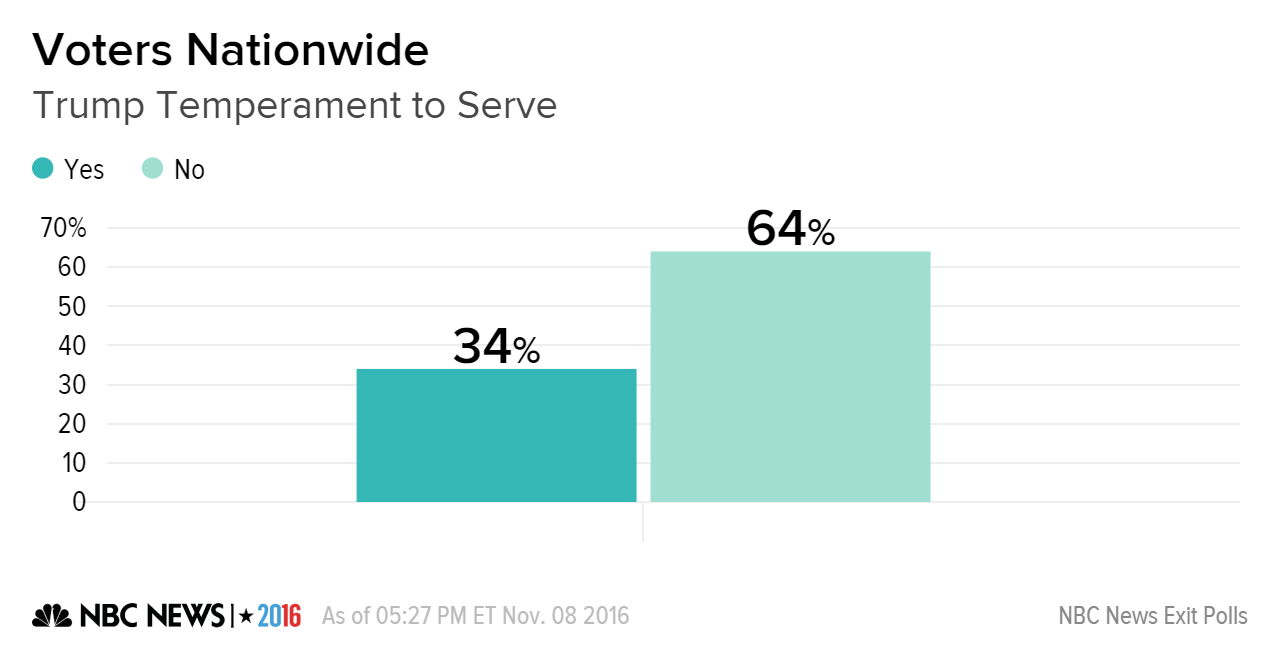
trump-temperament-nbc

1478656414_trump_treatment_of_women

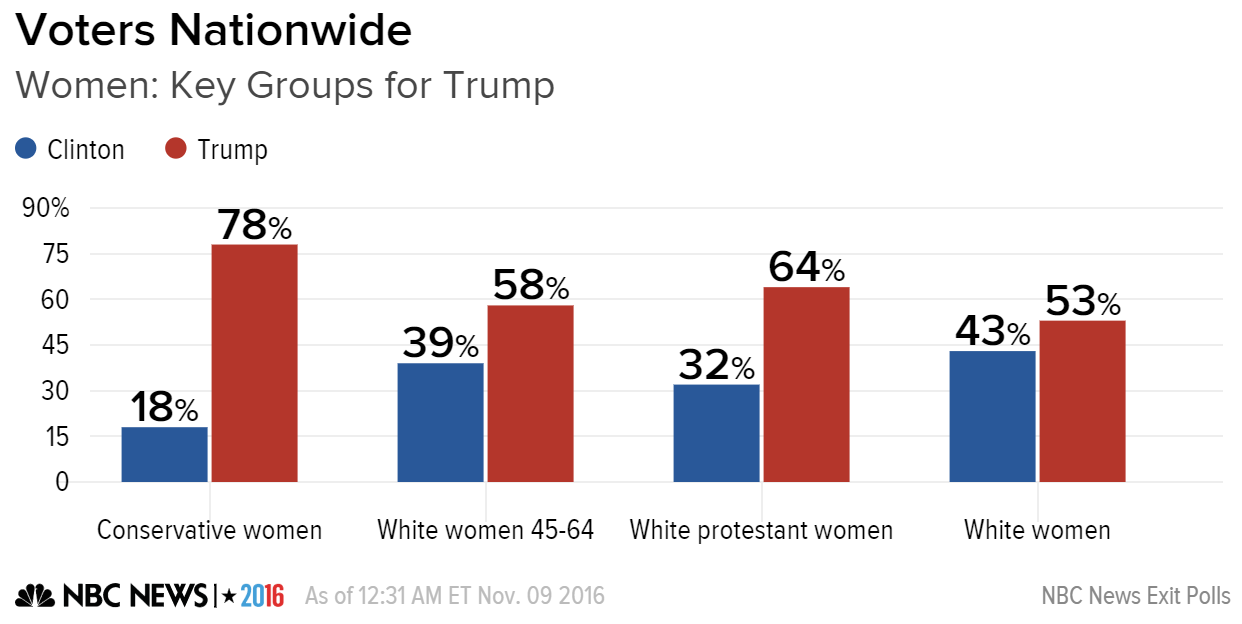
womens-votes

evangelicals-votes

white_catholics-votes

clinton-honesty-nbc

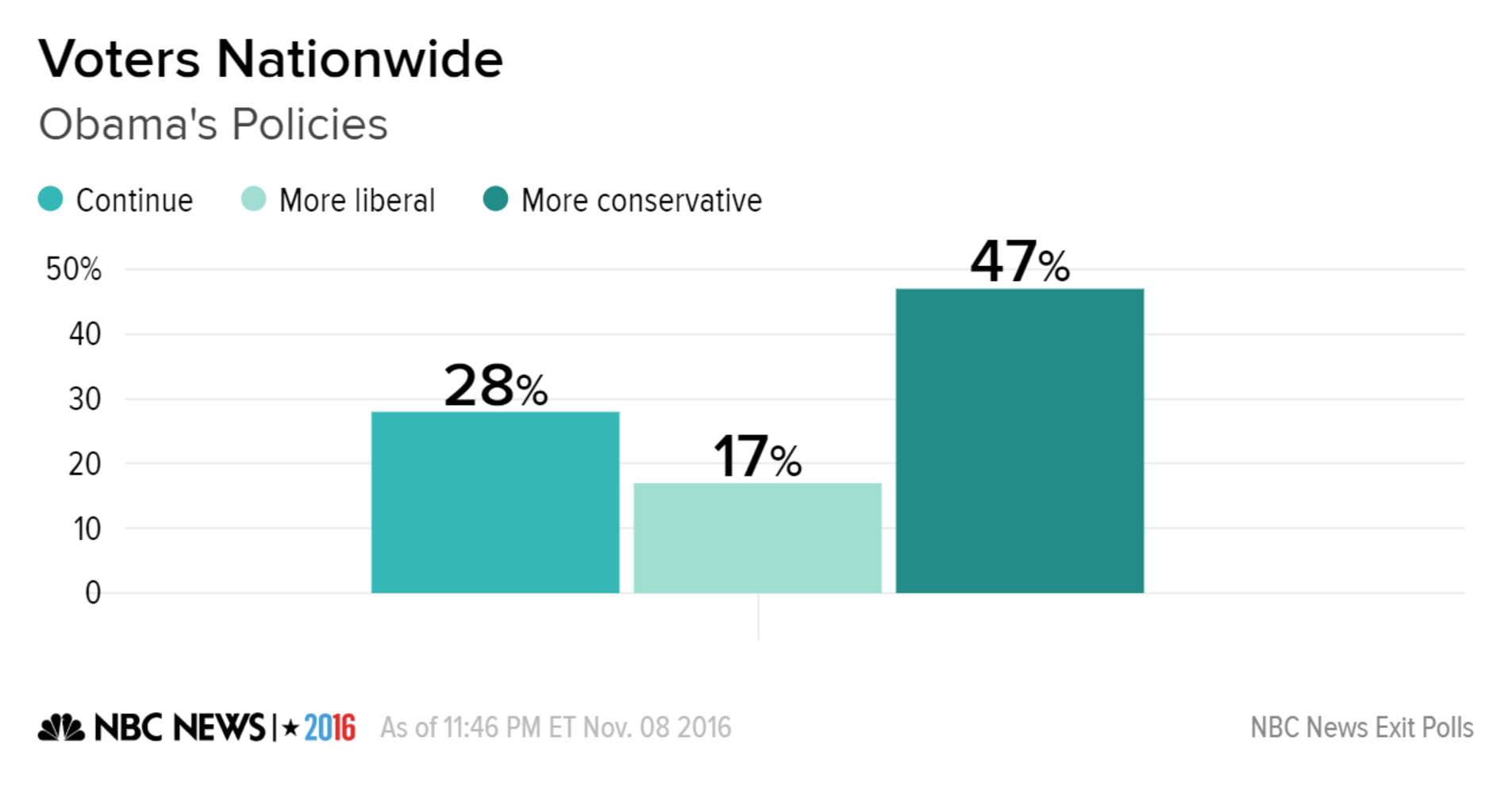
whether-to-continue

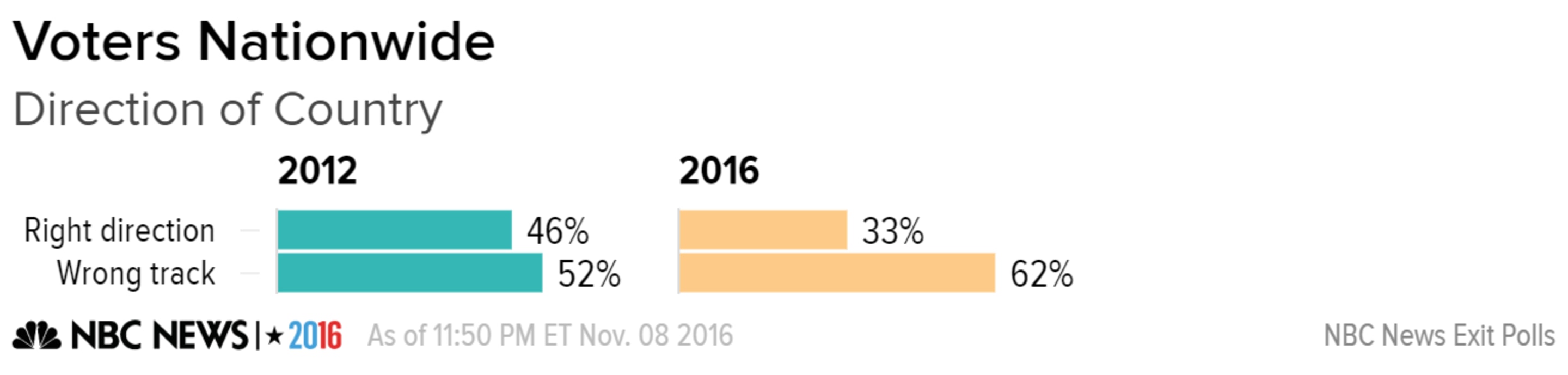
direction-of-the-country

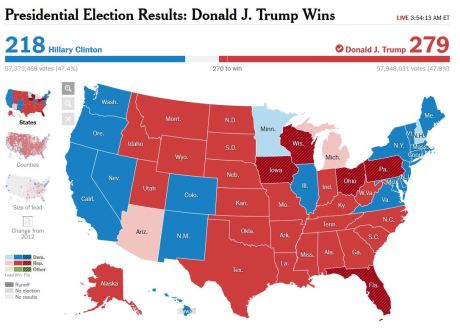
trump-wins

New York Times, Elections 2016

Like always, the dispirited enough to stay at home have given a carte blanche to the  desperate enough to ‘jump into the unknown’!

And no, this is not exclusively about the ordinary voters!
They’ve already sent plenty messages stating clearly that they’ve had enough.
But those whose job was to make things work had chosen not to hear.
Then, when it had become plenty obvious that the boil had been festering for long enough, most of them had stepped aside – leaving at the forefront of the ‘operating table’ a ‘surgeon’ whose long resume was anything but capable of generating trust and a ‘willing’ and ‘enthusiastic’ ‘wannabe’ with no experience.

And now they are trying desperately to find an ‘honorable way out’…


the-final-countdown


“We’re leaving together,
But still it’s farewell.
And maybe we’ll come back
To earth, who can tell?
I guess there is no one to blame
We’re leaving ground (leaving ground)
Will things ever be the same again?

It’s the final countdown.
The final countdown.”

the-final-countdown-2


quote-the-philosophers-have-only-interpreted-the-world-in-various-ways-the-point-however-is-to-change-karl-marx-250986

Change it into what? And on what grounds?

I had spent the first 30 years of my life under communist rule and I’ve witnessed, first hand, the debacle produced by a bunch of people trying to transform the world according to their own liking. And it’s not only that they had brought a lot of misery to an awful lot of people but they also brought it upon their own heads. They, and their families, have been indeed living a lot better than the rest of the people but a lot worse than the ordinary people living in the free world. Not to mention the fact that many of them ended up really bad, some of them at the hands of their own insatiable, Minotaur-like, leaders and some others during and immediately after the regime change.

I’m writing this post after watching Jon Haidt’s excellent lecture “Two incompatible sacred values in American universities“, delivered at Duke’s Departement of Political Science on October 6, 2016.

The point of Haidt’s conference being that each university should clearly declare its ‘telos’ as belonging to one of these two clear cut options:

the-point-of-a-university_dxo

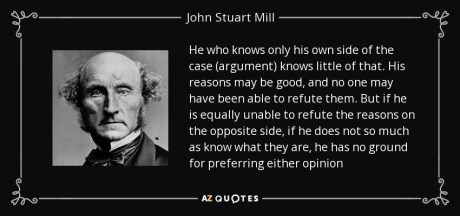
Don’t bother to search the quote attributed to John Stuart Mill.

It is only an interpretation belonging to Haidt himself, who had inferred it from one of Mill’s famous quotes excerpted from  “On Liberty”:
quote-he-who-knows-only-his-own-side-of-the-case-argument-knows-little-of-that-his-reasons-john-stuart-mill-125-0-0981

So, what should it be?

Change or Truth?

Before proceeding any further I strongly suggest that you take some time and listen to Haidt’s excellent arguments.

Now I’d like to discuss a little about ‘Change’ and ‘Truth’.

What both Marx and Haidt have in mind when they speak about ‘change’ is both ‘purposeful’ and ‘centralized’.
When they say ‘change’ they mean an ‘effort towards increased social justice’, effort whose parameters would be determined by the wise men (and women) delving in the depths of the University’s libraries and which would be implemented without fail, preferably with a sanction from the higher authority.

I had already mentioned, at the beginning of my post, where such ‘change’ would lead anyone  attempting to put it into practice.
And Haidt gives us an excellent explanation for why anybody who will ever attempt such a thing would eventually fail. (I told you to watch his conference…It may be long but every minute of it is packed with very interesting things!)

So why is Haidt challenging us to make this choice instead of giving us a clearer piece of advice?

Well… maybe you should ask him that… I’d hate to believe that he, in his own words, ‘has become afraid of that too many of his students might feel that he is so distanced from what is generally accepted that too few of them would follow him’.

So what should we do?
Some of us should embark on a ‘sterile’ search for the (absolute) truth and then, after eventually finding it, nurse it quietly in our lap but refrain from an even minutely more drastic action while others should attempt to implement change based on already ‘over the hill’ principles?

I’m afraid that would be a dangerous road to follow.

There is no such thing as an ‘absolute’ truth that might be nursed in our lap and even if there was such a thing we are not able to find it – individually or even as a group. There’s plenty evidence about that in Haidt’s discourse.
And then what would be the use of the whole enterprise if we are not planning to use the results of our quest, whatever those might be?

And here lies the crux of the matter.

I’m sure Haidt knows what I’m going to tell you now and I’m very sorry that most of your teachers have never mentioned at class this very interesting story.

Marx was not the first revolutionary thinker of his time.
OK, you already know that. There were a certain number of French intellectuals whose writings have set the stage for the 1789 Revolution.
What is less known is that John Stuart Mill himself had been groomed by his father “as the future leader of this radical movement”, whose aim was supposed to be “social reform based on utilitarianism” with the goal of attaining “the greatest happiness of the greatest number“.

The only difference between James Mill (the father) and Karl Marx being that Mill didn’t advocate the the forceful confiscation of the ‘means of production’.
Otherwise both were faithfully following Plato’s dictum:
Until philosophers are kings, or the kings and princes of this world have the spirit and power of philosophy, and political greatness and wisdom meet in one, and those commoner natures who pursue either to the exclusion of the other are compelled to stand aside, cities will never have rest from their evils, –nor the human race, as I believe, –and then only will this our State have a possibility of life and behold the light of day. Such was the thought, my dear Glaucon, which I would fain have uttered if it had not seemed too extravagant; for to be convinced that in no other State can there be happiness private or public is indeed a hard thing“.

Well, the problem with this line of thought is that it doesn’t work.
Again, Haidt has already presented a solid case about this and I’m not going to re-count his arguments.

So, since there is no such thing as an absolute truth to be discovered, one way or another, and no priest-kings on any white stallions that might come to our rescue, what shall we do?

Simple.
Follow Haidt’s, and John Stuart Mill’s, advice and take it one small step further.

The point of a university is to understand the world because only if you commit to truth, I believe, can you actually achieve justice.

We need to understand, and accept, two things:
Change has to be allowed to come naturally, not pushed forward simply because we are momentarily convinced that ‘The Truth’ had downed on us,
And that (social)justice is a process which has to be implemented on an ‘as needed’ basis, not an independent goal?

In fact Mill’s personal destiny is eloquent enough for what happens when somebody tries to breed a ‘perfect’ Priest-King.
“But in 1826, Mill began to suffer from a severe depression, which he attributed to his excessive analytical training and the resulting impairment of his emotional capacities. Reading the romantic poetry of Wordsworth and Coleridge helped Mill to overcome this mental crisis. It also inspired him to form a more complex view on human flourishing than the Benthamite utilitarianism of his father’s generation, with its dogmatic rationalism and unidimensional concept of pleasure.”

And this is why Haidt is absolutely right when he tells us that we need to expose ourselves to a lot more than what we are already familiar, and comfortable, with.
And this is why Heidegger kept warning us that truth as conformity between our words, or even our understanding, and the reality of the fact that we try to understand, and describe to others, is a Fata Morgana which consistently eludes us and that the only way to get any closer to her is ‘unhidennes’.

In this sense there is nothing better than an open mind, both towards our innermost thoughts and to the people living, and thinking, around us.

A mind open enough as to be able to simultaneously attempt to implement whatever changes become necessary in the light of the newly discovered truths AND accept the possibility that those ‘newly discovered truths’ might be incomplete or even altogether false.

Does all this seem rather schizophrenic?

Then let me rephrase the question I started with.

What’s the use of ever trying to understand anything if we’re not going, ever, to change our behavior as a consequence of anything we might come to figure out and on what basis is anyone to attempt any change if he never tried to understand anything above what he already knew long before he even started to think about any change?

As I was ready to close this post I stumbled upon the thought that maybe Haidt meant to apply in the academic world a principle that has been proved invaluable in the political life.

‘Separation of powers’.

Some universities would busy themselves with finding ‘the truth’ while others would attempt to find ways to put ‘it’ into practice.

Leaving aside the fact that this would smack too much of Marxism for my taste I’ll have to remind you that the separation of powers has become necessary in the political realm only because the government has an effective monopoly on power and we need to make it so that it cannot abuse this situation.

No university has any monopoly on truth and/or change.
Furthermore, not even the Academia, as a system, has been able to implement such a monopoly. Not for lack of trying, but that’s another subject.

So, instead of acquiescing to such efforts – by accepting certain universities as official ‘truth seekers’ and others as ‘path finders’/’change implementers’, we’d better ask each and all of them to clean up their acts.

And open up their collective minds.


If you are not aware of at least some of the many ‘forces’ which attempt to control your mind, at least in part, you are just as ‘out of your mind’ as those who believe their minds are successfully and consistently controlled by outside agents.

And those who are convinced they are in control of other people’s minds.

Just stumbled upon this joke:

One day, all the human body parts started arguing about who was on top… The mouth said, ”I should be on top because, without me, you wouldn’t be able to eat.” Then the stomach said, ”Ya but if it weren’t for me, you wouldn’t be able to digest and transfer all the minerals and vitamins throughout the body, I should be on top.” Then the heart said, ”I should be on top because I’m the one who takes the blood from point A to point B. Without me, the body would die.” Then the brain said, ” Well, without me, you wouldn’t be able to move, eat, digest or allow circulation of blood, so I should be on top.” Now, the asshole was beginning to get annoyed, ”You know, I should be on top because I can just shut my hole and then shit will accumulate and block the digestive track and screw all of you up.” It was chaos, everyone was yelling and fighting. Finally, the asshole got fed up, ”That’s it, I’m fed up, I’m shutting up my hole.”

So for a few days, the body couldn’t shit and the brain had trouble moving, the stomach digesting, the mouth eating and the blood flow going, everyone was begging the asshole to open up, The brain said, ”Please open up, you made your point, your on top, just open up.” The asshole smiled, ”So everyone agrees that I’m on top?” ”YES” everyone shouted. ”OK!” so the asshole opened up and the body could shit again. The moral of this story is, you have to be an asshole to be on top…“

Isn’t this interesting?

A bunch of guys are too thick to understand that they cannot live one without the others and to learn what mutual respect really means, one of them decides to teach the group a well deserved lesson and it is he who ends up being considered an ass-hole…

On the other hand… there are so many examples of ass-holes who end up ‘on top’ simply because they are the ones willing to do anything in order to get there – not caring at all if their actions hurt everybody else who happens to be around… AND because those who end up being hurt don’t see it coming or are too lazy, too thick or both at the same time, to do anything about it…

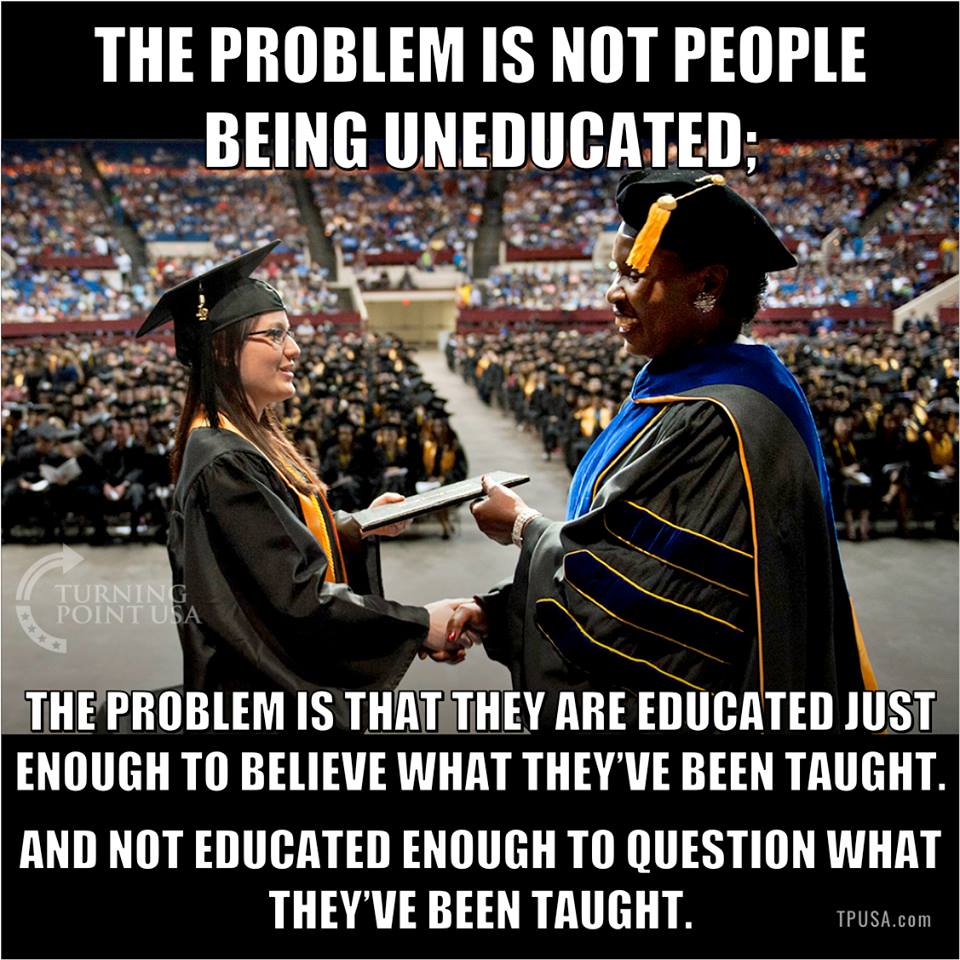
donald-trump-andy-borowitz

Besides the fact that calling someone an “ignorant” is a very ‘Trump’ thing to do in the first place, what if the real problem is that we have allowed ‘it’ to become a ‘system’ in the first place?

This way, after the process of learning and teaching has become a ‘system’, the ‘open market’ for ideas has become a very well – actually very badly – controlled oligopoly.
Learning means seeing and understanding the world around us. Teaching means passing around, and forward, the above mentioned knowledge and the meaning we’ve made out of it. Which ‘passed around knowledge and meaning’ shapes the way the ‘students’ go further. Deepen the knowledge and build future meaning.
In fact the very breadth of our species future depends on how past learned knowledge and built meaning had been passed around.
And what we have today, the current ‘social unease’, is the product of the manner in which we have been taught to see the world. Of the meaning we find in it.

Trump, as a social phenomenon, is nothing but yet another symptom of the current ‘malaise’. The incapacity of the contemporary society to make room for everybody is, simply put, a consequence of  information no longer flowing freely around. Of information being, tighter and tighter, controlled by the ‘system’.
The simple fact that Trump, if elected, has promised to put his stamp on the ‘system’ only proves this point…

Coming back to the ‘system’, the only way to fix it is to open it up, widely. If we continue to allow ‘it’ to divide us into ‘insiders’ and ‘outsiders’ (read ‘properly educated’ and ‘ignorant’) we will actually perpetuate ‘the problem’.

chded7au4aadm5

Specially after more of his antics have came to light…

I couldn’t find any current data so I’ll have to make do with what the Atlantic had published a month ago.

trumps-base

So, a little over 12% of his votes come from college, or higher, educated women while the total is no less than 48%.

Now, would you care to guess which of these women will continue to disregard his being ‘automatically attracted to beautiful’ and keep rooting for him?

Would you even consider Hillary Clinton as a likely candidate?

“Even though she found the job distasteful, Rodham mounted what she felt was her strongest possible defense of Taylor. As Newsday reporter Thrush wrote in 2008, “Her approach, then and now, was to immerse herself in even unpleasant tasks with a will to win.””

At that time Clinton had been ordered by a judge to defend a rapist – which all practicing lawyers can expect to be asked to do.
“Once she no longer had a choice in the matter, Clinton said in a 2014 interview that she had a professional obligation to give Taylor the strongest possible defense.

“I had a professional duty to represent my client to the best of my ability, which I did,” she said.

Gibson (the prosecutor who tried the case)  recalled that the young lawyer worked overtime on the case in hopes of impressing the court, which might them help establish the reputation of her new legal aid clinc.”

Further more:
“Despite her discomfort with the case, Clinton aggressively defended her client. In an affidavit to the court, she said a child psychologist had told her that children “from disorganized families,” such as the victim, “tend to exaggerate or romanticize sexual experiences.” “

In this sense is it possible that even a college educated woman, like Hillary Rodham Clinton, might vote for somebody like Trump, simply because she might consider other things to be more important than his bragging about ‘grabbing beautiful women, who allow him to do it because he is a “star”, by their pussies’?

OK, you’ll tell me that in the voting booth each of us should behave in a ‘personal’ rather than a ‘professional’ manner.

I’ll up the ante and ask you what kind of person is able to efface his/her personal self so efficiently, simply in order to ‘help establish his/her professional reputation’?

Or accept a gleeful ‘pussy grabber’ as the most powerful person on Earth?

“The purpose of Halacha is to disturb. To disturb a world that cannot wake up from its slumber because it thinks that it is right.”
Rabbi Dr. Nathan Lopes Cardozo

What is currently known as the ‘North Atlantic Civilization’ is a construction whose blue prints have been initiated in the Middle East, on the Banks of Jordan.

The Jews, those who had started the process and one of the very few peoples/cultures who have survived since that era, have reached a very interesting stage in their development.
Rabbi Dr. Nathan Lopes Cardozo discusses, in a series of articles, some very important ‘contemporary issues’.
For those of you who are unfamiliar with the context:
“The word “halakhah” is usually translated as “Jewish Law,” although a more literal (and more appropriate) translation might be “the path that one walks.” The word is derived from the Hebrew root Hei-Lamed-Kaf, meaning to go, to walk or to travel.”
Yigal Amir had killed Yitzhak Rabin in an attempt to halt the Oslo Peace process and
Baruch Goldstein had killed 29 and wounded 125 in “the Muslim prayer hall at the Tomb of the Patriarchs in Hebron.

When reading Dr. Cardozo’s considerations please engage yourself in a mental experiment. Try to identify at least one aspect of those mentioned here that doesn’t fit the rest of the North Atlantic cultural space.
I encourage you to use the links and read Dr. Cardozo’s articles in full. I have selected some of his words trying to suggest something, there is a lot more to be learned there.

“One of the greatest tragedies of Judaism in modern times is that certain halachic authorities, as well as people like Yigal Amir and Baruch Goldstein, forgot to study the first book of the Torah. They have become so dedicated to the letter of the law that they have done the inconceivable and have caused the degradation of Halacha.”

http://www.cardozoacademy.org/thoughts-to-ponder/the-desecration-of-halacha/

“It is for this reason that Halacha has always developed on the basis of case law, and not because of overall well-worked-out ideologies. It is sui generis. Much depends on circumstances, the kind of person we are dealing with, local customs, human feelings, and sometimes trivialities. God, as Abraham Joshua Heschel explains, is concerned with everydayness. It is the common deed—with all of its often trivial and contradictory dimensions— that claims His attention. People do not come before God as actors in a play that has been planned down to the minutest detail. If they did, they would be robots and life would be a farce.”

http://www.cardozoacademy.org/thoughts-to-ponder/chaos-theory-halacha-part-1-3/

“Not only do we see a considerable amount of chaotic halachic literature, published by numerous authorities, which seems to lack consistency and order, but we may even find contradictions in the various writings of one halachist. This doesn’t mean that the writer lacks a particular line of thought and some basic principles; it just means that within these norms almost everything is an open market.

I believe this is the reason why the Conservative movement, with all its good intentions and great scholarship, was unable to grasp the imagination of many halachic authorities. It is not the lack of knowledge, but rather the over-systematization that is responsible for this. Once there is too much of a unified weltanschauung and agenda, Halacha loses its vitality. The multitude of attitudes, worldviews, chaotic thinking and sometime wild ideas, through which the greatest halachic authorities freely expressed their opinions, is what kept the Orthodox halachic world alive. In some sense, and even almost paradoxically, Orthodox Halacha is less fundamentalist than Halacha in other movements within Judaism.

None of this should surprise anyone. When looking into the Talmud, which is the very source of Halacha, we find a range of opinions so wide, and often radical, that it is almost impossible to find any sense of order. There’s a reason why the Talmud is compared to a sea in which storms create unpredictable waves and turbulence. The revealed beauty of this natural phenomenon is what attracts people to gaze at the sea for hours on end. It reflects their inner world, which thrives only in the presence of tension, paradox and chaos.”

http://www.cardozoacademy.org/thoughts-to-ponder/chaos-theory-halacha-part-2-3/

“In my opinion, Halacha is in need of more “chaos.” It must allow for many ways to live a halachic life unbound by too many restrictions of conformity and codification. It must make room for autonomy on the part of individuals, to choose their own way once they have undertaken to observe the foundations of Halacha. Acceptance of minority opinions will have to become a real option, and some rabbinical laws must be relaxed so that a more living Judaism will emerge. While some people need more structure than others, in this day and age we must create halachic options that the codes such as the Mishneh Torah of Maimonides and the Shulchan Aruch of Rabbi Yosef Karo do not provide.

Surely those who prefer to live by the strict rules of the codes should continue to do so. For some, these rules are actually a necessity – even a religious obligation – since this may be the only way they can experience God. But they should never become an obstacle to those who are unable to adhere to them. Labeling these new approaches “non-Orthodox,” or “heresy,” is entirely missing the point.

I wish to be clear: I am not advocating Reform or Conservative Judaism which, as I stated earlier, have paradoxically become overly structured and agenda-driven. They lack sufficient “chaos” to make them vigorous.

While there is great beauty in attending synagogue three times a day to pray, we clearly see that much of it has become mechanic – going through the motions, but no religious experience. Yes, it’s better than not being involved in any prayer at all, but the price we pay is increasing by leaps and bounds. It is pushing many away. Codification is the best way to strangle Judaism. By now, Orthodox Judaism has been over-codified and is on its way to becoming more and more irrelevant.

I believe that one of Halacha’s main functions is to protest against a world that is becoming ever more complacent, self-indulgent, insensitive, and egocentric. Many people are unhappy and apathetic. They no longer live a really inspiring life, even though they are surrounded by luxuries, which no one would have even dreamed of only one generation ago.

The purpose of Halacha is to disturb. To disturb a world that cannot wake up from its slumber because it thinks that it is right. The great tragedy is that the halachic community itself has been overcome by exactly those obstacles against which the Halacha has protested and for which it was created. Halachic living has become the victim of Halacha. The religious community has succumbed to the daily grind of halachic living while being disconnected from the spirit of Halacha, which often clashes with halachic conformity for the sake of conformity. Many religious people convince themselves that they are religious because they are “frum.” They are conformists, not because they are religious but because they are often self-pleasers, or are pleasing the communities in which they live.

Large numbers of religious Jews live in self-assurance and ease. The same is true of the secular community. Both live in contentment. But as Rabbi Dr. Louis Jacobs notes: “Who wants a life of contentment? Religion throughout the ages has been used to comfort the troubled. We should now use it to trouble the comfortable…” ”

http://www.cardozoacademy.org/thoughts-to-ponder/chaos-theory-halacha-part-3-3/

“It is as irrational to reject all conspiracy theories as it is to accept them.”

Nassim Nicholas Taleb

Conspiracy theories are similar to religious superstitions.
They offer comfort to the emotionally insecure and create a meeting ground for the like minded.

Unlike full grown religions they lack a proper structure but that doesn’t mean their main ideas are not used for propaganda purposes, just as all religious dogmas have been. And still are….

Another difference between conspiracy theories and religions is that while both have been produced by human minds some of the conspiracy theories had been proven true while the most that can be said about religions is that they had been useful …

But what is a conspiracy theory and what does Utopia have to do with anything?

“Conspiracy theories as a general category are not necessarily wrong. In fact as the cases of Watergate and the Iran-Contra affair illustrate, small groups of powerful individuals do occasionally seek to affect the course of history, and with some non-trivial degree of success. Moreover, the available, competing explanations—both official and otherwise—occasionally represent dueling conspiracy theories, as we will see in the case of the Oklahoma City bombing…[but] there is no a priori method for distinguishing warranted conspiracy theories (say, those explaining Watergate) from those which are unwarranted (say, theories about extraterrestrials abducting humans).” (Brian Keely, Of Conspiracy Theories)

According to this definition a conspiracy theory is a ‘shape-shifter’. The notion covers both the true and the bogus ones while it can be used both ‘admiratively’ and disparagingly.
Again, just as it happens with religion, the mind set of those who consider each of them is of paramount importance.

Meanwhile ‘Utopia’ is, yet again, another creation of the human mind.
While religions and conspiracy theories are shared mental constructions that try to explain something which already exists Utopia is a shared mental construction which describes the ‘ideal’ state of  something that already exists and is perceived by those who experience it as being ‘perfectible’.

The link between all these being that the only two roads that lead to Utopia are, of course, ‘religion’ and ‘conspiracy theories’.

Am I being too harsh?

Utopia, “an imagined place or state of things in which everything is perfect“, is a word coined by Sir Thomas More “for his 1516 book Utopia, describing a fictional island society in the Atlantic Ocean.“. It “comes from the Greek: οὐ (“not”) and τόπος (“place”) and means “no-place“, and strictly describes any non-existent society ‘described in considerable detail’.”

Now why would a reasonable person attempt to reach a ‘no-place’ unless conned into it by a ‘conspiration’? No matter how desirable that ‘place’ might be…

The way I see it this is yet another argument that rationality is not at all the perfect ‘balancing’ tool some of us believe it to be. In fact we are not ‘rational’ at all but ‘rationalizers’. Since it is impossible to gather and analyze all pertinent information before making a decision we try to convince ourselves, and others, that the decision we are about to make (or have already taken) is the right one. In order to do that we marshal all arguments we can find that confirm our hypothesis and we (honestly?) try to water-down those who are contrary to our views.

Until our coveted utopia becomes a real-life dystopia…

That makes a lot of sense, doesn’t it?

What would we be without ‘our values’?
How could we judge things/people and evaluate situations without being guided by them?

But what if the ‘objects of our judgement’ do not belong to the same value system as we do?

What then?

I’m writing this immediately after reading a FB post. A female teacher, who ‘tries to be vegan’, has rather abruptly informed one of her female students “I don’t eat animals”, right after she had finished boasting about hunting a deer with her father. The student’s face ‘fell of’ and the teacher was wondering whether the Principal will chastise her.

So.
Is ‘not eating animals’ a value?
What is a value, after all? And do we go on affirming our values on every occasion?

By Google-ing ‘value’ one gets “principles or standards of behaviour; one’s judgement of what is important in life.”they internalize their parents’ rules and values””
It seems that a value is something extremely personal, ‘one’s judgement of what is important in life’, but also something that is learned from somebody else, “they internalize their parents’ rules and values”…

In this situation it would it be safe to say that a value is something which is simultaneously considered important by both a group and the individual members of that group?

Doesn’t make much sense? Except from an ‘arithmetical’ point of view?

Well… Let me give you an example.
Europe used to be a Christian continent.
Not anymore. A considerable number of Europeans no longer belong to any church and a lot of them do not consider anymore that God is their Maker.
But, on the whole, most Europeans still consider Christianity to be a ‘value’. Because they understand the role played by Christianity in the development of humankind, because there still are a lot of people who share this faith… the really important thing here being that very few Europeans would purposefully deface a Christian symbol, even when/if nobody would ever find out who did it. And this is valid even for the majority of the hard-core atheists.
At the same time, very few Europeans would – even among the believers – dream of imposing their creed, by force, on other people.

So what is the real value here? ‘Faith in God’ or ‘Live and let live’?

Actually I’m convinced that there is a direct connection between these two.

The Old Testament teaches us that ‘God made Man in his own image.’
It is very simple to make another step forward and understand that those who had written this believed that all men (or at least all those who shared their values) were equals among them (simply because they had been cast in the same ‘mould’) and, at the same time, that each of them shared at least a spark of divinity (the mould having a divine origin).
Europeans shared this value for two millennia.
No wonder that at some point it had morphed into what we now call ‘the human rights’ – a very similar concept/value, which produces the same social consequences: ‘Live and let live’.

Then how come some of the Christians felt very comfortable when using the sword as an argument to convert ‘the pagans’ to the only ‘true religion’?

Well… an alternative definition for ‘value’ could be ‘a certain conviction, reached out rather as a consequence of a specific set of circumstances than as a rationally deliberated conclusion, and shared by the members of the group living under those circumstances’.
According to this hypothetical definition the functional role of a value would be to ‘make it easier’ for each of those people. The ‘shared’ value would constitute a communication medium among the members of the community and a standard/guide for each of the individuals.

The problem with all this, as proven all along the human history, being that from time to time people act as if ‘values’ are ‘castles to be defended’. Or even ‘banners which have to be implanted on conquered soil’. Remember the Christians who used the sword to baptize pagans? Or the pyre to cleanse the souls of the sinful witches and those of the wicked heretics?

What happened in those moments with ‘Live and let live’? What drove those people to forget that ‘the others’ were also made ‘in His image’?

Or, in our days, how come there are so many people who consider that it’s OK to practically insult others while professing their own ‘values’. Which are not so widely shared as they would like them to be.

The strangest thing of all being that this very insistence, which sometimes becomes bullying, constitutes one of the reasons for which some of those values have such a hard time being accepted by ‘the others’.

Plant and fungi simply exist.
Animals ‘perform’.

Basically the main difference between plants and animals is that while plants – and fungi, ‘digest’ parts of their environment, the animals actively search for food and perform other activities which help them survive or result in the individual performer experiencing ‘pleasure’.

Most animals, number-wise, behave as if they were pre-programed. They act ‘instinctively’. Almost plant-like, only enjoying a lot more physical freedom. A bed bug will move a lot more than the plant on your night-stand but that doesn’t mean the bed-bug is considerably more intelligent than the lavender which guards your sleep.

At least some of the animals can learn. Meaning that individuals can alter their behavior, consistently, to suit changes in their environment. As if the ‘programs’ that have been ‘hard wired’ in them allow the individual members some leeway. As if parts of those programs can be re-written, at will, by the individual members themselves. And they don’t even need a brain to do that. These kinds of animals seem to enjoy a different sort of liberty than the simple liberty of movement

As we climb higher and higher up the evolutionary tree we encounter ‘trainable’ animals.
Which can be ‘convinced’ to perform a certain skill. For instance Norman, a dog, who has been bribed/trained to ride a bike.

dog-riding-a-bike

Animals who can be trained usually can also learn by themselves. Wolves, and dogs, learn how to hunt by watching their brethren while a simple slime, as we learned earlier, can learn how to deal with certain chemicals.

Men have taken this to the next level.

Animals, as opposed to plants, have a certain liberty. They can move. It’s exactly this liberty which sets the stage for their ability to be trained. By the environment – the wolf who doesn’t learn to hunt ends up hungry, or by a trainer – the dog who rides a bike gets tasty treats.

People, the human beings, enjoy an even wider liberty than the rest of the animals. Those who grow up surrounded by other human beings, of course.
The handful of individuals who had the misfortune to grow up lacking adequate attention from members of their own species had failed to develop a certain part of their mind, hence they remained prisoners, even after being ‘found’, in the ‘animal kingdom’.
It’s as if a certain ‘opportunity window’ has to be used before it inexorably closes, sometime between the 5-th and the 10-th anniversary.

If all goes well, human individuals are conditioned – first by training and later by learning – by those around them into something which is deemed to be the ‘acceptable behavior’, as per the social standards valid at that moment in time.
During this conditioning process most individuals also learn – mainly by trial and error, as opposed to ‘being trained into it’, how much individual freedom is included in those social standards.

At some point during this conditioning process, which actually never stops, the individual is considered ‘mature’ enough to be held fully responsible for his fate/actions.
This ‘moment’ has varied significantly during our history and it depended on many variables besides the obvious one – individual proficiency. Well… usually even that was measured indirectly, by considering the age of the individual.
And, for most of the time, Lady Luck has been the most important factor in determining how much freedom was going to be enjoyed by a certain individual. One could have been born a slave, a slave owner, a free person, a man, a woman, a serf, a landowner, in Europe, in sub-Saharan Africa during the TransAtlantic slave trade, in Hitler’s Germany, in Stalin’s Russia, in Pol Pot’s Cambodia, in North Korea…

In each of these situations he had to learn, fast, a skill. In order to make himself useful enough to the rest of ‘his gang’ so that they would ‘make some room’ for him. So that he would be able to trade the results of his skillful work for the ‘resources’ he needed in order to survive or even to prosper.
In order to be efficient, one must also become ‘meta-skilled’. Being skilled, at anything, is almost never really useful if one doesn’t know when/how to use his skills.

And, on top of all this, one should also learn to what end to use his skills.
Choosing properly one’s goals – and being able to evaluate correctly what others do or promise to do, is important not only for each individual but also for those who had helped into his conditioning – if they are still around, for his other contemporaries and also for their children.

Let me give you an example.
Driving a car is a skill. A rather basic one. So basic that a monkey could do it.
Learning to refrain from driving when you are too tired, or in a blizzard if the vehicle is not suitable, is a meta-skill. Sometimes a lot more important than the mere ability to start a car and to drive it from A to B.
Volunteering to drive an unsuited vehicle trough a blizzard to save somebody’s life or refusing, despite being offered a huge bribe, to drive a lorry full of hazardous waste to an illegal dumping site is what gives the real measure of your true self.

And, also, how free was the society that helped in your ‘conditioning’.