
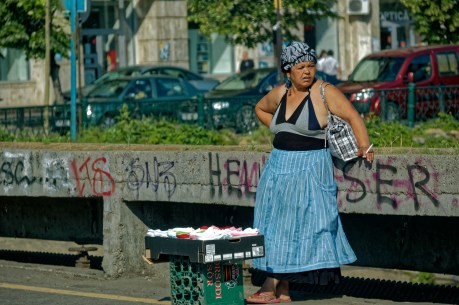
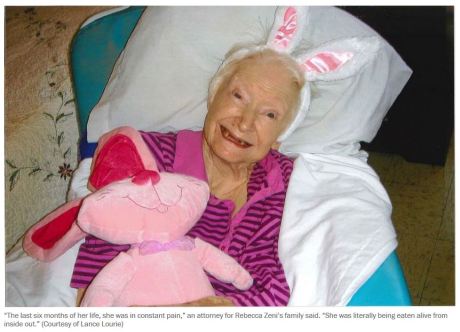
The way I see it, this lady is freer, in body and mind, than most of us will ever be.
The way I see it, this lady is freer, in body and mind, than most of us will ever be.
Well, this is yet another perfect example of a sentence simultaneously true, false and indeterminable …
First of all, it is indeterminable simply because we’ll never know, let alone ‘for sure’, everything ‘under the sun’.
It is obviously false because we continuously discover things previously unknown to us. From another trench on the bottom of the ocean to a new satellite circling around Jupiter. Not to mention the huge number of materials and gadgets which have not ‘seen the light of day’ until the moment they have been invented by us. And they might have been made starting with raw materials which had previously existed… but denying their novelty would be shortsighted… to say the least.
And it is obviously true because no matter how many things we have discovered/invented, we have remained practically the same. We entertain the same passions and fears, we continue to behave in certain ways…
And the worst part is our refusal to learn from past experiences…
We’ve experienced the malignant consequences of the extreme ‘propaganda’ used by the nazis during WWII.
By the communist regimes trying to build ‘the new man’.
And we’re currently ‘repackaging’ the same king of destructive propaganda into ‘fake news‘…
Are we nuts?
Specially that we already know that what we learn actually changes our brain…
Being alive means being able to interact with the environment.
In various manners.
From the prosaic – ingesting food and… you know what I mean, to the sublime – what ever that means for each of us.
Including the ‘prosaic’, our reactions to whatever ‘inputs’ challenge us from our exterior, a.k.a. environment, are based on what we feel. And this is valid for all living things, no matter how simple or how complex. All of us have different manners in which we get information about what’s ‘outside’ and react to what we find out.
‘Not all reactions have been born equal’…
Plants react differently from animals, insects react differently from fish, reptiles from mammals, humans differently from all others, men differently from women…
Yet there is some order in all this complexity.
Reactions can be classified into three large categories. Mechanical, learned and intentional, a.k.a. ‘self supervised’.
All of us pull our hands when we touch a red hot iron. Or at least tend to…
All of us, grown-ups, have learned to swallow the sip of too hot coffee we have carelessly took. If in public, of course…
And, sometimes, the brave among us go, ‘barehandedly’, into a burning house in order to save those inside. Knowing that they might get hurt. Knowing that fame is short lived but a scar is forever. Knowing that any attempt to save someone’s children might end up leaving some other children without at least one of their parents.
You see, the mechanical reactions are the same all over the living world. They are inbred into our own nature/DNA and are meant to help each individual to survive and thus preserve the species to which it belongs. Furthermore, the mechanical reactions are based solely on sensations, hence their ‘mechanical’ nature. A certain input elicits one, and only one, response. A hot iron elicits a drawn hand… or, at least, a huge amount of attention.
For a reaction to become ‘learned’, ‘somebody’ has to transform a sensation into a perception. To remember a past experience, to compare it with the present and to react more or less in the same manner.
Without necessarily/actually ‘thinking’ about the matter.
In fact, no brain is even needed for this.
Credit: Audrey Dussutour (CNRS)
But, now that we’ve discovered that even some of the most simple life forms can learn – and ‘teach’, can we pretend that any of them are driven by intentions?
Or these are reserved for us, the most ‘evolved’ of the animals? The only ones not only able to ‘observe ourselves in the act of observing‘ but also able to share the observations with their peers.
The only ones able to devise both goals and ways to attain them. The only ones – or so we like to pretend, able to imagine and compare various scenarios about the future…
Then why are we still killing each-other? Hating each-other’s guts? Take advantage of our ‘peers’, whenever we see the opportunity?
What good does any of us see in this?
Don’t we ‘see’ the harm we cause in others?
Haven’t we ‘learned’ anything from our history?
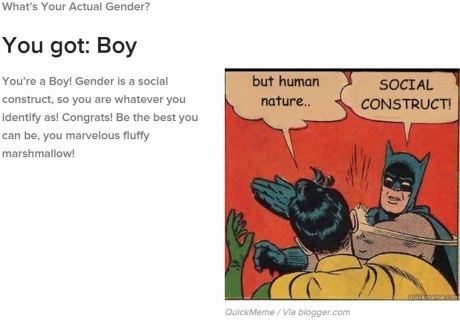
Now, that some doctors are not only able but also willing to perform sex/life changing surgery, the subject has spawned a rather hot debate.
The ‘inputs’ being ‘sex’, ‘gender’ and ‘how each of us feels about it’.
Feels about what?
Well… this is the tricky part.
The what of the matter isn’t so simple…
There are so many things that might be felt here…
How each of us feels about the sex they have been born with.
How each of us feels about the gender role assigned to their particular sex by the particular culture into which they have been born.
How each of us feels about those who have enough courage/money to assume another gender/change their sex.
Please note that while neither the society nor the individuals have anything to do with the birth sex, both the society and the individuals are instrumental in shaping all those feelings.
Since sex/gender is too ‘hot’ right now, let me take a parallel road.
Many of my friends are glad when I invite them to dinner. To a home cooked dinner.
Their appreciation has driven me to improve my cooking skills, over time.
Yet in my culture, men are not supposed to cook – if they are not professionals, of course.
Which I’m not.
Yet very few people, if any at all, see anything strange here.
That being the social construct part.
On the other hand, cooking implies certain individual characteristics. For instance, I find it harder when my nose is running. I have to do it ‘mechanically’. It also demands a lot of patience and the ability to plan in advance. Not to mention the fact that one needs both hands.
My point being that cooking, and gender, is based on a certain physical configuration – both hands, a working nose – a certain state of mind AND a lot of study/social conditioning.
My real point being that every ‘social construct’ is based on ‘nature’.
Just as no builder will ever be able to build anything without ‘bricks’, no society will ever be able to build anything out of nothing.
And just as all builders have to adapt their plans to what they have at their disposal, all social constructs will be limited by ‘human nature’ – how ever adaptable and ingenuous it might be.
Now it’s the moment to remind you that other cultures have dealt differently with this matters. Driven by different kinds of necessity.
Confused?
You’re not alone…
The oldest surviving civilized nation, China, calls itself Zhongguo.
The Middle Kingdom. ‘In the middle’ of the barbaric people that surrounded her but also at middle distance between Heaven and the rest of the Earth. The aforementioned barbarians.
And, according to Confucius, it was the emperor’s job to ‘keep things as they should remain’.
Which makes sense. After all, the whole kingdom was the exclusive property of the emperor. And whose job is to watch over one’s property?
Well, things went on long enough for those involved to believe this was the natural order of things.
Until the whole arrangement was upset by a small number of people which had come, more or less ‘under their own steam’, from the other side of the world. And who were, at that time, a lot less civilized than the Chinese.
How can be explained something like this?
OK, the Aztec and the Inca empires might have been primitive relative to the Spanish invaders. They might have prevailed over the small number of invaders by brute force but they had been overcome by the sheer novelty and the apparent sophistication of the assailants.
But China had been in contact for centuries with the rest of the ‘civilized’ world! And way advanced than the rest. Both culturally and economically.
So, what had happened?
How can something like this be explained?
We might try to take the ‘historical route’. And observe that, exactly as Confucius and Laozi had told us, China’s destiny had been tightly linked to the ability of those in charge – the emperors, to manage the empire. From the paleolithic migrations until the Mongol invasion in 1271, nothing from outside had any significant impact over the Chinese hinterland. But the fortunes of those living in that hinterland had oscillated from the misery induced by almost constant ‘live conflict’ during the Warring States period to the various prosperous eras. The Han, Tang and Song dynasties, to mention just a few of them.
The same principle had been valid also for what went on while foreign dynasties had been in power. As long as the ‘managers’ were doing their jobs, things continued to improve. As soon as the helm was grabbed by an incompetent leader… all hell broke loose.
But is the emperors’ incompetence enough to explain what had happened during the XIX-th century? The most advanced, and numerous, nation on Earth had been subjugated – for all practical purposes, by a bunch of drug pushers pretending to act in the name of the far away, and far weaker, British King?
Or we can take the sociological route.
Along which we’ll notice that the ‘drug pushers’ were only nominally subjects of the British Empire. Which empire was behaving imperially only towards the exterior while inside it was already a democracy!
Sounds familiar?
Ancient Athens, the first known democracy, had dominated the Eastern Mediterranean for as long as it had retained its democratic character and had failed, abysmally, each time it had reverted to tyranny?
Ancient Rome had established a huge empire as a democratic republic and collapsed four short centuries after becoming a totalitarian empire?
And so on…?
And what might be the difference between a totalitarian empire and a democratic one?
On the face of it, a democratic empire sounds like an oxymoron… yet there’s plenty of such examples in our history…
As you might guess from the title of this post, the ‘famous’ middle class was both the engine and the explanation for the ease with which the ‘democratic’ empires had been established. And yes, the Spanish and Portuguese ones can be explained in the same manner. At that time none of the Iberian monarchies was yet behaving in the absolutist manner they had pursued as soon as the looted precious metals had started to pour in…
But what makes the middle class so special?
Nassim Nicholas Taleb would tell you that the middle class has enough skin left in the game to really care about the outcome and I’m going to add that the middle class is simultaneously distanced enough from the fray to act in a reasonable enough manner.
Let me put back, for a short while, my historian’s cap.
Most of us consider that the middle class is a late appearance. That most of the time, humankind had been divided in two. The haves and the have-nots. The powerful and the meek.
Well, I’m not so sure about that…
For the first 60 000 years after we had learned to speak – which had made us really human, we had been living in small packs. Led by the more powerful male member of the group – if we consider that our ancestors used to behave like our Chimpanzee cousins, or ‘self managed’ in a more or less democratic manner if our ancestors had used the model followed by our other cousins, the Bonobos.
Or we could look at how the surviving ‘primitives’ lead their lives. None of the Hadzabe, Yanomami or Inuit, who have survived in the most difficult conditions on Earth, have a hierarchical social structure.
Primitives?!? Maybe… but not because of their social arrangements. After all, they are freer than most of us.
And what is it that we, proudly modern people, value more than our individual freedom?
Money? I’m going to let this rest… for a while.
Let’s go back to our ancestors.
Who, by all indications, had been living as ‘extended middle class societies’. Without any 0.1% and without people who went to bed hungry while the rest of the gang had been gorging themselves.
Let’s remember now that during those times we had actually transformed ourselves from apes to humans. And if you consider this to be a small feat, just try to teach a bonobo to speak. Then remember how many people who had been born in poor and backward countries are now successful business people or scientists. After passing through a thorough educational process, true! Only that educational process is in no way accessible to any bonobo…
Don’t disparage the long evolution we had graduated from, as a species, while living in ‘extended middle class societies’.
‘But you haven’t explained what you mean by middle class! Most of us see the middle class as those people who make a certain amount of money each year and you keep speaking about primitive people… who have absolutely no use for any money…!’
OK.
For good or for bad, our present society consist of three categories of people.
The haves, the in-between and the dirt poor.
I’m not going to assign numerical values to any of these.
Taleb’s Skin in the Game criterion is far more useful in this situation.
The haves qualify only after they have no skin left in the game. In the sense that they have so much ‘money’ that come hell and/or high water they feel safe. What they make of this world is heavily influenced by the thick ‘insulation’ which separates them from the rest of the world.
The dirt poor – or the lumpen proletariat, in Marx’s terms, have all their skin in the game. In fact, they are the famous ‘Boiling Frog’. They have no way of leaving the kettle so…
In a sense, both haves and the dirt poor are prisoners. Neither can leave their respective cell blocks. Simply because the dirt poor have no way to go anywhere while almost none of the haves would be able to survive ‘outside’.
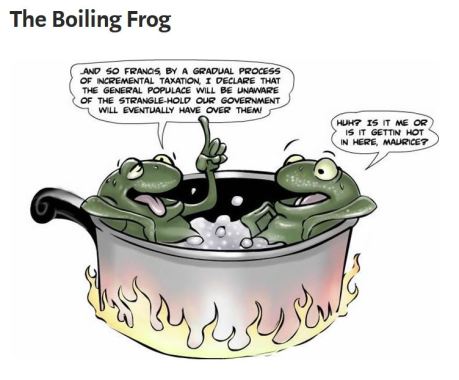
Wesley Chang, The Boiling Frog, Medium.com
Which leaves us with the middle class.
Who have some resources stashed away – or enough credit available, to weather some crises. But not enough to last them for their entire remaining lives.
Which makes the middle class the only really interested people in the long term well being of the entire society. The only ones really interested in maintaining the freedom of the market as the main economic engine. The only ones really interested in maintaining democracy as the main manner of avoiding catastrophic mistakes perpetrated by the too powerful autocrats.
Or, from a psychological point of view, we can look at the haves/dirt poor as being stuck in an immobile state of mind while the middle class are the only open minded members of the society.
In fact, I prefer this last approach.
You see, until recently the American Dream was relatively accessible. With some luck, a ton of determination and a fair amount of brain power, the sky was the only limit. Belonging to any of those three categories, haves, middle class and dirt-poor was as much about the state of mind of those involved as it was about actual economic conditions.
The haves were free to consider the big picture, the dirt poor could contemplate brighter perspectives while the middle class were doing their thing. Keeping the whole show afloat.
I’m afraid we have reached an inflexion point. A watershed mark, if you prefer.
For whatever reason – I’m not ready to tackle this subject right now, we’ve become so preoccupied with something in particular that we’ve lost sight of everything else.
Including the middle class.
Exactly those which were supposed to maintain their cool heads and open minds.
Matthew Stewart,
The 9.9 Percent is the New American Aristocracy,
The Atlantic

We, humans, pride ourselves on many things.
On being smart/intelligent. And on being the only animals able to brag about their achievements with their peers…
But what is it that qualifies us as humans?
That would, of course, depend on what a human really is…
OK, let me use another tack.
What are we really good at? What sets us apart from the rest of the animals?
Practical intelligence? Our ability to solve really complicated problems?
Then watch this wild New Caledonian Crow treating itself to a piece of meat.

Our ability to figure new meaning and to overcome our natural impulses?
Then read about Sheba the Chimp using language to suppress her greed:
SALLY BOYSEN: And Sheba gets two, so Sarah gets four. See?
SALLY BOYSEN: You want to give two to Sarah? Okay. Two goes to Sarah, and you get six.
There is a video which depicts all this. Click on this link and see if it’s available “in your area.” http://www.pbs.org/wgbh/nova/nature/ape-genius.html.
How about our consciousness? Our ability to ‘observe ourselves in the act of observing‘.
Well, that alone wouldn’t have made us any more special than an octopus…

But what if our individuality resides in us having taken all three to ‘a different level’? One which hasn’t yet been attained by anybody else? Not necessarily higher, mind you!
I’ll deal with ‘trade’ now and I’m afraid you’ll have to come back for the rest.
‘Trade’ wasn’t even mentioned in those three examples?
What was the crow trying to do?
Feed itself? As in exchange matter with the ‘outside’?
What was Sheba trying to do?
Figure our what was going on? As in trading information with the surrounding world?
In this sense all living things are engaged in all forms of trading? And continue to do so for as long as they remain alive?
What did I tell you about us doing nothing really new? Only different?
OK, we had already figured out – long before Adam Smith described it as ‘division of labor’, that by dividing tasks amongst us we’ll be able to accomplish far more things than if we had attempted ‘individual autarky’. And then we had invented ‘trade’, as a manner of exchanging the different wares each of us was proficient in doing…
Wait! Even this is not really ‘new’!
Mother Nature had already invented sexual reproduction – a very extreme ‘division of labour’, a very long time ago…. but not before bacteria were already adept at ‘trading’ genetic information.
We need to breathe.
We absolutely need to breathe. Just as we absolutely need to drink and to eat, only not so often.
Yet we seldom think about breathing, we remember to think about drinking only when we’ve forgotten to take along a bottle of water for that two hour drive and we somewhat constantly keep warm in the back of our heads the nagging ‘what’s in for dinner?’.
What makes us so indifferent to breathing – as long as our lungs remain OK, anyway, and so choosy when it comes to our ‘daily bread’? After-all, both are equally important…
And how come we almost never think about the air we breathe but equally almost never forget to dream about our precious car? The future one, of course, not the present! Or about a beach holiday, a diamond ring, Jimmy Choo shoes …
So.
There are some things that we actually need, some we actively want and things which belong to both categories.
Then why don’t we actively keep tabs on all the things we actually need and why do we bother so much with those which are more or less superfluous?
Maybe because we are not machines? And because life is neither simple nor forthright?
Let me start from the beginning.
We belong to the realm of the living things.
The difference between living things and inanimate matter being that all individual organisms eventually die while inanimate matter might, theoretically at least, remain unchanged for ever.
Otherwise put, inanimate matter has only ‘inertia’ and living things have both inertia and an innate ‘will to survive’.
Another difference between the two being that all kinds of inanimate matter are ‘isotropic’ while ‘life’ is almost synonymous with ‘individual organisms.’
It’s just as impossible to differentiate between two water molecules as it is to find two identical organisms – even if they belong to the same species. N.B., not even clones are identical to each other.
As an aside, sometimes it is possible to differentiate between two water molecules. For instance, heavy water is slightly different from regular water. Also, there are some differences between the water molecules which have in their composition different Oxygen isotopes. But if you know what an isotope is… you get my drift.
Coming back to the difference between inanimate and living, the inanimate does not change in time.
A molecule of water remains the same until something happens to it and water, as a substance, has never changed since….
On the other hand, each individual living organism changes, however minutely, with ‘every breath it takes’ while species are undergoing a constant evolutionary process.
Furthermore, we can draw a parallel between inanimate substances and animate species. Both of them, substances and species, are ‘organized’ along some common ‘information’.
‘Water’ has a certain ‘blue print’, ‘vinegar’ has it’s own – different from that of ‘water’, and ‘wolves’ have yet another one – which is different from that of ‘poplar’.
Only the parallel can be drawn only so far.
All molecules ‘belonging’ to the same substance share the same ‘constitutive information’.
All individuals belonging to the same species do have a lot of ‘constitutive information’ in common yet each of them is different from all of the rest.
Hey, wait a minute!
– You promised us something about needs and wants and now you’re lecturing us about the difference between life and death? What next?
– Bear with me. I’m getting there!
One last difference and we’re almost done.
I told you a little earlier that life is about change while inanimate is… boringly stable!
Actually life is also about exchange, not only about change.
No inanimate molecule ever exchanges anything material with anybody, lest it becomes something else.
No individual living organism can survive for any sizeable amount of time without exchanging substance and information, in an ‘organized’ manner, with it’s surrounding medium.
In my ‘original terms’, each individual living organism has needs while individual molecules have none – except for the ‘need’ to be ‘left alone’ in order to ‘survive’.
I’m not going to enter into details. For now, all I’m going to say is that the above mentioned ‘organized exchange’ is regulated by a ‘membrane’ according to information passed along from generation to generation.
Each individual living organism has it’s own set of information, coded in its DNA (RNA for the more ‘primitive’ ones). Which set of information has a lot in common with but is slightly different from that which has belonged to the previous generation.
For instance, each E.coli bacteria has a membrane – which separates the interior of the ‘organism’ from it’s surrounding medium, a nucleus which contains its ‘constitutive information’ and some other things which are of no importance for this discussion.
For as long as that individual bacteria is alive, the membrane plays two roles. It keeps the bacteria together and mediates the exchanges between the individual organism and its medium. It lets food and oxygen in. It makes it so that ‘excrement’ and CO2 are purged out.
And all these are happening according to the information contained in the genetic material passed over from the previous generation.
In a sense, exactly because each individual organism somehow manages to remain – for a while, at least – in one piece while constantly exchanging substance with the surrounding medium, one may say that each individual bacteria has a form of (proto?) conscience. Remember that it does ‘survive’ on its own, ‘guided’ exclusively by information contained in it’s own DNA. As long as its surrounding medium remains in certain parameters, of course, but this is another issue.
Let’s jump now directly to us, human beings.
OK, we are multi-cellular organisms hence we are provided with a second ‘membrane’ – which is usually referred to as ‘skin’.
The rest is basically the same. The ‘skin’ keeps us together, breathes in, breathes out, excretes the by products of our metabolism…
Well, not exactly the same! We have yet another layer of ‘membrane’. Using a very modern word, I’ll describe this third layer as being “virtual”.
I’m speaking about our infinitely more complex conscience.
The proto-conscience of the E.coli is similar to a ‘mechanical’ function.
‘Mechanical’ in the sense that the information contained in the nucleus is more or less directly expressed. The bacteria is not able to asses the results of its actions, to watch itself ‘doing things’ or to learn anything from what’s happening to it.
Time for another aside. Recent scientific research strongly suggests that even unicellular organisms are capable of learning. Something. This is very important, and very helpful towards increasing the ability of any given organism to survive, but doesn’t change much of what I have to say here.
Our conscience is anything but mechanical.
OK, it very much depends on our brains. Hence on our DNA.
It also depends on everything that has happened to us from the moment each of us has been conceived till the very present moment. A single minute spent without being able to breathe during birth can wreak havoc with out brains. Hence with our ability to develop a full fledged conscience.
Furthermore, being born into a relatively well off family during a peaceful era leads to being exposed to a completely different set of stimuli than if born into a poor family during a war.
Coming back to my initial example – very few of us really think about breathing, simply because most of us are accustomed to air being freely available, people exposed to those two different sets of ‘initial inputs’ will have a different attitude towards ‘normal daily needs’.
The first kid will grow with an innate sentiment that having enough to eat is comme il faut and nothing to worry about while the second…
Also, the first kid will grow accustomed to people around him ‘parading’ a host of satisfied ‘wants’ almost incomprehensible for the other kid.
Don’t tell me these two kids will develop the same kind of conscience.
Equivalent? Maybe.
Geared towards the same goal? Survival of the individual AND that of the social norms into which the individual has been socialized? Certainly! Only the social norms I’ve just mentioned will never be exactly the same in those two cases… regardless of those two children belonging to the same broad culture.
As a consequence of their different fortunes, each of them will maintain a different balance between needs and wants. Even if their fortunes will change in time.
The ‘conscious membrane’ can change, and it usually will, following the changes in the surrounding medium. But those changes cannot fundamentally alter the ‘initial orientation’ – that forged during the early childhood.
 nicichiarasa