Archives for category: evolution

Practical reason:
“All the forms of rationality so far considered involve proceeding from one belief to another. But sometimes people proceed from belief to action. Here desire as well as belief is relevant, since successful rational action is action that satisfies one’s desires.” Encyclopaedia Britannica.

On behaving reasonably:
The standard of behaviour is external. Generally, the law examines only conduct, not the excitability, ignorance, or stupidity that may cause it. The courts determine what the hypothetical “reasonable person” would have done in the situation. Such standards also demand a degree of foresight in anticipating the negligence of others—especially of special groups such as children.
The reasonable-person test presumes certain knowledge—e.g., that fire burns, water may cause drowning, and cars may skid on wet pavement. Community custom will influence such presumptions, such as the practice of driving on a certain side of the road even on private roads, a situation in which laws do not apply.

The Supreme Court on Monday (June, 2018) ruled in favor of a Colorado baker who had refused to create a wedding cake for a gay couple. The court’s decision was narrow, and it left open the larger question of whether a business can discriminate against gay men and lesbians based on rights protected by the First Amendment.

““Why aren’t you wearing the mask?” Jesse asked the customer on a recent day at a store in Rancho Palos Verdes, Calif. “I am not here to question what you believe in. These are the rules. I am just asking you kindly to wear the mask.”
The customer, Genevieve Peters, who was recording the entire exchange, refused. “We are in America here,” she said, “Land of the free.” Then she turned her camera on other shoppers, who were less than amused: “Look at all of these sheep that are here, all wearing this mask that is actually dangerous for them.”
Jesse, identified only by his first name in the video, telephoned the police, who did not arrive. Finally, when Ms. Peters left the store, others customers burst into applause.” (https://www.nytimes.com/2020/05/15/us/coronavirus-masks-violence.html?action=click&module=Top%20Stories&pgtype=Homepage)

‘The reasonable person test presumes certain knowledge’ … that businesses are allowed to ‘weed out’ customers based on the Bill of Rights… and that Covid-19 is a hoax…

‘Sheeple’…

Regulations don’t really work unless they reflect the mindset of the majority…

And here’s how it works.

The rule about driving on the ‘right’ side of the road is observed without much need for enforcement.
Because the consequences are clear. And consistent, unless you drive a tank.

People had the same problem with condoms.
Until HIV came along…
Nowadays very few people engage in casual sex without one.

Give us time and … if SARS-CoV 2 will be around for long enough…

105 Pastors Wrote a Letter To Keep Yoga Out of Ohio Schools. They Succeeded.
By Terry Firma

The endorsement of yoga is a violation of the First Amendment’s Establishment clause, which forbids government from picking religious winners and losers and enforcing its choice.

Based on my own experience, I consider transcendental meditation, with its veneration of the Maharashi Mahesh Yogi, uncomfortably close to a (half-baked) religion. Yoga, not so much, but opinion on that score is divided. You don’t have to be an angsty Jesus fan to concede that, depending on which yoga precepts are taught, its practice (derived from the Vedic / Hindu tradition) can veer into spiritual and religious territory. For consistency’s sake, it might be a good idea for atheists and agnostics to make common cause with the pastors (difficult though that may be!), and to err on the side of preferring that yoga instruction and public schools remain separate.

The first quote comes from the letter sent by the 105 pastors to the school districts in Ohio.
The second expresses Terry Firma’s own thoughts. Terry Firma being the author of the article…

Until reading his opinion I was convinced nobody else but those 105 pastors actually believed yoga could be considered a religion. Not in the First Amendment’s sense, anyway.

Here being the problem. A huge one.
By enlarging the definition of religion to encompass yoga – which is basically a practice, you end up with a wide enough definition to ‘engulf’ many other things. Science, and atheism, included.

Which, at some point, will be bundled with the items banned from being studied in schools.

What’s going on here?
Nothing much.
This is how ‘being rational’ works. You marshal all the resources you can identify towards reaching your goal.
Can the First Amendment be ‘helpful’ towards what ever I have in mind?
Does it mean that I’m going to actually weaponize it?

So what, if I’ll get a step closer to my target?

Have you considered all the consequences?

SARS-CoV 2 lock-downs have intensified the already heated discussion about ‘rights’. About “our rights”. Which have to be defended “at all costs”.

The way I see it, rights can be evaluated from two directions.
As ‘gifts’. Either gifted to us by ‘higher authorities’ or conquered for us by our ancestors.
Or as ‘procedures’. Elaborated in time by society and coined into law by our wise predecessors. Who had duly noticed that societies which respect certain rights work way better than those who don’t.

After all, societies are nothing but meta-organisms. Which, like all other organisms, function for only as long as the components interact according to certain, and very specific, rules. The ‘better’ the rules, the better the organism works.

In this sense, ‘rights’ are the code we use when interacting among ourselves. The rules we use when cooperating towards the well being of the society.

You don’t care about the society? Only about ‘your rights’?

OK, but if the society, as a whole, doesn’t work properly, who’s going to respect ‘your rights’?
Who’s going to help you when a bully will try to snatch ‘your rights’ away from you?
And bullies trying to separate you from ‘your rights’ are the most certain occurrence whenever societies cease to function properly.
Whenever the individual members of a society no longer respect each-other enough to collectively uphold their rights. Their rights.

Our rights.

Knowledge is being constantly (re)generated by us.

Everything we know, individually and collectively, has been first felt, then interpreted and finally communicated by us.

For something which has happened inside our sensorial sphere to become a piece of information we have to first notice it, then evaluate it and, finally, deem it important enough to remember. To codify it as information.

For something to make sense – whatever that means, the information we have about that something has to fit in to the rest of information we already have.

These three premises, which I hold to be self evident, lead me to the conclusion that:

Individual human beings will always have but a limited knowledge/understanding about/of the world.
A group of people are able to develop an aggregate understanding of the world which might be wider than those belonging to the individual members.
In time, a community of people will cobble together an even more complex weltanschauung. But still an incomplete one. For no other reason than the fact that the sum of a finite number of finite quantities will always be finite.

Consequences.

Since our understanding of the world is finite, determinism doesn’t make sense.
This being the reason for all authoritarian regimes/monopolistic arrangements caving in sooner rather than later. For the simple reason that those regimes/monopolies use but the brain power of those in power and waste the rest.
Our understanding of the world being finite, there is no way to demonstrate or refute God.

Which God is, anyway, nothing but a figment of our imagination.
Because of the very reasons I mentioned above.
Even if God itself would appear right now in a public square and on all the TV monitors in the world, the impression/understanding of him we would be left with after the experience would be of our own making.

Incomplete and inexact. Heavily dependent on everything else we already know.

In nature, most organisms feed on other organisms.
Deer eats grass, wolf eats deer. Scavengers and microbes eat poop and corpses. All together ‘eventually’ enrich the soil. Allowing for more grass to grow.

One way to look at this is to call it ‘fight for life’. ‘Survival of the fittest’.
Yet this entire ‘carnage’ has a very interesting ‘conclusion’.

A fine tuned ecosystem. Which has lasted, as a system, for a couple of billions of years. Becoming more and more elaborate in the process.
And which has survived – as a system, I repeat, momentous events.
Asteroids, geomagnetic reversals, continental drift…

The ecosystem has been so stable that it allowed one creature to evolve so much as to develop a special trait.
Self-awareness.
Which has eventually given birth to ‘reason’. To ‘rational behavior’.

Which means that while wolves eat deer to satisfy their hunger we start wars to satisfy our egos.

We see, therefore, that War is not merely a political act, but also a real political instrument, a continuation of political commerce, a carrying out of the same by other means. All beyond this which is strictly peculiar to War relates merely to the peculiar nature of the means which it uses. That the tendencies and views of policy shall not be incompatible with these means, the Art of War in general and the Commander in each particular case may demand, and this claim is truly not a trifling one. But however powerfully this may react on political views in particular cases, still it must always be regarded as only a modification of them; for the political view is the object, War is the means, and the means must always include the object in our conception.

Carl von Clausewitz

Which wars have proven to be so destructive that we finally found a way to dissuade ourselves from starting new ones. New majors ones… until now…

And if you don’t have any clue about what I’m talking about, click on the next word.
MAD.

Don’t fret. It is actually a very rational concept.
Not reasonable at all, only rational.

Acknowledgment.
I was inspired to write this by David Sarac’s Twitter profile.
“Theory of evolution points to the conclusion that becoming, not being, is the essence of reality”

“Friedrich Engels in a thinker’s pose
The four-meter-tall bronze sculpture of the other philosopher of communism, Friedrich Engels, is a bit smaller than the planned Marx statue in Trier. This Engels monument in his hometown, Wuppertal, was also made by a Chinese artist and offered by the government of China in 2014.”

I grew up under communist rule.
We studied marxism in school.
At some point, I was about 16, the teacher asked us about the relative merits of the different brands of materialism he had mentioned during his classes.
My answer was ‘dialectic materialism is better than all others because those who apply it into practice constantly gouge the consequences of their (political) decisions and fine tune policies accordingly’.
Some 15 years later the communist lager had imploded simply because those who were supposed to act in a dialectic manner had failed to put the principle in practice.
Coming back to the original question, ‘was Marx a determinist’, the answer is yes.
Marx’s dialectics is only a procedure. Meant to help the communists exercise the dictatorship mandated by Marx in the name of the proletariat. And dictatorships are determinist by definition.
Why mandate one if you are not convinced that things can be ruled?
For the long run and in a comprehensive manner?

Most of us consider corpses as being inert.
And those individuals who are in deeper stages of coma.

Living organisms, on the other hand, are considered as being reactive.
They drink when thirsty, eat when hungry, run when in danger…

As for behaving in a pro-active manner… things are no longer so simple.
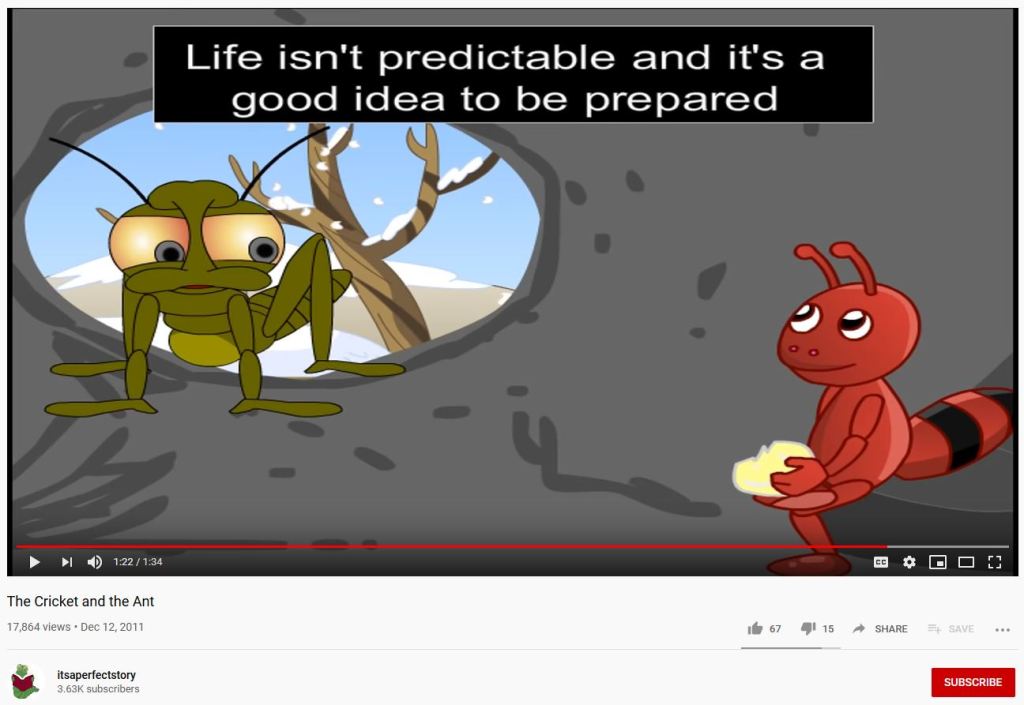
Ants, for example, are constantly praised for their behavior.

While crickets are disparaged for their recklessness …

But what about the dung beetle?
Also proactive?

They dig shelters and provide them with food for the next generation.
If this isn’t proactive behavior… I don’t know what else would qualify.

‘But … really?!? Can a beetle be ‘accused’ of behaving in a pro-active manner? An insect? Are you nuts?’

I’ll make a small break now. And point your attention to something I find very interesting.
“Life isn’t predictable and it’s a good idea to be prepared”.
Prepared for what?!? For God’s sake… remember? ‘Life isn’t predictable’!
Hello!!! The ant is hoarding food during the summer exactly because she doesn’t want to starve during the winter. She absolutely knows that winter is coming. She prepares herself because she knows what’s going to happen! Duh…

Coming back to the beetle, no, I ain’t nuts. I’m only trying to suggest that species act as if being proactive. Individual organisms do not necessarily behave in a proactive manner but species always do. Those who don’t… disappear soon enough.

Nothing existed before we came around. To notice.

They were there, alright. But didn’t existed, yet.

Most dictionaries do not discriminate between ‘being’ and ‘existing’.
But I still recall, vividly, those moments when – as a teenager, I tried to make myself remarked by the girl I fancied at that moment. More often than I’d like to remember, it was as if I didn’t existed at all.
I was standing there, making a fool of myself, yet I didn’t existed at all.

Simply because I wasn’t noticed.
By the significant one.

Everything which has a temporal dimension – movement, transformation or both, incurs costs and produces consequences.

From a rock sliding down a slope to me writing this.

The difference between these two being the simple fact that no rock has ever had any goal.

You see, the rock looses some energy and mass while sliding down. It accelerates at first but since no rock has ever slidden for ever.
Only rocks never do anything on their own. Something has to happen to them first.
They do bear the costs – they wear down, break, etc., yet they don’t mind. For they are not, at all, aware of what’s going on. And, anyway, completely unable to do anything about it. Hence not at all ‘responsible’ about any of the consequences produced by whatever they had been involved in. Happened to them, actually.

Fast forward to me. I’m not only alive – hence reactive to whatever happens to me, but also aware. Aware of my own awareness even.
I notice the costs I have to pay. Hence I try to minimize them.

And here’s the gist of the matter.
My awareness drives me to minimize the costs I incur during my life AND to be very careful about the consequences of my endeavors.

Theoretically, at least…