Archives for category: effective communication

Indeed!

Only there are a few hurdles which will have to be negotiated first.

Which ‘truth’?

Mine?
Which will set me free?
Theirs?
Which will set them free?
Or ours?
Which will set us free?

What is Truth in the first place?

What I believe in?
What we believe in?
Something which is out there and we learn about incrementally? In a collective manner but individually driven?

How can we find it? If ever, of course….

Agree to something which has worked until now?
Listen to what those around us have to say about the/any matter?
Do your ‘own homework’?
All of the above, in a respectful manner?

Freedom is too bothersome?!?
Have you considered the alternatives?


Nowadays, too many individuals are afraid of freedom. Specially of other people’s freedom, since other people’s freedom might bring in ‘unwelcome’ change.
Other people’s freedom might challenge our established way of life.
And why risk it?

Still interested?
History strongly suggests that societies which had considered the stability of their ‘established way of life’ to be more important than the freedom of any individual member to respectfully question everything have eventually failed to preserve that over-cherished way of life. Simply because those societies had not allowed their individual members to adapt their mores to the changes which inevitably alter the ‘environment’.

Conclusion?
Liberty is of utmost importance.
For both individuals and societies, equally.
And, as a matter of historical fact, real – as in ‘truly functional’, freedom can be achieved only together. By the individual members of a society, acting in concert. Through a robust mechanism of checks and balances – a.k.a. real justice, based on mutual respect between the members of the society attempting to maintain this arrangement.

Warning!
Since we currently experience a growing distrust among the members of many societies – America and Western Europe included, no wonder that actual individual liberty is sliding down a dangerous slope.
Simply because nobody is going to defend the liberty of somebody they do not trust/respect.

https://i.kym-cdn.com/photos/images/original/001/178/733/780.jpg

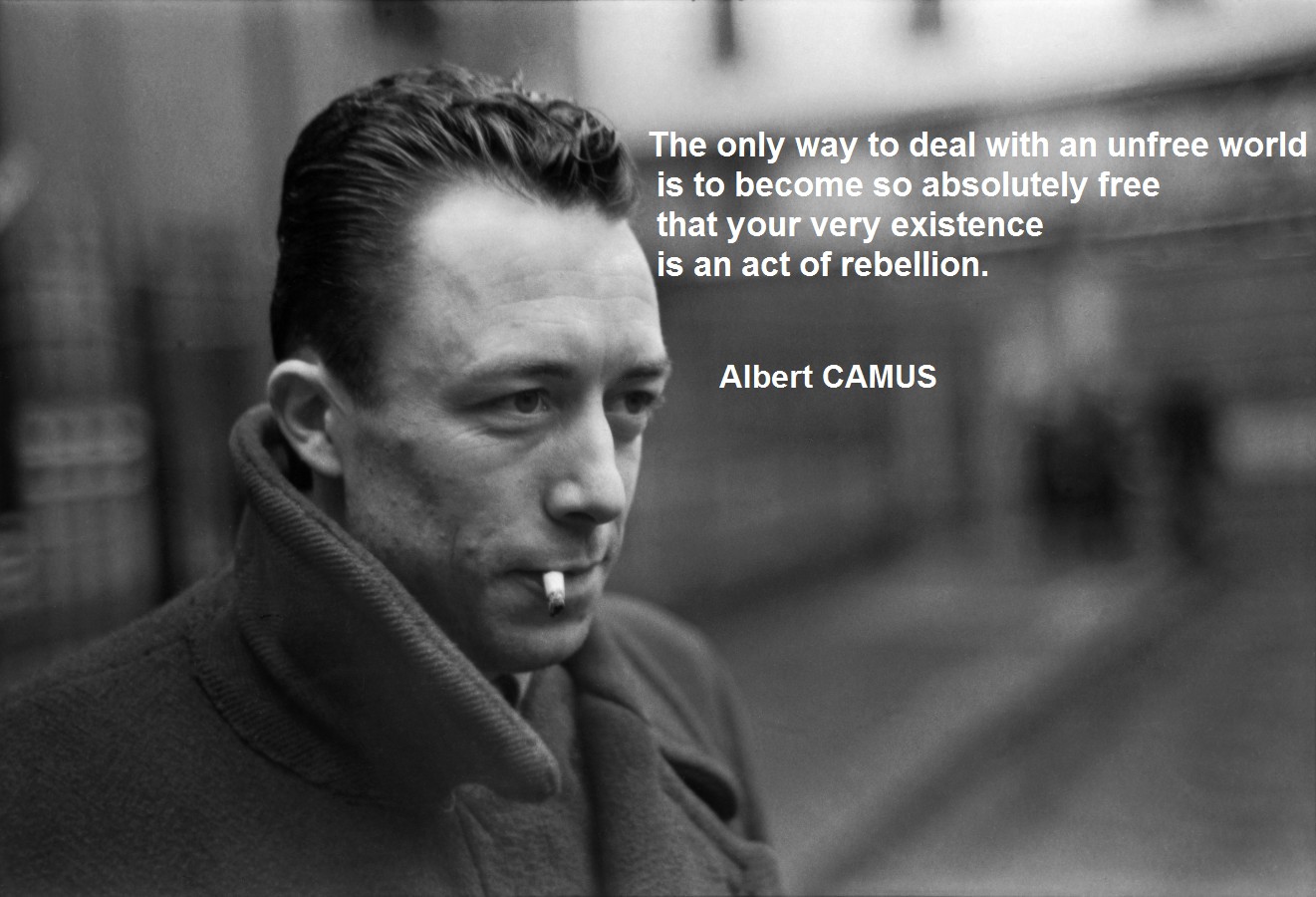
Last time I checked, for a rebellion to make sense, it had to be against some precise thing. Otherwise…

On the other hand, there are only two kinds of freedom.
‘Against all others’ – which starts as anarchy and very soon becomes atrocious dictatorship. Where the dictator is free to rule and the oppressed are free do obey. Or to attempt to climb into the dictator’s shoes…
Or ‘with all others’. Also known as ‘democracy’. The real thing, of course, not the ‘mob rule’ variety which is currently creeping upon us.

Hence the only sensible rebellion would be the one against any form of dictatorship and ‘executed’ in concert with the rest of the oppressed.

The whole world spins on this.

  1. Literally.
    The electron in a Hydrogen atom ‘dawdles’ around the proton because its negative electrical charge ‘recognizes’ the positive one and is attracted to it. Furthermore, the Moon revolves around the Earth because their masses ‘recognize’ each-other as such and, ‘hence’, are subjected to a mutual attraction.
  2. Factually.
    Things are a little more complicated at this level.
    For something which exists to become a ‘fact’, that something must be first noticed by somebody. Until then it exists in ‘total darkness’. We cannot even say it doesn’t exist, simply because we are not aware of the possibility of its existence.
    In this sense, the Moon had started to revolve around the Earth only ‘after’ we had recognized the pattern of its movement.
  3. Teleologically.
    Otherwise said, for as long as it fits our purposes AND/OR our understanding of the world.
    The Sun and the Earth had pulled at each other since the start of time. For only as long as we had been believing in Newton’s theory about gravitation, of course…
    And, at first, we had been convinced that it was the Sun who was speeding around the (flat?!?) Earth!
    Despite the many proto-scientists who did their best to open our eyes.

Homo had become sapiens when he had started to learn.
To actively discover information and to discuss the findings with their peers.

This was how our ancestors had developed both consciousness and language.

The next stage was reached when people were no longer satisfied with mere survival. And attempted to glimpse into the future.

” “But ask the animals, and they will teach you,
    or the birds in the sky, and they will tell you;
or speak to the earth, and it will teach you,
    or let the fish in the sea inform you.
Which of all these does not know
    that the hand of the Lord has done this?
10 In his hand is the life of every creature
    and the breath of all mankind. ” (Job 12:7-10)

Until that moment, the deal was simple.
People followed the rules – which had already been set in ‘stone’ and passed over from ‘the beginning of time’, and things continued unabated. Hence no need for further inquiry.

From that moment on, everything had changed.
People still had a set of rules to guide them. But they had also been endowed with ‘free will’:
“You, my brothers and sisters, were called to be free. But do not use your freedom to indulge the flesh ; rather, serve one another humbly in love.” (Galatians, 5:13) and
“Anyone who chooses to do the will of God will find out whether my teaching comes from God or whether I speak on my own.” (John, 7:17)

So, there were rules, there was freedom and there was the Will of God – which had to be determined if it was to be followed.
How to determine it? Nothing simpler. ‘Ask the animals and they will teach you.’.
Meaning that the answer of any question our ancestors might have had about the Will of God was accessible to them. And that they had the liberty – the obligation even, to look for that answer. By studying the nature.
Because understanding the nature – which was the incarnation of God’s Will, was considered by our grandfathers to be the key to understanding the Will of God. And, implicitly, a keyhole through which they could glimpse into the future. Their future, of course.

It was a very recent development that more and more people had become convinced that science had killed God. By producing ‘scientific evidence’ for more and more things which used to be considered ‘acts of God’.
Franklin’s lightning rod and Georges Lemaitre’s Big Bang are but two small examples.
Benjamin Franklin was convinced that ‘God governs by his Providence and that the most acceptable service we render to him is doing good to his other children‘ while Lemaitre was an ordained Catholic priest. Yet many of our contemporaries construe their endeavors as scientific proofs that there is no such thing as a Creator God.

And what about ‘science’?
What is it, after all?
An attempt to understand God’s Will or a method to prove that God does not exist?

How about science as an attitude?
Which maintains Man can, and should, learn about things. Regardless of the name each of us chooses to call them: ‘Nature’ or ‘the Will of God’.
Which also maintains that Man, in their quest for knowledge, must preserve its modesty. Nature and/or the Will of God might be ‘accessible’ but it would be actually presumptuous, for each and for all of us, to consider that we’ll ever be able to know/explore every nook and cranny of the World.
To learn, and express, all the Truth there is.

And why are we still trying to solve this riddle?

‘Cause this is indeed a riddle…

Remember those metaphorical stories whose heroes end up having to find the answer to one in order to save themselves/the day?
Like Sophocles’ “What walks on four feet in the morning, two in the afternoon and three at night?”

A riddle, of course, being a question which cannot be answered until the individuals attempting to solve it stick their heads out of the box into which the riddle had been framed.

So. Individualism? Collectivism?

Having grown up under communist rule – supposedly the most collectivist social arrangement to date, I can testify that there is no such thing as collectivism without individualism nor individualism without collectivism.

Libertarians’ mantra is that socialism/communism – and even liberalism, as Americans understand it, is a form of collectivism. And, of course, that collectivism is bad for you.
Socialists, on the other hand, maintain that the current situation – which is seen as being bad, is the consequence of the growingly extreme individualism which plagues modern societies.

Interestingly enough, both sides are simultaneously right.
Communism is indeed bad for you and the bad aspects of today’s society are a consequence of callous selfishness.

On the other hand, all communist societies are composed of a huge mass of obedient subjects AND a small number of individual, and very individualistic, leaders.
Similarly, all developed capitalist societies – including those sporting huge discrepancies between the shrinking number of haves and the growing number of utterly destitutes, have reached the current level of sophistication because most of their members continue to share the belief that ‘all men have been created equal and that all of them have certain, nonnegotiable, rights: Life, Liberty and the Pursuit of Happiness’.

“Share the belief…”
But wasn’t this the very definition of collectivism?
A social arrangement where the most important possession belongs to THE public?
Was there anything more consequential for what is currently known as the ‘Euro-Atlantic’ civilization than this shared belief? Other peoples have been in possession of way more abundant natural resources. Had reached ‘astronomical’ levels of civilization way before we were even able to wipe our noses… And yet…

Haven’t we, individual thinkers, figured out yet that unless we agree on ‘the basics’, we’ll be easy prey for the callous ‘snake oil merchantmen’ who have no qualms to use collectivist slogans to pitch some of us against the others?

Haven’t we figured out, yet, that there is no ‘political collectivism’ without fear? All collectivist social arrangements, both socialist and fascist/nazist, have been built using fear/contempt (of the other) to cement ‘the people’ into believing the lies proffered by false prophets. Lenin, Mussolini, Stalin, Hitler, Mao… Lies proffered by callously individualistic political agents… bent on satisfying their own domineering instincts and making ‘good use’ of pre-existing conditions.

Haven’t we figured out yet that individualism, the tame version developed along with the good aspects of the Western Civilization, is, by nature, the very beneficial consequence of the mutual respect which (still) exists among the members of our societies?

So, to answer the riddle, we need to understand that there is no real conflict between bona fide individualism and bona fide collectivism.
Just as there is no conflict between two perpendicular lines.

Since, by trade, I’m a mechanical engineer, I’ll use a very practical metaphor to illustrate this idea.
Consider a pressurized Oxygen tank. The more pressure inside, the more Oxygen you can store in it. The more useful the tank. Only if you ramp up the pressure too much, you end up with an explosion.
In this situation, you might consider ‘pressure’ to be in conflict with the ‘walls of the tank’, right?
Wrong. The conflict is only in your mind. Pressure is simply perpendicular to those walls. The more pressure those walls can withstand, the more useful that tank is for you.

But it’s your responsibility to determine the thickness and resilience of those walls. It’s your responsibility to choose how much to ramp up the pressure.
For the very simple reason that that tank is yours.
It is you who will suffer the consequences.

Yeah, right… then please show me the Mongolian version of how they had conquered most of Eur-Asia during the XIII-th century…

Anyway, the fact that this saying is so popular tells more about us than about who actually writes history.

First of all, we seem to be convinced that history is nothing more than the story of back to back ‘the winner takes it all’ kind of battles we had to win in order to survive to this day.

Secondly, we seem to be OK with this vision…

But what does it mean?
That (written) history reflects only what the victors have to say/want to disclose about what had happened?

Are we OK with this?

And still wondering why ‘history keeps repeating itself‘?

Wanna break the vicious circle?
Then how about ‘history is written by those who care enough among those who are able to write among those who have survived’?

This version of history is still incomplete. All history will always be incomplete, no matter how many people will have written it. How many sides of the events will have been covered.
But this version will be more inclusive. Hence more relevant.
Presenting survival, instead of winning, as being the essential part of any battle will diminish the intensity of the conflict. Hence allow us to learn more from it.

For instance, it will help us understand that war is the price paid, by both sides, for failing to figure out that cooperation works better than confrontation.

Just compare how the victors of WWI treated the vanquished with how the (same) victors of WWII treated (mainly) the same vanquished. And the aftermaths of WWI and WWII.

There is a technical reason. And some subjective ones. Acting in a synergic manner.

Trump had bean the darling of the high ratings/low expectations media for most of his adult life. During this period he had learned how to use it towards his own goal – an ever increasing notoriety, and those involved in the media had learned to love him back for the amount of publicity they had been able to sell on his back.

Now for the subjective ones.
First of all, he is a very ‘penetrant’ person. Like him or not, but you can’t ignore him.
Secondly, he happens to be the most powerful individual on Earth. Simply because he had been elected the President of the United States of America. Which is not only the most potent/civilized/democratic/you name it country, but also the leader of the free world. Meaning that the rest of the planet, democratic or not, sets it’s time after America’s clock. Willingly or unwillingly.
So the rest of world is watching anxiously everything that is going on in Washington. Wondering whether ‘Trump-ism’ will spread around. Or will remain yet another measure of American exceptionalism.

Thirdly, but maybe the most important reason, Trump can be analyzed as a symptom rather than as a cause.
In fact, there are a lot of Trumps scattered around the world.
Basically, there is very little difference between Trump and Putin. Trump and Erdogan. Trump and Bolsonaro. Trump and Dragnea – the most powerful politician in today’s Romania, my country. Even between Trump and Modi. Only none of these countries is similar to the US of A. None of them has such a distinguished democratic tradition.
And this is why so many people try to understand what’s going on.
Is Trump nothing more than an unhappy accident? Or the visible symptom of democracy becoming decrepit?

PS.
Even Abe is showing signs of contagion.
Post WWII Japan had survived by feeding whales to its people.
Now it is going to resume commercial whaling. In spite of all other previously whaling nations asking him to reconsider.
Really Abe? You need whale meat to survive?

And no, this is no joke! Alas…

Populism is scientific because its ‘adepts’ have a very rational behavior and use scientific tools to increase the appeal of their public messages.
And, on the other hand, populism is scientific because its advent is perfectly explainable given what we currently know. About our society, about our brains, about our psychology….

Let me start from the beginning.
In Thomas Kuhn’s terms, the last 60 or so years have witnessed a tremendous paradigm shift.
Science has replaced religion as the main paradigm and ‘religion’ has been demoted to  ‘religions’.

Science becoming the main paradigm means that we have grown confident about our knowledge. We might be aware that we don’t know everything yet but we continue to believe that we’re able to learn everything. That if we are diligent enough we’ll sometimes be able to look under every rock that is.
This attitude has led us to search for ‘perfection’. ‘Efficiency’ has displaced ‘redemption’. We have ceased our quest for salvation and are now obsessed with ‘buy low, sell high’. In other words, ‘make the most of it but strain yourself as little as possible’.

Which makes a lot of sense, doesn’t it?

A lot of sense… mainly when you no longer perceive the guy next to you as being a full-fledged member of your community. Your religious community, that is. Of your church.

You see, ever since Emil Durkheim, the sociologists have been aware that religion was not so much a story about the making of the world as a ‘common ground’. The ‘common core’ shared by the members of a given community. Which ‘common core’ makes it possible for those who share it to have respect. For themselves and for the other faithful members of the community. By sharing that common core, the individuals find their bearings in the ‘wide, wide world’ and, thus, know how to behave relative to their ‘neighbors’. With enough mutual respect among the individual members that the community is able to function. To survive, that is.

We no longer have that kind of community.
Our primary allegiance is no longer towards ‘church’. Most of us consider themselves primarily as members of a nation – something governed more by formal laws than by public sentiment, and only secondarily – if at all, as members of a ‘religious’ community.

Now, putting two and two together, it’s very simple to understand that in the given circumstances ‘populism’ was inevitable, right?

Too many of the would be leaders have no qualms about how they get what they want.
Power.
‘Buy low, sell high’ is the current mantra, remember? Accepted by all of us. Buyers, sellers, by-standards…
Too many members of the general public are willing to accept promises which are in line with their own expectations, even if those promises being put in practice means a lot of misery for OTHERS. Who cares about those others, anyway? They are not members of OUR ‘church’!

I’ll let you decide how sustainable is such a situation. I was going to use ‘community’ instead of ‘situation’ but it would have been horribly wrong. We no longer live in communities. We only happen to live in the same place.

For how long?

I am determined to fly.
Only my actual flying is relative to my ability to ‘negotiate’ the absolute determination with which my body and the rest of the planet pull at each other.

Translation:

There are three kinds of ‘determination’.
Absolute, relative and teleological.

‘Absolute determination’ is that situation where everything is under the same constriction. For instance, (almost) everything substantial in this Universe is affected by the gravitational field which permeates everywhere and everything.

Relative determination is that situation where either a special characteristic of something or a special circumstance induces a specific relation between that something and an ‘overpowering force’. For instance, any electrically charged particle is under the influence of the electromagnetic field while the ‘neutral’ ones are indifferent to the said field. Also, a dead leaf which happens to fall in a stream is under a double determination. It is simultaneously pulled towards the center of the Earth and helplessly transported by the water. OK, the flow of the water is indeed powered by the same gravity which pulls the leaf but, again, it is relative to the local relief.
Please note that even if the absolute determination might seem insignificant due to the effects of the relative one, the absolute never ceases. An electron which spins happily around a nucleus only seems impervious to the gravitational pull. Simply because the latter is way weaker than the former, at that scale.

Teleological determination is that situation where the determinant has an active role in shaping the influence it exerts over the determined. NB, ‘active’ and not necessarily ‘conscious’. For instance, no two working bees belonging to the same hive  will ever do exactly the same thing in the same (broad) situation, despite both being under the same absolute determination and under almost similar relative determination – they are twin sisters.

Things become way more interesting when we start discussing the influence of ‘intent’.
When the teleological determination becomes intentional.
Where the scope of the active action is influenced by the consciousness of the determinant instead of depending exclusively on ‘rules’ and chance.