Archives for category: Economy

“Give us today our daily bread”

We’ve been around for a while.
300 millennia, according to some. 70 millennia, according to others. Who use a more stringent set of criteria.
Anyway. Homo Sapiens is considered to be 300 000 years old while his nephew, Homo Sapiens Sapiens, is a little younger. Only 70 000 years…

Regardless of age, for most of this time we have been foragers.
OK, even our ancestors had tools. We’ve been around for 300ky while tools have predated us by more than 1my. Yes, our hominin predecessors were the ones to invent tools…

Then what is our contribution? Why are we the ones who are still around?

According to Ernst Mayr – if I interpret correctly – we’ve simply been lucky!
Nothing happened.
No catastrophic event bad enough to extinguish us. And no freshly minted ‘superman’ to take our place.
That question, regarding our contribution, speaks volumes about our infatuation with ourselves.

Hence the paradox.

Very recently, we’ve done something. Used agriculture on a large enough scale to change our way of life.

As foragers, we used to live in a certain way.
As homo economicus, who actively, agentically, produces food – and everything else we need, we’ve crossed yet another barrier. Benchmark? Anyway, we live completely different lives from those experienced by our foraging (fore)fathers. Despite the fact that there’s no biological or psychological difference between us.
Don’t believe me? Take a small child from the African or South American bush, lovingly raise them in a functional family and tell me if you find any difference. Between any of those children and their ‘already civilized’ school-mates. The key concepts here being ‘lovingly raise them in a functional family’ and ‘school mates’. If you understand what I mean…

‘Completely different lives’.
‘OK, I get it. They, the lives, are different. But are they better? Or worse?!?’

Your question, your very pertinent question, is extremely eloquent.
It fully expresses the paradox haunting us.

As foragers, we’ve learned to speak. To carve. To make beautiful tools. To paint…
As foragers, we’ve become human.

As agriculturalists, we live way longer lives. And accomplish way many more things.
Yes, ‘things’.
We speak the same. We paint the same. We carve the same. We even eat more or less the same things. Less of them but there’s nothing really new in our diet. Less diverse, heavily processed in too many instances, but no really new ingredients…
The only two differences between us and our fore-fathers is the length of our lives and the amount of things we end up owning.

So. Are our lives better?

Longer, for certain!
Less painful? Probably. Considering the physical pain…
Happier?

Then what? Give up agriculture? Go back to bare-back foraging?

How about learning from agriculture?
Digesting the concept, not only the produce…

As foragers, we were ‘expandable’. Each of us could do everything. Statistically, speaking… Gathering, hunting, fetching water and wood, you name it. We depended on each other, of course, but none of us was irreplaceable.
As homo economicus we also depend on each other. But differently!
Just remember what happened last week. When nobody knows how/why, yet, the fuel lines of an airplane taking off somewhere in India were switched off.
Or think about what happens when one of your colleagues calls in sick.

Smith, Adam ‘Free Market’ Smith, taught us about ‘the baker, the butcher and the brewer’.
We still have to digest his teachings.

Our daily bread demands a lot of cooperation.
We’re no longer capable to accomplish much individually.
Our longer and way more bountiful lives depend on our ability, and willingness, to cooperate.
Respectfully….
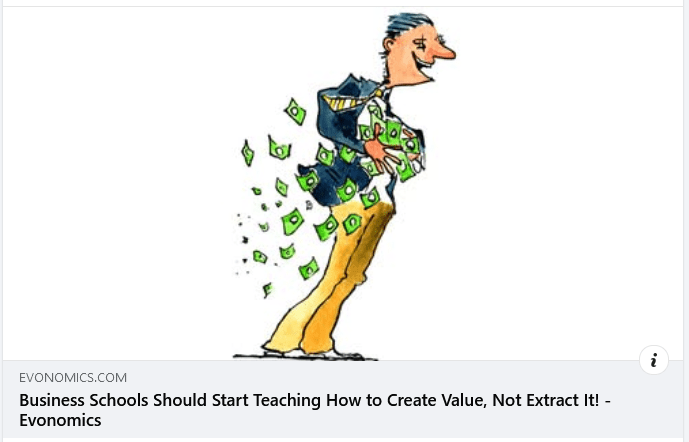
None other than Jack Welch, former chairman and CEO of General Electric,
has called shareholder-value ideology ” the dumbest idea in the world.”
Yet business executives still pretend that maximizing shareholder value
is their primary fiduciary obligation,
which is nonsense except in few restricted cases,
such as when a company is going to be sold.

Value… What is that?!?
Does it exist on its own?

Something must exist if anybody is to extract it, right?
If that something may be created, then it would be a no brainer to make some before attempting to extract it… if you want to be involved in a sustainable process, right?

How do you make value?
How does anybody establish that something is valuable in the first place?

– I declare this to be valuable.
– Who owns it?
– I do.
– How much do you want for it?
– xxx
– OK

That ‘this’ had became ‘valuable’ only when ‘OK’.
Before its value had been agreed upon, it being valuable was on the declarative level only.
‘Virtual’ versus ‘real’.

Only after two interested parties had negotiated about and agreed upon the value of something the value of that something has become established.

Jack Welch again:
“Shareholder value is a result, not a strategy…

your main constituencies are your employees, your customers and your products.
Managers and investors should not set share price increases as their overarching goal. …
Short-term profits should be allied with an increase in the long-term value of a company.”

As an engineer, as down to Earth as it gets, I tend to agree with Jack Welch. A company should be managed as a long term project. It needs to satisfy the natural interests of the investors – profit – in a sustainable manner. Providing something useful to both parties involved. A useful ‘thing’ to the buyers and a satisfying profit to the investors. While creating little to no damage to the ‘environment’ in order to remain acceptable to those living on the same planet…

But who am I to judge… even if I have the blessing of Jack Welch…
Who am I to tell anybody – any investor and/or any manager – how to run their business?!?

Are they blind? Don’t they see this economic model doesn’t work?

Inequality holds back the growth of the entire economy,
as research supported by INET has shown.
Even today’s business elites are worried about its impact:
In a 2015 poll of over 2,700 Harvard Business School alumni,
respondents said that they were more concerned about growing inequality than ever before.

Hm…
“Share holder value is a result, not a strategy”, remember?
Same with ‘inequality’.
Let’s focus on sustainability. On the process.
And notice that the process sputters!
As a consequence of our own decisions!

We have told/allowed the investors and the managers to run the business – not their businesses, the entire business environment – in the current manner.
And we are the ones bearing the brunt. Having to deal with, among other things, the current level of inequality.
We, our decisions, have produced the current situation. Inequality is but one of the consequences.
One, among many, of the consequences engendered by our own weltanschauung.

It is not from the benevolence of the butcher,
the brewer, or the baker, that we expect our dinner,
but from their regard to their own interest.
We address ourselves, not to their humanity
but to their self-love,
and never talk to them of our own necessities
but of their advantages.
Adam Smith, The Wealth of NATIONS, 1776

I’m sure you already know that Adam Smith didn’t invent capitalism. As Marx invented communism and Lenin invented bolshevism.

Adam Smith had done nothing more and nothing less but described what was going on around him. How a bunch of people acting according to their ‘moral sentiment’ took care of business. How individual needs – for meat, beer and bread – were met and how the wealth of nations was built in the process.

“To some people, Gen Z may seem salary ‘obsessed’. In some cases, say experts, it may be hard for older generations to understand why young workers have such an intense focus on pay. “At Gen Z’s age, older people worked 40 hours a week, and made enough money to buy a house and have barbecues on the weekend,” says Corey Seemiller, an educator, researcher and TEDx speaker on Gen Z. “Gen Z works 50 hours a week at their jobs, and another 20 hours a week side hustling, yet still make barely enough to cover rent.””

Do you notice any need being fulfilled, in earnest, in this, new, situation?
OK, things were not that rosy in Smith’s times either. Most people had to work hard, a lot harder than today, to make ends meet. But since Smith and until some 40 years ago things went better. Year after year.
When Smith was writing his books, Regular Joe-s used to live in crowded shacks, usually rented out from their employers. Nowadays, most of those in their 50-ies and 60-ies own the house they live in. Which house has nothing in common with the afore mentioned shack.

So, is this the new kind of progress?
A looking back in anger kind of progress?
Are you even aware of the huge number of people pondering whether capitalism is not as good as advertised – by those who have already enjoyed its spoils? For the simple reason that in the current (no longer) free (enough) market so many people can no longer enjoy the kind of economic well being their grand parents took for granted…

As someone who had experienced both communism and capitalism, the situation is clear.

Why does Marxism still exist when it clearly doesn’t work?

Marxism still works…
Marxism is a dogma. Despite everything pretended by marxists, marxism – as an ideology – is an article of faith. And as long as there are believers who continue to promote a faith, any faith, that faith continues to survive. To work…
On the other hand, there is a non-ideological side of marxism. A pre-ideological component, if you will.
The analysis made by Marx before reaching his conclusion. Before reaching the conclusion that communism is ‘the answer’…
The analysis was correct. Furthermore, even some of his predictions had been right. Our current obsession, induced by Milton Friedman, with profit as the ultimate goal of human activity has led us into an impasse.
But Marx’s solution – to a very accurately defined problem – was an abject failure. Communism was a failure. Each and every time!
But marxism still works… We, some of us, continue to believe according to this ideology…

To set a wolf to guard sheep
Latin proverb.

A first glance, it doesn’t make much sense to put an oilman in charge of a COP conference.
Nothing more than setting a wolf to guard sheep, right?

On the other hand, shepherd dogs are nothing but ‘converted’ wolves.
Wolves who had somehow figured out that it’s more sustainable to live with the humans than in the wild.
Former wolves who had somehow figured out that’s far more sustainable – for them, to protect the sheep than to prey on them.

OK, the agent driving the process had been human. But the facts remain. Dogs have evolved from wolves.

What are we waiting for?
If the descendants of the wolves had been able to ‘cross over’, why so many reasonable people continue to believe that the ‘Global Warming’ is a hoax?
After all, we’re the ones supposed to be reasonable…
And the way I see it, it’s unreasonable to believe that burning fossil fuel accumulated during millions of years can be ‘sustainable’. Forget about ‘peak oil’ and ‘peak gas’ and remember how hot the Earth was when the first drop of fossil fuel had been set aside by Mother Nature.

Tough times create tough men. Tough men create easy times.
Easy times create weak men. Weak men create tough times.

American proverb
Wealth lasts only for three generations: one to make it, one to keep it, one to squander it
Chinese proverb
If you raise your children, you get to spoil your grandchildren.
If you spoil your children, you get to raise your grandchildren.

Popular word of mouth

There’s no denying that, on average, each generation fares better than its predecessor.

Then why some people end up worse than their parents?
Is it a social thing?
Is it in their upbringing?
Is it the consequence of bad personal choices?

The easy way out would be to consider that legislation, material status, the culture one was born into and even the upbringing offered by the parents are nothing but circumstances. And, ultimately, it’s the individual who makes the call. And bears the consequences…
But the above mentioned individual doesn’t rise from and into a complete void… so I need to go deeper!

An equally true but somewhat more useful observation would be that we’re dealing here with something more important than mere wealth.

‘There’s no such thing! Nothing is more important than Wealth!’

Yeah, right… Individual people keep squandering the personal wealth accumulated by their forefathers, the humankind keeps going forward and you tell me personal wealth is the most important thing here…

But you do make a good point. Your insistence, obsessive even, about wealth being the crux of everything is very relevant.
Since I agree with you that wealth is important, indeed, then maybe it’s the ‘insistence’ which is causing the problem…

First of all, allow me to make a simple distinction.

There is wealth – structured opportunity, I’ll discuss this notion in another post, and there is personal wealth. Opportunity which belongs to somebody.
When an individual squanders the wealth inherited from their parents – or even that which they had managed to put together themselves, the wealth itself – the accrued opportunity – doesn’t disappear from the face of the earth. It just passes from one hand to another. Most of it, anyway. For the simple reason that most of today’s wealth is expressed in money. Which is fungible.

‘OK. So individual people squandering their inherited wealth do not represent such a big problem. The total wealth already present ‘on the face of the Earth’ remains (more or less) the same, no matter who owns it. And since new wealth is created everyday, the humankind, on aggregate, goes forward.’

That’s how things used to be. That’s how things had evolved for the last ten millennia or so. Ever since our forefathers had invented agriculture. Agriculture and money… Land and money cannot be destroyed. Buildings and almost everything else which carries value can. Be destroyed. Land and money also, actually, but it’s a lot harder to do it.

But there’s a catch here.

For wealth to do its trick – to function as an opportunity, people have to have access to it.
That’s why, for example, people do not keep their money under the mattress. When deposited in a bank, money will end up being used. The bank will lend them to somebody who needs it and that somebody will put that money to work, In no matter what shape or form. Kept under a mattress, money becomes mostly useless. At least for the time being…
And this is where ‘insistence’ – our obsessive insistence – that money is the only worthwhile goal for any respectable person becomes counterproductive.

‘Are you a communist?!?’

On the contrary, my dear Watson!

In fact, Marx had been just as infatuated with money as Milton Friedman was going to be a century later. With more or less similar results…
Friedman taught us that greed is good. Profit uber alles. That getting money trumps everything else. That getting money is not only good for the individual itself but also commendable. That everybody should make it their goal to become rich!
Marx, on the other hand – please remember that the ‘other’ hand is nothing but similar to its twin – advocated for all wealth to be stripped from its rightful owners.
See what I mean? Both Marx and Friedman had been thinking only about ownership. Who owns that wealth!

On average, we deal with the same situation.
According to Friedman – pushing his advice to the very limit, there’s no problem if someone owns all the money in the world. If it so happened, so be it.
According to Marx, nobody should own anything.
On average, the wealth corresponding to each living human in both situations would be the same.

We already know the consequences of Marx’s teachings. When all the wealth present in one country is managed by a very small number of people, the whole situation goes south. Fast. Very fast!
We also know what happens when the market is cornered. Becomes suffocated by a monopoly. The whole situation goes south. That’s why we cherish the freedom of the market!

Doesn’t make much sense?
To insist that the market must be free and simultaneously maintain that ‘greed is good’?

Yep! My point exactly…

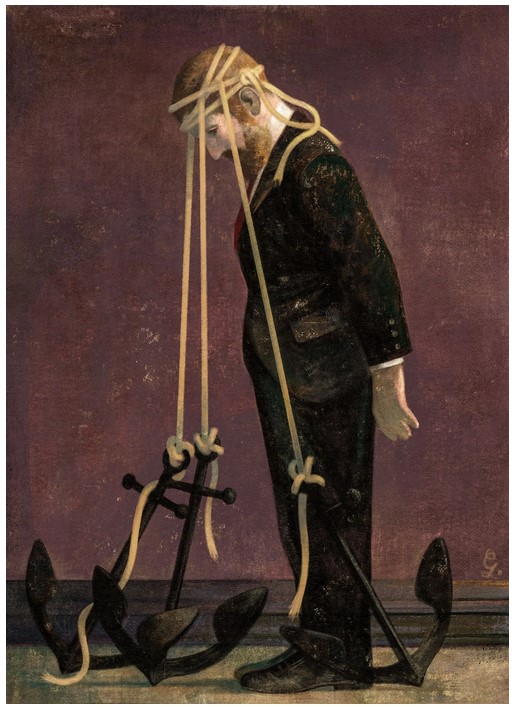
The vaunted human capacity for reason may have more to do with winning arguments than with thinking straight.
Illustration by Gérard DuBois
Why Facts Don’t Change Our Minds
New discoveries about the human mind show the limitations of reason.
By Elizabeth Kolbert February 19, 2017
https://www.newyorker.com/contributors/elizabeth-kolbert

Equality has become ‘the’ thing.
But things are not that simple. Not simple enough to be explained/solved in such a trivial manner.
Equality is a theoretical concept. It doesn’t exist, as such, in nature. Nor in practice.
Two ‘objects’/issues/items are declared, by us, to be equal if the differences between them are smaller than a threshold. Instated, again, by us. Mathematics – a theoretical field by excellence, being the only domain where the difference between two equal ‘objects’ is exactly zero.
On the other hand, societies where people consider themselves to be equal fare better than those where the differences between people are ‘manifest’.
Hence ‘equality’ must be important, right?
‘Societies where people consider themselves to be equal’…
The key word here is “consider”, not “equal “.
In this situation, equality is not only a concept but also a value.

The fact that a functional majority of the people living in those societies consider themselves to be equal creates a certain ‘environment’. A situation where those people actually complement each-other. A society which works as an organism. Not as a shoal of fish nor as a simple herd. A society which works a community.

A single parent can raise children. But two parents do it a lot easier. And, in most cases, better.
A single parent can adopt children. But no single parent, man or woman, is able to give birth to a child without being helped by a member of the ‘opposite sex’.
Societies where people consider men and women to be equal fare a lot better than those entertaining other beliefs. Which doesn’t negate the fact that men and women complement each-other. In a lot more situations than those in which they merely reproduce themselves.
Economies where the market is free fare a lot better than those where the economic decisions are made in a centralized manner. The communist camp – where the economies were run by the party, had crumbled under their own weight. Which strongly suggests that no matter how skilled it may be, a central planner will never be able to balance such a complicated process as a whole society/economy. Monopolistic situations, where decision making became too concentrated, invariably ended up in a pile of mess. Another proof that no decision maker, no matter how skilled/well intended, was ever capable of managing, by itself, a really complicated situation.
What is the real difference between a free market and one where decision making is concentrated in an unsustainably small number of hands? Or heads?
Economic agents are equal? Suppliers are equal among themselves, buyers are equal among themselves and suppliers are equal with buyers?
Or suppliers complement each-other in adequately supplying the market while buyers and suppliers complement each-other in maintaining the market afloat?
Which brings us back to where we have started.
Where people who complement each-other have reached the conclusion they’d better consider their complements as equals. And treat each-other as such.

The way I see it, capitalism is an environment. A ‘place’.
A ‘way’ for people to do ‘economy’.
What people do in that place depends on the place itself but also on how they choose to do things. This being the reason for which the American capitalism is different from the European one. And both completely different from the Chinese version.
In this sense, capitalism doesn’t actually work. Not by itself!
If those dwelling in this ‘place’ act freely – as in ‘free market’ – then the whole ‘thing’ remains ‘sustainable’. Not ‘good for everybody’, not always ‘nice’ but nevertheless ‘fair’. As in ‘you have a fair chance of reaching the other end’. Not to get necessarily rich but to make the ends meet!

The alternative to capitalism… if you take your ideological blinders off, you notice that there’s none!
Socialist/communist countries are/were also capitalist. The difference being that their economies are/were centrally planned. Their markets are/were anything but free!
This being the reason for which communism had crumbled under its own weight.
And for which in all places where the market is not free enough the ‘thing’ is not sustainable!

Any way you look at what’s currently happening, it doesn’t make any sense.

Forget about ‘we’re throwing away 30% of the food we produce while a third of us die of hunger’.
That’s ‘peanuts’. Not for those whose children go to bed hungry but…

People living on the northern side of the Mediterranean Sea had accomplished something marginally short of miraculous.
They had come up with an ideology which convinced them to respect each-other. Christianity.
They had been able to develop the best mechanism for allotting resources. The ‘free market’.
And the best mechanism for reaching decisions for the entire community. Currently called ‘democracy’.

In their attempt to understand, they have devised an extremely original manner of looking at things. ‘Science’.
Based on what they had learned through ‘science’, they had developed ‘technology’.

Working as a team – they used to respect each-other, as children of the same god – and making ‘good’ use of their technology, they had been able to conquer the rest of the planet.

At some point, Europe used to export almost everything – including coal, and import inconsequential things. Silk, spices, tea, sugar, cotton and tobacco.
At that moment, England was considered the factory of the world. It used to manufacture and export the most technologically advanced ‘wares’. Fabric, ‘china’, steel products, machinery, chemicals… And coal! Which was warehoused around the globe and used, eventually, by the English steamships plying the seas for commerce. And for war…

Look at us now!
We depend on our former colonies for much of our energy. Oil, that is.
We depend on the rest of the world for much of the fancy foods we currently eat. Brazilian beef, tropical fruit, fancy sea-food…
And we depend on China for cheap manufactured goods. From clothes to cameras to cranes. ‘White goods’, electronics – computers included, and almost everything else which is sold at decent prices.

Not to mention the fact that Europe had been the flashing point for three World Wars. I, II and the Cold one.
Not to mention the fact that as I write the biggest country in Europe – Putin’s Russia, is trying to annex some 15 % percent of one of its neighbors. Ukraine, also an European country.

If any of this does a modicum of sense to any of you… please let me know!

I, for one, am at a loss. I understand what happened – stay tuned, but I have no idea when we’ll figure out we’re on the wrong track. Going in the wrong direction.

I have no way of knowing what the creator of the meme actually wanted to convey through it.
All I know is what I make of it.

The ‘Austrian’ will eventually fall. Not only that nobody can stay in the saddle for ever but the guy uses only one hand to steer his bike. And the fact that he doesn’t use a helmet is the second proof that he doesn’t care much for safety. For his safety… At his age, he should have known better!

Hard to argue with Mises – the quintessential Austrian economist, if I remember right.
Specially since I grew up under a communist regime. Where laissez faire was absent and where the government was inept and immoral. Which regime, like all other authoritarian/totalitarian regimes in history, had crumpled under it’s own weight.

But wait!
Countries which use laissez faire had long ago invented the necessary mitigation mechanisms.
The unlucky entrepreneurs can declare bankruptcy and start all over.
The fraudulent entrepreneurs – well, many of them, go to prison.
While the inept and immoral governments get booted. Democratically!

My point being that laissez faire works better if there’s a safety net in place.
And that people should trust their government. But also keep it on a very short leash!