Archives for category: cooperation

I’m not going to educate you about what fractals are.
The internet is full of information, go find it. If you care, of course.

I’ll just remind you of an old saying,
‘There’s nothing new under the sun.’

As if nature doesn’t exert itself.
If something works… why invent anything new when you can adapt something which already exists?

In this sense, I somehow must admit that those who believe is God do have a point about this. Sometimes Nature seems to have been fine tuned by an engineer…

Or that engineers have learned a lot from Mother Nature?

Enough with this back slapping between the engineer in me and … whoever is at the other end of this game.

1. The ‘revolving’ principle.

Basically all matter turns around a center, is circled about or finds itself in both situations at the same time.
From the electrons which turn around the nuclei of the atoms to our Sun which spins around the center of the Milky Way.

Behind this principle lies another one.

2. The dynamic equilibrium.

Everything which exists is in a state of dynamic equilibrium.
Both internal and external.
Its components relate to each-other in such a manner as to keep that thing together while the surrounding medium exerts various influences towards that thing.
From the meager proton – whose quarks ‘cooperate’ to constitute a distinct individuality and somehow manage to remain ‘apart’ from the rest of ‘world’ despite the huge forces which keep each atomic nucleus together, to, say, a living organism – which remains alive for only as long as it conserves its ability to interact, both ways, with the environment.

I can probably identify a few more but today I’m going to mention only one more.

N. Killing your host might not be such a good idea.

Remember the fable about the Scorpion and the Frog?

‘Now you really got my attention! How on Earth are you going to spin this into your tale about fractals?!?’

When syphilis first appeared in Europe in 1495, it was an acute and extremely unpleasant disease. After only a few years it was less severe than it once was, and it changed over the next 50 years into a milder, chronic disease. The severe early symptoms may have been the result of the disease being introduced into a new host population without any resistance mechanisms, but the change in virulence is most likely to have happened because of selection favouring milder strains of the pathogen. The symptoms of the virulent early disease were both debilitating and obvious to potential sexual partners of the infected, and strains that caused less obvious or painful symptoms would have enjoyed a higher transmission rate.”

Robert J. Knell, Syphillis in Renaissance Europe…, 2004

Want some more?
How many people have you seen last winter wiping their noses? How many of them actually had the flu and how many suffered from having a benign ‘cold’.
You must have surely got my drift by now… flu kills many more people than the cold. And Ebola kills far many than the flu. And that’s why the cold viruses have far more chances of finding a host than both flu and Ebola.
On one hand, the more deadly a virus is, the less hosts are left for the next generations of viruses.
And on the other hand, the more dangerous a virus – or any other ‘parasite’, is, the more those in peril will try to do something about it.

N+1. If you can’t beat them, join them.

Now that I’ve mentioned parasites, let’s take a step further and talk about symbiosis.

“Mitochondria are rod-shaped organelles that can be considered the power generators of the cell, converting oxygen and nutrients into adenosine triphosphate (ATP). ATP is the chemical energy “currency” of the cell that powers the cell’s metabolic activities. This process is called aerobic respiration and is the reason animals breathe oxygen. Without mitochondria (singular, mitochondrion), higher animals would likely not exist because their cells would only be able to obtain energy from anaerobic respiration (in the absence of oxygen), a process much less efficient than aerobic respiration. In fact, mitochondria enable cells to produce 15 times more ATP than they could otherwise, and complex animals, like humans, need large amounts of energy in order to survive.”
The mitochondrion is different from most other organelles because it has its own circular DNA (similar to the DNA of prokaryotes) and reproduces independently of the cell in which it is found; an apparent case of endosymbiosis. Scientists hypothesize that millions of years ago small, free-living prokaryotes were engulfed, but not consumed, by larger prokaryotes, perhaps because they were able to resist the digestive enzymes of the host organism. The two organisms developed a symbiotic relationship over time, the larger organism providing the smaller with ample nutrients and the smaller organism providing ATP molecules to the larger one. Eventually, according to this view, the larger organism developed into the eukaryotic cell and the smaller organism into the mitochondrion.

Another interesting case of symbiosis is that between each of us and the flora which populates our guts and helps us to digest our ‘daily bread’.

Now, do you remember my post about viruses?
Where I mentioned that viruses are organisms which somehow penetrate into their hosts, take over the management mechanisms of said hosts and ‘convince’ them to actually manufacture the next generation of ‘invaders’.
Killing the host cell in the process, but not necessarily the whole host organism.

This being the difference between the common cold, influenza and Ebola viruses.
On one hand.

On the other hand, there’s the difference between a parasite and a symbiont.
A parasite always being a ‘nuisance’ – from the innocuous common cold to the deadly Ebola, while all symbionts bring along quite lot of added value.

‘OK, and where’s the fractal side of all this?’

How many of the politicians you know behave as parasites and how many as symbionts?
Relative to the rest of the society, of course.
How many of the business people you know behave as parasites and how many as symbionts?
How many of the working age people you know….

And do you remember about the dynamic equilibrium which is essential for survival?
Of everything? Including human societies?
Which need ‘division of labour’ and ‘free market’ in order to thrive?
We arise as human beings in the experience of observing ourselves observing.

Humberto Maturana, The origin and conservation of self-consciousness, 2005

Maturana’s essay is compelling.
Yet, like everything else done by us humans, it is not ‘complete’.
It doesn’t mention ‘memory’, nor ’empathy’.

A key difference between a psychopath and a sociopath is whether he has a conscience, the little voice inside that lets us know when we’re doing something wrong, says L. Michael Tompkins, EdD. He’s a psychologist at the Sacramento County Mental Health Treatment Center.

A psychopath doesn’t have a conscience. If he lies to you so he can steal your money, he won’t feel any moral qualms, though he may pretend to. He may observe others and then act the way they do so he’s not “found out,” Tompkins says.

A sociopath typically has a conscience, but it’s weak. He may know that taking your money is wrong, and he might feel some guilt or remorse, but that won’t stop his behavior.

Both lack empathy, the ability to stand in someone else’s shoes and understand how they feel. But a psychopath has less regard for others, says Aaron Kipnis, PhD, author of The Midas Complex. Someone with this personality type sees others as objects he can use for his own benefit.

Kara Mayer Robinson, Sociopath vs. Psychopath: What’s the Difference, WebMD

You see, both the psychopath and the sociopath are aware of their own doings. They are able to observe themselves observing. And doing whatever it is that they are doing.
They are aware of their goals.
And do what it takes to achieve them.

The problem with the psycho/sociopaths being that a quirk of their memory allows them to learn – to remember, through language, the information contained in past experiences, but denies them the ability to recollect/imagine the emotional consequences imposed by their actions upon those who happen to be affected.

That’s why the psycho/sociopaths don’t have a functional conscience.

Sometimes during their coming of age, something went wrong.

The interface which mediates some of the information traded between their brains and the rest of the world is flawed.

Our brain consists of three main sections. The reptilian, the limbic and the neocortex.
The reptilian part deals with the ‘mechanical’ aspects of our lives – breathing, heart rate, etc, the limbic deals with our emotional lives – and is the first which can store easily accessible ‘memories’, while the neocortex is the part where most of our ‘reasoning’ takes part.
Of course that these three parts are interconnected. That’s how we can influence our breathing and why we – well, most of us, are able to control our sexual urges.

My point being that self-awareness is not enough.
Both psycho and sociopaths are able to calibrate their actions in order to achieve their goals. Which is the functional definition of being aware of yourself.
By not being able to fully grasp the emotional consequences imposed by their actions upon those who are affected by them, the psycho/sociopaths can develop only a more ‘focused’ understanding of the world than the rest of us.
Which can sometimes be a lot deeper than usual. Some of the psycho-sociopaths have been notoriously proficient manipulators…

But no matter how deep that understanding may have been, its lack of breadth has proven fatal. Historically and statistically speaking, of course.

This being the reason for which having a functioning conscience is an evolutionary advantage for individuals.
And, maybe even more important, for the communities composed of those individuals.

Societies which have successfully identified and kept in check those who behaved improperly fared way better than those which had allowed the ‘bulls’ to take control over the ‘china shop’.

And what better example is there than the fact that democratic societies constitute a better medium for their members to live in than the authoritarian ones?

As long as democracy isn’t replaced by mob-rule, of course…

Men grow up ‘against’ their fathers.
Women grow up with their mothers.

Men try to ‘fix’ their relationship before the older one ‘grows out’.
Women don’t have this problem. By the time they have reached that stage of the relationship, they are beyond the point of no return.  Either not really speaking to each other or so ‘in sync’ that there’s no difference of opinion left to speak of.

Statistically speaking, of course.
For both genders.

Scientists haven’t made up their minds yet. They cannot agree whether viruses are actually alive or not.
They do pass over their genetic information to the next generation but that’s it.
They don’t do anything else of what all other living organisms do. Viruses don’t ‘eat’, don’t excrete, don’t feel anything…
A virus doesn’t do anything else but somehow injects itself into a ‘host’, hijacks its ‘control mechanism’ and ‘coerces’ the host to ‘mass produce’ another generation of future invaders.

Same difference exists between regular people and ‘ideologues’.

Regular people ‘earn’ their keep by being useful. The more they do for their communities, the more comfortable is the life they lead.
OK, for this to happen as described here the market would have to be actually free… I’m discussing principles here…. you get my drift.

On the other hand, ideologues act very much like viruses.
They get inside the heads of the unsuspecting and convince them to change their behavior according to the ‘ideological’ view of the world.

This is not necessarily a bad thing.
Some of the viruses have been useful for the living world
The problem is that most of the time the process takes place ‘under the table’. Most of the people don’t even know what’s being done to them. Hence they have nothing to say about it.
Because they have been kept in the dark, people are being denied their most important function.
Because they’ve been kept in the dark, the people have been robbed of their ability/opportunity to choose.

As much as we’d like it to be unique, reality is a spectrum.

Varying from factual to ‘seat of the pants’. And everything in between.

But what is this thing we call ‘reality’?

The key word here being “we”, of course!

First of all, reality is a concept. Which covers everything we know it exists ‘out there’.
Mind you, not everything ’which exists out there’, only ‘what we know about’.

We know about how?
Here’s where things become really interesting.

Maturana says that we, humans, are the first animals able to ‘observe themselves observing’ – his definition of ‘self-awareness’.
We not only observe things, we’ve developed the ability to set them apart from us. To understand that ‘things’ are both separated from us and still connected to us.
Even this understanding of ours comes in various degrees.
Some of us behave as if there is no tomorrow while others have developed intricate thought systems which connect our past actions (a.k.a. ‘sins’) with our future (a.k.a. ‘redemption’).

‘But most of the religious people base their faith on myths rather than facts!’

Well… myths are facts too.
Not in the sense that all the content of all myths had necessarily happened!
My point being that a story becomes a myth/fact as soon as enough people believe in it. Regardless of that story being a factual description of a real incident, an interpretation thereof or even the figment of somebody’s imagination.

Too much confusion… facts are no longer factual, reality is no longer real… everything is in a sort of limbo…

Yep. You’ve got the gist of it.
Our own consciousness has thrown us in limbo. Which, obviously, is yet another of our own inventions…
The funniest thing being that our consciousness hates being in limbo. And tries to explain everything it comes in contact with. Which explains why we have so many myths.

Now, if we want to explain the difference between the factual and the seat of the pants realities, we need to retrace the whole argument.

We have the ‘real’ reality – everything that exists out there, and the conceptual one. Everything that actually exists versus what we know it exists. Or it may exist.
What we know it exists can be further divided into things we think we have completely understood, things we ‘know’ but we still cannot fully explain and things which continue to baffle us.
For instance, we think we know everything there is to be known about internal combustion engines, we know when we are in love but we cannot explain ‘love’ and we are completely baffled by the callousness of some of our brethren.

Chapter 1.
Feelings, perceptions, facts.

Everything starts with a feeling.
Followed by a reaction.
Which, in biology/psychology/sociology is whatever the feeling organism does after it has been ‘poked’.
At this level, everything happens ‘mechanically’. Even for the most ‘sophisticated’. None of us is aware of what’s going on inside out gut yet a lot of information is being exchanged during the digestion process. We might ‘be there’ when we eat but our presence is not requested while our digestive tracts break down our food into usable ‘chemicals’.

Organisms which are capable of learning sometimes transform their feelings into perceptions.
In the sense that their reactions are no longer determined exclusively by their genes. In some instances they use their learned knowledge to improve their reactions, hence their chances to survive.
Think, for instance, of the many things our dogs do for us. Without having a clear understanding of whats going on but, nevertheless, faring a lot better than their wild cousins, the wolves. Or about the huge amount of data passed from one generation of elephant matriarchs to the other.

Further up the decision chain are the conscious species.
Those whose individuals are capable of ‘observing themselves observing’.
This self awareness is what makes the difference between being capable of being trained and that of actually being able to learn. To choose what you consider to be important and to decide according to that particular piece of information.

This being how facts are born.
We, self aware intelligent individuals, notice something. Deem it to be of a certain importance and, hence, call it a ‘fact’.
Regardless of that something actually having happened or being nothing more than a figment of our imagination.


Perfection is absolute. Hence unattainable.
Yet chasing it constantly improves the reckless who attempt it… simultaneously keeping their pride at bay.

Success is relative. Hence always reachable.
All you have to do is beat all your opponents. Preferably to a pulp.
The only limitation being that you are expected to remain inside the rules.
Only nobody says anything if you bend them. No matter how ‘creatively’.

As I mentioned before, life is about individual organisms being able to interact with their environment and species being able to evolve as a reaction to what happens in the same environment.

Interaction between environment and individual organisms is based on sensations.
The organism ‘feels’ itself and its environment and (re)acts  based on the gathered information.

The (re)action ca be very basic – as in voluntarily abstaining from breathing when submerged in water, to utterly sublime. Writing a love poem or saving a toddler from a burning house.

Please note that only writing a love poem ‘demands’ a human being. Abstaining from breathing while under water comes naturally for all animals which don’t have gills while saving a toddler from a burning house can be very well ‘performed’ by a dog.

I mentioned earlier that (re)actions can be grouped in three large categories. ‘Mechanical’, ‘learned’ and ‘self-supervised’, a.k.a intentional.

The ‘mechanical’ ones being those also known as ‘instinctive’. They are practically inscribed in our DNA and constitute our default mode. None of us – plant, animal or human, needs any training whatsoever in order to ‘perform’ them.

The ‘learned’ – or ‘trained’, (re)actions are those which depend heavily on past experience. They start from the same kind of sensations as the instinctive ones but the organism takes the time to transform the sensation into a perception before (re)acting.
A very good example would be riding a bike. A child can learn to do it well before becoming able to entertain such complicated notions as ‘destination’ or ‘goal’. They are simply happy to do it. Same thing being valid for trained circus dogs or monkeys.

The really tricky (re)actions are the ‘intentional’ ones. Those which are performed under self supervision. Of which we are, at least perfunctorily, aware.

‘OK, very nice recap. You’ve already covered this ground. Get to the point!’

I’ve already reached it.
According to this ‘scheme’, given the fact that we pretend to be rational and that we all live in the same world, all of us should behave more or less in the same manner. Right?

‘Like bees? Or ants? Like a school of fish?’

Yeah, something along that line…

‘Or like Pol Pot/B.F. Skinner tried to teach their respective followers?’

You’re stretching it a little bit but yes, you could say that …

‘But this ain’t happening! Not even the most bigoted followers of any cult nor even the most disciplined soldiers will ever behave in such a manner…’

I told you we’d already reached ‘the point’! You made it yourself…

And here’s why:

Yes, we all live in the same world.
More or less…

But we shouldn’t forget the differences!

Biological ones come first.
Those which make each of us feel differently, even when all of us experience the very same conditions. Temperature, time past from the last meal, elevation from the sea level, etc., etc.

On top of those come the ‘social’ differences.
In this instance ‘social’ has a far wider meaning than in everyday life. Yes, there is a huge difference between individuals belonging to different social strata but that’s only a small part of what I have in mind.
‘Social’ differences means all differences consecutive to the ‘mere’ existence of human society.
Let’s make a thought experiment and evaluate the ‘social’ differences between a guy born in what we now call France some 20 000 years ago and another guy born in the same place 2 000 years later. What do you reckon?
OK. Now let’s consider a Frenchman born in 1920 – two years after the end of the WWI, and his son, born in 1947. Would it make any sense to compare the two sets of differences? Those between the conditions encountered by the two prehistoric guys separated by two almost inconsequential millennia and those encountered by the father and son born 27 years apart in the XX-th century?
Or we could compare a native of the Amazonian forest to a New Yorker. Both born in, say, 1999. Statistics have it that the Amazonian native might already be dead…

Small wonder then that perceptions are so different from one individual to another… given that individual perceptions depend on both our senses and our individual experiences – which, in their turn, depend heavily on where and when each of us have been born.

Right now I feel the need to insist on the difference between sensation and perception.
Sensation being, simply put, what we feel while perception is what reaches our conscious mind.

‘What?!?’

Yeah…  strange, isn’t it?
Let’s return to ‘riding a bike’ for a moment.
It was a big moment when your dad removed the ‘helper’ wheels and you soloed for the first time, right? Just as big as when you walked for the first time… only you can’t remember that, do you?…
You were paying very close attention to everything you were doing… while your father kept telling you ‘relax, you’ll be fine’…
And now – if you’re still riding, of course, you do it instinctively. You pay attention only to where you’re going, without bothering about maintaining the balance or other ‘mundane’ things like that. The whole process takes place ‘behind the scene’. It was you who had learned what to do. Consciously, of course. Only once learned, the whole ‘thinking process’ was moved ‘to the attic’. Out of the way, that is.
There are a lot of things which are done in this manner. Subconsciously and not unconsciously. Riding bikes, driving cars, operating machinery… perceiving the world…
We learn how to do it – according to some rules which depend on our culture, and then we continue to do it subconsciously. For all our lives or until something happens. For instance, until we move to a country where they drive on the ‘wrong’ side of the road. And we have to learn some new rules…

Otherwise put, ‘perceiving’ means subconsciously making sense of what we feel by using some previously acquired ‘rules of thumb’. Those who specialize in this field use ‘heuristics’ to describe them.
The problem with the rules of thumb being that they can very easily become ‘cognitive biases’. A.k.a. ‘fences’ which divert us from the ‘straight and narrow’. As in the situation when some of us feel uneasy in the presence of an unknown person with a different skin color.

‘But what happens when consciousness kicks in?’

I thought you’d never ask…

It depends.
On many things. Both ‘social’ and individual.
On the education experienced by each particular individual, on their ‘brain power’ and, last but not least, on something vaguely called ‘individual character’. Something which some people are convinced it can be educated, one way or another, while others are convinced it is ‘hard wired’ into each of us.
If you ask me, both are right. In various, individual, degrees. Character has as much to do with how each of us have internalized their particular experiences as it has with how much ‘spiritual stamina’ exists into each of our souls.

On the practical side of the matter, after each perception reaches the frontier of our consciousness, each of us starts digesting it in earnest. As in attributing ‘value’ to it. Determining whether what has just happened was a consequence of an intention or a happenstance.  Then whether that intention was good or bad. And, finally, the ‘judging’ consciousness establishes a plan of action.  Which can vary from ‘do nothing’ to ‘no holds barred’.

Which explains why no two people will ever react in exactly the same manner when confronted with the very same set of circumstances. There are no two individuals who feel exactly the same, have been exposed to the very same cultural influences AND internalized them in exactly the similar manner. Nor have exactly similar characters and amounts of brain-power.

But what was Mathew trying to tell us?
I’m afraid we are dealing  here with a badly translated metaphor.
‘Poor in spirit’ doesn’t make much sense… unless we consider it an attempt to dull our senses… which may make some sense in certain circumstances…
Only I’m more interested here to determine what Mathew tried to say rather than to interpret the intentions of those who had done the translation. And of those who had, manually, copied the many successive generations of Bibles which had been produced until Gutenberg had, for the first time, printed it in many identical copies.
So, the way I see it, Mathew was speaking of those who are able to stop their conscious mind from building far-flung ‘scenarios’ out of everything that happens to them. Or in their vicinity.

Very similar to the Buddhist concept of ‘non-attachment’?

Well… we do live in the same world, after-all… and we have been ‘made’, more or less, ‘the same’.
We might not be identical, nor having had the very same experiences during our lives… but we do have a lot in common. Despite our differences.

In one of my previous posts, I was arguing about everything belonging to one of these three categories: ‘Aphasic’, Alive and Alert.

The point I’m trying to make now being that each of us ‘rubber-stamps’, according to their individually biased interpretation, each people who crosses their path into one of those three categories.

Some consider that the ‘brain dead’ should be ‘eugenized’ while Plato had talked himself into believing that the ordinary people were too stupid to participate into the collective decision making process and should have been governed by specially trained ‘king-priests’. Thus setting the stage for all subsequent dictatorships, by offering any would-be authoritarian figure a ‘solid’ philosophical backing….

Meanwhile, the ‘alert’ among us are doing their best – or their worst, to accede to the ‘king-priest’ status.

Their favorite method?
You must have already inferred from the title… interpreting the law to fit their goals.
Or even rewriting it to that purpose.

In a yet older post, I mentioned that rules, a.k.a. laws, are made by us.

Intentionally, all of them. Regardless of their nature. Regardless of us only having discovered some of them – like the law of gravity, convened on others – like driving on only one side of the road, or having devised yet others ‘out of the blue’ – the rules for playing bridge, for instance.

Coming back to the judicial system, it’s simple to notice that even here the laws belong to the same three broad categories.

‘Don’t kill/steal’ are ‘natural’. People – well, most of them, have long ago understood/noticed/learned that it’s far more comfortable to live in a society were people don’t kill each-other. Hence they felt the need to set an uniform manner in which to react to ‘trespassers’.

Then, as social life became more complex, people have felt the need to ‘code’ many of the frequently occurring interactions. Matrimony, for instance. Or inheritance. Commercial law. And so on.

Finally, as we’ve become more ‘sophisticated’, some of us have started to ‘jump the gun’. Or to put the wagon in front of the horses…
Believing that laws, if enforced forcefully enough, can change – more or less ‘overnight’, human behavior, they started to impose over the rest of the society various ‘synthetic’ ones.
For instance, the communists have imposed their weltanschauung over the societies which have been weak enough to accept it… Unfortunately, this hasn’t been the only instance in which the more powerful have imposed ‘new’ laws over those who were too weak to protest efficiently. The Spanish have forcefully baptized the Aztec and the Inca, the North American Whites have transformed the more or less nomad ‘Indians’ into ‘reservation’ dwellers while imposing abject servitude upon imported Irish and then African people…

And so on…


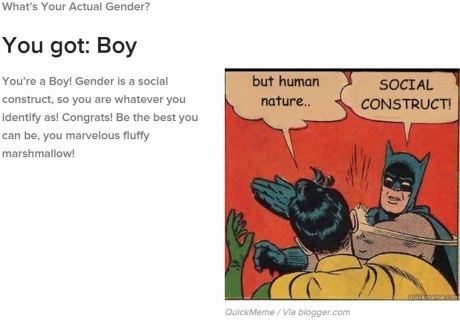
Human Nature as a social construct

Now, that some doctors are not only able but also willing to perform sex/life changing surgery, the subject has spawned a rather hot debate.

The ‘inputs’ being ‘sex’, ‘gender’ and ‘how each of us feels about it’.

Feels about what?

Well… this is the tricky part.
The what of the matter isn’t so simple…

There are so many things that might be felt here…

How each of us feels about the sex they have been born with.
How each of us feels about the gender role assigned to their particular sex by the particular culture into which they have been born.
How each of us feels about those who have enough courage/money to assume another gender/change their sex.

Please note that while neither the society nor the individuals have anything to do with the birth sex, both the society and the individuals are instrumental in shaping all those feelings.

Since sex/gender is too ‘hot’ right now, let me take a parallel road.

Many of my friends are glad when I invite them to dinner. To a home cooked dinner.
Their appreciation has driven me to improve my cooking skills, over time.
Yet in my culture, men are not supposed to cook – if they are not professionals, of course.
Which I’m not.
Yet very few people, if any at all, see anything strange here.
That being the social construct part.
On the other hand, cooking implies certain individual characteristics. For instance, I find it harder when my nose is running. I have to do it ‘mechanically’. It also demands a lot of patience and the ability to plan in advance. Not to mention the fact that one needs both hands.
My point being that cooking, and gender, is based on a certain physical configuration – both hands, a working nose – a certain state of mind AND a lot of study/social conditioning.

My real point being that every ‘social construct’ is based on ‘nature’.
Just as no builder will ever be able to build anything without ‘bricks’, no society will ever be able to build anything out of nothing.
And just as all builders have to adapt their plans to what they have at their disposal, all social constructs will be limited by ‘human nature’ – how ever adaptable and ingenuous it might be.

Now it’s the moment to remind you that other cultures have dealt differently with this matters. Driven by different kinds of necessity.

“It began hundreds of years ago, deep in the Albanian Alps—an unusual tradition where women, with limited options in life, took the oath of the burrnesha. A pledge to live as a man. To dress like a man, to work like a man, to assume the burdens and the liberties of a man. But these freedoms came with a price: The burrneshas also made a pledge of lifelong celibacy. Today these sworn virgins live on, but their numbers have dwindled. Many Albanians don’t even know they exist. What happens when the society that created you no longer needs you? And how do you live in the meantime?”


“In Samoa, gender identity is largely based on a person’s role in the family and if one family has numerous sons and no daughters, it’s not uncommon to raise one of the boys as a girl.

In fact, being a Fa’afaine or the practice of males adopting female gender roles and the attributes traditionally associated with women is deeply embedded in much of Polynesia.”

Confused?

You’re not alone…

“Some Polynesian elders believe there are boys born with the “Fa’afafine spirit,” while others say it can be nurtured.”