Archives for category: collective identity

Humberto Maturana teaches us that human consciousness can be understood as our ability to ‘observe ourselves observing‘.
In other words, consciousness might be reduced to self-awareness.

I’m afraid it’s not enough.
While no individual can be described as conscious if not commanding a certain degree of self-awareness, being able to observe their own observations doesn’t elevate an observer to fully conscious status.

How many of us have ‘enjoyed’ messing up ants or other insects just for the fun of it? When we were teenagers, of course.
OK, we continue to squish the cockroaches we happen to see and to spray our gardens against mosquitoes and other pests.
Only we no longer do it for fun. We employ a ‘healthy’ rationale to justify our actions – cockroaches/mosquitoes are ‘bad for us’.
And we try to do it in a reasonable manner. We don’t soak the entire garden with the most potent insecticide available. Simply because we’ve understood, the hard way, that bees are also important for us.

Otherwise put, it’s not enough for us to be able to keep tabs on what we do, we must also take responsibility for our actions.

After all, we’ve been able to notice that bison ‘engineer’ their own environment.

“Herds of bison milling through Yellowstone National Park may seem aimless to the average visitor, but a new study reveals the animals are hard at work engineering their ecosystem. By rigorously mowing and fertilizing their own patches of grassland, the big herbivores essentially delay spring until late summer.”

Maybe the time is ripe for us to understand that we, humans, have done the very same thing for quite a while now.
The world we live in is, to a certain – but rapidly growing – extent, the consequence of our own decision making.

The faster we learn to accept that, the higher the chances we won’t repeat past mistakes.

Covid-19 is a good eye opener.

While socially distancing to save our asses, we have the opportunity to use our brains.
And understand how many people contribute, ‘under the radar’, to our well being. To us leading a civilized life.
As civilized as we, as a community, have been able to put together.

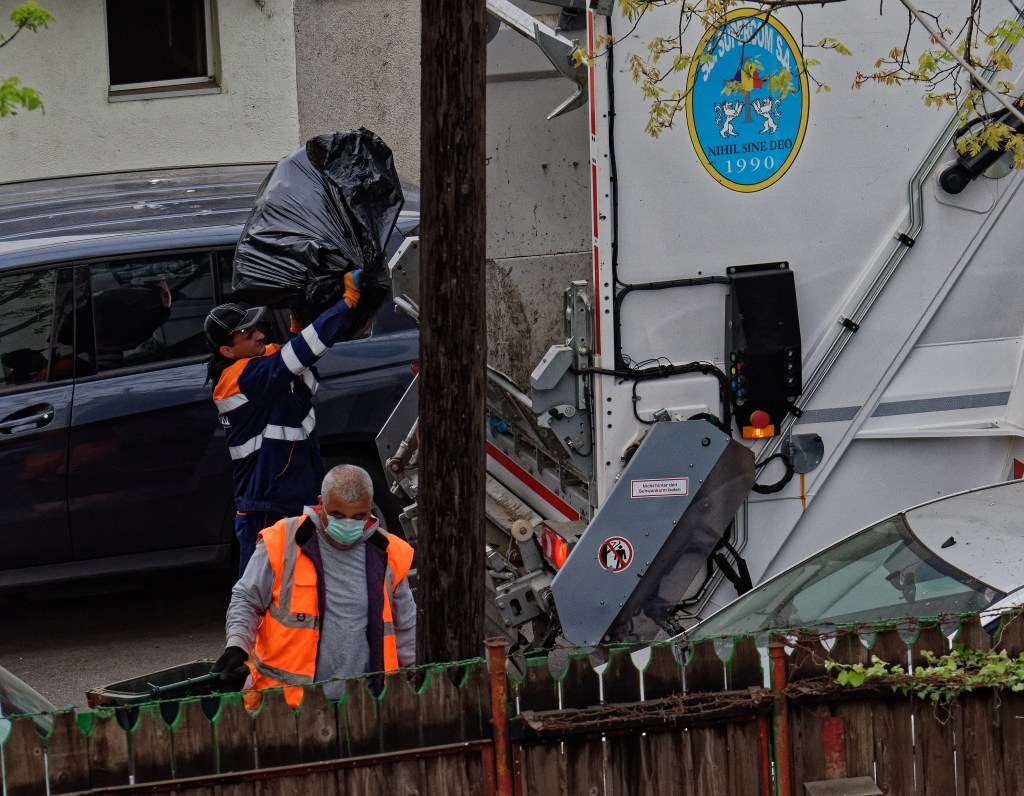
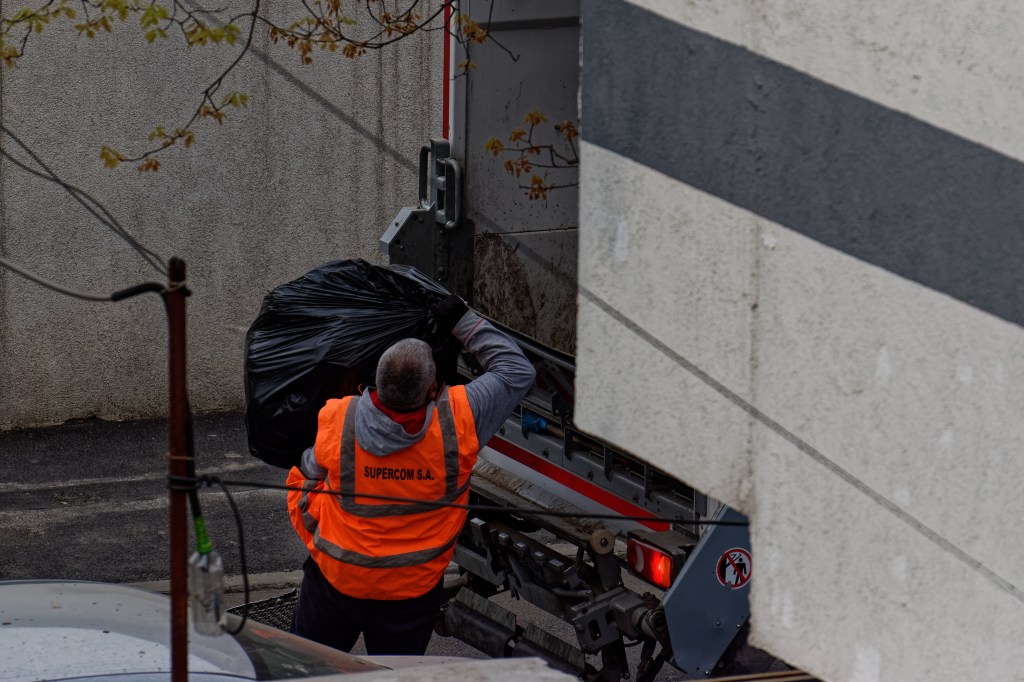
This morning I realized how much we owe to the garbage collectors.
To those who clean up our cities.
To the people who make it so that we, the socially distanced, may continue to entertain the illusion of leading a normal life.

When I was admitted to the Bucharest Polytechnic, I learned that engineers and dogs have a few things in common. An intelligent gaze and the inability to use words when trying to express themselves.
When I started daubing in photography I discovered ‘there’s more than meets the eye’.
When studying to become a mediator I learned, as if it was still necessary, that ‘truth is somewhere in the middle’.

Nowadays, we all expect Science to come forward.
To find the answer.
To break, once again, the barrier which separates us from of the unknown. To take us by the hand and deliver us from evil.

But wasn’t Art the one supposed to provide for our metaphysical needs?!?
Even though it had been Archimedes who was the first to advertise his ‘physical’ breakthrough by shouting ‘Eureka’? While running naked up and down the streets of ancient Syracuse …
It had been the artists who used to trample their boots in the sludge at the bottom of our ordinary lives in order to open our windows towards new horizons…
The ones we expect to transform mud into statues.
To morph suffering into hope!

But is there such a great difference between science and art?

‘The man in the street’ might indeed entertain the notion that art is based on inspiration while science is defined by discipline.
Only this is nothing but yet another proof that it’s high time for us to learn how much inspiration one needs when trying to find a new cure.
And how much discipline must be observed by anybody who attempts to turn their inspiration into something to be traded with another soul.

Addressing the issue from another angle, “can spring be furloughed”?

A friend of mine answered ‘yes’. ‘If there’s no one to notice it …’
Another friend said ‘no’. ‘Spring coming no matter what is the only thing which keeps my mind, and soul, whole.’
Let’s enjoy spring. Together, as it unfolds us.

Let’s not allow it to shed its petals in vain.

“Yes you can! No people to feel/live/see it, no spring.”

Remember Protagoras? “Man is the measure of all things”?

Without man, there’s no meaning?

Yes, our world becomes meaningless.
The moment we no longer care enough about it.
The moment we stop paying attention.

The other day I had a riveting conversation with my son.
With my 21 years old son.

I asked him to comment on my previous post.
The one about too many people allowing sentiment to cloud their judgement.
The one about even reputable news agencies using click-bait titles to entice readers. Hence reinforcing the habit of sentiment being allowed to cloud reason.

‘Life was never better for so many of us’, explained my son. ‘Since WWII most of us had enjoyed peace. Since the Spanish Flu, we hadn’t experienced a pandemic. Since Salk, we’ve led ourselves to believe we were safe from disease. Since the fall of communism, even the ideological divides have paled down. And now we have enough technology to feed the entire planet, comfortably. The point being that we have no idea how to deal in this situation. What to do. How to behave.
Simply because we have no relevant prior experience.
Until recently, historically speaking, we have successfully dealt with wars, famines and pestilence.
But it’s the first time that we experience such abundance.
We need to adapt to the new reality.
To transform it into an opportunity. Into an opportunity to go forward.
We have to avoid, at all costs, the pitfall of allowing this abundance to bog us down.’

Heartening, isn’t it?
That a person so young can find such deep meaning.
If I may say such things about my own son…

OK, Trump did say something.
Which isn’t exactly stupid, by the way.
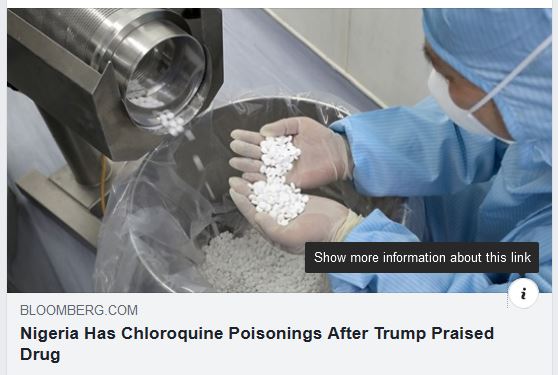
Two halfwits had self medicated themselves to death. With the very same substance Trump was peddling.
But we don’t know for sure whether those two had ever heard Trump advertising that substance. “In Nigeria, households still regularly use tablets containing chloroquine for treating malaria, even though it was banned in 2005 for first-line use because of its declining effectiveness. News of a February study in China about the use of chloroquine for the coronavirus had already sparked lively debate in Lagos, so people began stocking up.”
And there’s a lot of other people, way more knowledgeable than Trump on the matter, who advocate the same course of action.

Yet Trump is held accountable for those two ending up dead…
Are we going to get out of this state of mind?
Ever?

The sooner the better….

After all, what’s the real difference between those who see Trump as their savior and those who see Trump as their arch-enemy?

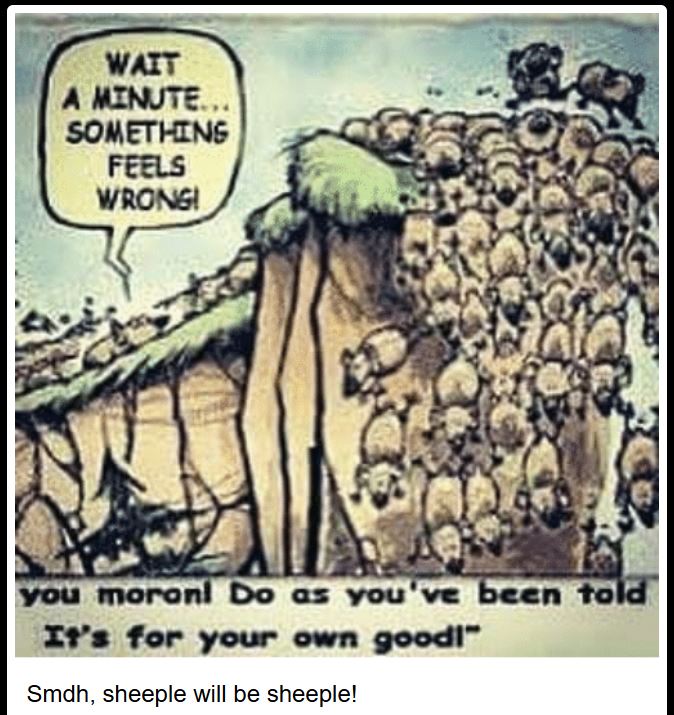
Some see here a herd of sheeple being led to disaster by:

The Democrats
The Republicans
The Government, in general
Any other con artists of their choice.

I see at least one guy who just figured out what was happening.
And who tries to share what they’ve learned!

Maybe it’s to early… I’ll take my chances though.

Germany has weathered this crises a lot better than most of her neighbors.

There are no toll- booths on the German highways. Not that I know of, anyway.

And what has this to do with anything?!?

Well, does your heart bill you for its services?
Your lungs? Your gut? Brain?
The immune system?
Even if each of them works at a cost… for the whole organism!

The health care system is the social equivalent of the immune system.

We, each cultural community around the world, might treat it as an industry. Fine tuned to maximize profit.
Or as a social service. Meant to protect the society from the consequence of disease. And run as efficiently as possible, of course. But sized to be able to cope with reasonably estimated ‘loads’.

There is a fine balance to be held here, of course. A multi-dimensional equilibrium, actually.

It depends on us, as individual members of the brain, to fine tune that equilibrium.

Or else…

Any attempt to learn something, to increase your knowledge about a certain subject, is nothing more and nothing less than an attempt to become intimate with it.

Students have two open roads ahead of them.

One which implies a lot of wooing, patience and a certain degree of self appeasement.
The other asks for a direct, almost blunt, approach.
While the first is more like the student dancing around the subject, the second is akin to a hands on combat.

The results are, obviously, different.
Not exactly different. Only fundamentally.

The difference is very much like the difference between courtship and rape.
The end result might be a child. But…

Same thing with art and science.

It is true that in order to have sex, both partners need to be, at least somewhat, naked.
But there is all the difference in the world between having sex and making love!

The end result is only apparently the same!

Where S stands for Sociological.

So. Let me present you with a sociologically fictitious scenario.

We have an intelligent observer and and a trans-galactic vehicle.

There are no details available about the observer except for the fact that it has access to a comprehensive real time stream of data about what is going on inside – or, more exactly, on the surface, of the trans-galactic vehicle.

And here’s what the observer had recorded.

The vehicle is being continuously transformed by its passengers.
In fact, there are two manners in which the passengers change their vehicle.
By interacting directly with it.
And as unintended consequences of the interactions which take place between the passengers themselves.

The passengers are evolving.
During the observation period, some of them had become dominant.
But no matter whether they had become dominant or not, most of the passengers had disappeared. Both as individuals and as species.

The current dominant species is the most intriguing ever.

It displays a strange mix of intelligent behaviors and suicidal tendencies.

It is composed of rather autonomous individuals who are adept at finding ingenious solutions to almost intractable problems.
But, strangely enough, they haven’t yet been able to figure out two basic things:
The limited nature of the vehicle on which they live. In both time and space.
Nor how to balance their individual functional autonomy with their need to cooperate towards their natural goal. The survival of their own species.

If the whole ‘project’ were a SF movie, the text above would have been the opening.
Followed by:

Currently, the dominant passengers are being taught a lesson by the apparently most insignificant amongst those transported by the vehicle. By a virus, as the dominants refer to it.
The virus – like all of its kind, is able to hijack other organisms and somehow convince them to work for him. At a very high cost for the hijacked organisms.
In this case, the hijacked organisms belong to the dominant species.

And what have the individuals belonging to the dominant species chosen to do?
Inform each-other promptly and cooperate earnestly towards the common goal?

Not exactly. Not yet, anyway.

Homework:
What would the intelligent outside observer think about the whole situation?
Would He consider to lend a helping hand?

We’ve been told to go on as usual.

I’m not pointing fingers here.
I just try to convince you how hard it is to make the right decisions. ‘Going forward’ as opposed to ‘looking back’.
I just try to convince as many of you as possible to stop for a moment and think about it. As dispassionately as possible.

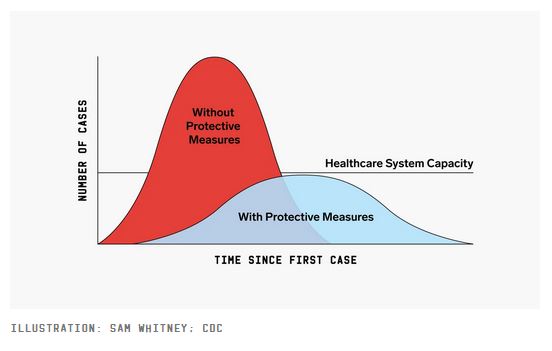
We’ve also been told that we need to flatten the curve.
That our systems were not prepared enough for the onslaught that was going to happen.

Some people continued ‘as they were’ while others tried to ‘flatten the curve’.

For a while.
Now, after some time, people from both categories have started to entertain second thoughts.

Trying to figure out what’s going on here, I’ve asked my self a couple of questions.

Who had chosen to go on as usual and who had chosen to distance themselves from the rest of the society?

‘Go on as usual’ first:
– Those who don’t trust the government.
– Those who are convinced nothing can happen to them.
– Those who felt they had no alternative. Who live paycheck to paycheck or who provide essential services to the society. Like healthcare for instance. Or those who bake our daily bread. Pump the water we drink. Tend the generators who lighten our bulbs and power the computer I use to write this post.

Now those who attempt to ‘flatten the curve’:
– People who tend to trust the authorities.
– Those who understand they should really protect themselves. Who are older and/or already sick.
– Those can work from home.
– And people who are otherwise fine but afford to distance themselves from the fray. Those who have enough resources to do it.

Am I imagining things or the picture is already a lot clearer?

And the other question now.
Why the second thoughts?

Because things have unfolded more or less as the government said they were going to.
Because things have started to happen. If not to them, directly, at least to some of those living around them.
Because there still is no alternative in sight. And because there is nothing much to convince them that their efforts are appreciated by the rest of the society.

Because the government might have been right to tell them to ‘lie down’. But because the same government has failed to do enough in the meantime. Not to mention what it had failed to do before.
Because staying put allows you to start thinking. ‘What next? For how long can we go on like this?’

So.
What next?
What are we doing to convince those who actually keep us going to continue doing so?
What are we doing to convince those who have chosen to restrict their lives to a barren minimum that their efforts are worth it?

What are we doing to convince everybody that there will be a life worth living at the end of all this?