‘Japanese’ logic: If somebody can do it, I can too. If nobody could do it, I will.
‘Romanian’ logic: If somebody can do it, let them do it! If nobody could do it, why should I?
These two capture rather accurately the respective Weltanschauungs.
There are two things which bother me, though.
Once a Romanian determines that something must be done, they will find a way. No matter how unconventional… It’s not any lack of individual self-confidence which keeps Romania back…
Secondly – but, to me, far more important, who gets to determine whether ‘it’ is worth doing? The doers themselves or somebody else? And what governs the relationship between the two? Is any mutual respect involved there?
For some reason, this whole thing made me remember Oscar Hoffman’s words.
‘Logical correctness isn’t enough. For a sentence to be actually true, it also has to make epistemological sense’.
Both viruses and people are atoms put together according to specific sets of rules. Further more, the same sets of specific rules determine how each of them interact with the places where each of them happen to live.
I need to make a pause here. And mention the fact that life alters, profoundly – if given enough time, the space where it ‘unfolds’. For instance, the blue-green algae have transformed the Earth atmosphere into what it is today.
Viruses which kill too much of what they get in contact with do not survive for long. They either peter out, like Ebola usually does, or have been wiped out. Like small pox was. And polio is close to be.
People who destroy too much around them… soon find out they no longer have a viable home.
And this is valid both for individuals and for the entire species.
Nature, on the other hand, doesn’t care. It simply goes on.
The malicious has made an option. Had chosen. Willingly! And, supposedly – according to the hypothesis being discussed here, knowingly.
The ‘stupid’ just stays put. Until the relevant information penetrates his ‘thick skull’. It’s not his fault that those who attempt to convince him are not skillful enough.
And if the ‘stupid’ happens to be in a ‘powerful’ position… (hence his inability to understand fast enough is liable to produce considerable damage) who needs to be chastised?
The ‘stupid’ himself? Who presumably ‘doesn’t have a clue’ about what’s going on? The malicious who had made the whole situation possible? The ‘lazy bystandards’? Who had allowed this to happen? Out of carelessness?
Or those who are liable to suffer the consequences? Who had understood what was going on but…
On the other hand… Could Dietrich Bonhoefer – a renowned pastor and theologian, utter such ‘simplistic’ words? So callous?
I’m not exactly old. Only old enough to continue to check my email. From time to time…
For reasons outside my knowledge, this morning I’d found – in the ‘promotions’ section’ a link to a ‘common sense with Bari Weiss’ article. The title was apealing, the name rang a bell – even though I had no idea about who the person was, so I read it.
My reaction was intense enough to start writing. Not before looking her up…
The point being that she is basically right. Enabling is a powerful phenomenon. But she is also basically wrong.
Powerfull it might be, only enabling is not necessarily malignant. As she implies.
Enabling is done by people with means. Powerfull and or resourcefull enough for their actions to be effective. What the enablers choose to enable… is something else.
And the consequences of enabling depend on the enablers’ choices!
Things might come up right. Or wrong.
The kind of enabling curently predominant in America has been detrimental to the society at large. Leading to the enablers becoming irrelevant. Just as Weiss advertised. Trump has been supplanted by those who had occupied the Capitol – after being enabled by him, while on the other side of the political divide things aren’t going any better. Cultural cancellation isn’t going to end up well.
But enabling can lead to different outcomes. Depending, of course, on what is being enabled.
Take Germany, for instance. Yes, nobody knows who its President is. Only the country, as a whole, functions far better than many of those whose Presidents are on everybody’s lips. Simply because the German enablers had chosen to enable the ‘right’ kind of behaviors.
“First day of class. The law school teacher entered the room and asked a student sitting in the first row: ‘What’s your name?’ ‘Nelson.’ ‘Get out of my class and never come back!’ Everyone was scared and outraged but no one dared to speak up. ‘Very well!’ said the professor after Nelson had left. ‘Let’s start!’ ‘What do we have laws for?’ The students were scared but they tentatively answered the questions. ‘So that order may be maintained?’ ‘No!’ ‘For us to fulfill?’ ‘No!’ ‘So that trespassers might be punished?’ ‘No!’ ‘For justice to be made?’ ‘Finally! And what is justice?’ The students were already pissed off but they continued. ‘When human rights are upheld?’ ‘Not bad. Elaborate!’ ‘To differentiate good from bad?’ ‘Then was I right to throw Nelson out?’ Silence. ‘I want an answer!’ ‘No…’ ‘You might say and injustice had been committed?’ ‘Yes…’ ‘Then why nobody did anything about it?’ ‘What do we want laws for if we don’t have the will to uphold them? Each and everyone of you needs to speak up whenever you witness injustice being done! All of you! Always!’ ‘Go bring Nelson back! After all, he’s the real teacher. I’m nothing but a student here!’ ‘We should all learn that whenever we don’t defend our rights, our dignity vanishes.’ ‘That dignity is not negotiable’!” I’ve just read this on somebody’s FB wall. And a couple of comments. “‘But why did you have to throw Nelson out?!? Couldn’t you have simply explained your point? Lousy teacher… you just enjoyed playing God!’ ‘There is a small difference between explaining ‘something’ to somebody and making the same somebody actually feel that ‘something’. The same difference which exists between a lump of clay and the same lump of clay after God had breathed soul into it’.“
This book represents Djuvara’s thesis for his 1974 Doctorat d’Etat.
There are two main ideas which are to be pointed out here. A first one hidden under the distinction he identifies between ‘culture’ and ‘civilization’. The second being the bread and butter of his thesis. That civilizations are initiated in one place, diffused/exported for a while and then replaced – or led further, depending on how one chooses to interpret the facts, by people until then living somewhere on the fringes of the civilization they are replacing/refurbishing.
Nothing really new, right? ‘Cyclical History’ wasn’t invented yesterday. And certainly not by Neagu Djuvara.
Well, Djuvara’s ideas – like everybody else’s, are nothing but ‘overgrowth’. Things which sprung in people’s minds ‘on top’ of what those people had already learned. Found out. Or, of course, both.
In a sense, what I’ve said in the previous sentence is the very condensed abstract of Djuvara’s second ‘main idea’. The first, the ‘hidden’ one, – again, in an extremely abridged version, being that ‘history, as a narrative, is nothing more and nothing less than what historians choose to make of the facts they had learned about’.
Too blunt? Well, first and foremost, I’m an engineer. Not a fancy pen-pusher…
OK. Let’s go further. I’m going to illustrate, briefly, Djuvara’s main thesis by presenting his version of what had happened in Europe. What had started as an European phenomenon, more precisely.
The Roman civilization had grown at the periphery of the Ancient Greece. And, eventually, took over more ‘space’ than the Ancient Greeks. The Russian civilization had grown at the periphery of the Byzantine/Orthodox one and eventually took over. Or, at least, attempted to… The Holy Roman Empire of German Nation ‘recycled’ – or, at least, attempted to, the ‘ancient’ values and traditions. Great Britain had grown at the periphery of Europe until it took over the whole world. At least for a while… The US, which had started as a British colony, had grown into the most powerful nation known to man.
‘OK, I understand what you meant by trailers and trailblazers. Some of those who trail might end up trailblazing. Do you want to add anything? Is there an actual point to your post?’
Yep. As they say about the market, ‘past performance is no guarantee about the future’. The fact that things have happened as they did is no guarantee that they’ll keep unfolding in the same manner.
In a sense, Fukuyama was right, after all… Even if not in the sense he thought it!
According to “The end of history” people – all over the World, had realized the relative merits of ‘liberal democracy’ and ‘capitalism’. Which were going to be put in practice, effectively marking ‘the end of history’. Thirty years past that moment, it seems that things aren’t going in that direction.
I’m I contradicting myself? Who’s right, after all? Djuvara? Since history doesn’t seem to have stopped? Or Fukuyama, but for some other reason? Than the one advertised by him?
‘History, as a narrative, is nothing more and nothing less than what historians choose to make of the facts they had learned about’
Then, if history is ‘man made’, what about the future?
Can we really make it? Predict it?
‘Make it’, for sure! If not us, then who?!?
‘Predict it’… that’s something totally different!
There are signs, though.
First of all, Djuvara had described something which can be compared with fire burning in a savannah. It starts in one place, burns for a while… and then starts up some place else. Until now, no fire – no fire known to man, had burned any savannah so thoroughly that nothing was left for a ‘second’ fire.
Secondly, Fukuyama said that history will end when all humankind will sync. When all ‘civilizations’ will be run according to the same paradigm. According to the liberal democratic and capitalist paradigm, in Fukuyama’s vision. We’re still far from that. Only there is one paradigm which is willing to play that role! To fill those shoes…
The ‘greed is good’ paradigm! Or, if you don’t like to think in ‘monetary’ terms, the ‘my version is the only right one’ paradigm.
The problem being that these two work in concert. They are two facets of something called ‘intellectual arrogance’.
I’ll come back to this notion sometime in the future. Now I’ll end up telling that there’s not much left of the ‘savannah’.
When things were unfolding as Djuvara described them, the planet itself was more or less ‘virgin’. Unexploited. Unoccupied. Human culture used to be diverse. Ideas were developing. Traded. From one place to the other. From one culture to the other.
Nowadays, much of the planet – our home, is occupied by the, more or less, same civilization. And by an increasingly similar culture.
Nothing inherently good nor bad here, mind you!
If we still have no definitive history, then the future hasn’t been written yet. It’s up to us to choose the right trail. For no other reason than the fact that there are very few trails left for us to burn!
Attempting to value individualism over collectivism is similar to trying to establish which came first, the chicken or the egg.
Having experienced both – collectivism and individualism put in practice as political principles, I have noticed that neither extreme is capable of working in a sustainable manner.
Communist regimes had fallen one after another. Fascist regimes did the very same thing. Pirate republics could never resist for long.
Coming back to what is happening in the US, I’m afraid very few people are aware of how much collective thinking had been embedded in the American Psyche. The good kind of collective thinking… Americans go to church. A place where you go to to be together, not alone. Americans used to help each-other. Charity used to be a big thing. Slowly, it had become a dirty word. And so on.
Individuals can not exist on their own. They need each other to survive. And to thrive. Collectives can not last for long unless the individuals who constitute them do respect each-other. Help each-other maintain and develop their individuality.
“Those are called Witches Stairs. Allegedly, witches can’t climb up them. You will occasionally find them in very, very old New England homes.
(photo by Daphne Canard)”
Yesterday I got a notice from FB:
I presume this was the ‘consequence’ of some artificial intelligence employed by FB doing its job.
Doesn’t make much sense but…
For whatever reason, I made a screen capture of the notice and shared it on FB. A friend asked me about the original post. I looked it up and it was no longer there! I searched FB for the picture… and there it was. Shared multiple times by multiple people. Sometimes with the accompanying text, sometimes baren. And, at least once, bearing a very similar warning:
I’m not questioning FB motives for fact checking the information on its walls. That’s a good idea. Only I’m not so sure the ‘artificial’ intelligence FB uses to implement that idea is intelligent enough for the task….
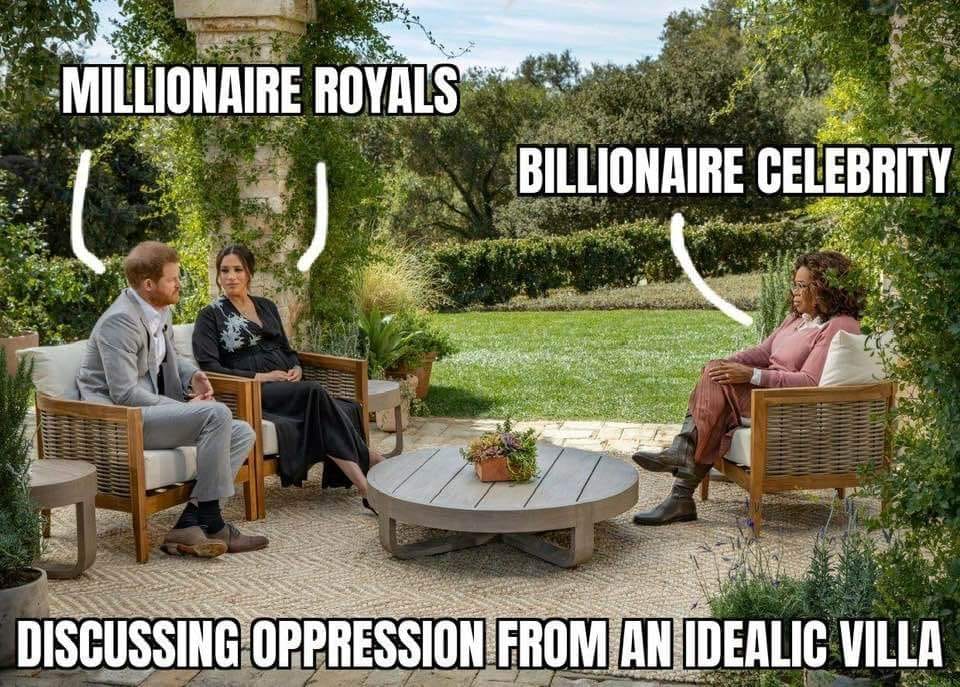
Meghan and Harry had a chat with Oprah. Which had eventually been broadcasted on TV. Basically, there was nothing new nor really interesting there. For me, anyway. Yet there’s a lot of reaction.
I don’t really care about the reason for which the royals have treated Markle the way they did. About the reason which convinced the couple to speak up. The individual reasons for those who comment on the internet to do it as each of them had chosen to do it.
There are two points I need to make here.
The fact that they are rich and famous doesn’t change the fact that the oppression they’re speaking about is real….Maybe they experience it differently… maybe they have it easier when speaking about it… but opression continues to be dealt. Among us, by people like us.
And, secondly but just as important, those three weren’t discussing about mere oppression. They were talking about racist oppression!
Could this be the reason for so many people taking issues on this subject?
I fully agree with Sowell but the fact that Sowell is right doesn’t change the fact that we’re the ones responsible for present day racism.







 nicichiarasa