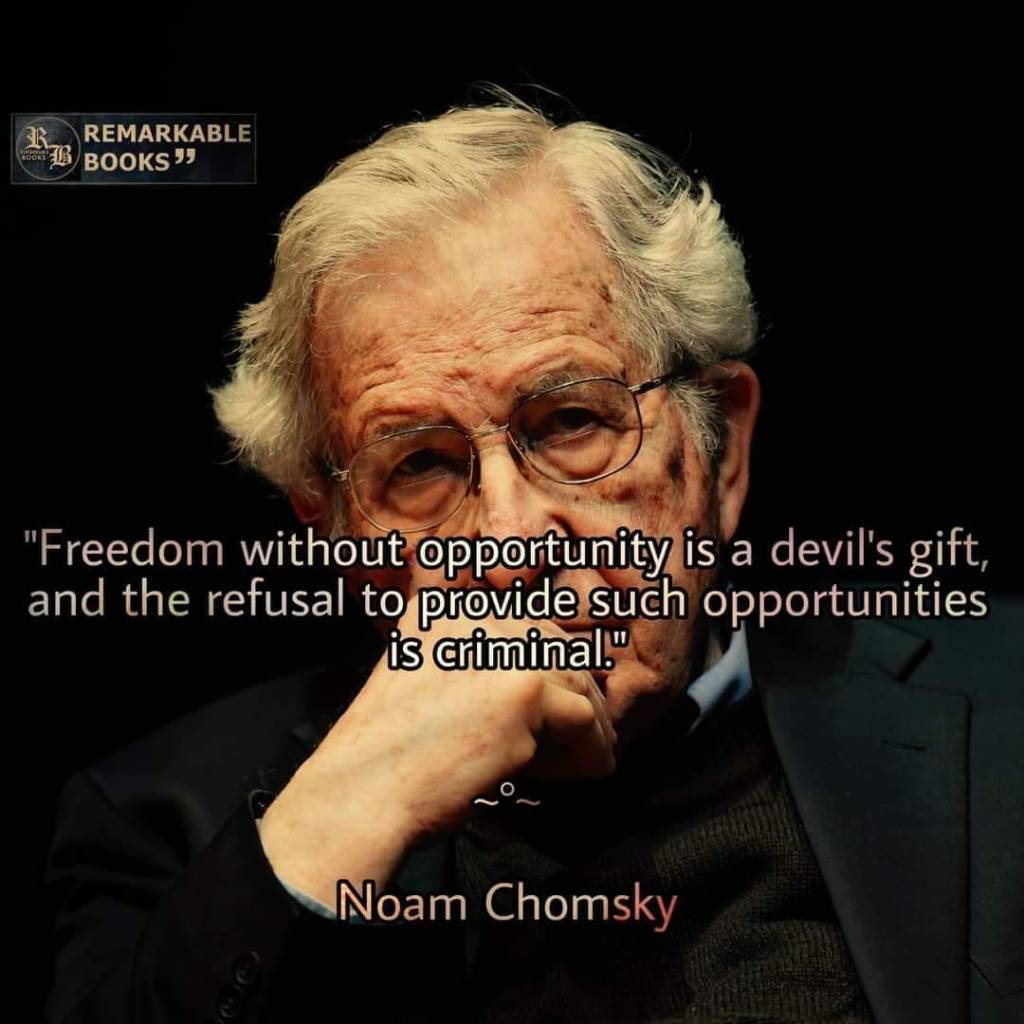
As usual, Chomsky is only half-right. Opportunities shouldn’t be provided. Period! In fact, nobody should be able to control/provide sizable amounts of opportunity!
On the other hand, making it so that only a small number of people enjoy all the opportunities in the world is, indeed, criminal. Unsustainable for the longer time frame, actually!
For something to become a resource, it has to be identified first. As such…
Coming back to Kissinger, we need first to accept that he is the product of the world before him and one of the factors who continues to shape the current one.
We can learn from him – and coldly assess the present situation in order to avoid past mistakes going forward – or … we can let him win! And follow in his footsteps: Divide et impera, manipulate people into doing things against their own nature, despise everybody who thinks differently than what we consider to be right …
– How did you manage to mess things up so thoroughly? – By allowing too much coherence to slip away. After we – well, some of us, already had a fair understanding about how things worked. About how we got there in the first place. – Would you care to elaborate? – Things went on more or less linearly up to when we had learned to speak. That was when it had all started. When we had realized what a start was. And that was it. Speaking to each other allowed us to access the second level of consciousness. Self awareness. Speaking to ourselves – a.k.a. ‘thinking’, gave us the illusion of ‘knowing’. ‘Knowing’ led to ‘knowing better’ and ‘knowing better’ gave birth to arrogance. For a while, this process had been kept in check by the harsh reality. People, like all living organisms, have certain needs. Basic needs. Food, shelter… During most of our evolution, getting enough food and shelter consumed most of our resources. And time. Only a very small number of people had enough spare time. And energy left for thinking. And only a very small percentage of this already small number of people used their minds to think about anything else but how to preserve their privileged status. Which status was the source of their ‘spare time’ in the first time… Slowly but surely, those having something else in their minds besides their selfish self interest have come up with a thing called ‘technology’. By carefully, and considerately, watching those who worked, the selfish thinkers have noticed that from time to time and from craftsperson to craftperson there could be noticed small differences in how things were done. Hence the concept of ‘how things are done’. With the natural sequel of ‘let’s do things in a better way’. Technology made it possible for workers to be more productive. Communities as a whole became more productive. Hence increased the possibility for more people to have spare time for thinking. Some communities made good use of this new possibility while others failed to do so. Usually for reasons depending on the ‘general conditions’ and not at all imputable to the communities themselves. Unfortunately, technology also had two less fortunate consequences. By freeing more and more people from want, it also freed them from ‘religion’. Until that moment, people who were ‘excluded’ from society – who did not partake in ‘religion’, could not survive on their own for any significant length of time. After the advent of technology, reclusion no longer meant almost instant death. Technology also produced ‘hard science’. A corpus of knowledge about how nature works. Which knowledge can be summarized as a collection of natural laws. No longer depending as much on their contemporaries and cognizant of those natural laws, some of the thinkers – whose numbers had been constantly swelled by the continuously improved technology, have reached the conclusion that through thinking a human might, given enough time and resources, understand basically everything. Some of those had become dictators. Others had become consultants. Both categories extremely confident in their own knowledge. Arrogant, even. This is how we messed things up. This bad.
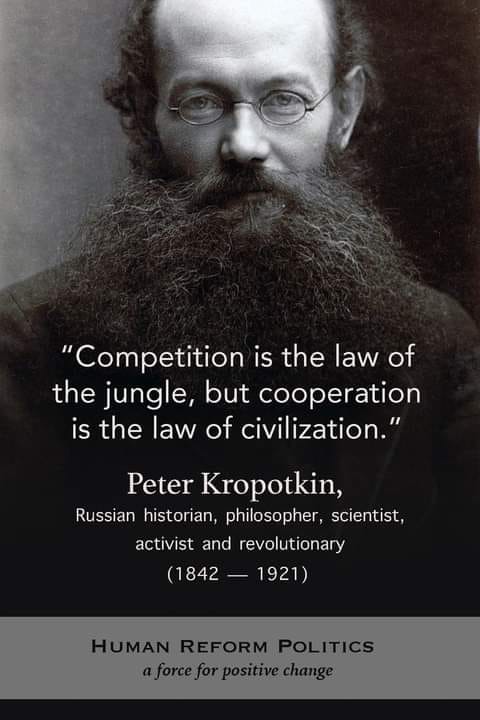
The Bolshevik Revolution had nothing to do with cooperation. Nor with civilization. It was nothing but the famished underdog eating the bloated plutocrat. The ensuing indigestion lasted for almost a century and resulted in a huge number of people suffering from ideological food-poisoning. Too many of the poisoned ending up dead…
Yet here we are. Again! Trying to sort out a re-heated dish. Which had already been proved to be unpalatable!
No wonder ‘gaslighting’ had been determined to be ‘word of the year’…
As for Kropotkin… he was a true revolutionary! He was gaslighting his audience before the term had even been coined…
‘Jungle’ – or ‘bush’, is where evolution takes place. Some of us might see it as a venue for cut-throat competition but it’s nothing but the opposite of it. The fact that some of us misperceive the jungle doesn’t change the evidence. In nature, death doesn’t happen at the whim of someone. A lion kills only when hungry. And chooses to hunt the already weak. Leaving the rest of the herd in a better situation.
The kind of cooperation designed by Marx and put in practice by Kropotkin – the communist ‘civilization’, is the epitome of stagnation. When humans are no longer free to fine-tune competition with cooperation – and are forced to cooperate as they are told to from above, things end up in chaos.
All revolutions – 1789, 1917, 1989, have proven – time and time again, that things cannot be sustainably maintained as the rulers consider to be appropriate. That no matter how skillful the ‘designers’ consider themselves to be, society is a too complex thing for a small gang of however powerful people to be able to ‘keep afloat’. This being the point where Marx, along with all other ideologues, had gotten it completely wrong.
According to Marx, it’s enough for a bunch of people to pretend they have a ‘theoretically clearer understanding of the line of march’! In fact, this is the sole argument made by Marx when explaining why the communists were entitled to lead the proletariat. ‘Because they knew better!’
Well, we know, now, what it means to be led by people who pretend to be above all others! By people who pretend to be better than the rest…
Going back is not an option. If back were good enough, we wouldn’t have left it in the first place.
Many people believe we’re reliving the fall of Rome. Contemporary with that fall was the advent of Christ’s teachings. The fact that, eventually, Christianity has altered his teachings to fit the needs of the christian hierarchy doesn’t demean any of what he taught us.
That people who treat each-other respectfully fare a lot better than those who allow the exploitation of the weak.
That people who live ‘together’ fare a lot better than those who keep forgetting that ‘strong’ and ‘weak’ are both relative and temporary.
That people who are convinced that ‘survival belongs to the fittest’ will eventually make place for those who understand that evolution is solely about the demise of the unfit.
“And Jesus knew their thoughts, and said unto them, Every kingdom divided against itself is brought to desolation; and every city or house divided against itself shall not stand: And if Satan cast out Satan, he is divided against himself; how shall then his kingdom stand? And if I by Beelzebub cast out devils, by whom do your children cast them out? therefore they shall be your judges. But if I cast out devils by the Spirit of God, then the kingdom of God is come unto you. Or else how can one enter into a strong man’s house, and spoil his goods, except he first bind the strong man? and then he will spoil his house. He that is not with me is against me; and he that gathereth not with me scattereth abroad.”
How many times have these words been invoked? By people who use them to divide? To carve a follow-ship? A follow-ship for them to lead…
How many times have these words been invoked? By individuals cocky enough to pretend they are speaking for Christ? Cocky enough to pretend they are able to fill Christ’s shoes…
For the outsiders, it seems like Gorbachev ‘made’ Putin. Gorbachev had destroyed the Soviet Union and, thus, had set the scene for Putin to take over.
I’m afraid things are a little more complicated than that.
Gorbachev – at that time, the best informed decision maker in the whole USSR – had been smart enough to understand that no matter what he might had tried to do, the corpse was already rotten. That everything but a major ‘upheaval’ could not accomplish anything more than prolong the agony. What he had done was nothing more than allowed the things to happen according to their nature.
I’ll make a short break here and remind you that all ‘imperium’ had eventually ended in failure. The tighter the control exercised by the ruler, the more abject the eventual failure. Check your history book.
So. Gorbachev had taken the appropriate steps. What he had done was in step with the natural flow of history.
Eltsin and Putin, on the other hand, had done the exact opposite. Eltsin had tried and Putin had succeeded in regaining the ‘reins’ of the government. The reins, the whip, ever stronger control over the barn where the whole stash of hay is deposited…
Why things had unfolded like this? Because they – Eltsin and Putin, had chosen this venue and because nobody else had been able to do anything about it.
OK, Gorbachev, Eltsin and Putin had made their respective calls in basically the same social and political environments. The economic situations were ‘somewhat’ different but this doesn’t change what I want to stress out. Each of them had done what had crossed each of their individual minds. Each had been able to do whatever each of them had wanted because… Because that particular ‘social arrangement’ allows the ruler to make whatever decisions they may see fit. Because that particular ‘social arrangement’ – dictatorship, no matter how much window-dressing had been slapped on it, allows the person who happens to clamber ‘on top’ to keep making mistakes until the whole ‘carriage’ disintegrates.
‘Most people confuse liberty and democracy. They are not the same.’
Liberty and democracy are not the same indeed.
Like my left hand is not the same with my right one.
But I need both in order to lead what I consider to be a normal life.
Most people – specially if they get help, can survive without a hand. Or without either liberty or democracy.
But without both… without both hands or without both liberty and democracy… I’d be at somebody else’s mercy!
‘What?!? What kind of liberty is there under communist rule???’
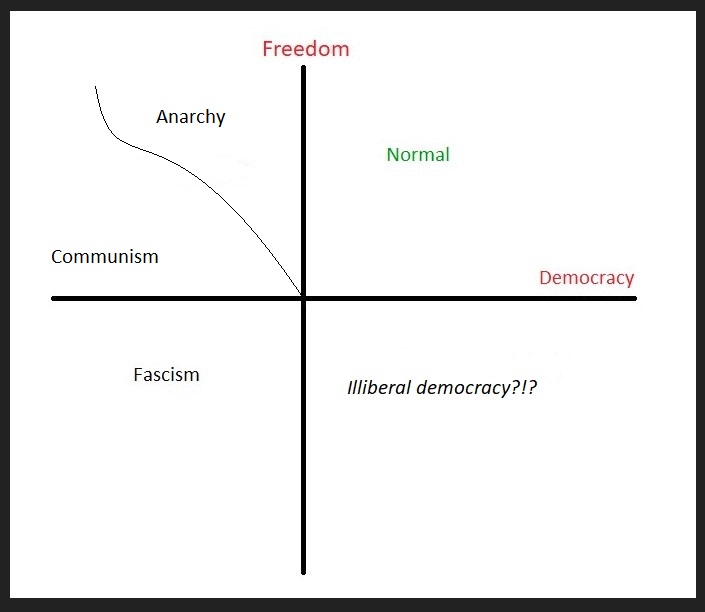
You see, liberty has two ‘faces’. Two dimensions. Three, actually, but I’ll be talking about only two of them in this post.
There is the ‘inner liberty’ and there is the ‘socially sanctioned liberty’.
Liberty itself is a human concept. We have noticed something, wondered about it, named it and then attempted to understand it. This was, and continues to be, a collective effort.
In some places ‘liberty’ had appeared ‘naturally’. There was enough liberty naturally sloshing around, hence the circumstances were right for those who had happened to live there at the right time to notice it. Furthermore, the conditions had been right again for the entire community to be able to agree among themselves about the concept and about how to use it/put in practice their new intellectual achievement.
Other places have not been so lucky. They had been close enough, geographically and socio-historically, to notice the ‘birth of liberty’ but their specific conditions were not ‘right enough’. Many people living there coveted liberty but the local conditions made it impossible for liberty to take hold. In these places ‘inner liberty’ – individually assumed freedom, can be found a lo more easily than presumed by those unfamiliar with the local realities.
Yet other places had it even worse. Initially on the path towards liberty – and democracy, they have somehow stumbled. For whatever causes – internal and/or external, something went wrong. People became disappointed enough to give up not only democracy but also liberty. Including their own, individual inner freedom.
A somewhat intermediary situation constitutes the third abnormal quadrant. The people involved have given up their liberty – partially, but those running the show continue to use (‘pretendingly’) democracy as a window dressing to hide their true intentions.
The last hundred years or so have been extremely relevant in this matter. All communist regimes had fallen. Under their own weight. Most fascist/nazi regimes are no longer with us. Had been so ‘arrogant’ – read self destructive, that their neighbors had to do something about them. Had created so much disruption around them that those whose very existence was endangered had been forced to spring into action. ‘Illiberal democracy’ is a rather new ‘development’. Would be fascist/nazi dictators don’t have all circumstances aligned to make their final move so they have to make do with what there is at their disposal. The local population is ‘despondent’ enough to pay attention to their arguments but not desperate enough to follow them into the ‘unknown’. Hence this oxymoronic abomination.
‘Illiberal democracy’… On the other hand, the spin doctors promoting illiberal democracies hope to be able to reap the benefits of democracy – the population being ‘rather favorably disposed’ towards the government while having to pay less ‘lip service’ to individual human rights. A balancing act, with no safety net, which is alluring to those reckless enough to attempt it but which will end up badly. Sooner rather than later.
But the most interesting ‘combination’ – for me, at least, is Anarchy. In the sense that those who ‘swallow’ the lure are self delusional. They have somehow convinced themselves that their, own, liberty somehow trumps the liberty of everybody else. They feel so strong, so immune to any outside influence, that they would willingly accept to live in a no rule environment. Without understanding that ‘no rule’ means ‘no holds barred’. They actually don’t realize that unfettered liberty actually means ‘Each of us free against all others’. This being the reason for which Anarchy, as a political arrangement, has never survived for long enough to be noticed. Except as a transitory phase.






 nicichiarasa