Archives for category: 1989 and the Global Financial Crisises.

Comentariile din clip au fost provocate de faptul ca Manuel Valls, premierul Frantei, a folosit un avion guvernamental pentru a se duce, impreuna cu doi dintre copiii sai, la un meci de fotbal. Ma rog, la finala dintre Barcelona si Inter.

Sunt curios daca va avea si el bunul simt sa-si dea demisia.

Bine, lucrurile nu stau chiar atat de simplu cum pare la prima vedere.
Pana la urma Valls s-a dus la un meci de fotbal la care si-ar fi dorit sa se duca cel putin 20% dintre europeni iar spusele lui Ioan Rus au oarecare acoperire in practica.

Ce vreau sa spun este ca ‘elitele si oamenii politici’ nu sunt rupti cu totul de realitate.
Problema cu care ne confruntam, si noi si ei, este ca perceptia lor asupra realitatii nu mai seamana aproape deloc cu cea pe care o avem noi.
Ceea ce, iarasi, nu este neaparat rau. Mai multe perspective asupra unui anumit lucru inseamna mai multa informatie disponibila cu privire la lucrul respectiv.

Numai ca degeaba avem, fiecare dintre noi, cate o bucatica de informatie daca nu putem colabora, daca nu punem in comun informatia respectiva. Daca piesele puzzle-ului nu apuca nicidata sa fie asamblate corect.

Si cum sa comunicam eficient daca ‘elitele si oamenii politici’ nu realizeaza odata ca ‘oamenii de rand’ s-au saturat sa fie tratati ca niste oi, ca destinele lor sa fie hotarate de sus iar lor doar sa li se spuna, fara menajamente, care e situatia si ce hotarari “S-AU LUAT” in numele lor.

Does he have any ‘right to exert his authority, inside the limits that have been delineated for him’?

Somebody who has real authority enjoys a certain degree of autonomy, if not outright independence. ‘Authority’ is almost never clearly delineated, there is always a gray area where the discretion of the individual in charge is the one that calls the shots.
More over if we, the ‘subjects’, consider that he has ‘the right’ to exercise that authority then it’s us who are in deep trouble.
‘Exertion of authority’ ‘smacks’ of the situation  when the ‘authority man’ had conquered his position against the wish of his subjects – like the emperors of the old. (Or like the communist dictators of not so long ago, only they pretended to exercise their authority for the benefit of the people while the emperors of the old were more straightforward and declared themselves ‘gods’)
Nowadays, at least in the democratic states, authority is, theoretically, used as a tool, towards the accomplishment of what the person in charge is supposed to achieve, not as a right enjoyed by that person.
In fact the notion of a right to exert authority inside some limits is akin to what has been described as ‘feudalism’, a social arrangement not that different from the Athenian democracy. The people were divided in two categories, just as in the previous situation – the ‘imperiums’ of the Antiquity, the difference being that in an imperium the top class was inhabited by a single individual – the emperor/dictator, while in feudalism/Athenian democracy the top class was inhabited by the free people, whose authority/freedom extended only as far as it started to encroach the authority of the equivalent individuals. I have to remark here that in many circumstances feudalism has very quickly degenerated back to imperium – for instance in absolutist France, ‘L’etat c’est moi’, or in tsarist Russia, while England successfully avoided that due to the spirit enshrined in Magna Charta.
The difference between feudalism/Athenian democracy and the modern democracy being that currently we can no longer speak of individual authority simply because nowadays no one has the “right” to own slaves – as the Athenian ‘democrats’ had, nor even enjoy extensive authority (bar the right of life and death) over other people – the serfs, as the feudal barons did not so long ago.

This doesn’t catch the entire picture – each of us is heavily dependent on the environment into which we happened to be born – but clearly states the difference between us humans and the rest of the animal kingdom.
We are able to make conscious decisions and we love to apportion blame.

When engaging into our favorite pastime we’d better take into consideration two things: Our consciousness/rationality is limited and we can speak about blame only if intent was present.
We don’t have unlimited access to other people thoughts, nor can we see very far, so, in reality, we are aware of a very limited portion of the world around us. Moreover, no matter how confident we are in our minds, our processing power is also limited. So both our decisions and our ability to accurately apportion blame are not at all infallible. Far from it.
On the other hand blaming natural causes or even people who are not aware of (some) of the consequences produced by their actions for what has happened to us doesn’t make sense. A lighting doesn’t know that it frightens people and may wreak havoc in a city if the electric grid is knocked out of order, just as the ‘financial engineers’ who came up with the concept didn’t know, at first, what effects ‘securitization‘ will have upon the global financial markets.

Hey, you promised us something about manipulation and management, not another essay about financial markets manipulation!

True enough so let me discuss first what manipulation is: nothing but a psychological tool. Please note that I’m concerned here with the lofty notion of ‘thought manipulation’, not with the mere ability of ‘juggling’ objects into position….
Regardless of why or for what purpose it’s performed, manipulation remains a simple and very efficient tool that can be used even ‘pre-consciously’ – if you don’t believe me remember how toddlers manipulate their parents into buying them diverse things that are not only a complete waste of money but also sometimes dangerous for their long term health. In this case the manipulation is twofold: the merchandisers position certain items near the cashiers’ desks so that the children might not miss them.

As with any tool it’s up to the user (a.k.a. manipulator) to set the standards, what’s acceptable and what not.

Really? But what if the manipulator is not fully aware of the consequences of his acts? (Remember my digression into the subject of limited rationality/consciousness?) Could it be that the entire world might be shaken, even worse that it has already been, by the yet unforeseen consequences of a manipulation already underway?
Well, as no manipulator is that skilled as to be able to avoid detection for very long, the sad part about the whole thing is that most of the time we know/feel that we are being manipulated and allow it to happen out of laziness or complacency… This being exactly the moment when we should start blaming ourselves for our own lassitude.

Even more ‘interesting’ is how we rationalize the daily use of manipulation:

“The uncomfortable truth is that when resolving all the different pressures from existing customers, your own organization, bids for new business, and the like, you are inevitably going to have to persuade people to do things that are not entirely in their own interests.”

So, how much ‘out of their own interests’ is it acceptable for us to manipulate the thoughts of other persons? Specially when they are, after all, our close associates – either clients, subordinates, bosses or even colleagues, friends, relatives, close family.

And, given that sooner or later everybody realizes at least some of the manipulation he has been subjected to, the survival of our entire social life basically depends on how much manipulation each of us is disposed to submit to.

Rather scary, don’t you think? Specially if we take into consideration the fact that manipulators do not always know exactly what they are doing….

Don’t despair. There are people, among the ‘movers and shakers of this world’, who have noticed at least part of what’s going on and have started to act:

“Fundamentally, I believe, the gap (between HR’s aspirations and actual role) arises from two complementary causes. First, executives and managers often think their job is to get financial results rather than to manage people. Second, when executives and managers neglect people management, the HR function worries about lapses and tends to “lean in” to right them itself. On the surface, this approach seems to meet an organization’s needs: management moves away from areas it views as unrewarding (and perhaps uncomfortable), while HR moves in, takes on responsibilities, solves problems, and gains some glory in the process.

But this approach is based on erroneous thinking. It is bad for management and bad for the company as a whole. When HR sees itself as manager, mediator, and nurturer, it further separates managers from their employees and reinforces a results-versus-people dichotomy. That’s why many HR teams refer to the rest of the company as “the business”; too often, they don’t really perceive themselves as a core part of that business.”

When more of us will get it that we’re all together in this, we’ll reinvent mutual respect and scale back manipulation to its natural status: a very useful tool for grabbing the attention of whomever we want to talk to. Used in this manner, like all decent advertisers do, manipulation becomes not only innocuous but also useful for both parties. One is able to get its message across and the other finds out easier what’s going on in this world.

There are costs to be incurred, of course. Those who refrain from more aggressive manipulation may loose some money at first and those who pay a lot of attention to the messages – precisely because they are no longer aggressively manipulative – may end up spending in this manner a lot more time than they used to until now. But if and when we’ll realize that long time survival is a lot more important than short time profit then we’ll foot the bill without much hassle.

Dr. Wayne W. Dyer, “Everything you do…” : https://www.facebook.com/drwaynedyer/photos/a.387583371029.167523.83636976029/10151331343881030/?type=1&theater
Segoviano, M., et all, Securitization, Lessons Learned and the Road Ahead: http://www.imf.org/external/pubs/ft/wp/2013/wp13255.pdf
Case Study, The Colapse of Lehman Brothers, Investopedia: http://www.investopedia.com/articles/economics/09/lehman-brothers-collapse.asp
Peeling, Nic, Principles of Management, Dorset House Publishing, http://www.dorsethouse.com/features/excerpts/exdpch1.html
Allen, Peter L., Toward a new HR. Philosophy, McKinsey Quarterly: http://www.mckinsey.com/insights/organization/Toward_a_new_HR_philosophy?cid=other-eml-alt-mkq-mck-oth-1504
Dolmanian, Sarchis, Profit, Might it be overrated?: https://nicichiarasa.wordpress.com/2013/10/08/profit-might-it-be-overrated/

Bill Gates Alex Wong Getty Images

Bill Gates disapproves of Thomas Piketty’s method of leveling the play-field – levying a capital tax – and proposes a different tack: a progressive tax on consumption.

While I agree with both Gates and Piketty that extreme economic imbalances are bad for the society I profoundly disagree with both about how we should deal with them.
First things first. Extreme economic imbalances being bad has nothing to do with morals and very little to the fact that the poor feel bad when exposed to the excesses of the ‘filthy rich’.
They are bad simply because the dirt poor cannot express their creative potential and because the rich end up concentrating too much of the decision power. The society as a whole – including the super rich – looses, specially on the long run.
Taking the decision power from the hands of the super rich and giving it to the governments, through increased taxation, would only complicate matters. Not to mention the byzantine mechanism needed to enforce Bill Gates’ consumption tax.
Encouraging the rich to donate more would somewhat alleviate the problem but not much since until the money were distributed, if ever, the decision power would still remain too concentrated for our own collective good.
How about those same very rich people, now that enough of them have understood the perils associated with extreme economic imbalances, simply setting an example and start calculating wages using a completely different principle than is used today?
What if instead of ‘as low as the market allows’ they would ‘compensate’ their employees, all of them, as generously as their businesses can reasonably afford to? Somewhat in line with what Ford did back at the start of the XX-Th century, with more than excellent results for both sides? And does again now!

And how about the same rich and powerful individuals using their ‘political muscle’ and insisting on better governance? After all if their businesses and trust funds would have been run as most governments are run today they would have gone under a very long time ago…
And then, after the governments would have been ‘fixed’, and tax money not wasted anymore, how about the very same 1% start paying in earnest their ‘normal’ taxes, like the rest of us?

Surprise, surprise…

The real dangers of extreme economic imbalances: https://nicichiarasa.wordpress.com/2014/10/29/extreme-fragility-dead-ahead/
Why Ford increased wages back then: http://www.forbes.com/sites/timworstall/2012/03/04/the-story-of-henry-fords-5-a-day-wages-its-not-what-you-think/
Ford increases wages now: http://www.wsj.com/articles/ford-to-move-hundreds-of-entry-level-workers-to-higher-pay-rate-1423026005

I started to comment on “The reason the economy crashed and has been slow to rebound is because of government intervention, not the market mechanism” by Nick Sorrentino and got carried away. So I transformed the comment into a post of my own.

I fully agree with your conclusion “I prefer an open sourced economy to one which is manipulated by programmers writing in a language which is full of bugs and which brings the system down periodically.” but I find your initial assumption to be too vague.
The current situation was indeed heavily influenced by government decisions. And yes, they were completely out of touch with reality – central planning never works.
But here is where our ways depart.
The solution for the current situation is not at all ‘less’ government. Or, god forbid, ‘no government’!.
Free market is the most efficient way of running an economy only it has two limitations. It is populated by people and the total amount of trade-able goods is limited. Hence the market is never really free. We do need a free market only the natural evolution of any limited system is to gradually loose it’s freedom. So it is us who have to guard the freedom of the market.
And this is what ‘government’ business should really be. Not to tell us what to do – to plan for all of us – but to make sure that nobody becomes so powerful as to be able to dictate to others what to do.

Some of you might wonder “Why should we not accept any monopoly if it has been ‘lifted to power by the free market'”?
I mentioned earlier that there is no such thing as a really free market.
OK, you might disagree with that, after all we both advocate freedom and I’ll use a reason we both agree upon: “central planning doesn’t work“. Ever! So why do you think that a private monopoly would be able to function any better than a public one? Just because it’s private? I assure you that Lenin saw the entire Russia as his back yard and that didn’t stop him from messing that country so big that it’s still reeling under the consequences. King George saw the American colonies as his private possessions and that didn’t make the early Americans any happier.
So what we have to implement is a completely different kind of government, not a weaker one. Blaming ‘the (notion of) government’ instead of specific government decisions only induces the impression that ‘government’ as a whole is useless/despicable and that drives people away from (the concept of) government.

What we really need, that different kind of government I was speaking about, is a government that is closely watched by the people and who jealously defends both the political and economic freedom of the individuals, not either notion of ‘central planning’ or ‘vested interests’ – which, in the end, are uncannily similar.

http://www.againstcronycapitalism.org/2015/01/the-reason-the-economy-crashed-and-has-been-slow-to-rebound-is-because-of-government-intervention-not-the-market-mechanism/

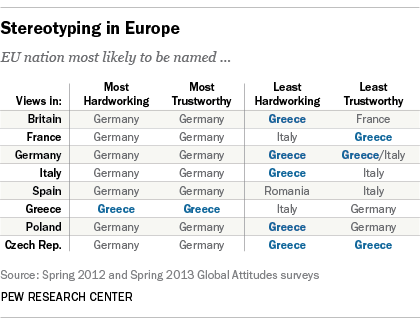
Interesting .
Cannot stop wondering how is it to belong to a people/tribe and reach the conclusion that the members of another people/tribe are more trustworthy than your own ‘mates’?!?

http://www.pewresearch.org/fact-tank/2015/01/27/greek-election-reflects-countrys-differences-with-the-eu/

layered smoke screens

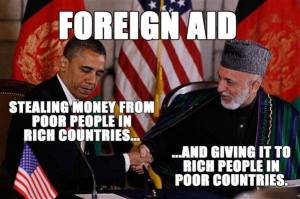
This post is not about Foreign aid per se but rather about how a generous idea becomes thwarted in the hands of some callous people who are left to their own devices by the public’s initial lassitude.
This is also about how the public’s justified frustration (after they had realized what was going on behind their backs) is misguided by the same kind of callous people like the ones who orchestrated the shenanigans in the first place.

“România încheie epoca Băsescu cu un PIB dublu în termeni nominali şi cu 25% mai mare în termeni reali şi cu 430 de kilometri de autostradă în plus”

Eu unul nu mai inteleg nimic.
Din textul articolului rezulta ca ‘e de bine’. O serie intreaga de laude insotite si de cateva ‘bemoluri’, ca sa nu poata spune ‘rauvoitorii’ (adica eu, rasete in surdina) ca textul ar fi prea laudativ.

Pe de alta parte titlul spune totul. 43 de km de autostrada pe an !!! si 25% crestere in termeni reali a PIB-ului in aceiasi perioada. Pai si daca faceam un depozit la banca tot ieseam mai bine!

Sau poate ca toata chestia o fi la misto?

Istoria este facuta, in mod evident, de oameni.
Nu doar scrisa de oameni, de supravietuitorii evenimentelor, ci chiar ‘decisa’ de ei.

In cea mai mare parte a timpului istoria unei colectivitati este suma ‘vectoriala’ a deciziilor luate de fiecare dintre membrii respectivei comunitati. Si asta chiar daca in cartile de istorie ni se prezinta cu precadere vietile ‘personalitatilor istorice’.
Daca nu ma credeti ganditi-va la faptul ca avem animale domestice doar pentru ca nenumarate generatii de fermieri le-au domesticit si au contribuit la ameliorarea rasele… Sau la modul in care au fost perfectionate, in timp, arta olaritului, navigatia cu vele sau prelucrarea prin aschiere a metalelor…
De cele mai multe ori am avut de a face cu o evolutie relativ lenta, in care fiecare dintre cei in cauza au schimbat cate putin din ceea ce era deja cunoscut, chiar daca unele dintre schimbari au avut efecte dramatice. De exemplu Newton. Merele au tot cazut din copac si fara sa stie de gravitatie iar oamenii le-au tot cules de pe jos fara sa se intrebe de ce cad…
Un alt exemplu extrem de ilustrativ pentru ce vreau sa spun este George Stephenson. Da, va aduceti bine aminte, cel prezentat in cartile de istorie ca fiind marele inventator al locomotivei cu aburi. O fi fost el mare numai ca a fost doar unul dintr-un lung sir de oameni care si-au adus contributia la dezvoltarea ‘drumului de fier’. Dati un click pe numele lui si puteti afla mai multe amanunte.

Ce vreau sa spun este ca datorita activitatii inaintasilor de foarte multe ori suntem pusi in fata unor alternative destul de clare si de obicei destul de stranse. Trebuie doar un pic de prezenta de spirit, de harnicie si de cooperare din partea celor din jur. Doar cat sa ne ajutam unii pe altii in ceea ce avem de facut cat si sa nu ne lasam unii pe altii sa o luam brambura pe campii atunci cand ‘ne ia cu căpuțul’.

Si totusi… Au fost in istoria multor popoare, sau chiar a omenirii intregi, momente cu adevarat critice in care cel aflat, intamplator sau nu, in punctul cheie a avut cu adevarat ‘controlul macazului’.
Un exemplu ar fi lt.col Stanislav Petrov, rusul care a salvat omenirea de la dezastrul nuclear ce ar fi urmat sa se intample doar pentru ca o masinarie nu fusese bine reglata…

Ultimul moment de genul asta din istoria Romaniei a fost Revolutia din Decembrie ’89.
In momentul acela Ion Iliescu a avut la dispozitia sa increderea a 87% din electorat. Ar fi putut duce Romania oriunde. Ce a ales sa faca … stim cu totii… Uite asa au ajuns unii sa fie cinstiti – si din cauza asta saraci – iar altii – multi dintre ei crescuti la ‘poalele stejarului’ – sa faca naveta intre puscarie si palatele lor imbracate in marmura.

Un alt personaj, de-a dreptul tragic, care a contribuit decisiv la conturarea acelui moment istoric, a fost Corneliu Coposu. Tot respectul pentru viata sa si pentru tot ce a fost nevoit sa indure. Nu-mi pot totusi opri gandurile… ce ar fi fost oare daca acest OM ar fi ales sa nu reinventeze PNȚ-ul? Daca ar fi infiintat un partid crestin democrat curat, fara istoria – tragica dar nu fara de pata – pe care taranistii o aveau in carca din perioada interbelica? Si daca ar fi fost putin mai selectiv cu privire la cei pe care i-a primit in partid, inca din primele zile… Apropo, voi mai tineti minte vre-un taranist din anii 1990-2000? Emil Constantinescu? A venit din Alianta Civica, nu din PNȚ.
Iar dupa ce a fost ales a fost parasit de toti si lasat sa indeplineasca de unul singur toate promisiunile electorale ale intregii Conventii Democratice in timp ce membrii ei ‘de rand’ erau ocupati sa se scuipe unul pe celalalt atunci cand nu se bateau pe ciolan…

Cum ar fi aratat oare viata politica romaneasca contemporana daca Iliescu nu ar fi avut impotriva cui sa asmuta haitele de falsi mineri si daca un partid curat ar fi avut printre membrii sai fondatori o personalitate cu verticalitatea lui Corneliu Coposu? Dar poate ca verticalitatea, si nici abilitatea politica dusa pana in apropierea prestidigitatiei de care a dat dovada Iliescu, nu sunt suficiente in momente din astea…

Poate rigoarea germana? Cuplata cu maturizarea alegatorilor, intervenita intre timp si care a dus la o cu totul si cu totul alta alegere decat cea facuta in 1990?

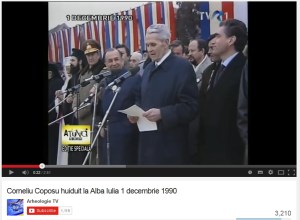
coposu huiduit la alba iulia

Efectiv mi s-a facut rau urmarind acesta marturie a acelor timpuri. Mi s-a strans stomacul ghem.
Si apoi mi-am dat seama ca oamenii aceia nu il huiduiau pe omul Corneliu Coposu ci simbolul PNȚ-ului.
“La fel ca  toata istoria interbelica, acest partid a fost “idealizat”  mult mai mult decat a fost justificat, istoric vorbind. Martiriul membrilor acestui partid, in frunte cu Iuliu Maniu şi Ion Mihalache,  care îşi vor găsi sfârşitul in închisorile comuniste, justifica poate aceasta “amintire istorica”, politic vorbind au daunat uneori intereselor tarii  si poporului roman. Din nefericire,  putini cercetatori romani s-au “aplecat” asupra documentelor din arhivele aliatilor occidentali pentru a trage aceasta concluzie.

….In perioada interbelica, PNŢ-ul a fost caracterizat prin lipsa de viziune a unor lideri ai partidului, politicianism dur, care a daunat grav intereselor Romaniei si in special acele scindarile si lupta intestina a unor grupuri de interese care au pus deseori partidul pe “butuci.”

Nu asta ar fi trebuit sa fie treaba unor lideri cu viziune? Sa inteleaga ca nu se poate incepe o viata politica cu adevarat noua noua in siajul unor hoarde de batausi ‘camuflati’ cu praf de carbune si nici incercand sa reincalzesti o ciorba despre care atat oamenii obisnuiti cat si cei cu ceva ‘constiinta istorica’ oricum nu aveau o amintire prea buna?

Din punct de vedere pur tehnic ar fi posibil sa inhami caii si in spatele carutei.
Merge mai greu, e mult mai complicat sa iei curbele dar, una peste alta, daca cineva ar avea vre-un avantaj din chestia asta, sunt sigur ca si o asemeanea aiureala ar putea fi construita. Chiar daca foarte multi ar face pe ei de ras.

De vreo doua saptamani incoace ma mir continuu.
A fost un fel de cutremur politic iar cel considerat outsider a fost ales cu o majoritate covarsitoare.

Si de atunci incoace aproape toata lumea – majoritatea celor care se vad pe sticla sau isi fac simtita prezenta pe net – discuta despre orice altceva decat despre semnificatia acestui lucru.
Unii se plang, sau chiar isi pun cenusa in cap, pentru ca n-au reusit sa intuiasca/masoare ce avea sa se intample.
Altii analizeaza, in detaliu, cum se paruiesc cei din PSD.

Foarte putini spun, sau scriu, ceva despre situatia ‘macro’ care a produs circumstantele in care atat de multi oameni au iesit sa voteze, si nu oricum ci pentru a-si manifesta nemultumirea cu privire la directia in care mergea Romania.

Motivele sunt arhicunoscute. Oamenii s-au saturat sa tot treaca istoria pe langa ei – asa cum s-a intamplat in ultimii 25 de ani –  au inteles ca acest lucru se intampla si din cauza coruptiei aproape generalizata SI s-au hotarit in sfarsit sa faca ceva pe chestia asta. Si atunci de ce nu vorbeste nimeni serios despre chestia asta? Serios, adica nu la modul declarativ – asa cum a facut-o, de exemplu, Basescu.

Azi dimineata am inteles, in sfarsit.

Din cele mai vechi timpuri partidele au urmarit castigarea puterii politice pentru a putea astfel conduce, influenta, pentru a-si putea impune propriul program, propria viziune despre conducerea societatii

Si cum ‘scopul scuza mijloacele’ iar ‘hotul neprins e negustor cinstit’ nu mai conteaza cum castigi puterea politica cu conditia sa nu fii prins. De ‘oamenii legii’ sau de electorat, nu conteaza. Ce conteaza e ca tu sa ajungi la putere, sa-ti poti ‘impune propriul program’ fara ca ceilalti sa se prinda ca au fost trasi pe sfoara.
Ca se vor prinde peste vreo cativa ani, dupa ce tu ti-ai facut suma… asta e alta chestie. Daca la alegerile urmatoare nu mai reusesti sa repeti isprava – ai promis prea mult data trecuta sau te-ai compromis prea tare pe parcurs – te dai la o parte – elegant sau cu scandal, dupa cum ti-e felul – si te pregatesti pentru data viitoare.

Oare asta sa fie cu adevarat continutul conceptului de democratie?
Nu cumva e de fapt invers?
Mie mi se pare ca rolul functional al partidelor este, de fapt, de a identifica si concentra diversele alternative care devin posibile pe masura ce trece timpul, sa le articuleze in propuneri de actiune politica si sa le prezinte ‘in piata publica’, demosului. Acesta alege una dintre variante si partidul sau alianta care a propus respectiva varianta are la dispozitie o anumita perioada de timp sa puna acea varianta in aplicare. Adica alegatorii ‘impun’ viziunea lor asupra societatii si nu partidele….

Poate ca sunt eu naiv numai ca cea mai superficiala privire asupra istoriei ne spune ca Platon a gresit fundamental atunci cand a spus ca cel care a descoperit adevarul are nu doar dreptul ci chiar obligatia morala de a-i convinge si pe ceilalti sa accepte acel adevar.  (Platon, Mitul Pesterii.)
E foarte plastica toata descrierea lui cu peretele pe care joaca umbrele si foarte didactica metoda folosita – concluziile sunt trase, sau macar acceptate, de invatacel si nu predate didactic de magistru – dar asta nu reduce cu nimic mirarea cu privire la ‘ce il face pe cel iesit din pestera sa fie convins ca locul in care a ajuns nu este o pestera si mai mare’?
A, ‘mai mare si mai buna’ o sa spuna cineva!
Mai buna pentru cine? Daca lui i se pare asa asta nu inseamna ca este neaparat mai buna si pentru ceilalti!

‘Relativism absolut’, va fi concluzia aceluiasi ‘cineva’, ‘nu se poate sta de vorba cu el!’.

Pai da, asa au spus toti dictatorii. Stim noi mai bine decat supusii nostrii asa ca astia n-au decat sa asculte ce le spunem noi.

Daca ne uitam cu un pic mai multa atentie la istoria Greciei perioada lui Pericle – contemporanul lui Platon – o fi fost varful de glorie al Atenei democratice numai ca asta inseamna ca de acolo incoace Grecia nu a facut altceva decat sa decada!
Iar Pericle a fost doar primul dictator dintr-un sir care nici macar nu a fost prea lung. Transformarile pe care el, Pericle, le-a pus in practica aplicand invataturile lui Platon si transformand Atena dupa cum a considerat el ca era mai bine au pregatit locul pentru a fi cucerit de Filip al Doilea al Macedoniei. Acesta avea un fiu, Alexandru, exact asa cum Platon avea si el un elev, pe Aristotel. Si cum geniile se atrag Alexandru a fost elevul lui Aristotel si, banuiesc eu, a primit de la acesta cam acelasi gen de invatatura precum a primit Pericle de la Platon.

Asa ca Alexandru s-a pornit sa cucereasca lumea… si a murit, in culmea gloriei, de prea multa bautura. Iar Grecia nu a mai cunoscut o clipa de independenta pentru urmatoarele doua milenii. O fi bine, o fi rau…

Urmatorul imperiu, cel Roman, a inceput tot in mod democratic. Cata vreme a ramas democratic, sau macar a pastrat o aparenta democratica – adica pana la Cezar – s-a dezvoltat organic. Dupa ce capii ‘partidelor politice’ au inceput sa se razboiasca intre ei au mai construit intr-adevar niste palate si niste temple splendide dar imperiul in sine incepuse deja sa intre in declin.

De fapt intreaga istorie Europeana este dominata de aceasta constanta, atata vreme cat autonomia indivizilor este pastrata sau creste bunastarea intregii societati este prezervata sau se imbunatateste. In perioadele in care societatea isi ‘pierde vigilenta’, devine osificata se complace in situatia in care conducerea treburilor se face de la centru lucrurile se inrautatesc rapid iar citeodeata atat de tare incat este nevoie de cate o revolutie pentru a le repune pe fagas.

Secolul douazeci a cunoscut trei razboaie, mondiale, pe tema asta.
In WWI cele doua imperii central europene – Wilhelm al II-lea era Kaizer, adica imparat, exact acelasi titlu ca cel purtat de Franz Joseph, imparat al Austriei si rege al Ungariei – incercau sa supravietuiasca impotriva transformarilor ce aveau sa vina.
In WWII trei autoritarisme – German, Italian si Japonez – au incercat sa controleze cat mai mult din restul lumii.
In timpul celui de-al treilea, cunoscut indeobste sub numele de Razboiul Rece, un ‘lagar’ – care se alinta singur cu apelativul ‘socialist’ – a incercat sa puna in practica acelasi principiu al lui Platon – convinge-i cu forta ca ce le spui tu e mai bine pentru ei insisi, chiar daca lor nu le vine sa creada – camuflat de data asta sub forma invataturilor lui Marx.In prezent, la inceputul secolului XXI, ne pregatim de un nou razboi ‘aproape rece’ si de un altul cat se poate de cald iar toate astea se intampla tot din cauza ca unii se incapataneaza sa creada ca ‘stiu ei mai bine’.

Acum intelegeti de ce spun ca ne chinuim sa punem in miscare o caruta la care caii au fost inhamati invers?
Procesul democratic nu este despre a castiga puterea cu orice pret pentru ca apoi sa iti impui viziunea ta asupra societatii.
Mai devreme sau mai tarziu oamenii isi vor da seama ca au fost pacaliti si se vor ‘razbuna’. Nu cred ca un sir de razbunari duce la un rezultat cat de cat multumitor.

Cred ca a venit momentul sa meditam mai degraba la ce greselile au fost comise si la cum putem readuce lucrurile pe un fagas functional in loc sa ne mangaiem pe cap cu pe vot normal, Victor Ponta era preşedintele României astăzi.” (Gheorghe Nichita, RFI)
Iar primul lucru pe care trebuie sa facem este sa intelegem o data este ca nu politicienii stabilesc ce e normal sau nu.
Ei doar trebuie sa puna in practica normalul pe care poporul il considera potrivit intr-o anumita situatie. Altfel dam in totalitarism iar de acolo pana la prabusire nu mai este decat un pas.