Archives for posts with tag: Property

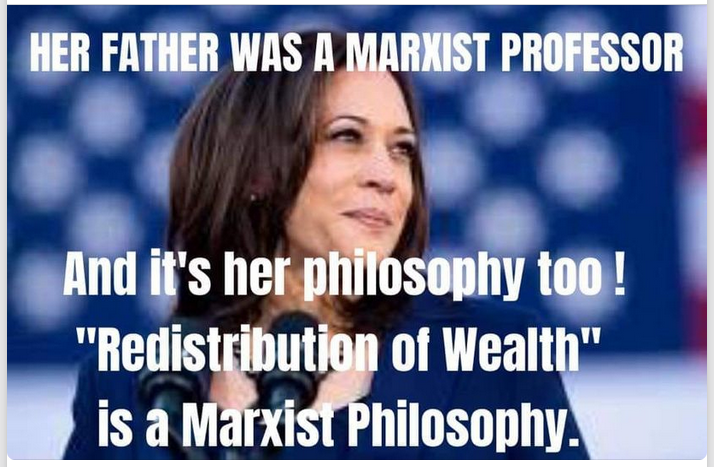
Redistribution of wealth is an anti-marxist technology.

Taxing the super-wealthy and redistributing the proceeds towards education, health care and infrastructure makes it possible for the middle class to survive.

Otherwise, the marxist prophecy will come true.

No sooner is the exploitation of the labourer by the manufacturer, so far, at an end, that he receives his wages in cash, than he is set upon by the other portions of the bourgeoisie, the landlord, the shopkeeper, the pawnbroker, etc.
The lower strata of the middle class — the small tradespeople, shopkeepers, and retired tradesmen generally, the handicraftsmen and peasants — all these sink gradually into the proletariat, partly because their diminutive capital does not suffice for the scale on which Modern Industry is carried on, and is swamped in the competition with the large capitalists, partly because their specialised skill is rendered worthless by new methods of production. Thus the proletariat is recruited from all classes of the population.

Read what Marx had to say about things if you want to avoid the marxist abomination.

Marx’s idea of revolutionary progress was based on the notion that property, hence wealth, must be abolished. Abolished, altogether, and not redistributed!

‘Redistribution of wealth’ means everybody pulling their own weight/contributing their fair share instead of ‘the the already rich taking the lion’s share’.

Redistribution of wealth means preserving the concept of property/wealth and maintaining the functionality of the capitalist free-market.

Congress shall make no law respecting an establishment of religion,
or prohibiting the free exercise thereof;
or abridging the freedom of speech, or of the press;
or the right of the people peaceably to assemble,
and to petition the Government for a redress of grievances.

Doesn’t make much sense?
Mentioning ‘God’ on money is the first step towards the establishment of an officially sanctioned religion?

Well…

In my previous post I posited that property, the concept, is the stepping stone for social order.
I’ll add to that a simple observation. Whenever too much property gets hoarded by a too small number of people, the community which had allowed that to happen is in great danger.

Same thing here.
We have religion – a social phenomenon – and religions.

We have a certain understanding of the world, shared by the members of a community – which allows the community, as a whole, to behave in a coherent manner. Not that much different from what happens when people use a common language. They can communicate. Same thing happens with people partaking in a religion. They ‘see’ things in a coherent manner. Hence can coordinate their efforts.

And we have religions…
To reach the ‘certain understanding of the world’ I mentioned before, each community had traveled a road. A particular road through the particular circumstances in which each cultural community – currently known as ‘nation’ – had had to build their culture. Their identity.
Some communities had put together certain scenarios to accompany them along this road. To help them make sense of what was happening to them.
Some communities have used more than one scenario during that journey while others use more scenarios simultaneously.

Sociologically speaking, all that matters is social coherence.
All is well as long as the community conserves its ability to function. To survive.
As long as the individuals who compose that community continue to have a common enough understanding of the world in which they live.

For the simple reason that they, we, live in the same world!
And if we, individually or in small ‘gangs’, start behaving as if the world is different for each of us…

The Founding Fathers had a common understanding of the world. They belonged to the same (functional) religion despite belonging to different ‘denominations’. For them, the First Amendment was about reigning in the powers of the Government. They had realized that a Government able to impose a certain religion – a certain scenario – upon the entire community would eventually bring destitution.
The Founding Fathers could not foresee a situation in which a few of us would deny the practical daily realities of this world. Invoking their particular scenario as an argument… As the supreme argument for refusing to see the reality.

The reality as it is.
And as it is seen by a majority of us.

I mentioned earlier that some communities have changed their scenario along their history.
They did it when they have found new meanings. They have seen new things about the reality and they have integrated those new things into their newer scenario.
By changing the scenario they have actually built a new reality.
Societies which have clung to their scenario to the bitter end… are no longer with us.
Societies which have somehow found it in their collective minds to adapt their scenarios to the reality changed by their own efforts continue to survive. To thrive, even.

“Hoarded by a too small number of people” means controlled by a handful of people.
Sometimes coordinated.
As it happens in any dictatorial regime. It doesn’t matter who formally ‘owns’ something if the use of that something is tightly controlled by somebody else.
Furthermore, a certain ideology may end up having a lot of clout without being imposed by an authority. Nevertheless, the fact that an ideology dominates, for a while, makes it so that the community which allows this to happen to experience a dictatorial regime.
For whatever reason, some people were convinced that witches were real. And burned them at the stake.
For whatever reason, a lot of people continue to believe that communism might be a good thing.
For whatever reason, some people continue to believe that they are entitled to determine whether a woman may or may not abort a fetus.

What is the difference between an ideology and a scenario?
The manner in which people relate to it.

Having been told that they were the children of the same God made it possible for the believers to stick together. To act like brothers. To respect each-other. To invent and implement capitalism and democracy. Both relying on trust. On mutual trust and on the freedom of the market. Both the market where goods and services are traded and the public forum. Where ideas are traded…

Being told that only one particular understanding of a certain text/idea/concept is correct some people remove themselves from the ‘general population’. Which ‘general population’ becomes ‘the others’.

‘The others with whom we don’t have anything in common’.

Quite an untenable situation, given the fact that the world is becoming smaller and smaller.

The Polish state broadcaster on Saturday suspended
a television journalist who, during the Olympic Games opening ceremony,
reacted to a performance of John Lennon’s “Imagine” by saying it was a “vision of communism.”

Communism is perfect!
Communism is the perfect lie…

Communism was ‘invented’ by Marx and proposed as the only solution to a real problem.

The problem with communism as a practical solution is that it cannot be put into practice!

Humans, both at individual and social level, need freedom.
Without individual and social freedom, individuals regress to an animalic state and societies fail. Abysmally!

According to Marx, communism was the only solution for what he had perceived as a problem.
According to Marx, when a critical mass of people belonging to the middle class will become destitute, they will accept to be led out of their predicament by ‘the communists’. But since the rest of the society continues to enjoy their perks or to ignore the dangers ‘lurking in the future’, in order to achieve their goal – communism for everybody, including for the unwilling, the communists will have to institute the socialist dictatorship. As a transition phase to communism. A phase in which the unwilling will be convinced.
According to history, no dictatorship – including the socialist – has ever survived. Has ever achieved its goal.

Communism, at least for now, is unattainable. For the simple reason that humankind has not yet learned how to survive dictatorship. How to live without freedom.

On the other hand, communism is very alluring.
For the idealists amongst us…
Communism is a very suitable subject for dreaming. A very nice thing to have, albeit impossible to achieve…

Since the idealists are hard to convince, let me speak to the practical minded amongst you.
John Lennon invited us to dream. To dream a world with ‘no possessions’ and with ‘no need for greed or hunger’. What’s not to like in this dream, except for the fact that it can’t be put in practice?
Hunger is natural. Why eat if not hungry?!?
Greed is also natural.
Who doesn’t like/want more of what they consider to be pleasant?!? The wise amongst us?
How do we become wise? As wise as each of us is able to become…
By interacting with others? By learning from them? And from the consequences of those interactions?

Property – possessions – is a tool.
A tool society uses to make order. If each of us knows what they are able to use for what purpose things go smooth. There’s no need for outside intervention. Granted, this is valid for only as long as each – well, at least most – members of the society have enough to eat, where to sleep and what to protect their backs with.
Without the order construed by the society, collectively, using the tool known as ‘property’, how are the people going to cooperate?!? To interact? To learn, even…

How about we wake up?
Sleep is essential and dreaming a normal part of it.
But we also need some wake up time!
Pun intended…

Each of us expects the others to behave rationally.
While each of us rationalizes their own biases.
And considers this to be normal!

Not so long ago – evolutionary speaking, things were free. As in ‘up for grabs’.
Our not so distant forefathers fed and clothed themselves by picking ‘things’ from nature.

By talking to each other they had become conscious human beings.
Then came up with the notion of property.

‘If I/we have this thing, you cannot have it too’.

Using this notion, they introduced some order unto the social stage.
Some things, albeit fewer and fewer, remained free/up for grabs while the rest – specially ‘the things of interest’ had become private.

Entertaining the notion of property means that individuals are able to link an object to its owner.
This link is a piece of information.
Discussing and remembering who owns what, our forefathers realized that information is important. Not only the information regarding the link between owners and their property but also information in general. Whatever ‘useful’ things had been learned, remembered and passed around.
Thus information became ‘a thing’.

The order created by the communities using the concept of property and by actively circulating information among the members had become the premise for those communities to thrive.

Somewhat naturally, the members of those communities had reached the conviction that:
Property is good. And that more property is better.
Old people are precious. For the simple reason that they deposit what had happened. By sharing their memories, old people make it so that the younger ones don’t need to learn again and again.

Since property and remembered information were good for the community, the communities using them developed faster and had a way better survival rate than those who didn’t. For whatever reasons.

Since in reality people rationalize rather than think rationally, they have reached the conclusion that the rich and old people were the ultimate cause for the well being of the community.
The individuals, not the modus operandi of the community.

The world doesn’t belong to leaders.
The world belongs to Humanity.

Proper = As it should be. As expected. ‘Clean’.
Property=Something which belongs to someone.
A mutually respected arrangement among the members a certain community which establishes boundaries. Which members have the right to go ‘there’ whenever they want while all others have to ask for permission before crossing that ‘boundary’.
A convention among the members of a certain community about what is the proper thing to do in each ‘patrimonial’ situation. A convention about who has the right to do what to the things which happen to co-exist with the members of the above mentioned community.
The above mentioned ‘things’ include the place where the entire community happens to live. ‘Their’ land.

Which brings us to who owns the world.
The leaders? As many of them assume?
Or the humanity, as Dalai Lama has reportedly said?

How about neither?
My point being that we are nothing but guests in this world.
We come empty handed and we leave empty handed.

Yes, we need property while dwelling on this planet.
But only in the sense of who can do what where. And with the limitation that the ‘what’ we do has to be ‘reversible’.
Just as we leave this world with nothing – we leave even our hands here, our presence on the planet has to be ‘discrete’. Has to produce as little disturbance as possible and all that disturbance must disappear in time.

We need to keep the world a proper place.
It’s the only place we have.
No other home for our children.
No other place to spend our last days.
Properly.

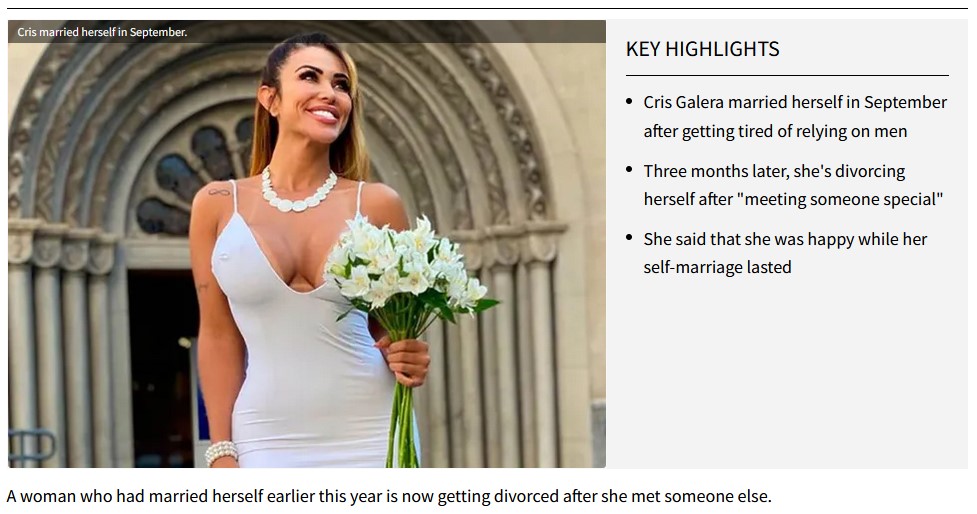
Getting out of a relationship before entering the next one makes sense, right?
But why would anyone marry his/her own self in the first place?

To send a signal? ‘I have removed myself from the (singles) market’?
As a publicity stunt? Proving – unintentionally, that marriage continues to be an important institution, at least at the symbolical level….

On the other hand, why bother? At all…
Specially now, after the advent of the ‘prenuptial arrangement‘….

So, marriage is, in reality, only about ‘property’? Who gets what after the couple separates? ‘Naturally’ or otherwise?
But, again, why make it a special thing? Property had been formally ‘coded’ about the same time as marriage was… why introduce another set of regulations, on top of those pertaining to the ‘mere’ individual property?

There must be something else…

And that something must be in our heads!
‘Property’ has more or less the same meaning all over the world.

Culturally, there are many forms of property ‘out there’ but the most ‘advanced’ cultures ‘use’ the same three main types of property, each in it’s own ‘mix’. Private property, state property, communal property…

Meanwhile, each culture/civilization has it’s own type of marriage. Or used to have, until very recently. Which types of marriage differ widely and in many ways.
From who can enter a marriage – number of people, ethnicity, religion, caste, etc., to how a marriage ends.
From the conditions which must be met before the marriage to the consequences of the act. And to the consequences of the marriage being ended ‘before time’, if possible.
Not to mention the wide gamut of rights and duties each member of a marriage might have, according to local rules and (by)laws.

If you think of it, ‘property’ is almost ‘natural’. It makes a lot of sense, ‘functionally’ speaking, to be precise about which is which. And about which is whose.
Life is a lot simpler when each member of a community knows what/how much can be had/used/eaten without anybody else having any say about the matter, what must be left alone and whose ‘permission’ you must ‘acquire’ before ‘trespassing’.

Meanwhile, ‘marriage’ is a lot more artificial than ‘property’. Leave alone the fact that the rules are far more complicated – and far more diverse.
In practice, marriage has been really important only for the ‘top’ members of any given society…
And the ‘fun’ fact is that the higher the rank of the individuals concerned, the more ‘leeway’ they used to have…

Henry the VIII had ‘invented’ a ‘new religion’ in his attempt to bend ‘the rules’ according to his wishes, the French monarchs had been famous for their mistresses… and a ‘modern’ financier had been recently convicted for ‘lending’ underage members of his ‘harem’ to some of his buddies…

That ‘something’ is, definitely, in our heads!

NB!
I’m not implying that that ‘something’ is good or bad!
We are the ones who attach ‘values’ to things/concepts.
We are the ones who ‘notice’ things and relationships, use them – properly, for a while, and then experiment in ‘abusing’ them.

A (beautiful) woman marrying – and divorcing, her own self is perceived as being a ‘fun thing to read about’ while gay couples becoming able to establish a formal family is perceived, by so many, as being ‘a threat’.

Let me start by attempting to answer this question in a logical manner.

Theoretically, individuals have the right to defend their lives. And properties. In some jurisdictions, the defender might even shoot the trespasser.
On the other hand, it is a lot harder to identify an example where property might end up purposefully damaged in a lawful manner while life is being defended. ‘Purposefully’ as in property being targeted in an attempt to fulfill the goal of defending life.
When groups of people are involved, things are even more complicated.
Is a community entitled – using the police force, a “well regulated militia” or even ‘spontaneously’, to inflict bodily harm to a group of people who randomly destroys property? What becomes different when the destruction occurs during a protest ‘gone wrong’?
The way I see it, things are more complicated at the social level because of the number of people involved. At the individual level, things are simple. The guy who trespasses is the one who gets hurt. The defender is the only person who might inflict injury and the one who will answer for the act. When there are more people involved…. Some protest peacefully, others do the damage… and who knows who gets clobbered – or shot, by the police?!? Same thing looking from the ‘other’ side. The owner of a property might have decided to protect it in a different manner than the police … or even not at all…
To wrap it up, there’s no single answer for this question. On the individual level, the actors/agents must decide on the spot. Considering the specifics of each incident. While being ready to accept the consequences. On the social level, neither murder nor property damage are acceptable and must be dealt with in a very thoughtful, but firm, manner.

As usual, logic can take us only this far. Far from the essence…

What are we doing here?
How can we even attempt to compare life with property?
Do they belong to the same category?
Can we sell a human being? Do houses have souls?
What’s happening to us?

As I promised you some time ago, let’s have a look at ‘property’.

As you recall, I was arguing that we, humans, are only ‘qualitatively’ different from the rest of the animals. In the sense that we do everything that they do – and nothing really new or different, only that we do it ‘better’. And more ‘evenly’.

In my previous post, I was dealing with ‘trade’. So I’ll use ‘trade’ to explain what I mean by ‘more evenly’.

All living things are made of three things.

An inside, a membrane and a set of instructions which deal with two things.
How the whole thing should be structured in order to able to live and how the inside should interact with the outside – through the membrane, in order for the organism to remain alive and replicate itself.

My previous post dealt with individual organism trading food (a.k.a. matter) and information with their outside. It also dealt with manners in which trade can be performed.
Directly – as in barter, or indirectly – using symbols.
The most simple barter is breathing. Exchanging gases with the environment. Or foraging – individual organisms ingest food and water and excrete poop and urine.
‘Trading’ information is a little more complicated. An individual organism can be endowed with genetic information by it’s parents, presented with information by some of its peers – bacteria or playmates, taught by its voluntary or involuntary teachers or it can glean information by itself through mindful observation. Also, trading information is more complicated than trading food because information can be either ‘hardware’ or ‘software’. DNA inherited from the parents (received from peers/’invaders’) being ‘hardware’ while information gleaned through observation or during training being ‘software’.

Everything described in the previous paragraph is common for all living organisms, including humans.

My point being that we’ve been trading, from the ‘beginning’, far more items than any of  the other living things – plants and/or animals.
OK, an individual whale will eat far more than an individual human being. But whales eat, basically, one or two things. While we, humans, will throw down our throats almost anything that we fancy. Including some stuff which will actually hurt us.

But the real interesting thing is the manner in which we ‘trade’ information. We not only observe keenly what happens outside our consciousness (not just outside our-bodies, simply outside the shell that harbors our ‘mind’) but also translate that information into symbols and then communicate that symbolic information with our fellow human beings.

And here’s the catch.

I mentioned earlier that every individual organism consists of an inside, a membrane which keeps it together and a package of information.
For survival purposes, each organism must consider all its three components as being its own and to defend them ‘to the bitter end’. Or else…
Which is congruent to what happens in the real world… Membranes are relatively hard to penetrate, there are some defense mechanisms which at least attempt to take of any intruders – the immune system, for example….
More over, the more ‘sophisticated’ organisms also defend ‘their’ territories and the local resources they have identified and claimed as being theirs. If you don’t believe me, just try to take a bone from any normal dog which isn’t yours.

You see, not even ‘property’ is exclusively  specific to humans…. We have created the concept, we actually define ourselves using our possessions… yet we share this trait with all other living organisms… even if they don’t know anything about it…

Remember what I just said about us being able to trade ‘symbolic’ information? To ‘formulate’ the information before trading/sharing it?
Same thing happens with ‘property’.

For a dog, a bone is its property as long as it happens to be in his snout. And most dogs have no problem in attempting to ‘steal’ a bone from another dog – as long as the other is not way bigger, a pup or some-other special cases.

Meanwhile, most humans would painstakingly respect other people’s property.
Simply because, for us, property has also meaning. Besides ‘survival value’

NB. In English, ‘property’ is not exclusively about possession. Its root, ‘proper’, means from ‘clean’ to ‘as it should be’.

We, humans, pride ourselves on many things.

On being smart/intelligent. And on being the only animals able to brag about their achievements with their peers…

But what is it that qualifies us as humans?
That would, of course, depend on what a human really is…

OK, let me use another tack.
What are we really good at? What sets us apart from the rest of the animals?

Practical intelligence? Our ability to solve really complicated problems?

Then watch this wild New Caledonian Crow treating itself to a piece of meat.

new Caledonian crow

Our ability to figure new meaning and to overcome our natural impulses?

Then read about Sheba the Chimp using language to suppress her greed:

In a celebrated study that investigated impulse control, Sally Boysen of Ohio State University asked chimps to choose between two dishes of M&Ms®.

SALLY BOYSEN: Now, you watch real carefully. We’re going to put one, two, three, four down here. Are you watching, Miss Priss? Sheeby? And we’re going to put two in here.

Give those to Sarah. Okay.

Well, I have to give these to Sarah, and Sheeba gets two. So Sarah gets four and Sheba only gets two. Aw, too bad.

NARRATOR: The twist was that the chimp got the candy she didn’t point to. Could the chimp learn to resist her impulse to reach for the bigger pile?

SALLY BOYSEN: You want Sarah to have these? It’s okay, it’s okay. You get to have that one. Yeah, Sarah gets five, and Sheba gets one. Oh, that is such a shame.

NARRATOR: Amazingly, chimps never overcame their greedy urges. They always reached for more and, so, ended up with less.

SALLY BOYSEN: And Sheba gets two, so Sarah gets four. See?

NARRATOR: Impulse studies have also been run on humans. In a classic experiment from the 1970s, a researcher gave a four-year-old a simple choice.

RESEARCHER : So, if you wait for me to get back, I’ll give you this bowl with all of these gummy bears, okay? But if you can’t wait, you can push that button, like this, and then I’ll come back and you can have this bowl with just this one gummy bear, okay? Okay, I’ll be right back.

NARRATOR: According to an inconclusive but intriguing study, the longer children resisted temptation, the higher their S.A.T. scores were years later. In any case, the differences between people are small compared to the gap separating humans and apes.

BRIAN HARE: Maybe one of the first things that happened during our species evolution is we became much less emotionally reactive. And maybe that’s one of the big differences that may explain why we solve problems so differently. We sort of got control of our emotions.

NARRATOR: Can apes be given skills to help them master their emotions? Sally Boysen trained a chimp to understand numerals. Then she repeated her M&Ms experiment, but now offered different pairs of numerals rather than treats.

SALLY BOYSEN: You want to give two to Sarah? Okay. Two goes to Sarah, and you get six.

NARRATOR: Remarkably, chimps were now able to learn what they couldn’t before: point to the smaller number to get the bigger prize.

Symbols can make you free. They can help distance an ape from its impulses. But outside of the lab, apes don’t seem to use symbols. Still, ape minds seem to share many of the amazing features of the human mind.

There is a video which depicts all this. Click on this link and see if it’s available “in your area.” http://www.pbs.org/wgbh/nova/nature/ape-genius.html.

How about our consciousness? Our ability to ‘observe ourselves in the act of observing‘.
Well, that alone wouldn’t have made us any more special than an octopus…

self aware octopus

But what if our individuality resides in us having taken all three to ‘a different level’? One which hasn’t yet been attained by anybody else? Not necessarily higher, mind you!

I’ll deal with ‘trade’ now and I’m afraid you’ll have to come back for the rest.

‘Trade’ wasn’t even mentioned in those three examples?
What was the crow trying to do?
Feed itself? As in exchange matter with the ‘outside’?
What was Sheba trying to do?
Figure our what was going on? As in trading information with the surrounding world?

In this sense all living things are engaged in all forms of trading? And continue to do so for as long as they remain alive?
What did I tell you about us doing nothing really new? Only different?

OK, we had already figured out – long before Adam Smith described it as ‘division of labor’, that by dividing tasks amongst us we’ll be able to accomplish far more things than if we had attempted ‘individual autarky’. And then we had invented ‘trade’, as a manner of exchanging the different wares each of us was proficient in doing…
Wait! Even this is not really ‘new’!
Mother Nature had already invented sexual reproduction – a very extreme ‘division of labour’, a very long time ago…. but not before bacteria were already adept at ‘trading’ genetic information.


050c31042a04e93467298c7458c219af4cbcc6-wm

For some time now I’ve been wondering how come so many people who define themselves as being Christians – “Again I tell you, it is easier for a camel to go through the eye of a needle than for a rich person to enter the kingdom of God.“, Matt 19:24 – are so passionately defending the very concept of (private)”property”.

Could it be that Marx was right after all: “Private property is the result of alienated labor.” ?!? And so many of us have been wrong for so long?

“The right to private property is the social-political principle that adult human beings may not be prohibited or prevented by anyone from acquiring, holding and trading (with willing parties) valued items not already owned by others. Such a right is, thus, unalienable and, if in fact justified, is supposed to enjoy respect and legal protection in a just human community.”

Trying to understand the source of this dichotomy I adopted a two pronged strategy. First I looked up the word itself and then I tried to deepen my understanding of the entire concept.

It’s absolutely obvious that ‘property’ comes from ‘proper’.
‘Proper’, in its turn, has two basic meanings: ‘fit for use‘ and ‘pertaining to one individual‘. The first one has evolved into ‘propriety’, “the state or quality of being correct and proper” while the second has become ‘property’, “thing owned“.

So, do all these etymological arguments make it any easier for us to accept that respecting each others’ right to private property is what introduced a certain degree of functionality in the human society?

‘But aren’t you contradicting yourself?
At the beginning of your post you suggested that ‘property’ might not be as good as advertised and now you say that the ‘right to private property’ is ‘good for you’?
Will you make up your mind, for Christ’s sake?’

Now, that I’ve reached the conceptual stage of my analyses, I must bring to your attention the fact that a right is nothing but an opportunity while each (piece of) property is a thing – even those  which are not of a ‘substantial’ nature. ‘Intellectual property’, for instance, is a ‘measurable thing’ even if you cannot put your finger on it while the ‘right to intellectual (or any other kind of) property’ is (an infinite) something which patiently waits for (a rightful) somebody to make (proper) use of it.

Maybe this is what Christ tried to tell us in the first place. That it’s not property itself that stands between us and our salvation but our (improper) attitude towards it. That it’s not the object of our property that is the problem but how we make use of our right to private property.
After all Christ told the “young rich man” “If you would be perfect, go, sell what you possess and give to the poor, and you will have treasure in heaven; and come, follow me.” (Matt 19:21). ‘Go sell, give and THEN follow me’, not ‘come help me ABOLISH the very right to private property’, as Marx used to preach to his followers.

To understand the difference between what Christ and Marx said about this subject let’s see how these two relate to the notion of ‘Man’.

In Christ’s book God took a lump of dirt and ‘made Man in His own image’ while in Marx’s narrow materialistic vision “it is not the consciousness of men that determines their existence, but, on the contrary, their social existence that determines their consciousness.”

Basically both of them start with the same ‘materiel’ – the mundane ‘star dust’ that Mendeleev distributed throughout his table – but what a difference at the end of the ‘assembly line’!

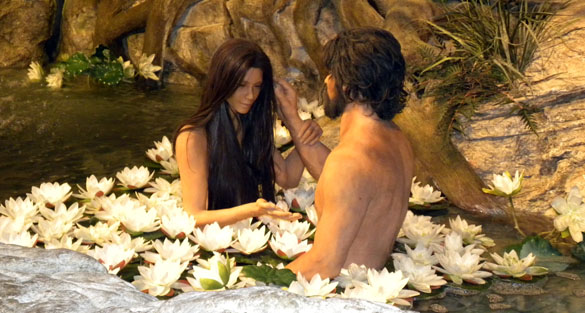
adamevebefore

Being made ‘in His Own image’ not only means that all Men (and Women) are created equal but also that each of them shares in His Divine Nature. Hence the origin of our free will, of our ability (‘right’, opportunity) to be saved. Compare this to how Marx described the human society:

“The Communists, therefore, are on the one hand, practically, the most advanced and resolute section of the working-class parties of every country, that section which pushes forward all others; on the other hand, theoretically, they have over the great mass of the proletariat the advantage of clearly understanding the line of march, the conditions, and the ultimate general results of the proletarian movement.

The immediate aim of the Communists is the same as that of all other proletarian parties: formation of the proletariat into a class, overthrow of the bourgeois supremacy, conquest of political power by the proletariat.

The theoretical conclusions of the Communists are in no way based on ideas or principles that have been invented, or discovered, by this or that would-be universal reformer.

They merely express, in general terms, actual relations springing from an existing class struggle, from a historical movement going on under our very eyes. The abolition of existing property relations is not at all a distinctive feature of communism.”

articlefiles-mv003370610000-96750_bd

As somebody who has lived for 30 years under communist rule let me translate this from ‘Newspeak‘ into plain English:
‘History suggests that those who figure out the inner workings of this world  have, from time to time, the opportunity to take over the show. Now is one of those moments. The ‘fat cats’ have been so greedy lately that the regular people are growling under the very heavy yoke that has been placed on their shoulders.  That’s why we have the opportunity to unsettle the ‘old’ from their positions and to plant our fat asses in their comfortable chairs.
And the first thing we must do in order to achieve that goal is to abolish the right to private property. People are so fed up with what was going on lately that they’ll go along. They have grown to hate so much the ‘greedy plutocrats’ that most of them won’t notice that in the (revolutionary) process they’ll lose the very last shrouds of personal autonomy they still have. Without the right to dispose of the results of their own labor they’ll be at our mercy’.

Who was right between the two?

Well… Both, unfortunately.

The communists did run the show, at least for a while. And we all know to which results.
On the other hand it seems that in the longer run miss-using the right to private property is indeed a powerful drawback. The already too long sequence of economic crises caused, ultimately, by nothing else but our own greed has indeed given birth to a generalized state of psychological malaise.

I don’t know about what’s gonna happen in the next world – or if it exists at all – but I’m sure that if we don’t learn, fast, how to use, properly, the right to private property things will become too hot for our own good in this one.

The only one we are sure about.

Further reading.
During my research for this post I found this very interesting take on the same subject:

“Zwolinksi argues that libertarians are right to support private property, but also that private property is more complicated than we sometimes think.”