One of my high-school mates had emigrated to Canada. From Romania. He’s been living there for 25 years now. We keep in touch. A few years ago, he told me:
“We come from their future. I currently experience things which had already happened in Romania.”
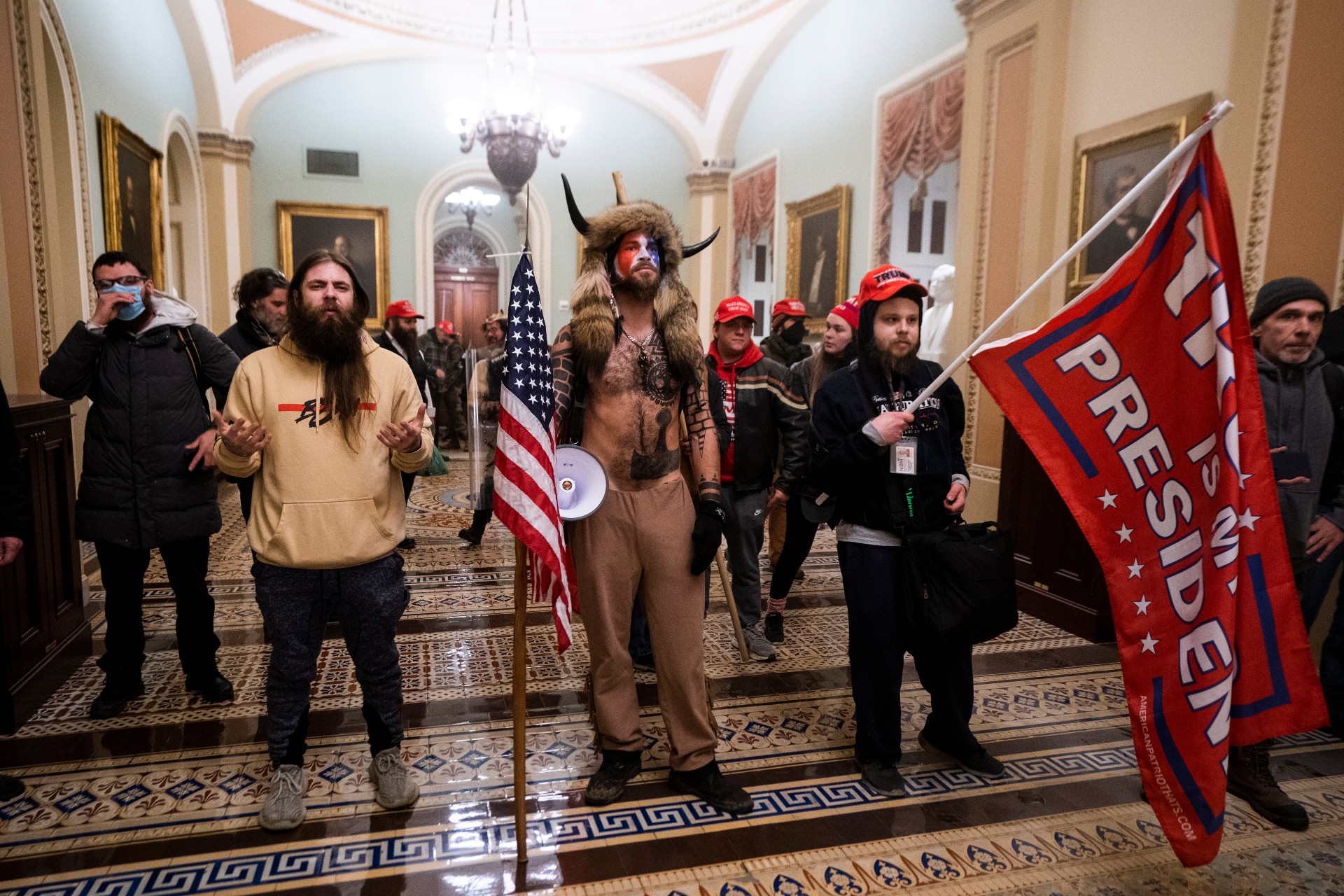
His prophecy had been fulfilled, and then some, yesterday. The sixth of January, 2021.
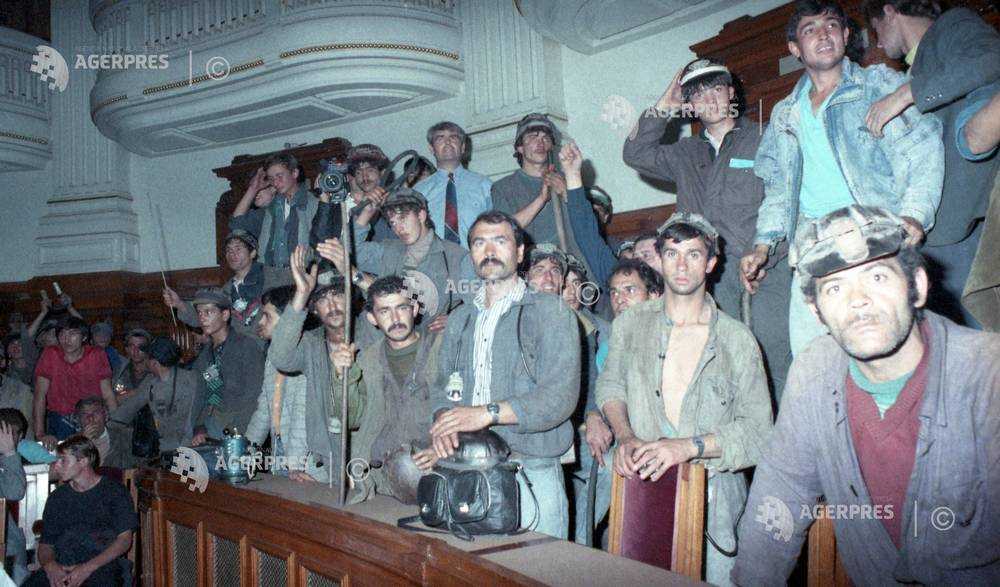
1991, Romanian miners occupying the Romanian Parliament.
The differences between the two instances exist and they are not insignificant.
Both Trump and Iliescu – the Romanian president at that time, had been democratically elected. Both on populist platforms, even if the concept wasn’t as widely used in 1991 as it is now.
Only 1991 wasn’t the first time the miners had come to Bucharest. In 1990 Ion Iliescu – the ‘cripto’ communist leader who had risen to power as a consequence of the 1989 uprising, had ‘thanked’ the miners for quelling a ‘festering’ anti neo-communist protest organized mainly by students. In fact, this had been yet another precedent. ‘Occupy’ Piata Universitatii 1990 versus Occupy ‘Everything’ 2011. In 1991, the miners had, again, ‘occupied’ Bucharest. Again, ‘supposedly’, under their own volition. The then prime minister, Petre Roman, had adopted some very stringent free market reforms. Which had fallen foul of both Iliescu and certain swaths of the population. Hence the miners had not been driven back to Valea Jiului until Petre Roman had been revoked from office.
And 1991 wasn’t the last time the miners had attempted to make themselves noticed… As the old saying goes, it’s harder to quiet down a hornet’s nest than to stir it up!
Two days ago, I did a very stupid thing. I cleaned it, then I forgot to turn it back on.
A small freezer.
This morning, after throwing everything away and while washing the plastic containers, I realized – again, how much we depend on each-other.
The freezer itself was made by somebody else. The electric current it uses comes into my home as a consequence of many people cooperating for this purpose. The food I cooked and stashed away had been grown by an unknown number of toiling individuals and distributed, then sold, by yet another legion. The garbage I made on this occasion will be disposed of by yet another team of hard working people.
A good place to start understanding what Covid had done to us is the cemetery.
A man had died. A good man had died. Of old age. Covid had nothing to do with it.
But his beloved wife, and one of his daughters, could not attend his funeral service. They had tested positive while he was in hospital.
On the other hand… On my way home, I stopped by to see an old friend. He lives alone and has a rather frail health. No relatives and, due to his relativelly old age, only a couple of able-bodied friends. It’s a good thing that we have phones. If I’ll ever be quarantined simultaneously with his other friend, he’ll depend exclusivelly on delivery services….
Between 1776 and 1970 the world had leaped forward. Technologically, economically and socially. Not only that we’ve managed to learn so much about the world and to produce immense wealth but we’ve somehow managed to ‘spread around’ the results. The proportion of people who had improved their fortunes had grown constantly during the entire period.
Isaac Newton hadn’t invented gravitation. He only ‘noticed’ it. Put it in words. Adam Smith hadn’t invented the free market. He had noticed how it used to work and opened our eyes about it. For what ever reasons, enough of us had chosen to close those eyes back. And have reached the conclusion that ‘greed is good’.
Milton Friedman was both horribly wrong and exactly right.
He was horribly wrong in the sense that he had perpetuated Marx’s error. Karl’s, not Groucho’s.
Money isn’t everything. Life beats it to the post. Profit is, indeed, essential. Only it is nothing but an indicator. About how efficient a corporation is. Meanwhile the role of a corporation is to accomplish – as Friedman himself had dully noted, the will of the shareholders.
The problem arises from the fact that ‘near mindedness’ blinds. If/when both shareholders and management have nothing but ‘money’ in their scopes the market actually looses its freedom.
Economic agents no longer converge towards the market to solve each-others problems – like Smith had noticed, but to ‘make money’.
Each of us: I, you, she, he, brings their individual contributions. And the end result, our reality, is defined by the quality of the interactions between us.
The new reality, ours, being the ‘place’ where we, the ‘beneficiaries’ of the interactions between us – simultaneously cooperating and competing free agents, and the previous reality, will have to lead our lives.
In nature, most organisms feed on other organisms. Deer eats grass, wolf eats deer. Scavengers and microbes eat poop and corpses. All together ‘eventually’ enrich the soil. Allowing for more grass to grow.
One way to look at this is to call it ‘fight for life’. ‘Survival of the fittest’. Yet this entire ‘carnage’ has a very interesting ‘conclusion’.
A fine tuned ecosystem. Which has lasted, as a system, for a couple of billions of years. Becoming more and more elaborate in the process. And which has survived – as a system, I repeat, momentous events. Asteroids, geomagnetic reversals, continental drift…
The ecosystem has been so stable that it allowed one creature to evolve so much as to develop a special trait. Self-awareness. Which has eventually given birth to ‘reason’. To ‘rational behavior’.
Which means that while wolves eat deer to satisfy their hunger we start wars to satisfy our egos.
Humberto Maturana teaches us that human consciousness can be understood as our ability to ‘observe ourselves observing‘. In other words, consciousness might be reduced to self-awareness.
I’m afraid it’s not enough. While no individual can be described as conscious if not commanding a certain degree of self-awareness, being able to observe their own observations doesn’t elevate an observer to fully conscious status.
How many of us have ‘enjoyed’ messing up ants or other insects just for the fun of it? When we were teenagers, of course. OK, we continue to squish the cockroaches we happen to see and to spray our gardens against mosquitoes and other pests. Only we no longer do it for fun. We employ a ‘healthy’ rationale to justify our actions – cockroaches/mosquitoes are ‘bad for us’. And we try to do it in a reasonable manner. We don’t soak the entire garden with the most potent insecticide available. Simply because we’ve understood, the hard way, that bees are also important for us.
Otherwise put, it’s not enough for us to be able to keep tabs on what we do, we must also take responsibility for our actions.
After all, we’ve been able to notice that bison ‘engineer’ their own environment.
“Herds of bison milling through Yellowstone National Park may seem aimless to the average visitor, but a new study reveals the animals are hard at work engineering their ecosystem. By rigorously mowing and fertilizing their own patches of grassland, the big herbivores essentially delay spring until late summer.”
Maybe the time is ripe for us to understand that we, humans, have done the very same thing for quite a while now. The world we live in is, to a certain – but rapidly growing – extent, the consequence of our own decision making.
The faster we learn to accept that, the higher the chances we won’t repeat past mistakes.
When I was admitted to the Bucharest Polytechnic, I learned that engineers and dogs have a few things in common. An intelligent gaze and the inability to use words when trying to express themselves. When I started daubing in photography I discovered ‘there’s more than meets the eye’. When studying to become a mediator I learned, as if it was still necessary, that ‘truth is somewhere in the middle’.
Nowadays, we all expect Science to come forward. To find the answer. To break, once again, the barrier which separates us from of the unknown. To take us by the hand and deliver us from evil.
But wasn’t Art the one supposed to provide for our metaphysical needs?!? Even though it had been Archimedes who was the first to advertise his ‘physical’ breakthrough by shouting ‘Eureka’? While running naked up and down the streets of ancient Syracuse … It had been the artists who used to trample their boots in the sludge at the bottom of our ordinary lives in order to open our windows towards new horizons… The ones we expect to transform mud into statues. To morph suffering into hope!
But is there such a great difference between science and art?
‘The man in the street’ might indeed entertain the notion that art is based on inspiration while science is defined by discipline. Only this is nothing but yet another proof that it’s high time for us to learn how much inspiration one needs when trying to find a new cure. And how much discipline must be observed by anybody who attempts to turn their inspiration into something to be traded with another soul.
Addressing the issue from another angle, “can spring be furloughed”?
A friend of mine answered ‘yes’. ‘If there’s no one to notice it …’ Another friend said ‘no’. ‘Spring coming no matter what is the only thing which keeps my mind, and soul, whole.’ Let’s enjoy spring. Together, as it unfolds us.
Germany has weathered this crises a lot better than most of her neighbors.
There are no toll- booths on the German highways. Not that I know of, anyway.
And what has this to do with anything?!?
Well, does your heart bill you for its services? Your lungs? Your gut? Brain? The immune system? Even if each of them works at a cost… for the whole organism!
The health care system is the social equivalent of the immune system.
We, each cultural community around the world, might treat it as an industry. Fine tuned to maximize profit. Or as a social service. Meant to protect the society from the consequence of disease. And run as efficiently as possible, of course. But sized to be able to cope with reasonably estimated ‘loads’.
There is a fine balance to be held here, of course. A multi-dimensional equilibrium, actually.
It depends on us, as individual members of the brain, to fine tune that equilibrium.
I’m sure you’ve already learned everything worth knowing about how to flatten the curve…
My post is about something else. About the need to think with our own heads. Individually. Each on their own.
More damages are caused by the manner in which we have chosen to react than by the pathogen itself.
‘Then what should we do?’
I don’t know. And I just told you to stop taking cues, blindly.
There is something I do know. Nobody can get out of something like this on its own. Alone. And another thing. If we get out of it as a herd, we’ll very soon end up in another trap.
‘Damned if you do, damned if you don’t… I really can’t figure out what you want to say….’
OK. We, humans, are social animals. We not only raise our young – all mammals do that, we raise them in a social context. We live in groups and we raise our children to belong there.
Living in a social context has consequences. From being prone to infestation to having adopted specific behaviors. Humberto Maturana is actually convinced that our very conscience – ‘our ability to observe ourselves while observing‘, a paraphrase, is a product of us leading our lives in close community.
One of these specific behaviors is the herd instinct. Whenever in a dire strait, the members of a group pay a lot more attention to the rest of the group than in the ‘peaceful moments’. This has two bright sides and one huge drawback.
All members of a group paying close attention to the others makes it easier for those who need it to get attention. And help. All members of a group paying close attention to the others makes it easier for the group to follow when one of them finds a way out. All members of a group paying too close attention to the others makes it very likely that the entire group will dash out at the first opportunity. Without checking first where they’re going to land. Nor whether there are any other opportunities.
Another specific behavior is ‘opportunism’. Some of us have figured out that by keeping their chill in a crises they are more likely to identify whatever opportunities might exist in that moment. And the deeper the crises, the bigger the opportunities.
Theoretically, these two should work like a charm. The opportunists keep their chill, look around, identify the best way out and the rest of the herd follows them to safety. A win-win situation.
Yeah… but!
Wouldn’t it be a way lot better whether all (or, at least, ‘more’) of us would keep their chill? Wouldn’t we be able to identify even more ways out? It would take a lot more time? We’d need to discuss things over, to negotiate… we’d have to exert a lot of discretion… True enough. Hence we’d need to evaluate two things. First, how urgent the dangerous situation is and, then, whether a better alternative would be worth searching.
And something else. In a ‘follow me blindly’ situation there’s no going back. The consequences for a hasty choice might be tremendous.
We might end up with more people being hurt by our blunder-some reaction than by the cause which had spooked us.
Yet another specific behavior is responsibility. Living in a social context means that, sooner rather than later, individuals are censored for their actions. By the rest of the community or, sometimes, by the stark reality. Unfortunately, sometimes entire communities are censored, by the stark reality, for not behaving responsibly. For not imposing responsibility upon their members.
For not taking enough time before choosing between flight and fight.
Let me put things into perspective. How many of you have chosen to continue smoking despite having been warned? How many of you have emptied the shelves despite being told there’s enough for everybody? Or that there will be soon enough? How many of you do not smoke in the presence of your children? Because you know it will hurt them? How many of you have taken active measures to protect the elderly? For the very same reason…
As for the economy being the main casualty of the present scourge… I’m afraid ‘the economy’, as we know it, has been dying for quite a while now. That’s why it is so susceptible to SARS CoV-2.
The Ancient Greeks had come up with the concept of ‘oeconomia’ as the art of making the ends meet. Adam Smith had described the free market as the place/environment where competing agents made it so that people – solvent demand, could satisfy their needs. Nowadays, too many of us understand/accept ‘economy’ as the art of getting rich. ‘Free’ in ‘free market’ is understood as ‘free’ to do anything you want. Because very few are asked to answer for the long term consequences of their actions.
The economy, as the manner in which we cooperate towards fulfilling our needs, has fallen prey to our gluttony. And to our nearsightedness. Greed is not good. And SARS CoV-2 is only an eye opener, not the cause for the current implosion.





 nicichiarasa