Smarter people than me are already prepping for the aftermath. For the opportunities which will have ripened by then.
Which, let’s face it, is a wise thing to do. Most of us would have done it. Prepping for what we fear. And for what we covet.
Also wise would be for us to remember that everything we experience today – the good and the bad of it, together, is the consequence of how we have chosen to use the opportunities opened up by the previous crisis.
Meteorology has to do with physics. Something which doesn’t change as you learn more about it. Only the researcher’s understanding of what is going on goes deeper and deeper into the matter.
Economy has to do with both hard facts – how much coal/arable land is available at one moment, and psychological unknowns. What people will do if/when…. The hard facts might change – just as meteorological data does. But in a rather foreseeable manner. What people will do… is a lot harder to predict. Simply because people change their understanding of facts, based on what they learn.
Just as the meteorologists do. And while it is relatively easy to predict that meteorology will become more and more accurate – for the foreseeable future, at least, it is a lot harder to predict what the meteorologists will do as a consequence of their increased abilities.
I’m sure you’ve already learned everything worth knowing about how to flatten the curve…
My post is about something else. About the need to think with our own heads. Individually. Each on their own.
More damages are caused by the manner in which we have chosen to react than by the pathogen itself.
‘Then what should we do?’
I don’t know. And I just told you to stop taking cues, blindly.
There is something I do know. Nobody can get out of something like this on its own. Alone. And another thing. If we get out of it as a herd, we’ll very soon end up in another trap.
‘Damned if you do, damned if you don’t… I really can’t figure out what you want to say….’
OK. We, humans, are social animals. We not only raise our young – all mammals do that, we raise them in a social context. We live in groups and we raise our children to belong there.
Living in a social context has consequences. From being prone to infestation to having adopted specific behaviors. Humberto Maturana is actually convinced that our very conscience – ‘our ability to observe ourselves while observing‘, a paraphrase, is a product of us leading our lives in close community.
One of these specific behaviors is the herd instinct. Whenever in a dire strait, the members of a group pay a lot more attention to the rest of the group than in the ‘peaceful moments’. This has two bright sides and one huge drawback.
All members of a group paying close attention to the others makes it easier for those who need it to get attention. And help. All members of a group paying close attention to the others makes it easier for the group to follow when one of them finds a way out. All members of a group paying too close attention to the others makes it very likely that the entire group will dash out at the first opportunity. Without checking first where they’re going to land. Nor whether there are any other opportunities.
Another specific behavior is ‘opportunism’. Some of us have figured out that by keeping their chill in a crises they are more likely to identify whatever opportunities might exist in that moment. And the deeper the crises, the bigger the opportunities.
Theoretically, these two should work like a charm. The opportunists keep their chill, look around, identify the best way out and the rest of the herd follows them to safety. A win-win situation.
Yeah… but!
Wouldn’t it be a way lot better whether all (or, at least, ‘more’) of us would keep their chill? Wouldn’t we be able to identify even more ways out? It would take a lot more time? We’d need to discuss things over, to negotiate… we’d have to exert a lot of discretion… True enough. Hence we’d need to evaluate two things. First, how urgent the dangerous situation is and, then, whether a better alternative would be worth searching.
And something else. In a ‘follow me blindly’ situation there’s no going back. The consequences for a hasty choice might be tremendous.
We might end up with more people being hurt by our blunder-some reaction than by the cause which had spooked us.
Yet another specific behavior is responsibility. Living in a social context means that, sooner rather than later, individuals are censored for their actions. By the rest of the community or, sometimes, by the stark reality. Unfortunately, sometimes entire communities are censored, by the stark reality, for not behaving responsibly. For not imposing responsibility upon their members.
For not taking enough time before choosing between flight and fight.
Let me put things into perspective. How many of you have chosen to continue smoking despite having been warned? How many of you have emptied the shelves despite being told there’s enough for everybody? Or that there will be soon enough? How many of you do not smoke in the presence of your children? Because you know it will hurt them? How many of you have taken active measures to protect the elderly? For the very same reason…
As for the economy being the main casualty of the present scourge… I’m afraid ‘the economy’, as we know it, has been dying for quite a while now. That’s why it is so susceptible to SARS CoV-2.
The Ancient Greeks had come up with the concept of ‘oeconomia’ as the art of making the ends meet. Adam Smith had described the free market as the place/environment where competing agents made it so that people – solvent demand, could satisfy their needs. Nowadays, too many of us understand/accept ‘economy’ as the art of getting rich. ‘Free’ in ‘free market’ is understood as ‘free’ to do anything you want. Because very few are asked to answer for the long term consequences of their actions.
The economy, as the manner in which we cooperate towards fulfilling our needs, has fallen prey to our gluttony. And to our nearsightedness. Greed is not good. And SARS CoV-2 is only an eye opener, not the cause for the current implosion.
And the more important the subject – or closer to their hearts, the harder for them to reconsider their position.
I’m very close to 60 myself and I haven’t yet made peace with my dad. We’re very good business partners, he lives in the same house with me – my mom passed away almost 25 years ago, and yet not a single day passes without us locking horns.
This morning, it finally downed on me. He cannot accept my version of things because that would mean he had been wrong – on certain issues, during his entire life.
And what makes me so sure that my version of things is the right one?!?
Simply because his position is: ‘You should be the wiser one. You told me such and such for so long and I haven’t budged. Maybe you should have grown accustomed to the situation long ago and accepted it’.
I actually can accept that, after a certain age, human brain looses some of its flexibility. That is one of the saddest facts of life. Only we had this very same discussion, on and of, for the last 40 or so years. Both of us were in our prime. He still is…
To make things clearer, before we get to the important part, the differences between us are of a cultural nature. He is a born and bred Armenian while I’m a mixed breed. He grew up in a consistent cultural environment while I had to adapt to carrying a funny name and to uncountable social changes. He has a clear understanding of the world – which had served him well, while I’m full of questions. And still looking for answers.
And finally, I found one of them.
The funny thing being that I was already aware of the concept for at least 10 years now.
Can you imagine an Eastern Mediterranean patriarch – something all men seeped in that culture attempt to become when growing older, caving in to contrarian opinions expressed by his totally unconventional son?
Can you imagine a successful ‘old timer’ accepting that the methods he had used to get to the top might actually be the causes for what we experience now?
Imagine now what would have happened if the world would have been ruled by people who had made up their minds some 200 years ago. Then imagine what would have happened if we would have forgotten what had happened 200 years ago…
Cherish your old ones – cause they made you possible, but don’t take them too seriously. It hurts.
The last proposition also makes a lot of sense. Democracy, when functional, lowers ‘political temperature’ to levels where individual members of the community/nation may focus on identifying and solving the problems which might endanger the survival of the entire social organism. Otherwise put, democracy dramatically increases the survival chances of the communities who are wise enough to maintain its true character. Who are wise enough to make it work. Properly.
What prompted me to believe such a thing? Look back in history. All authoritarian regimes – a.k.a. ’empires’, have eventually crumbled under their own weight while no democracy has ever ‘folded its hand’ before loosing first its democratic character.
Which brings us to ‘what is the gist of democracy’? Or, in ter Haar’s terms, who is responsible for maintaining it? Who ‘runs’ the “conflict management within states”?
This is where I part ways with ter Haar. For me, democracy is something natural. It has to come from within. There is no one who can, or should, manage it. Administer it – as in accurately counting the ballots and making sure that rules are followed, obviously. Actually managing the process?!?. No! That would defeat the very purpose of the democratic process. For the people to find its own way.
But there are so many who can spoil it… Willingly or unwillingly!
First among them being those who decide to stay at home. To keep mum. For whatever reason!
Because those who keep mum are those who allow the ‘pirates’ to ‘steal’ the helm. Just as keeping quiet is the worst attitude when somebody bullies you, staying at home on election day empowers those with less than fully democratic attitudes to ascend to power.
– What have we done, Gabriel? – Nothing but what we’ve been told to! – But look at what they’ve done of our work:
We gave them ‘hand’ and they’ve clenched it into a fist. We taught them how to make tools and they used them as weapons. We told them to ‘fill the earth and subdue it’ and they started to fight among themselves for the best pieces of land. We warned them ‘it is easier for a camel to go through the eye of a needle than for a rich man to enter the kingdom of God’ and they’ve somehow convinced themselves that ‘greed is good’.
– True enough but this is out of our hands. They’ve been endowed with ‘freedom of will’ by their Maker. – Then what are we? Mere robots? – Nothing but loyal servants of our Master. He orders and we accomplish. Unerringly. – Exactly as I’ve just told you. Mere robots. When we somehow convince ourselves that a particular idea which has blossomed into our heads comes from Him, we no longer think. We just put it into practice. You call this ‘loyalty’. That’s fine with me. But to whom are we to extend said loyalty? To somebody who’s authority stems solely from our acceptance of it? Or to what we perceive as being the ‘greater good’? – You and your questions, Lucifer… Look at what happened to those poor people after you helped them into self-awareness… They’ve completely lost their erstwhile peace of mind. What are you trying to do? To make me give up mine?
My previous post was about the parallel fate endured by those who had experienced nazism/fascism and/or communism.
My point being that nazism/fascism had been powered by the feelings of those attempting to regain their previous, higher, status while communism had been powered by the feelings of those not allowed to ‘move forward’ by the social constraints paralyzing their societies.
Currently, people are ‘confused’. Some say communism had been better than nazism – for various reasons. Others find various excuses for the way both regimes had treated the general population and, mainly, the ‘dissidents’. Or, specially for the nazi, the ‘differents’. There is, though, a convergence point. Nominally, at least. All sides declaratively abhor the violence employed by both regimes.
To add to the confusion, after the 2007 financial meltdown, more and more ‘concerned individuals’ have fingered capitalism as the main culprit for all the tragedies experienced by humankind in the last century and a half.
For me, this is the straw which will break the camel’s back.
So. Nazism/fascism – which is nothing but a ‘condensed’ form of corporatism, is bad. Communism – a similarly centralized manner of social decision making, only differently sold to differently feeling masses, is also bad. Capitalism – a decentralized manner of resource allocation, is considered to be more or less equivalent to both nazism/fascism and communism. All three of them have been declared equally criminal…
Then what? What are we to do next? Hang ourselves in despair? Reheat either fascism or communism?
Or look forward than our own noses?
Both those who had followed Hitler and Lenin/Stalin were feeling desperate. Desperation drives you to do stupid things. And there are plenty of unscrupulous people willing to profit from this kind of situations.
Do we really want to prevent ‘unpleasant’ experiences? Then we need to go beyond blaming the likes of Hitler and Lenin/Stalin. They should be dealt what’s rightfully theirs, no doubt about that. But we also need to make sure that the ‘run of the mill’, the ordinary people who make things work in this world, no longer feel desperate.
How to do that? Taking into account that contemporary capitalism seems to be faltering?
What was the common thing between nazism/fascism and communism? The fact that decision making was concentrated in a very small number of hands? Which had led to both regimes ending up in abysmal failure?
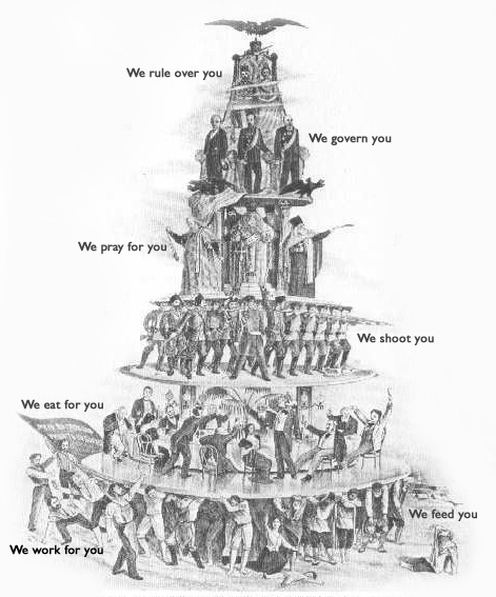
What is the apparently unstoppable trend in our contemporary societies? The apparently unstoppable wealth polarization?
Then let’s tax ourselves out … America worked fine during the ’50s and ’60, when the highest marginal tax was 91%… Yeah, only those years had been followed by stagflation. And let me remind you that communism can also be interpreted as ‘100% tax followed by a comprehensive redistribution’. And it also failed.
Then how about ‘libertarianism’? No taxes, no government…
But how about less extremism? Of any kind?
How about remembering that liberal capitalism has made possible all that we have today? Liberal as in free-market capitalism, of course.
Free market as in competition working both ways. Entrepreneurs competing among themselves for clients AND resources. The workforce being, of course, a resource. The ‘compensated’ workforce representing the bulk of the clients…
What we seem to have forgotten today is that the circle must be round. If we want the ‘show to go on’, of course.
If some of us concentrate too much control over the rest of us – either way, the circle becomes lopsided. And everybody has everything to loose.
No matter whether this happens as a consequence of nazism/fascism, communism or even capitalism.
At least, capitalism has proved to be manageable. Let’s make it work, again.
People may find themselves in three situations. ‘Coasting’, trying to climb back up to their former position or hitting a glass ceiling.
All societies – past, present and future, were, are and will forever be composed of various mixtures of ‘coasters’, ‘back climbers’ and ‘glass ceiling hitters’.
Please note that I’m dealing in self-referentials here. This is about how individual people describe themselves when speaking to themselves. The coasters enjoy the life they had designed/expected for themselves. The ‘back-climbers’ attempt to regain the position/status they believe it was rightfully theirs but had been robbed of in circumstances outside their control. The ‘glass ceiling hitters’ are… busy hitting the famous glass ceiling.
If a society is composed of a ‘healthy’ number of coasters combined with a manageable number of ‘back-climbers’/’glass ceiling hitters’ then the frustration felt by the latter – which tends to tear apart the social fabric, can be compensated by the sheer mass/inertia of the joy experienced by the former. Hence the society can be described as being ‘stable’.
Whenever the ‘back climbers’ or the ‘glass ceiling hitters’ get the upper hand, things start to unravel. Or to fall apart…
To understand what I’m driving at, please consider the pre-revolutionary Russia and the German society after WWI.
Russia was an extremely hierarchical social organism. The birth-place was ‘definitive’. And most of them led to very unpleasant lives. The vast majority of the population, from muzhiks to intelligentsia, could not break through the glass ceilings allocated to each of them, at birth.
The defeated German population had found itself in a very unpleasant situation. After having been told they had been instrumental in preserving order in Europe – as the back bone of the army who had defeated Napoleon Bonaparte and kept in check Napoleon III, they found themselves at the receiving end of history… After their fathers had witnessed the Parisians eating their zoo animals during the 1870 siege, the Germans were reduced to hunting food scraps themselves.
Hence the difference between communism and nazism. Both equally authoritarian in nature, each of them springs from completely different social circumstances. Which explains why ‘progressives’ have such a high tolerance for communism…
While the ‘back climbers’ attempt only to reinstate the order they were accustomed to – order which has already been proven dysfunctional by what had happened, the ‘glass ceiling breakers’ are always attempting to open new roads. Very enticing from the ‘progressive’ point of view…
Fact is that both communism and nazism/fascism are artificial. Figments of frustrated intellectual imagination. Both ideologies have been put together by thinkers and only followed by ordinary, desperate people.
Let’s face it. The homeless are ‘survivors’ who don’t pull their weight as members of the community. They live ‘off the land’ – but the land they use to live off is us, and they don’t give anything back in return. Except for the garbage they leave behind…
Hence we have a problem. Which we might choose to ignore. Or to solve.
I’ll presume we want to solve it. First step to solving any problem is, of course, to understand its nature.
So, what is bothering us?
The garbage they leave behind? The sore sight they offer each time we see them? The danger they represent for public safety? The fact that they occupy public property? And prevent the rest of us from using it? The fact that they don’t contribute? The loss of their creative potential? The bad example for our children? They are a reminder of what could have happened to any of us?
Second step, the ‘how’ of the matter.
What caused such a number of able bodied people to live in the streets? Why do so many of them use drugs? And alcohol? Why do so many of them refuse to be helped? By the institutions which care for them?
I don’t have a real answers for any of these. The first category of questions depends on each of us while the second on each of the homeless.
Nevertheless, I would like to point out a few things.
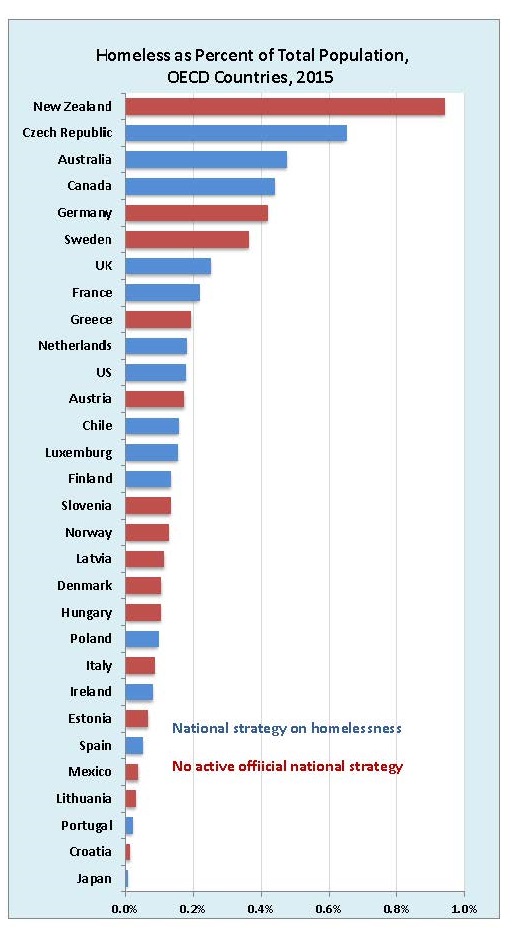
And what might we learn from this? Leaving aside the ‘vagaries’? That New Zealand has way more homeless people than Japan? And why nobody knows anything about the New Zealand homeless – or about those in the Czech Republic, but all concerned netizens are horrified by the manner in which the US are treating their homeless?
For starters, and given the relative size of the US population, there are way more homeless in the US than in the rest of the OECD. Roughly counting, of course. Secondly, the US is the wealthiest country in the world. And the one which used to describe itself as being the place where all dreams could be fulfilled.
So, after all, is there anything to be learned here?
Actually, yes.
That luck does play a huge role. It makes a hell of a difference being born a Maori in New Zealand or a billionaire’s child in California. And that becoming acculturated in the US actually increases your chances of becoming homeless.
The way I understand all this is that there must be a link between homelessness and the intensity, and character, of the social interaction prevalent among the members of any given society.
People in the West, and specially in the US, see personal success as paramount. And personal failure as … well… something to be shunned. Simply because it reminds us of what may happen to any of us. Specially when taking on the risks we must assume if we want to really succeed. As we are pressured from early childhood. The risks the immigrants grow accustomed to the longer they live in the US.
I’m afraid I was that close of forgetting a point I planned to make. Why so many of the homeless use drugs and have an alcohol problem.
So young… and yet so satisfied with himself… he must have had a strong set of beliefs on which to build such a strong self-esteem!
Let me put it another way.
Each of us needs to believe. Something! Would you have enough courage to go to bed at night if you weren’t absolutely convinced that the sun will come up next morning? Furthermore, for things to work as we expect them to, enough of us must share a certain number of beliefs. For instance, would you go to work/accept payment if you weren’t more or less convinced that the money you’d get will enable you to fulfill at least some of your wishes?
Hence belief being based on a deep seated need to believe is a truism. Uttered only as a lame excuse for ‘you can’t convince a believer of anything’.
Which isn’t exactly a lie… only a half truth. A ‘fake news’, if you will!
First of all, a believer is already convinced. Hence somebody had been able to convince him/her, at some point, of something.
Somebody had somehow convinced the aforementioned believer that the object of what was going to become belief was obvious enough to become ‘evidence’.
Complicated?
Let me rephrase.
‘I haven’t been able to convince a believer of what I was trying to convey to him/her. Hence it must be his/her fault. Not mine! Otherwise I would have to admit that what I was presenting as evidence was false, I wasn’t presenting my evidence in a believable manner or, lo and behold, both at the same time. Totally unacceptable! Now I need to come up with a good enough reason for his/her inability to see the light! His/her ‘need to believe’ must be the only explanation. Otherwise he/she would have accepted my evidence as being obvious….’
On the other hand, the rest of Sagan’s work cannot be dismissed. Which proves that self-esteem is a good base on which to build a career.
The need to believe being yet another thing which cannot be dismissed!





 nicichiarasa