A story opens a space. An explanation sets limits.
A story empowers. An explanation tells how those powers are to be used.
Neither are true. Each wants to be true but neither will ever reach the exact place. ‘Bull’s eyes’ are safe. We keep trying, although those of us who know their way around words are aware how elusive truth is.
The downside of the whole thing being that words, ‘storied’ words, might kill. As in actually! And uselessly…
Unless accompanied by a valid explanation, of course.
Then we start exploring the world our parents – and all their ancestors, have prepared for us.
At first, we’re like sponges. We absorb, unconsciously, everything which takes places around us. Some according to what our parents had in mind for us, some not.
After a while, on our own and/or under our parents’ supervision, our attention starts to focus. More and more of the things which are stored in our memory are learned. Increasingly a consequence of focused labor and less and less a happenstance.
Almost simultaneously, we start adding our transformative efforts to those already effected by our predecessors. Minute at first, more and more significant as we become more experienced.
At some point, we reach something called ‘maturity’. That’s when ‘play’ ceases being a legitimate manner of learning for us. We are allowed to continue playing but only for recreational purposes…
At least we’re still allowed to explore… but from now on, we’re expected to do it in a serious manner. According ‘to plan’, that is. From now on, wandering is considered to be a sin!
‘You’re an adult, for God’s sake. Act like one!’
I’m sure most of you have experimented things. Either as an experimenter or, mostly in school, as a learning apprentice. How many of those experiments had been ‘blind’? As is neither you nor anybody else present had any idea about what was going to happen? And how many had a more ‘modest’ goal? Just to convince the ‘students’ that the ‘theory’ was valid?
If you think of it, the second sentence covers quite a lot of ground. From the second grade teacher pouring water over some sugar ‘Look, it has disappeared’, to the scientists anxiously watching the gauges at the CERN laboratory…
A few short generations ago, people had to decide whether that plant was edible or not. And had developed methods to accomplish that task. They survived, right? Nowadays we design new plants/animals and ‘cook up’ fancy snacks to be sold in supermarkets…
During our parents’ ‘watch’, Popper had come up with a test for what belonged to the realm of science – and had to do with ‘reality’. Nowadays, we brag about being able to create VA. As in virtual reality… Enhanced virtual reality, even!
Nothing good or bad about all this. For as long as we keep our eyes open… and, at least one of them, focused on the ‘hard’ reality… that which makes us possible!
Simple high-school physics teaches us about radio-active elements. And about the fact that some of them can start a so called ‘nuclear chain-reaction‘. For said chain reaction to start, a certain ‘critical mass‘ must exist before-hand.
As soon as that ‘critical mass’ is achieved, the reaction starts by itself. No ‘trigger’ is required since it actually triggers itself.
But there’s one more thing which has a certain relevance here.
“Concentration”.
It’s not enough for the critical mass to exist, it also needs to be concentrated enough.
If the radio-active nuclei are positioned far enough one relative to the other, the decay of each of them goes ‘unnoticed’ by the rest. None of the individual ‘explosions’ can trigger the chain reaction. But if the nuclei are crammed together – as in an A-bomb, a split second after detonation, the reaction accelerates itself until the whole shebang goes bang.
And there’s the ‘cherished’ middle of the road. When the ‘environment’ moderates the reaction. Slows it down to ‘self-sustaining’… as it happens in the (well managed) nuclear power-stations.
‘Yeah… very interesting… but… what on Earth has any of this to do with your professed interest? “Exploring the consequences of our limited conscience”…’
Very few individual humans are naturally ‘radio-active’. And, in normal settings, they are ‘well taken care of’.
Before going forward, I’m going to return, briefly, to the ‘nuclear’ chapter of physics. I’m sure the word ‘plutonium‘ does ring a bell with most of you.
Plutonium is a mostly ‘artificial’ – as in man-made, chemical element. A few scattered atoms can be found in nature – plutonium occurs when uranium atoms absorb ‘extra neutrons’, but the vast majority of the plutonium which exists on Earth has been produced in our nuclear reactors.
Said plutonium can be used to fuel reactors. And to make bombs. Actually, it is far easier to concentrate plutonium for a bomb – if you have enough spent nuclear fuel, than to achieve the same result – a nuclear explosive device, starting from uranium ore.
Let me wrap this up.
Playing God can be dangerous. We’ve been tinkering with Nature for a while now.
At one time or another, we’ve turned various naturally occurring ‘things’ into weapons. From sticks to rocks, then metals… now chemical elements!
At first, we just picked them up and used them as they were. Then we’ve shaped them to better fit our purpose. And ended up changing the sub-atomic composition of Mendeleev’s elements…
Now, that we’ve reached “MAD“, we’re looking for something new.
The latest piece of technology, the Internet, is the latest addition to our Arsenal. To our weapons making factory.
Forgetting that the by-products of our previous ‘explorations’ have already proven themselves to be extremely dangerous. The Three Mile Island, Chernobyl, Fukushima, the huge stockpile of ‘residual’ plutonium we need to somehow dispose off…
Yep. The Internet is being used to distribute – sometimes very exactly targeted, weaponized information. Which information actually transforms the susceptible individuals into time-bombs.
Tell a guy that his freedom is constantly challenged by the government. Then tell him the ‘Covid’ mask isn’t 100% effective. And end up by asking him ‘why does the government demands you to wear something which is not foolproof’?
Each of those three are legitimate.
Put together, they become explosive. They actually blow up people’s minds. Derail people’s ability to think straight. Statistically speaking… Which is enough, of course!
What will happen when the number of ‘deranged people’ will be enough to reach ‘critical mass’?
Only God knows. But it will certainly be far worse than whatever the ‘troll farmers’ have in mind!
“You can’t deprive others of their liberty without forfeiting your own. Liberty is lost with every person seeking to control others for their comfort and sentiment.”
Getting a vaccine and wearing a mask are sensible things to do, right?
Establishing a free environment, where all individuals might enjoy their liberties, is also a sensible thing!
For the simple reason that even a casual examination of history provides ample proof that freer societies fare far better than those which curtail individual freedoms.
Simpler said than done… Mention the mandatory mask and the imperative advice to get vaccinated to those passionate about individual liberty and you have a hornets’ nest on your hands.
Or maybe this is an excellent occasion to discuss the ‘gap’ we constantly need to bridge between individual freedoms and a free society?
Can you have a free society composed of slaves?
The answer depends on who gives it to you. I’d spent the first 30 years of my life under communist rule. My country, Romania, was declared, by those who were ruling it at that time, as being free. Both domestically and internationally. The only free individual was the ruler. Nicolae Ceausescu. He was the only guy who could do as he pleased. And only for a while… Until 25 December 1989… In the end, the regime had crumbled and the only ‘free’ individual had met with the consequences of how he had chosen to use his freedom.
So no, you cannot have a free society when one individual, or a group of individuals, impose their will on everybody else.
‘Your liberty to swing your fist ends where my nose begins’
Otherwise put, if you refuse to get vaccinated/wear a mask you might be instrumental in getting me sick. Or dead.
‘Might’! It’s the ‘might’ part which troubles you! Why should you shoulder a minimal risk/discomfort for my safety? Specially when you’re not convinced that my safety is in danger… Or, maybe, you’re thinking ‘let him take whatever precautionary measures he considers to be necessary!’
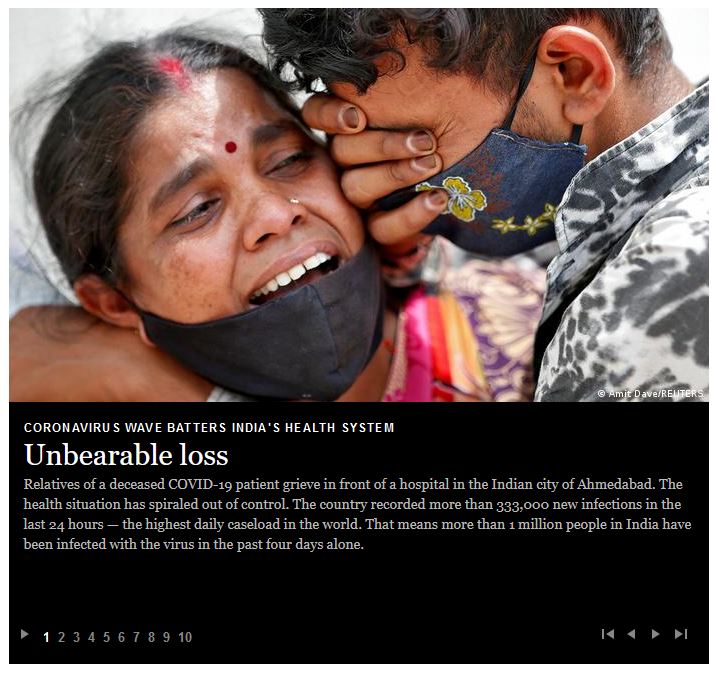
Because of India, that’s why!
Do you consider present day India to be a free society? Do you consider that people currently living in India are truly enjoying their freedom? Today?!?
And no, I’m not going to contrast what’s going on in India with what the Chinese government had done. First pretend nothing had happened then lock up the entire population.
No! I’m going to contrast what’s going on in India with how the ‘other’ China had reacted to the Covid pandemic. Or with the South Korean response.
Different economic realities… Different cultures… Maybe! But also different levels of economic and social disruption!
Don’t tell me that what’s going on in today’s India won’t have repercussions!
For a while, after WWII, many in the Eastern part of Europe were convinced that, soon, ‘the Americans will come’. And save them from communism.
At the end of the Korean war, most of those hopes were dying away. Whichever were still alive had been buried at the end of 1956. When the Soviets had occupied Budapest. And nobody lifted a finger…
The erstwhile hopeful had adapted to the new reality. Changed tack … Instead of hoping that America will eventually deliver them from communism, they saved themselves. One way or another, they left their countries and pursued the American Dream in America proper.
They somehow reached those shores – welcoming shores, in those times, set to work and made it. You see, in those times the American Dream was not as much about becoming rich as it was about becoming ‘your own man’. Being rich was considered useful, indeed, only it wasn’t seen as a goal in itself.
As to how to do it, things were crystal clear. Luck was optional while hard work was deemed essential. And, often enough for people to become convinced, things went on as expected!
‘Find what you’re good at, work hard and, sooner rather than later, your dream will come true’.
And it did. For many enough so that achieving the American Dream was considered to be the norm rather than an exception. Maybe not for everybody. But for many enough so that Regular Joe was convinced that hard work and determination will take you places.
Is this assumption still valid today?
When so many of the well paying jobs have been exported? When it’s far easier to make money by investing already owned capital than it is to work your way up the socio-economic ladder?
A lot of people point their finger at those who prefer to take hand-outs instead of accepting minimum wage jobs. On the face of it, it doesn’t make much sense, does it? No matter how generous, hand-outs will never be large enough for a comfortable life. While hard work will, eventually, take you there. Are you sure about that? About hard work eventually taking you ‘there’? In the present conditions?
Furthermore, the former American Dream was about about giving your best before expecting Fate to reward your efforts. Today’s mantra, ‘greed is good’, had completely altered the premises. ‘Get as much as you can, give as little as possible’ has become the new modus operandi.
What?!?
Maybe put in this way it will be easier to recognize.
Buy low, sell high.
‘Profit maximization’.
You see, using fancier words, those who prefer hand-outs to hard work do nothing but obey, intuitively, the law of the diminishing returns.
Then hand-outs should be drastically reduced!
That’s, indeed, one way of solving the problem…
Except for another ‘rule’.
You catch more flies with honey than vinegar!
But this is about ‘flies’, not ‘people’!
Yeah, right… as if people were less intelligent than flies…
You see, Henry Ford had found a way out. By dramatically increasing the ‘benefits’ extended to his workers he had managed to retain a stable work force. And, an unforeseen consequence, he had set in motion the wheels of the consumer society. The very economic set up which had made possible the fulfillment of the American Dream.
Currently, solvent demand is drying up. Unnoticeably, for now. For as long as credit will take up the slack, the evidence will remain under the radar.
But ‘evidence’ has the bad habit of hitting the fan. Exactly at the worst possible moment…
Becoming mature implies giving up a lot of things.
A lot of the erstwhile held convictions. No matter how they had happened to accure on you.
For instance, growing up means giving up the widely held belief that growing old will, eventually, ‘open up’ your mind. That living long enough will transform each of us into a wise person.
Living is nothing but an opportunity. What happens during that time depends heavily on ‘Lady Luck’. And, of course, on what each of us is able to make of the opportunities presented by the afore mentioned Lady Luck.
In dear memory of Petre Anghel, my Teacher, who had passed away before we had the chance to finish discussing this subject.
The malicious has made an option. Had chosen. Willingly! And, supposedly – according to the hypothesis being discussed here, knowingly.
The ‘stupid’ just stays put. Until the relevant information penetrates his ‘thick skull’. It’s not his fault that those who attempt to convince him are not skillful enough.
And if the ‘stupid’ happens to be in a ‘powerful’ position… (hence his inability to understand fast enough is liable to produce considerable damage) who needs to be chastised?
The ‘stupid’ himself? Who presumably ‘doesn’t have a clue’ about what’s going on? The malicious who had made the whole situation possible? The ‘lazy bystandards’? Who had allowed this to happen? Out of carelessness?
Or those who are liable to suffer the consequences? Who had understood what was going on but…
On the other hand… Could Dietrich Bonhoefer – a renowned pastor and theologian, utter such ‘simplistic’ words? So callous?
I’m not exactly old. Only old enough to continue to check my email. From time to time…
For reasons outside my knowledge, this morning I’d found – in the ‘promotions’ section’ a link to a ‘common sense with Bari Weiss’ article. The title was apealing, the name rang a bell – even though I had no idea about who the person was, so I read it.
My reaction was intense enough to start writing. Not before looking her up…
The point being that she is basically right. Enabling is a powerful phenomenon. But she is also basically wrong.
Powerfull it might be, only enabling is not necessarily malignant. As she implies.
Enabling is done by people with means. Powerfull and or resourcefull enough for their actions to be effective. What the enablers choose to enable… is something else.
And the consequences of enabling depend on the enablers’ choices!
Things might come up right. Or wrong.
The kind of enabling curently predominant in America has been detrimental to the society at large. Leading to the enablers becoming irrelevant. Just as Weiss advertised. Trump has been supplanted by those who had occupied the Capitol – after being enabled by him, while on the other side of the political divide things aren’t going any better. Cultural cancellation isn’t going to end up well.
But enabling can lead to different outcomes. Depending, of course, on what is being enabled.
Take Germany, for instance. Yes, nobody knows who its President is. Only the country, as a whole, functions far better than many of those whose Presidents are on everybody’s lips. Simply because the German enablers had chosen to enable the ‘right’ kind of behaviors.
Miruna Gritu, așa o cheamă pe prietena berzelor din Sibiu, este atât de cunoscută în lumea iubitorilor de animale încât atunci când un cetățean din Biertan a găsit doi pui de urs, a sunat-o pe ea. Nu la Garda de Mediu. La Asociația Prietenii Berzelor!
După cum înțelegeți din context, aceasta s-a dus la Biertan. Pe drum a tot dat telefoane până când a aflat că la Zărnești există un sanctuar pentru urși. Așa că a luat puii – deshidratați și foarte slabiți de diaree, și i-a dus la Zărnești. Între timp a fost sunată de cineva de la Garda de Mediu. Invitată la sediu. Și amendată cu 10 000 de lei. Pentru că a transportat urși fără să fi fost autorizată în acest sens.
Garda de Mediu este o înstituție care se ocupă cu ‘ocrotirea mediului’. Urșii fac, evident, parte din mediu. Garda este obligată să se ocupe de bunăstarea urșilor. Obligată să aplice legile. Pentru simplul motiv că dacă s-ar apuca oricine să transporte urși unde li se năzare, urșii ar avea de suferit. Împreună cu restul mediului.
Miruna Gritu se ocupă și ea tot cu ocrotirea mediului. Cu ocrotirea aceluiași mediu… Berzele pe care le oblojește Miruna Gritu nu sunt cu nimic mai prejos decât urșii care tocmai au fost protejați de Garda de Mediu.
Și atunci?!?
Cum putem ieși din situația asta? Ce era să facă comisarul de la Garda de Mediu? S-o lase în pace pe Miruna Gritu după ce aceasta tocmai încălcase legea? Ce exemplu dădea? Pe de altă parte, cam câte berze poate să îngrijească Miruna Gritu cu banii aia?
Am să închei cu o altă serie de întrebări.
Care este amenda minimă pentru transportat urși fără autorizație?
Și, mai ales, cum rămâne cu sustenabilitatea? Facem ceva pentru ea, pe bune, sau ne ‘acoperim cu hârtii’?