Archives for category: skin in the game

Regulations don’t really work unless they reflect the mindset of the majority…

And here’s how it works.

The rule about driving on the ‘right’ side of the road is observed without much need for enforcement.
Because the consequences are clear. And consistent, unless you drive a tank.

People had the same problem with condoms.
Until HIV came along…
Nowadays very few people engage in casual sex without one.

Give us time and … if SARS-CoV 2 will be around for long enough…

Everything which has a temporal dimension – movement, transformation or both, incurs costs and produces consequences.

From a rock sliding down a slope to me writing this.

The difference between these two being the simple fact that no rock has ever had any goal.

You see, the rock looses some energy and mass while sliding down. It accelerates at first but since no rock has ever slidden for ever.
Only rocks never do anything on their own. Something has to happen to them first.
They do bear the costs – they wear down, break, etc., yet they don’t mind. For they are not, at all, aware of what’s going on. And, anyway, completely unable to do anything about it. Hence not at all ‘responsible’ about any of the consequences produced by whatever they had been involved in. Happened to them, actually.

Fast forward to me. I’m not only alive – hence reactive to whatever happens to me, but also aware. Aware of my own awareness even.
I notice the costs I have to pay. Hence I try to minimize them.

And here’s the gist of the matter.
My awareness drives me to minimize the costs I incur during my life AND to be very careful about the consequences of my endeavors.

Theoretically, at least…

Nothing will ever happen unless:

– There’s enough, and suitable, space.
– There are enough, and suitable resources. In that place, of course.
– Something starts it.

Trivial?

Good!
What you’ve just read being trivial for you only means you’ve already figured this out.
That you cannot master anything
– which happens outside your consciousness,
– you don’t really understand,
– you haven’t set your mind on.

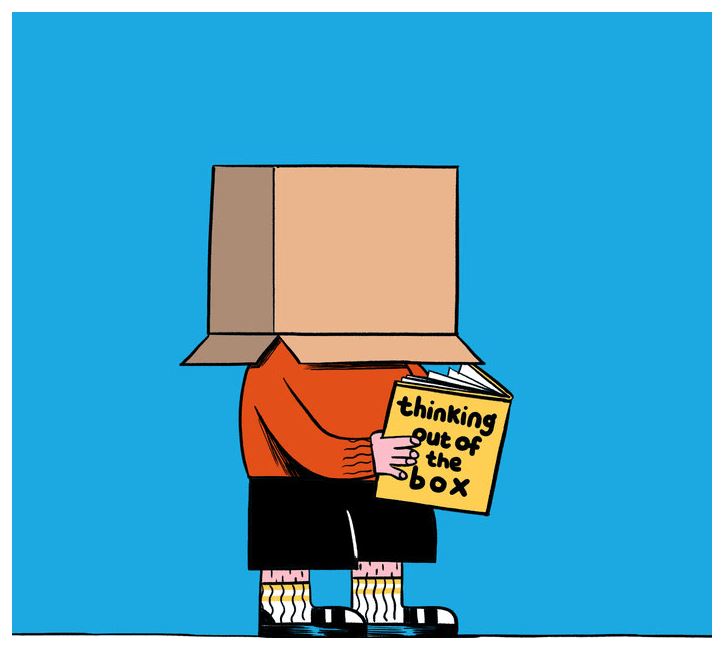
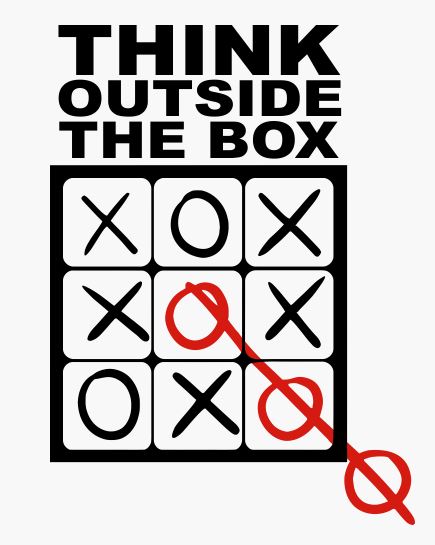
There are a lot of people who prod us to ‘think out of the box’.
And a few who dare to warn us about the perils of pushing it too far…

I’m gonna invite you to the next level.
Instead of sending your imagination to think outside the box – while the rest of you remains comfortably inside, let’s step outside ‘in person’.

Classic thinking outside the box does nothing but enlarges the box. Brings inside a portion of the outside. Moves the walls.
Bringing in a lot of additional clutter in the process.

By stepping outside, physically, you have the opportunity to actually see the problem as an ‘independent’ box. Separated from you and separated from the environment.

How about this for a change in perspective?

This way it will be easier for you to notice, and carefully examine, the links which exist between you and the problem. Between ‘the’ problem and the rest of the problems. Between the problems and the environment. The place where you have to cope with the problems.

The place where you live.

And that, my friend, is your biggest problem.
How to step out of your own life.
In order to make it better.

There are facts which need to be checked.
And facts which are ‘somewhat’ obvious.

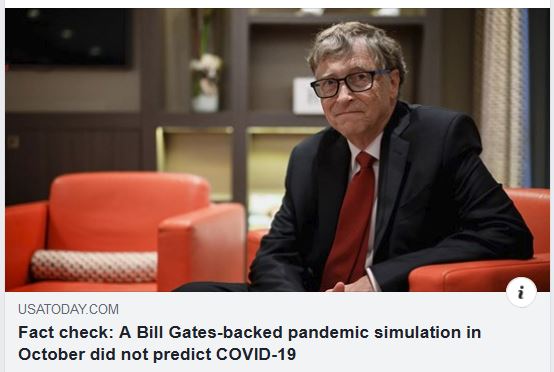
USAToday felt the need to fact check whether Bill Gates sponsoring a ‘pandemic simulation’ didn’t predict COVID-19…

What next?
Fact checking whether a fire crew exercising fire fighting didn’t predict the next … fire?!?

Given my experience of living under communist rule, I can tell you that too much consistency is bad. Having to toe the line is dangerous. For individuals and for societies, as a whole. Communism did fall, you know.

On the other hand… some consistency is needed.

Let me give you an example.

The whole world is asking China to do ‘the right thing’ about its wet markets. In Bill Maher’s terms “eating bats is bat-shit crazy“.

Why?!?

Because of what science tells us. That bats are full of corona-viruses, which are bad for us.

That’s what we say, anyway. Those of us who side with ‘science’… And who ask the Chinese to give up their traditions.

Let’s examine the problem from the other side.

‘We’ve been eating bats for ages. And nothing happened to us. Now you say that this flu like disease is produced by viruses who live in bats. Why would we believe you – and give up eating bats, if you don’t believe your own scientists? And balk when they tell you to quit smoking. To stop piling plastic into landfills. To stop heating up the planet.

To vaccinate your children, for God’s sake…’

“Yes you can! No people to feel/live/see it, no spring.”

Remember Protagoras? “Man is the measure of all things”?

Without man, there’s no meaning?

Yes, our world becomes meaningless.
The moment we no longer care enough about it.
The moment we stop paying attention.

The other day I had a riveting conversation with my son.
With my 21 years old son.

I asked him to comment on my previous post.
The one about too many people allowing sentiment to cloud their judgement.
The one about even reputable news agencies using click-bait titles to entice readers. Hence reinforcing the habit of sentiment being allowed to cloud reason.

‘Life was never better for so many of us’, explained my son. ‘Since WWII most of us had enjoyed peace. Since the Spanish Flu, we hadn’t experienced a pandemic. Since Salk, we’ve led ourselves to believe we were safe from disease. Since the fall of communism, even the ideological divides have paled down. And now we have enough technology to feed the entire planet, comfortably. The point being that we have no idea how to deal in this situation. What to do. How to behave.
Simply because we have no relevant prior experience.
Until recently, historically speaking, we have successfully dealt with wars, famines and pestilence.
But it’s the first time that we experience such abundance.
We need to adapt to the new reality.
To transform it into an opportunity. Into an opportunity to go forward.
We have to avoid, at all costs, the pitfall of allowing this abundance to bog us down.’

Heartening, isn’t it?
That a person so young can find such deep meaning.
If I may say such things about my own son…

Where S stands for Sociological.

So. Let me present you with a sociologically fictitious scenario.

We have an intelligent observer and and a trans-galactic vehicle.

There are no details available about the observer except for the fact that it has access to a comprehensive real time stream of data about what is going on inside – or, more exactly, on the surface, of the trans-galactic vehicle.

And here’s what the observer had recorded.

The vehicle is being continuously transformed by its passengers.
In fact, there are two manners in which the passengers change their vehicle.
By interacting directly with it.
And as unintended consequences of the interactions which take place between the passengers themselves.

The passengers are evolving.
During the observation period, some of them had become dominant.
But no matter whether they had become dominant or not, most of the passengers had disappeared. Both as individuals and as species.

The current dominant species is the most intriguing ever.

It displays a strange mix of intelligent behaviors and suicidal tendencies.

It is composed of rather autonomous individuals who are adept at finding ingenious solutions to almost intractable problems.
But, strangely enough, they haven’t yet been able to figure out two basic things:
The limited nature of the vehicle on which they live. In both time and space.
Nor how to balance their individual functional autonomy with their need to cooperate towards their natural goal. The survival of their own species.

If the whole ‘project’ were a SF movie, the text above would have been the opening.
Followed by:

Currently, the dominant passengers are being taught a lesson by the apparently most insignificant amongst those transported by the vehicle. By a virus, as the dominants refer to it.
The virus – like all of its kind, is able to hijack other organisms and somehow convince them to work for him. At a very high cost for the hijacked organisms.
In this case, the hijacked organisms belong to the dominant species.

And what have the individuals belonging to the dominant species chosen to do?
Inform each-other promptly and cooperate earnestly towards the common goal?

Not exactly. Not yet, anyway.

Homework:
What would the intelligent outside observer think about the whole situation?
Would He consider to lend a helping hand?

We’ve been told to go on as usual.

I’m not pointing fingers here.
I just try to convince you how hard it is to make the right decisions. ‘Going forward’ as opposed to ‘looking back’.
I just try to convince as many of you as possible to stop for a moment and think about it. As dispassionately as possible.

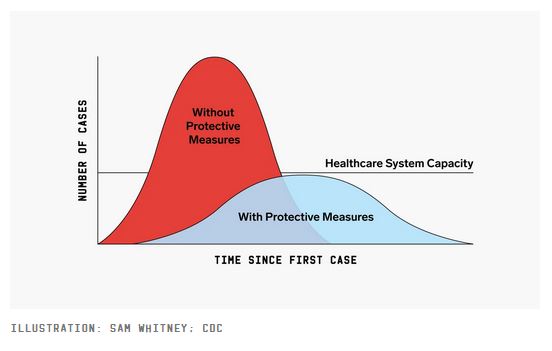
We’ve also been told that we need to flatten the curve.
That our systems were not prepared enough for the onslaught that was going to happen.

Some people continued ‘as they were’ while others tried to ‘flatten the curve’.

For a while.
Now, after some time, people from both categories have started to entertain second thoughts.

Trying to figure out what’s going on here, I’ve asked my self a couple of questions.

Who had chosen to go on as usual and who had chosen to distance themselves from the rest of the society?

‘Go on as usual’ first:
– Those who don’t trust the government.
– Those who are convinced nothing can happen to them.
– Those who felt they had no alternative. Who live paycheck to paycheck or who provide essential services to the society. Like healthcare for instance. Or those who bake our daily bread. Pump the water we drink. Tend the generators who lighten our bulbs and power the computer I use to write this post.

Now those who attempt to ‘flatten the curve’:
– People who tend to trust the authorities.
– Those who understand they should really protect themselves. Who are older and/or already sick.
– Those can work from home.
– And people who are otherwise fine but afford to distance themselves from the fray. Those who have enough resources to do it.

Am I imagining things or the picture is already a lot clearer?

And the other question now.
Why the second thoughts?

Because things have unfolded more or less as the government said they were going to.
Because things have started to happen. If not to them, directly, at least to some of those living around them.
Because there still is no alternative in sight. And because there is nothing much to convince them that their efforts are appreciated by the rest of the society.

Because the government might have been right to tell them to ‘lie down’. But because the same government has failed to do enough in the meantime. Not to mention what it had failed to do before.
Because staying put allows you to start thinking. ‘What next? For how long can we go on like this?’

So.
What next?
What are we doing to convince those who actually keep us going to continue doing so?
What are we doing to convince those who have chosen to restrict their lives to a barren minimum that their efforts are worth it?

What are we doing to convince everybody that there will be a life worth living at the end of all this?

About half of our manufactured goods come from China. From half-way around the world. A shipping container needs about a month to arrive to Rotterdam from Shanghai. While ordering the merchandise takes some five minutes over the internet.

Shanghai is in China. A country so far away that hourly wages are a fraction of those in Europe. Or in the US. That being the reason for so many of our manufactured goods coming from there.

China is a country so far away that it took more than a month for the rest of the world to find out that a pandemic was brewing in Wuhan.
China is a country so far away that the CDC expert embedded in China’s Disease Control Agency was deemed useless by the current American Administration.

China is a country close enough for the Chinese tourists to had been a staple for the Italian hospitality industry. “5.3 million overnight stays in 2018
China is a country far enough for an “official opening ceremony” to had been “held at the Auditorium Parco della Musica, a multicultural complex, in the Italian capital on Tuesday, at the presence of Italian Minister of Cultural Heritage, Activities and Tourism Dario Franceschini and Chinese Minister of Culture and Tourism Luo Shugang.”

The ceremony was held because “2020 has been designated the China-Italy year of culture and tourism, as the year marks the 50th anniversary of China-Italy diplomatic ties.
“Tuesday” was the 21st of January 2020.

The same day

  • United States confirms its first case in Washington state, a man who traveled to the Wuhan area.
  • China confirms two additional deaths, a sixty-six-year-old man and a forty-eight-year-old woman
  • New cases are announced in China, including in Beijing, Shenzhen, and Shanghai.
  • Chinese state media raises number of confirmed cases to 291 and confirms 15 medical workers in Wuhan have been diagnosed with pneumonia.
  • Hong Kong confirms its first case, a person in their thirties.
  • Taiwan confirms its first case, a woman in her fifties.

The above timeline was ‘borrowed’ – through the Internet, of course, yet another example for how close we are of eachother, from https://www.thinkglobalhealth.org/article/updated-timeline-coronavirus on 3/28/2020, 12:30 GMT
Which Internet pulls us together by pooling information/data while simultaneously rips us apart by feeding us a constant stream of fake news.

We are so close together that you can send/receive almost everything (from) almost everywhere.
We are so close together that everybody who has a smart phone can see their similarly equipped buddies halfway across the world.

We’re so far apart that we still have to make up our collective mind about which comes first. The Economy or the People.
We’re so far apart that we haven’t figured out yet that there’s no such thing as a running economy without enough able bodied and mentally sane people. To produce, transport, distribute and buy the things we need.
We’re so far apart that we haven’t yet figured out that the present number of people cannot survive – let alone maintain a decent living standard, without a running economy.