Archives for category: Mutual Respect
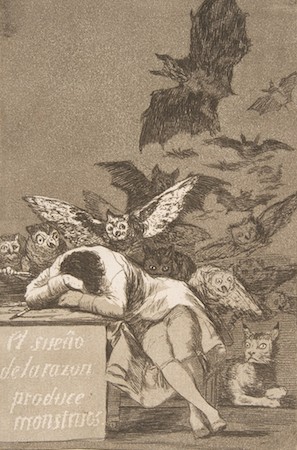
the-sleep-of-reason
People have started to freak out after realizing the full scale of what has just happened.
Some see him as a just retribution for our past sins – and they are probably right about this – while others look at the whole situation as if it was a sort of a Rorschach test.
How about Trump as an opportunity?
The inverse of a Rorschach test since that is about the shrink trying to learn something while an opportunity is about the subject bearing the responsibility for the consequences …
An opportunity, and a prod, for the silent majority to remember that ‘The sleep of reason produces monsters‘?
The way I see it Clinton would have done everything in her power to lull us back into our erstwhile stupor while Trump, willingly and/or unwittingly, is already making enough noise… Even the Sleeping Beauty must have already heard something…
So, test or opportunity, now it’s up to us to find a way out of the current mess. Which, I have to repeat this, is our exclusive responsibility.
The problem being that for those inside, the ‘light at the end of the tunnel’ can be the actual exit or the head-light of a train engine barreling down towards them.
‘Lady Luck’ is a tough bitch and that’s why one should be really careful with these things.
PS. The ‘shrink’ already has a huge ‘blot’ to muse about. Some people never learn.
Emily Linroth being a spokeswoman for the National Park Service, the organization which has cleaned up “the National Mall following the inauguration and the Women’s March on Washington Saturday.

I was planning a post and going to use this title, but without the quotation marks.

I wasn’t aware of the book that begins with the very same words.

Before starting to write – the original post was meant to be about the relationship between us, people, and the laws that govern our lives – I checked on Google whether somebody else had already used the same title and where they had went from there.

Since G‑d is the ultimate perfection and is free of all limitations and definitions, it is self-evident that, in the words of the Alter Rebbe, “The fact that He creates universes does not express what G‑d is.” At the same time He is, as Maimonides writes in his Laws of the Fundamentals of Torah, “the one who brings every existence into being; all existences exist only as derivatives of His ultimate existence” and the one upon whom “all existences are utterly dependent.” It is also obvious that just as no creature can comprehend the nature of G‑d’s creation of reality ex nihilo, so too no creature can comprehend the nature of G‑d, even the nature of G‑d as the creator of the world and the source of every existence.

In the words of the great Jewish philosophers: “If I knew Him, I would be Him.”

So, though a person realizes and understands that no thing can create itself, and that one must therefore conclude that the created reality has a source that generates its existence, this is proof only of the existence of the Creator, not an understanding of what He is, even as “Creator.”

Now, after reading Rabbi Schneerson’s (the Lubavitcher Rebbe) words, I cannot stop wondering what drives certain people to pretend that they have fully understood God’s will and therefore their actions/words are not only ‘correct’ but also above any doubt.

Not to mention their insistence that we, the rest of the (not divinely blessed with such a deep understanding) people, must follow their directions or suffer the consequences?
Here on Earth, at ‘their’ hands…

On the other hand, the same principle has been affirmed – time and time again – by various scientists.
For example, by Werner Heisenberg.
The depth of the uncertainty principle is realized when we ask the question; is our knowledge of reality unlimited? The answer is no, because the uncertainty principle states that there is a built-in uncertainty, indeterminacy, unpredictability to Nature.


For more than a year now I was struggling to understand the circumstances that have produced the current political mess in America.

I finally figured it out.

Confusion and dissatisfaction!

If you have enough people that are both confused and malcontent then all kind of ‘strange’ things will happen.

Only one of them won’t be enough to explain the whole gamut of what’s going on and that’s why I wasn’t satisfied by any of the many articles that pointed out one reason or another for the ‘popular discontent that brought the Donald to the White House’.
In fact no amount of ‘unhappiness’ can explain how two mature parties can nominate such lousy candidates. Neither Hillary Clinton nor Donald Trump fit, not even loosely, the profile of a decent President. That’s why the voter turn-out was the lowest in the last 80 years or so.

But if you add ‘confusion’… things begin to clear out.

And no, I’m not speaking here about the regular people being confused as a result of the ‘politicos’ having misbehaved horribly.
I’m afraid things are way deeper than this.
Even those who believe themselves to be educated in these matters seem to be swimming in a sea of thicker and thicker fog.

Take, for instance, the current debate about the differences between ‘republic’ and ‘democracy’.

A republic is a representative type of government, and its goal is to simultaneously control the majority while protecting the minority. For example, in the republic of the United States, the government is limited constitutionally, and power is divided between the three branches of government.

A democracy is a type of government that grants eligible citizens the right to equal participation. This right is provided directly through the creation and development of laws or through elected representatives. The interest of the majority is the most important aspect in a democracy.

A republic is a representative form of democracy. A republic has an elected head of state, such as a president, that serves for a specific period of time. In a republic, the interest of the majority rules through its elected representatives. However, a republic has a constitution that protects the minority from being entirely overruled or unrepresented.

See what I mean? Adding insult to injury this definitions were published by a site which calls itself ‘reference.com‘ …

I’m not going to pick truth from fiction in that quote, that would only add to the already too thick confusion.

Enough for me to say that ‘republic’ is indeed a manner in which societies are organized (a.k.a. ‘governed’) while ‘democracy’ is a manner in which societies decide for themselves. Yes, these two things have a lot in common but we should not confuse them.

There are republics which only pretend to be democratic – like the late Soviet Union or the current Democratic Republic of Korea, some which are democratic in a rather strange way – Iran for example, or which are slowly ‘loosing’ democracy behind – like Orban’s Hungary or Putin’s Russia. History has also a few examples of republics which had given up democracy all together. Hitler’s Germany, for instance.

On the other hand there are monarchies (OK, constitutional monarchies) which are perfectly democratic. The British Commonwealth, Sweden, Norway, Holland, Belgium…

What can explain the current confusion?
‘The interest of the majority is the most important aspect in a democracy’?!?
A major lack of understanding about what democracy really means?

A terrible confusion between the formal aspects of democracy – freedom to vote for what ever candidate accompanied by a fair account of the ballots – and the really important tenets of democratic behavior – honest, open and mutually respectful exchange of ideas about the current state of affairs between the interested members of the society?
My point being that true democracy is about the opportunity to rationally convince those around you/making yourself available to be convinced by rational arguments, not about the majority imposing its view on the minority. That is nothing but mob rule, a horrid perversion of what democracy was meant to be.

Basically, what happens – under all forms of social arrangements/forms of government: republic, constitutional or absolute monarchy – in a society is that people need to know where that society is headed to. Authoritarian societies are run by the ruler – and the people, willingly, unwillingly or with mixed spirits, agree for the time being – while the democratic societies entertain a certain ‘effervescence of ideas’ which bring forward the important problems that need to be resolved and what would be the socially acceptable manners for those problems to be fixed.

But in order for that ‘effervescence of ideas’ to be efficient, the ordinary people have to contribute in earnest to the exchange and the politicians need to pay close attention and to cooperate among themselves and with the rest of the society towards solving those problems.

That’s why I’d like you to remember when was the last time that people on the different sides of the political divide have actually talked together?
Why do we have a ‘political divide’ in the first place?

Aren’t we supposed to be ‘all together’ in our respective countries?

What’s gotten into us that made us fight each-other so bitterly?

Why do we succumb so easily to ‘divide and conquer’?

Why are there still so many politicos who keep using this method, despite the ample proof that has been provided to us, through out the history, that ‘divide and conquer‘ inevitably ends up in disaster?

http://politics.blog.ajc.com/2017/06/16/when-your-own-rhetoric-gives-you-license-to-commit-mayhem-and-worse/

Modern technology has produced some rather perverse ‘side effects’.

What used to be called ‘democracy’ has slowly been driven into ‘mob rule’.

It is hard to determine whether this is the desired effect of some (un) ‘intelligent design’ or an unforeseen consequence of the callous machinations of the ‘power hungry’ but it doesn’t matter much, does it?

Let me first clarify some concepts.

For me ‘democracy’ is way much more than what happens in and around the polling stations.
Fairly counting the votes is indeed important but even more important is what takes place long before the ballots are cast.
A really functional democracy is that where every stakeholder has the opportunity to voice their concerns and where the rest pay attention to everything that is said in the public square. By both their political friends and by their political adversaries.
In fact no ballot can be cast efficiently unless the voters have developed a fair image of what is going on in their society. While no one can develop an actually complete understanding of anything, let alone one regarding such a complex system as an entire society, we must jealously keep in our minds that ‘not entirely complete’ is one thing and ‘heavily biased’ through a severe lack of pertinent information is quite a different one.

On the other hand ‘mob rule’ is a what happens when voters’ passions are so high that enough of them are no longer able to think with their own heads and allow themselves to be ‘led by the nose’. Into voting for a specific somebody or, alternatively, into not voting at all ‘because it doesn’t matter, anyway’.

At first democracy actually meant first hand, person to person, meetings in the public square.
The Ancient Greeks solved their ‘state affairs’ in the Agora, the Romans in the Forum while “Althingi” (the name of the oldest parliament that is still in existence, that of Iceland) means ‘General Assembly’.

Slowly, as the constituencies grew larger, the stakeholders needed some more sophisticated manners of keeping in touch. Luckily for them, Gutenberg had already invented the printing press. The American Founding Fathers – who had made good use of this first instrument of what was going to be the mass-media – had insisted passionately on the ‘freedom of the press’. And for good reasons. As I pointed out a little earlier, access to information is paramount for an efficient decision. Further more printed material is a very handy tool when it comes to conveying information from one person to another. Its rather stable nature allows it to survive unadulterated, at least for a while. So it can be handled around or kept for further reference since it is relatively easy to organize. And searched at will. All these discouraging the ‘communicators’ from lying – blatantly, at least. Since lies where relatively easy to pin-point and prove those who needed to maintain their credibility refrained themselves from ‘exaggerating’ too much. The fact that the general public was rather particular about this kind of things also helped in this matter.

Later, when radio and television were introduced, things had become more complicated. Given the fleeting nature of spoken – rather than printed – words, the ‘talking heads’ felt less compelled to stick to the straight and narrow.
Things were compounded by the advent of the ‘political-marketing specialists’ and of the ‘bean counters’.
The latter kept insisting that the mass-media venues have to be as profitable as possible – hence publish more and more of ‘what the audience asks for’ instead of bona-fide information while the former kept telling to the politicians that they have to ‘get under the skin of their constituents’ – by, again, telling them what they were more likely to believe instead of treating them as the grown-up adults they were.
The consequence of all this merchandising was that the erstwhile more or less compact public has been gradually carved up into discrete, and growingly separate, ‘publics’. Otherwise known as ‘echo-chambers’.

The apparition of the Internet/social networks has further deepened the already existent divides. People no longer know what the others really think or feel. But their ignorance doesn’t keep them from having opinions. Or from voting about things they do not really understand. So they vote how they are told by their trusted ‘analysts’/’experts’.

Now, is it of any use for us to blame anybody for what had happened?

Or would it be a lot better for all of us to grow out of this before the ‘whirlwind’ makes a ‘hard landing’ on top of our heads?


Israel has been backed up by the US ever since it was established.
They didn’t enjoy an unconditional carte blanche but the amount of help was  very consistent and, above all, very dependable .

Until a few days ago.
Nowadays Netanyahu, Israel’s PM, feels like he has been thrown in front of a bus by the departing President of the US, Barack Obama. Because the US ambassador, Samantha Powers, had abstained herself, instead of exercising her veto, about a resolution calling for Israel to “immediately and completely cease all settlement activities in the occupied Palestinian territory, including East Jerusalem.

Ever since Israel has been reestablished by his original inhabitants Russia’s rulers have tried to use this situation in their advantage. Egypt, Syria, Iraq, and lately Iran, have received backing from Kremlin in their fight against Israel. By meddling into this conflict Russian rulers were simply trying to get international stature.

Recently Russia’s ambassador to the UN had used his veto power to block a resolution asking for the ceasing of the bombardments in Aleppo. Yet another proof that Russia’s leaders do not care about how they become respected on the international stage, as long as that respect is manifest. As in ‘the world listens when they speak’.

During the Obama administration the US refrained itself from such drastic measures. The US has refused – for now, at least – to re-engage in the brinkmanship game with the Russian leaders. Effectively denying the latter the kind of status they so strongly desire.

Israel has just become yet another collateral victim in this conflict.
Just as the Arabs have been for the last three centuries.
Caught, at first, in the middle of the endless colonial wars between England and France on one side and the Ottoman empire on the other. And later in the cold conflict between Russia and the US.

Theoretically it means “from each according to their abilities, to each according to their needs”.

Practically it looks like this.

famine-in-ucraine

In fact real life communism still is, and always was, about a whole country kow-towing to a dictator who pretends to care for nothing else but for the welfare of the people. His people!

The point being that each resource allocation game needs a referee. Otherwise all rational people would take as much as they could carry from the communal reserve – because it is free – and bring back as little as possible, hence nothing if not coerced to – because it implies some effort.

OK, any reasonable five years old would tell you that the communal reserve would very soon become empty if things would go like this – hence that presumably ‘rational’ behavior would be anything but – only it would be very rational to at least try, wouldn’t it? For how long it would work, no matter how short that interval…

And something else.
You are most likely familiar with ‘bad money drives out good’. There have been a lot of examples to prove this, one of them being Christ driving the money changers out of the Temple.
Some of you might not be familiar with how money worked in those days so here is it.
A coin was a simple ‘slab’ of precious metal, of somewhat constant weight, approximately round, which had been ‘stamped’ with the face of the local ruler. At first, in the minting shop, all coins belonging to the same edition were more or less of the same weight. But, since the edges of the coins were not ridged, ‘smart’ people started to ‘shave’ the coins.
And, after the first guy had started to shave them, each individual who got a coin would have been foolish not to shave it, just a little bit. Maybe the next guy would be foolish enough to accept it, after being shaved. To contest it the recipient would have had to go to the money changers and pay for their expertise. And this is how the coins became smaller and smaller…
Only the priests at the temple didn’t want to be fooled. So they hired some money-changers to vet the coins the believers brought to the Temple. The very money-changers that Christ had driven away. “God doesn’t need this kind of guardians. If we keep them here it would mean that we expect people to cheat. Even here, at the Temple. And if we expect them to cheat, they will surely do so!”

Only some people do cheat. And since some cheat, the rest will have to do something about it. Either make cheating the rule, which would lead nowhere, or make it so hard to cheat as to become impractical. Hence the ridges at the edges of the modern coins. Which can no longer be shaved because the ridges would make it obvious.

Coming back to our ‘communal reserve’ you would have to employ a guardian to make it sure that no one would take any more than they really need and that everyone periodically brings back stuff according to their abilities.
But how would that guardian determine what are the real needs and the real abilities of each of those individual members of the community?
And, even more importantly, what would stop the guardian from taking the whole ‘communal’ reserve into his private possession? As in acting like a communist dictator? Simply because ‘he needs it’?

The only alternative that worked was the free market. That where you sold your abilities and where you could buy things to fulfill your needs. Where prices were set at the meeting point between ask and demand.
But the same principle, bad money drive out the good, acts even here.
‘Smart’ people try to organize ‘monopolies’. Which, basically, is the same thing as they attempting to become the owners of the ‘communal reserve’.

This whole thing looks like an intractable vicious circle?
Take heart, that’s what ‘reeds’ are for.
We invented those, when we realized that we needed them, didn’t we?

reeded-coins

You still wondering what to use in order to transform that vicious circle into a virtuous one?
How about individual freedom coupled with a healthy dose of mutual respect?

teenager-government

Why am I am trying to make any sense of something said by a comedian?

orourke-trump

Because he’s right?

With a twist, of course!

While ‘government’, all of them, tend indeed to behave like ‘teenage boys’ their actual behavior depends very much on their up-bringing and on the amount of supervising their stakeholders/parents invest in them.

Which brings us to

the-government-you-deserve

Now all that is left for us to do – for ‘all’ of us, that is, including ‘the Government’ – is to remember that the individuals who make up the government also belong to the people. They cannot be essentially different from the people itself and they will, eventually, share the same fate as the rest of us.

Or even worse.

the-higher-you-are

The House Jack Built, Metallica


donald-trump-grab-them-by-the-pussy-cartoon

Or is it the (unforeseen?) consequence of some very ‘intelligent design‘?

Some people believe that “racial prejudice” is “the natural human inclination … to identity (sic) with members of one’s own tribe, race or ethnic group” and “Post-racial multiculturalism is the exact but equally extreme and insane opposite of Nazi racial ideology“.

Compare this to “Religion, which should foster sisterhood and brotherhood, which should encourage tolerance, respect, compassion, peace, reconciliation, caring and sharing, has far too frequently — perversely — done the opposite. Religion has fueled alienation and conflict and has exacerbated intolerance and injustice and oppression. Some of the ghastliest atrocities have happened and are happening in the name of religion. It need not be so if we can learn the obvious: that no religion can hope to have a monopoly on God, on goodness and virtue and truth“.

What’s going on here?

Where does all this ‘confusion’ come from?

Let me start from the ‘bottom’ of it.

“No religion can hope to have a monopoly on God, on goodness and virtue and truth”.

While I fully agree with Desmond Tutu on the gist of his words I must contradict him on something very important.

Religions cannot hope at all. About anything. Anyway you look at them. No matter which definition you use, religion – all of them – is something that people do together. A common effort.
It is the individuals who are the actual doers. Who love and hate. Or hope, in this case.
Who pretend that their religion is the only true one. Or understand, as Desmond Tutu did, that each religion is yet another manifestation of God.

“Religion has fueled alienation and conflict and has exacerbated intolerance and injustice and oppression.”

Again, it was individual ‘religious’ people who have done all of those things, not religion per se.
All sacred texts have been written by human people. I can even accept that the first manuscript of each religion was directly inspired by God. Only each of them have been copied a thousand times over. And heavily editated.
Then came the individual human people who have read those texts, interpreted them, passed them on and acted upon those interpretations. Upon their convictions, actually.

And this is how “Some of the ghastliest atrocities have happened and are happening in the name of religion”. Not because of ‘religion’ but ‘in the name of religion’.
Simply as a consequence of how certain people have chosen to interpret/use religious teachings.

And not only ‘religious’ teachings.

People are able to interpret – and use in their own (perceived) advantage, every bit of information that comes their way. And now, that we have started to understand more and more about how our brain is working, the manners in which we use that information have become more and more ‘convoluted’.

“Post-racial multiculturalism … began as an understandable overreaction to Nazi racial ideology…before being consolidated by academics into an instrument of socio-political intimidation, rewards, punishments, manipulation and control, a modern, secular replacement for the power-political role of medieval church ideology.”

So.
It was the academics/priests who have done the damage. Not their religion nor the information they had at their disposal.

But why?
How come people whose religions – all of them do this – are adamant about ‘respect your neighbor’ become involved in wars?  Sometimes even in ‘religious’ wars ….
How come academics, whose very job are to teach their students to think autonomously, use their ‘rank’ in order to subdue ‘their’ file?

Could the religious warriors have something in common with the intransigent academics?

How them sharing the unbreakable conviction that they own the truth?
Forged inside the ‘echo-chambers’ where they have grouped themselves according to their specific beliefs? (No matter whether those beliefs are of a religious or ‘rational’ nature…)

Only after I had reached this point in my discourse I was able to fully appreciate Desmond Tutu’s words: ‘Religion … should encourage tolerance, respect, compassion, peace, reconciliation, caring and sharing’.

He doesn’t say anything about giving up on your own kind.
Or about leaving your roots behind.

All he actually says is ‘Be very careful. If all of you will accept to see only the same side of things you will become a herd. And while there is indeed ‘safety in numbers’ all herd members are ultimately headed for the abattoir’.

Diversity isn’t something to be forcefully, hence falsely, celebrated. Or imposed on others.

What we need to preserve, and celebrate, is our ability to ‘walk around’ the things that we encounter. To entertain, and discuss among ourselves, different – even conflictingly different – versions of what we see around us. This ability would only enhance our chances to solve the problems we’ll certainly be faced with.

‘Culture’ is nothing but layer upon layer of place-specific information which have accumulated in time while ‘religion’ is how a certain group of people have learned, again in time, to cooperate in a certain environment.
It doesn’t matter whether that ‘environment’ has been created by a God, has evolved according to Darwin’s theory or both.
What really matters is how we react – conditioned by our cultures and by our religious upbringing – to what is happening to us. Both individually and collectively.

In this sense, each culture we manage to preserve will only add to our chances of long term survival. As long as we’ll learn to sincerely respect each-other, of course.
Again, both individually and collectively.

PS.
A comment on my FB wall, “True religion is God entering history and the lives of humans and revealing Himself. All other religions are man’s attempt to explain the world around him in terms of god or attempts to control lots of other people in the name of some god“, helped me to understand that “There is ‘religion’ – the shared attitude that helps us to cooperate, and there are religions – specific ways that individual communities have traveled in order to attain that attitude.
And something else. What if ‘God entering history’ and enough of us reaching the shared understanding that it is far better to cooperate amongst us – love thy neighbor – than to fight each-other are the same thing?
How to put this understanding into practice? In the various, and continuously changing, circumstances we have to face?

How about this being the very reason for us having so many religions/cultures?

People are very passionate when discussing about their future and their rights.
As they should be.

Children are a very strong ‘avatar’ for our future while the rights to live and to freely dispose of our bodies two of the most important rights.

And this is where things get really complicated.

Some people advocate mandatory vaccination against the most dangerous diseases.
Some people advocate women’s absolute freedom to have an abortion – a few of them extending this right up to the last moment of the pregnancy.

Other people believe that vaccines are mostly benefiting the big pharma and choose not to immunize their children.
Other people believe in the absolute right of the fetus to live – so much so that some of them would even ban all contraceptive methods.

The ‘interesting’ thing here is how this four categories of people intersect each-other.

A lot of the people who advocate women’s right to have abortions also advocate the mandatory vaccination of children while a lot of people who consider abortion a mortal sin also consider vaccination to be inspired by the devil.

Now let me get this straight.
You have the right to ‘kill’ your baby inside the womb but you should not be allowed to let them die of a preventable infectious disease?
You are to defend a fetus, at all costs and against all consequences for the mother, as long as they inhabit the womb only to let them catch whatever preventable infectious disease might come across their path?

Consistency is over-rated?

We really need to restart using our common sense?