Archives for category: Mutual Respect

“It is a very difficult decision for all parents because we live in a society that values profit over public health.”

“It’s more like listening to what other mothers were saying…
There was a … huge amount of evidence that it was harmful. Even if there weren’t ways that we could scientifically prove it, it was just talking from one mother to another.”

“Doctors do not do their own research, they are heavily brain-washed when they end school  with this idea that it is all good and then they do not question it much themselves”.

“A beautiful child went to have a vaccine and came back and a week later he had a tremendous fever, got very, very sick and now is autistic”

vaccine sceptic island

Well, the scope of this post goes way beyond the dispute between the vaxxers and the skeptics.

As a matter of fact, at face value all the four quotes I started with are spot on.

Most autistic children living in the so called civilized world have been immunized before having been diagnosed, both the doctors and the anti-vaxxers have been ‘brain-washed’ by their peers into holding to their current beliefs while very few of them have conducted any independent scientific research into the matter and yes, we do seem to live in a society which values profit over public health.

What next?

Ayn RAnd

Ayn Rand in 1957: her novels The Fountainhead and Atlas Shrugged earned her a cult-like following, dubbed the Collective. Photograph: New York Times Co./Getty Images


“But Rand’s philosophy of rugged, uncompromising individualism – of contempt for both the state and the lazy, conformist world of the corporate boardroom — now has a follower in the White House”

So.
The author tells us that Rand despises both (big) government and the ‘corporate boardroom’. He also tells us that the current American President shares the same convictions. I might agree about Trump despising ‘corporate boardrooms’ but I have a definite feeling about Trump having nothing against the notion of ‘big and powerful corporations’ (specially those he controls personally).
“Born Alisa Zinov’yevna Rosenbaum in 1905 in St Petersburg, Russia, she saw her father impoverished and her family driven to the brink of starvation by the Soviet revolution, an experience that forged her contempt for all notions of the collective good and, especially, for the state as a mechanism for ensuring equality.”
It looks like Ayn Rand hated (big) government simply because the Soviet one had failed to deliver what it had promised… And that she had lost confidence in the notion of ‘common good’ for the very same reason…
The problem is that trusting the Soviets, or any other authoritarian regime, is childish to start with…. well then, maybe we shouldn’t wonder about her reaction…
Further more, expecting the government, any of them, to ‘ensure equality’ is even worse! Governments are meant to ‘maintain order’, not to decide the outcome of the game…Regardless of what some of those who climb to power seem to believe!

As for rejecting the very notion of common good, that means rejecting capitalism itself.
“It is not from the benevolence of the butcher, the brewer, or the baker that we expect our dinner, but from their regard to their own self-interest. We address ourselves not to their humanity but to their self-love, and never talk to them of our own necessities, but of their advantages”
If each of those ‘professionals’ didn’t see their personal interest as being conjoint with the ‘common good’ each of them would have tried to double-cross the others. The baker would have tried to use the worst possible flour, the brewer to sell whatever stinking concoction while the butcher would have tried to pass rotten dogs as dry cured beef.

Oh, that’s what’s currently going on in our no longer free market?

Then maybe Rand was a prophet, after all….

“Put more baldly, the reason why Republicans and British Conservatives started giving each other copies of Atlas Shrugged in the 80s was that Rand seemed to grant intellectual heft to the prevailing ethos of the time. Her insistence on the “morality of rational self-interest” and “the virtue of selfishness” sounded like an upmarket version of the slogan, derived from Oliver Stone’s Wall Street, that defined the era: greed is good. Rand was Gordon Gekko with A-levels.”


“Talking about morality in a class about nationalism is sort of like talking about modesty in a swingers club or moderation in a crack house.”

John Faithful Hammer

Absolutely brilliant observation!

I haven’t tried swinging but I imagine that each of the participants does exert a certain form of ‘modestly’, otherwise they would be rapidly kicked out by the rest.
Similarly, no crack addict would survive even his first ‘session’ without being actually ‘moderate’.

As for ‘nationalism’… well, there is nothing wrong when people stick together in an attempt to lead a decent life, in close cooperation with the other nations.
Nationalism becomes dangerous, a.k.a. immoral, only when the people promoting it attempt to lead a (more) than decent life at the expense of all those who happen to live around them. The ‘funny’ part being, of course, the fact that this kind of nationalism invariably leads to tragedy. Mostly for those foolish enough to ‘swallow’ it, but not exclusively.

“Now is the winter of our discontent, made glorious summer by this sun of York was coined by Shakespeare and put into print in Richard III, 1594. The ‘sun of York’ wasn’t of course a comment on Yorkshire weather but on King Richard. In this play Shakespeare presents an account of Richard’s character that, until the late 20th century, largely formed the popular opinion of him as a malevolent, deformed schemer. Historians now view that representation as a dramatic plot device – necessary for the villainous role that Shakespeare had allocated him. It isn’t consistent with what is now known of Richard III, who in many ways showed himself to be an enlightened and forward-looking monarch. The discovery of Richard’s skeleton under a car park in Leicester has provided precise evidence of the extent of his deformity. While being somewhat curved Richard’s spinal deformity has now been shown to have been exaggerated and deliberately faked in some portraits.

Living matter is a ‘particular case’ of  ‘ordinary matter’. It’s composed of the very same kind of atoms and its ‘living character’ is provided by the particular manner in which those atoms relate to each other. Otherwise said, the living matter is ordinary matter organized in a particular manner.
Furthermore, this ‘particular’ manner of organization’ has been honed through eons of ‘evolution‘.

Living matter depends on being able to perform two things.
It has to ‘Differentiate’ and to ‘Communicate’.

Each organism, no matter how simple or how complex, has to be able to keep its ‘inside’ separate from its ‘outside’ and to be able to ‘decide’, according to its own rules/needs, what goes in and what goes out.
A previously living individual organism dies the very moment when it can no longer fulfill any of these two conditions.

All organisms which live by exactly the same ‘rules’ belong to the same species and need to be able to communicate those rules across successive generations. As soon as the organisms belonging to one species  fail to do so that species becomes extinct.
A special observation must be made about the fact that the species whose organisms have found ways to communicate directly among the members of the same generation tend to be ‘sturdier’ that those whose members communicate exclusively with their successors.
For instance bacteria which have ‘learned’ to transmit to their ‘kin’ information about how to survive when ‘intoxicated’ with antibiotics have it easier that those who cannot do such a thing.

Human being are a ‘special case’ in the animal kingdom, just as ‘living matter’ is a special case of ‘ordinary matter’.
We are both animals and something else than that.

We’ve taken differentiation and communication to the next level. We perform them ‘on purpose’.
We have become ‘aware’ of what we are capable of.
We knowingly use our power to differentiate and choose (some of) the criteria we use when differentiating.
We knowingly use our power to differentiate and choose what to communicate of what we know.

And we consider this behaviour as being ‘rational’.

Some of us are so aware of what is going on that are constantly warning us about the limited nature of our rationality.
They say that our rationality is in fact ‘bounded‘ and that we should give up pretending that we are maximizing/optimizing anything since, in reality, all that we do is adopt/defend the first solution that seems good enough for our self-imposed goals/criteria.

Yet so few of us yield to this kind of warnings and continue to purposefully use ‘communication tricks’ in order to establish their version of the reality. Just as the Bard had done in his days.

Let me go back to what humans are in relation to the rest of the animal kingdom and extend the analogy with the difference between living matter and ordinary matter.
I’ve already mentioned that species whose members are ‘more generous’ communicators are better survivors than those whose members communicate less.
Now please imagine what would happen if a few bacteria, otherwise able to ‘share’ their ‘knowledge’ with their brethren, learn how to ‘crack’ a certain antibiotic but choose to keep that to themselves.

The ‘optimists’ among us would say that those bacteria will eventually give birth to a new species of ‘super-bugs’
The pessimists would observe that their small number dramatically increases their chances of being ‘cooked’ to death in an autoclave or ‘dissolved’ by the next swab with bactericide before having any chance at multiplying themselves into eternity.
Meanwhile the cynics/realists among us would start studying how to convince more bacteria to stop contributing to the shared pool of information about how to beat their common enemy, the antibiotic. And, probably, the best way to do it would be to inform the other bacteria that some of them are holding up information. If the bacteria would behave like so many of us currently do all of them would stop all information sharing. To our delight, of course.

Let’s take a step closer to the end of this post and try to evaluate what would happen if those few bacteria would choose to share false information about how to deal with antibiotics. Purposefully, in their attempt at becoming ‘dominant’.

A very ‘rational’ attempt, according to some of us…

‘Alternate reality’, anyone?

I keep hearing about capitalism having failed us.

I’m afraid this is not possible.

Capitalism cannot fail, simply because it is nothing but a human concept.

It is us who are failing.
It was us who had identified the concept, used it properly for a while and then replaced it, tacitly, with another.

‘Capitalism’ worked wonders, as long as we applied it ‘as advertised’, while ‘monetarism’ – the surrogate we allowed to creep in where capitalism used to stand proudly, has started to unveil its ugly face.

You see, capitalism used to be about ‘faith’. We trusted that ‘the other’ would honestly attempt to meet his end of the bargain. That trust convinced us to close, and take to fruition, business deals which were designed (a.k.a. negotiated) to meet our respective needs. We were doing that simply because we had understood that a good deal today – good for both of us, that was, would mean at least another good deal tomorrow.

For some reason – bad money drives out good, capitalism is being replaced, slowly but too fast, by ‘monetarism’.

Too many of us start ‘businesses’ with the sole goal of ripping their ‘business partners’, a.k.a. clients,  of as much money as they possibly can. Legally or otherwise.

Without understanding – or caring, even, that they are actually slaughtering the goose with the golden eggs. Capitalism itself.

epipen

No matter what opinion each of us entertains about ‘alternate reality’, fact is that none of us is able to grasp all relevant aspects of even the most basic concepts.

Growing under a communist regime I had learned, very quickly, to keep my mouth shut.

Like all authoritarian regimes, communism eventually crumbled.
Mostly under the pressure that had been built from within and which could not be accurately measured, simply because people were conditioned to keep their mouths shut.

Nowadays technology makes it possible for some of us to ‘look’ ‘beyond’ what most understand by ‘freedom of expression’.

“… anxiety and action shouldn’t be based only on what could happen in theory as much as what’s likely to happen in practice — and how much it will affect you.

Some people are afraid of sharks. While the prospect of being eaten by a giant fish is vivid and terrifying, it’s also unlikely, old chum. In fact, the drive to the beach is far more dangerous than the swim once you get there.

Likewise, avoid getting hacked. But more important, start taking action on the bigger risk: The stuff publicly posted on social sites.”

Alternate meaning of ‘freedom of expression’?

‘You are free to express yourself and I am free to use whatever information you have chosen to share’!

Actually it makes a lot of sense.

Let’s imagine, for instance, that my son comes home and tells us he is going to marry someone.
Twenty short years ago my wife would have phoned her best friend and told her about it. In two days the news would had traveled around and feed back would had poured in, specially if we were living in a small community. We would had been informed about all past indiscretions attributed to our son’s intended spouse, as long as any had ever surfaced.
Nowadays, being technological savvy, my wife would google the name first, even before phoning her best friend – if she wasn’t already privy of ‘enough’ indiscretions, of course.

Would it make any sense to blame the public authorities who do the same thing? Or the private agents who, in their attempt to fulfill their jobs, use whatever information is publicly available about each of us?
My question should have a special meaning for those of you who live in democratic countries – where the public authorities execute whatever mandate you have entrusted them with, and under an economic regime governed by the (more or less) free market – meaning that all ‘private’ agents need at least some support from their stakeholders (yes, that’s you!) in order to remain economically viable.

I’ll come back to this subject.

Meanwhile you can learn more about it by reading the article that spurred my rantings:

“Anything you post can and will be used against you”

Just click on the title.

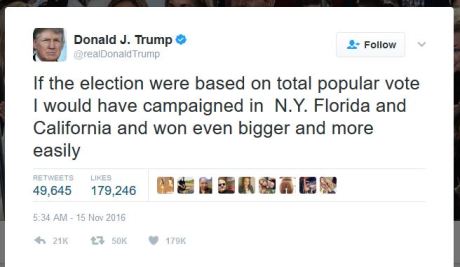
bigger-and-more-easily

Human memory is rather shallow.

Two and a half months later I had already forgotten about this.
My memory has been refreshed by a FB post.

“Just as you don’t have to outrun the bear, just the other guy, your political proposal doesn’t have to be perfect, just better than the other guy’s.”

What do we really mean when we say ‘politics’?

A beauty pageant intended to crown the most skillful public speaker/con artist among us?

Or a social mechanism used by the whole community in its attempt to adjust to whatever fate throws at it?

And how about cooperating with the other guy in taming the bear instead of racing him to our mutual deaths? ‘Cause outrunning all the others doesn’t mean survival.

It only means having to watch all of them being eaten.

Somebody shared this tweet on Facebook:

technicality

Nothing but American ingenuity efficiently solving the problems at hand.

The technicality used to put Capone away was ‘invented’ because Capone had pissed off so many people, so hard, that enough of them had eventually decided to do something about him.

Let’s see what Trump chooses to do from now on.

Darwin had wrote “On the Origin of Species by Means of Natural Selection“.
Some of us had mistakenly understood ‘evolution’ as being a ‘fight for survival’.
‘Fight’ as in ‘kill/subdue all those around you’, not ‘strive to improve yourself’, unfortunately.

Ernst Mayr had put things right. ‘Evolution is not about the survival of the fittest but about the demise of the unfit.‘

Adam Smith, a philosopher, had explained to us that free market capitalism functions because ‘the butcher, the brewer and the baker‘ cooperate across their respective ‘professions’, fully understanding that by respecting each-others work each of them would better serve their individual interests than by struggling individually.
Unfortunately too many of his contemporaries, and some later exegetes, mistook Smith’s words as meaning that ‘Greed is Good’.
And proceeded accordingly. Which was just another ‘application’ of Gresham’s Law. The ‘greedier’ among the capitalists slowly climbed to a dominant position and created a situation later described as ‘savage capitalism.’
Since people have a tendency to over-react, and to make matters worse instead of solving the problem, Karl Marx came up with an even more stupid idea than ‘Greed is Good’. According to him, the world should be run, in an equally authoritative manner, by a different class of people. Not by the ‘greedy capitalists’ but by the ‘virtuous communists’.
As if there ever was any real difference between dictators…

Almost a century later than Smith, Emil Durkheim, a sociologist, revisited the concept of ‘cooperation’ – from another angle, and demonstrated that society had leaped forward when each of its members developed his/hers particular talents instead of toiling together indiscriminately.  And then traded, on the free market, the results of their efforts. Nothing really new, just told in a different manner.
A marked difference from the ‘rantings’ of Marx. Who, by the way, had assessed the situation perfectly. Which makes it all the more baffling the fact that he was able to propose such aberrant remedies.

Almost simultaneously with Durkheim, another guy had noticed two very interesting things.  After a successful career as an engineer Vilfredo Pareto had started to study economics. Then he turned his attention to sociology. As an economist he had noticed the Pareto Principle – 80% of the results (income) are produced by 20% of the causes (agents), while as a sociologist he discovered that whenever social mobility, upwards as well as downwards, is hampered, the society where this happens will, sooner rather than later, experience serious difficulties. In fact this observation is quite straightforward. Whenever young people from the ‘lower strata’ cannot accede, despite being better qualified and harder working, to more meaningful positions because those positions are ‘safeguarded’ for members belonging to the ruling minority, the people from the lower strata stop striving while those from the ruling minority become lazy and careless. The recipe for disaster, don’t you think?
If we put both Pareto’s observations together we discover something similar to Smith’s budding concept of a free market. Whenever an individual, or a group of individuals, become so powerful as to dwarf those around them, economically as well as politically, the free market, economically as well as socially, stops working.

That’s why all monopolies have never failed to collapse.
That’s why all authoritarian regimes, including those built according to Marx’s rantings, have eventually failed – causing great harm to those fool enough to believe in them.

That’s why dinosaurs had disappeared – they had grown too big for their own good.
They behaved as if they were ‘greedy’. They seemed more interested in dominating the world instead of minding their own business.
Fishes – which are older than dinosaurs – survived and thrived.
Crocodiles, alligators, turtles, tortoises, snakes and you name whatever other reptiles come to your mind have survived the same conditions that have cut the mighty dinosaurs down to size.

That’s why Mayr goes on warning us. ‘Evolution is not about the survival of the fittest but about the demise of the unfit.‘

Let’s not destroy ourselves, as a species, attempting to prove him wrong.

Update
Pareto’s elite theory is rather straightforward.
As soon as a society ‘grinds to a halt’ tension starts to build up. A ‘lion’ – or a coalition of lions, will sooner or later seize the opportunity and ‘make a grab for it’.
By tearing the calcified sinews which tied the society down the lions actions unleash – for the moment, at least, the creative forces that could not assert themselves. Things become markedly better than they used to be.
Because the lions are ‘lazy’ they soon hire ‘foxes’ to run the show. Unfortunately the foxes tend to be rather narrow minded and soon their narrow-mindedness coupled with the decrepitude of the lion ‘in charge’ bring back the society to the original – aka bogged down, situation.
A younger lion/fresh coalition of lions restarts the cycle.
Basically we have the definition of the boom-bust cycle.
A very compelling example would be the manner in which communist states had crumbled under their own weight. Or the manner in which all monopolies – or even companies in dominant positions, eventually screw up. The automobile industry – a mature economic field, would be a very good example for this.
Nothing dramatically different from Schumpeter’s ideas, albeit at a different scale.
Ideally, in a free (aka fully functional) ‘market’ there are a number of lions which keep each-other at bay and a big enough number of foxes to keep the show together. The lions, acting in concert, make sure that the foxes do not take over while the foxes prevent the lions from driving the whole thing over the cliff.
If the circulation of the elites is hampered, in any way, shape or form, the continuous/evolutionary social and economical fine tuning no longer works and the society reverts to the boom-bust cycle.
A really free market would closely resemble Darwin’s, or more exactly Mayr’s, evolution while the present situation is one where the circulation of the elites has been brought almost to a halt.
The whole process tends to be rather ‘circular’. As in a vicious circle.
Or a virtuous one. As it used to be, until very recently.

NB. This blog is more like a collection of notes than anything else.
I write them down because doing this streamlines my thinking process and I make them public because readers’ feed-back (mostly on FB) is very helpful.

We seem to be stuck between two apparently irreconcilable positions.

Both the ‘free-market totalitarians’ and the avid ‘state interventionists’ agree about the present situation being untenable but are unable to identify a mutually acceptable way out.

And the rest of us watch them fighting each-other, as if mesmerized by some irresponsible/immature  hypnotism stage-artist, instead of clearing a path of our own!

But since we’re already gathered around the ring, let’s see first what are they fighting about.

The laissez-faire people maintain that things will eventually get in shape by their their own – only if we’d let them, while the statists say that waiting for that to happen would take too long and provoke too many ‘collateral victims’.

Each of the two sides advocate a very specific solution.
The ‘anarho-marketeers’ are OK with what seems to be going on – relatively fewer and fewer individual people/corporations becoming richer and richer/more and more powerful while the rest are falling behind but not at all OK with the left behind becoming angrier and angrier.
Meanwhile the interventionists demand that the state should take more and more ‘things into its hands’ and ‘solve’ them. As if it knew how.

I must confess that I fail to see any real difference between them. Both imply that a small number of individuals – belonging to the same species and being subjected to the same cultural and social conditioning – becoming extremely powerful relatively to the rest of the people.

Historically, all societies which had allowed power to become concentrated in too few hands had crumbled. The more concentrated the power, the faster the fall.

When confronted with the argument that greed, for both money and power, is bad for you, both sides react in a very fatalistic manner.

‘Greed is natural, hence it must be good!’

The funny thing – if anything about any of this might be considered funny, is that greed has been castigated by all religions. And by mainstream science.

Let both religion and science rest for a while.
Actually this is one instance where common sense is more than enough.

Greed, like appetite, is indeed natural.
But that doesn’t make it necessarily good.

We need indeed to strive towards improving our lot, just as we need a healthy appetite.
Otherwise we’d end up worse than where we were at the start.
Dead by starvation.
Or both.

But hoarding a good thing doesn’t necessarily improve it.

There is a difference between appetite and gluttony.
That’s why we use different words for each of them.

glutonny-for-power