Archives for category: Mutual Respect

Homo had become sapiens when he had started to learn.
To actively discover information and to discuss the findings with their peers.

This was how our ancestors had developed both consciousness and language.

The next stage was reached when people were no longer satisfied with mere survival. And attempted to glimpse into the future.

” “But ask the animals, and they will teach you,
    or the birds in the sky, and they will tell you;
or speak to the earth, and it will teach you,
    or let the fish in the sea inform you.
Which of all these does not know
    that the hand of the Lord has done this?
10 In his hand is the life of every creature
    and the breath of all mankind. ” (Job 12:7-10)

Until that moment, the deal was simple.
People followed the rules – which had already been set in ‘stone’ and passed over from ‘the beginning of time’, and things continued unabated. Hence no need for further inquiry.

From that moment on, everything had changed.
People still had a set of rules to guide them. But they had also been endowed with ‘free will’:
“You, my brothers and sisters, were called to be free. But do not use your freedom to indulge the flesh ; rather, serve one another humbly in love.” (Galatians, 5:13) and
“Anyone who chooses to do the will of God will find out whether my teaching comes from God or whether I speak on my own.” (John, 7:17)

So, there were rules, there was freedom and there was the Will of God – which had to be determined if it was to be followed.
How to determine it? Nothing simpler. ‘Ask the animals and they will teach you.’.
Meaning that the answer of any question our ancestors might have had about the Will of God was accessible to them. And that they had the liberty – the obligation even, to look for that answer. By studying the nature.
Because understanding the nature – which was the incarnation of God’s Will, was considered by our grandfathers to be the key to understanding the Will of God. And, implicitly, a keyhole through which they could glimpse into the future. Their future, of course.

It was a very recent development that more and more people had become convinced that science had killed God. By producing ‘scientific evidence’ for more and more things which used to be considered ‘acts of God’.
Franklin’s lightning rod and Georges Lemaitre’s Big Bang are but two small examples.
Benjamin Franklin was convinced that ‘God governs by his Providence and that the most acceptable service we render to him is doing good to his other children‘ while Lemaitre was an ordained Catholic priest. Yet many of our contemporaries construe their endeavors as scientific proofs that there is no such thing as a Creator God.

And what about ‘science’?
What is it, after all?
An attempt to understand God’s Will or a method to prove that God does not exist?

How about science as an attitude?
Which maintains Man can, and should, learn about things. Regardless of the name each of us chooses to call them: ‘Nature’ or ‘the Will of God’.
Which also maintains that Man, in their quest for knowledge, must preserve its modesty. Nature and/or the Will of God might be ‘accessible’ but it would be actually presumptuous, for each and for all of us, to consider that we’ll ever be able to know/explore every nook and cranny of the World.
To learn, and express, all the Truth there is.

‘Things are not at all what they ‘really’ are but only what they seem to be.’

Confusing?

What we have here is the intersection between ‘reality’ – a.k.a. ‘absolute’ truth, and knowledge – a.k.a. logos or relative truth.

‘Things’, ‘existence’ and ‘reality’ are concepts.
Developed by us, conscious people, through the use of ‘logos’ and starting from two implicit premises.
That there must be something outside our consciousness – both the individual and collective ones.
And that our perceptions do have at least some correspondence in that ‘outside’.

By adding layers and layers of logos, collectively known as ‘culture’, upon our initial perceptions we’ve actually built an alternative reality. The one we call ‘civilization’.

The ‘thing’ being that this second reality is just as ‘outside’ our grasp as the original one was. And continues to be.
Because of our own consciousness, which both separates and connects us to ‘reality’.

What we are left with are our ‘perceptions’.
And with our understanding, for those who had reached it, that ‘perceptions’ are ‘real’ only in the sense that they do correspond to some segments of ‘reality’ but they are not necessarily similar to them.

Our concepts, not matter how gingerly refined and thoroughly revised, are only representations of ‘reality’.
‘Real’, in their own right: developing them produced, and continues to, its own set of consequences – a.k.a. ‘civilization’.
The downside being that some of those concepts have begotten rather unpleasant consequences.

‘Moral depravation’, ‘pollution’, ‘corruption’…

It doesn’t really matter how many of these consequences are the result of ‘direct’ action or unintended spin offs.

What matters is that we have to understand there will always be a distance between what we believe at some point and the object of our belief. That that distance may have enormous consequences. And that our only chance to avoid those consequences is transparency.

Heidegger was speaking about ‘unhiddenness’.
The limited nature of both our consciousness and rationality produces the distance between our concepts and their ‘real’ correspondents.
Only by openly, and respectfully, sharing what we know about ‘things’ we’ll be able to shorten that distance.
Otherwise, the limited nature of the reality we live in – the planet itself, will no longer be able to accommodate the hiatus between our concepts and the only reality we have at our disposal.

https://www.snopes.com/fact-check/hepatitis-c-drug-prices/

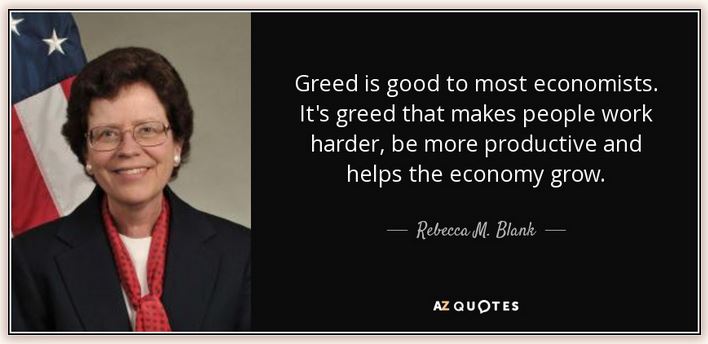
https://www.azquotes.com/quote/1133913

Then, if ‘greed is THAT good’, why blame Big Pharma for ‘buying’ politicians in order to extract as much profit as possible from their work?

Specially when it does work as advertised?

We priced the product at exactly the same as the existing standard of care, which worked about 50% of the time, and are providing a benefit that, based on real world experience, works about 98% of the time. From our perspective, it was a very good value.

I think our failure, if I have to take a step backwards, we were unable to have a good enough conversation with the payers. Perhaps we were a little conservative about what we could have or should have said to them to allow them to prepare for the number of patients that came forward. Honestly, it was far more than we thought. We did not think the system could or would try to handle as many patients as it did. We essentially quadrupled the number of patients treated in a year. That surge really created a lot of pain.

Ooops… so it’s the ‘payers’ who are hurting, not the patients themselves…

Gilead’s CEO Admits To ‘Failures’ In Setting Price of $1,000-A-Pill Breakthrough

Hepatitis C Treatment Highlights Disparity in Worldwide Drug Prices

“Tolerance without reasonable limits is like walking around with a “KICK ME” sign that you put on your own back.”

John Faithful Hamer

Well…

‘Tolerance’ is a two dimensional thing.
‘Intensity’ and ‘wideness’.
What I tolerate and how far I allow things to go before I react to them.

Indiscriminate and limitless tolerance is, indeed, incompatible with life as we know it.

Actually.
It would mean total surrender to the first ‘bidder’.

(Absolute) intolerance would mean ‘constant warfare’.
A.k.a. beating the crap out of anybody who even dares to look up.
…. Being (feeling) compelled to attempt to …

Your choice.

Our choice?

– History is the story of what we remember of what had happened, right? Based on our shared individual recollections, the ‘written sources’ we have at our disposal and our interpretation of any other material traces we might have found… and properly preserved…

– Yep!

– Then no history, no matter how diligent and well intended the historian, will ever be the actual representation of what had really happened, back then!

– Well, you seem to be quite familiar with Heidegger’s work.

– I can’t say that. Popper’s injunction that science is more about being prepared to acknowledge your ignorance than about really knowing is enough for me.

– Then we might be soon delivered from History, after all.
When enough people will share your attitude/paradigm – that no matter how hard we’ll ever try we’ll never know anything for sure… it will be impossible for any would be dictator to pretend they have the ‘right’ answer for any problem we might encounter.

The worst thing about your parents passing away is the fact that from that moment on, every time you’ll turn to anybody for help that somebody will first pass judgement on you.

And why are we still trying to solve this riddle?

‘Cause this is indeed a riddle…

Remember those metaphorical stories whose heroes end up having to find the answer to one in order to save themselves/the day?
Like Sophocles’ “What walks on four feet in the morning, two in the afternoon and three at night?”

A riddle, of course, being a question which cannot be answered until the individuals attempting to solve it stick their heads out of the box into which the riddle had been framed.

So. Individualism? Collectivism?

Having grown up under communist rule – supposedly the most collectivist social arrangement to date, I can testify that there is no such thing as collectivism without individualism nor individualism without collectivism.

Libertarians’ mantra is that socialism/communism – and even liberalism, as Americans understand it, is a form of collectivism. And, of course, that collectivism is bad for you.
Socialists, on the other hand, maintain that the current situation – which is seen as being bad, is the consequence of the growingly extreme individualism which plagues modern societies.

Interestingly enough, both sides are simultaneously right.
Communism is indeed bad for you and the bad aspects of today’s society are a consequence of callous selfishness.

On the other hand, all communist societies are composed of a huge mass of obedient subjects AND a small number of individual, and very individualistic, leaders.
Similarly, all developed capitalist societies – including those sporting huge discrepancies between the shrinking number of haves and the growing number of utterly destitutes, have reached the current level of sophistication because most of their members continue to share the belief that ‘all men have been created equal and that all of them have certain, nonnegotiable, rights: Life, Liberty and the Pursuit of Happiness’.

“Share the belief…”
But wasn’t this the very definition of collectivism?
A social arrangement where the most important possession belongs to THE public?
Was there anything more consequential for what is currently known as the ‘Euro-Atlantic’ civilization than this shared belief? Other peoples have been in possession of way more abundant natural resources. Had reached ‘astronomical’ levels of civilization way before we were even able to wipe our noses… And yet…

Haven’t we, individual thinkers, figured out yet that unless we agree on ‘the basics’, we’ll be easy prey for the callous ‘snake oil merchantmen’ who have no qualms to use collectivist slogans to pitch some of us against the others?

Haven’t we figured out, yet, that there is no ‘political collectivism’ without fear? All collectivist social arrangements, both socialist and fascist/nazist, have been built using fear/contempt (of the other) to cement ‘the people’ into believing the lies proffered by false prophets. Lenin, Mussolini, Stalin, Hitler, Mao… Lies proffered by callously individualistic political agents… bent on satisfying their own domineering instincts and making ‘good use’ of pre-existing conditions.

Haven’t we figured out yet that individualism, the tame version developed along with the good aspects of the Western Civilization, is, by nature, the very beneficial consequence of the mutual respect which (still) exists among the members of our societies?

So, to answer the riddle, we need to understand that there is no real conflict between bona fide individualism and bona fide collectivism.
Just as there is no conflict between two perpendicular lines.

Since, by trade, I’m a mechanical engineer, I’ll use a very practical metaphor to illustrate this idea.
Consider a pressurized Oxygen tank. The more pressure inside, the more Oxygen you can store in it. The more useful the tank. Only if you ramp up the pressure too much, you end up with an explosion.
In this situation, you might consider ‘pressure’ to be in conflict with the ‘walls of the tank’, right?
Wrong. The conflict is only in your mind. Pressure is simply perpendicular to those walls. The more pressure those walls can withstand, the more useful that tank is for you.

But it’s your responsibility to determine the thickness and resilience of those walls. It’s your responsibility to choose how much to ramp up the pressure.
For the very simple reason that that tank is yours.
It is you who will suffer the consequences.


Yeah, right… then please show me the Mongolian version of how they had conquered most of Eur-Asia during the XIII-th century…

Anyway, the fact that this saying is so popular tells more about us than about who actually writes history.

First of all, we seem to be convinced that history is nothing more than the story of back to back ‘the winner takes it all’ kind of battles we had to win in order to survive to this day.

Secondly, we seem to be OK with this vision…

But what does it mean?
That (written) history reflects only what the victors have to say/want to disclose about what had happened?

Are we OK with this?

And still wondering why ‘history keeps repeating itself‘?

Wanna break the vicious circle?
Then how about ‘history is written by those who care enough among those who are able to write among those who have survived’?

This version of history is still incomplete. All history will always be incomplete, no matter how many people will have written it. How many sides of the events will have been covered.
But this version will be more inclusive. Hence more relevant.
Presenting survival, instead of winning, as being the essential part of any battle will diminish the intensity of the conflict. Hence allow us to learn more from it.

For instance, it will help us understand that war is the price paid, by both sides, for failing to figure out that cooperation works better than confrontation.

Just compare how the victors of WWI treated the vanquished with how the (same) victors of WWII treated (mainly) the same vanquished. And the aftermaths of WWI and WWII.

There is a technical reason. And some subjective ones. Acting in a synergic manner.

Trump had bean the darling of the high ratings/low expectations media for most of his adult life. During this period he had learned how to use it towards his own goal – an ever increasing notoriety, and those involved in the media had learned to love him back for the amount of publicity they had been able to sell on his back.

Now for the subjective ones.
First of all, he is a very ‘penetrant’ person. Like him or not, but you can’t ignore him.
Secondly, he happens to be the most powerful individual on Earth. Simply because he had been elected the President of the United States of America. Which is not only the most potent/civilized/democratic/you name it country, but also the leader of the free world. Meaning that the rest of the planet, democratic or not, sets it’s time after America’s clock. Willingly or unwillingly.
So the rest of world is watching anxiously everything that is going on in Washington. Wondering whether ‘Trump-ism’ will spread around. Or will remain yet another measure of American exceptionalism.

Thirdly, but maybe the most important reason, Trump can be analyzed as a symptom rather than as a cause.
In fact, there are a lot of Trumps scattered around the world.
Basically, there is very little difference between Trump and Putin. Trump and Erdogan. Trump and Bolsonaro. Trump and Dragnea – the most powerful politician in today’s Romania, my country. Even between Trump and Modi. Only none of these countries is similar to the US of A. None of them has such a distinguished democratic tradition.
And this is why so many people try to understand what’s going on.
Is Trump nothing more than an unhappy accident? Or the visible symptom of democracy becoming decrepit?

PS.
Even Abe is showing signs of contagion.
Post WWII Japan had survived by feeding whales to its people.
Now it is going to resume commercial whaling. In spite of all other previously whaling nations asking him to reconsider.
Really Abe? You need whale meat to survive?

“One of Pareto’s most noteworthy and controversial theories is that human beings are not, for the most part, motivated by logic and reason but rather by sentiment.”

Coming from an engineer – Pareto had started as one, this concept becomes even more noteworthy.
Why would a ‘professional using precision measurements and seeking consistently reproducible results’ focus his attention on sentiment rather than reason?

Because this is the reasonable thing to to?

And one of the reasons for which I tend to agree with him – besides being an engineer myself, is that he had started his studies using the most ‘reasonable’ instrument ever devised by man: “Residing in Florence, he studied philosophy and politics and wrote many periodical articles in which he first analyzed economic problems with mathematical tools.”

So, Pareto had reached the conclusion that human beings are driven mostly by sentiment after rationally analyzing the economic (and political) life.

OK. But what lies behind ‘sentiment’?

Pareto had proposed ‘residues’ as ‘motivation’ for sentiment. His theory is interesting only rather complicated. Almost byzantine. A well written summary can be read here.

What I find fascinating about Pareto’s theory is the rather veiled but certain correspondence which exists between his ‘residues’ and Maslow’s “hierarchy of needs”.

I’ll try to ‘raise the veil’ at a later date, today I’ll just point you towards a very relevant ‘coincidence’.

The psychologist had traveled the same road as the engineer.

Maslow (1943) initially stated that individuals must satisfy lower level deficit needs before progressing on to meet higher level growth needs. However, he later clarified that satisfaction of a needs is not an “all-or-none” phenomenon, admitting that his earlier statements may have given “the false impression that a need must be satisfied 100 percent before the next need emerges” (1987, p. 69).

Both had started ‘deterministically’, trying evidentiate ‘the’ (ironclad?) link between behavior and conditions – and expecting that link to be of a rational nature, only to reach the conclusion that individual sentiment/evaluation is at least as important – if not more so, as reason in the decision process. In shaping human behavior.