Archives for category: Mutual Respect

About half of our manufactured goods come from China. From half-way around the world. A shipping container needs about a month to arrive to Rotterdam from Shanghai. While ordering the merchandise takes some five minutes over the internet.

Shanghai is in China. A country so far away that hourly wages are a fraction of those in Europe. Or in the US. That being the reason for so many of our manufactured goods coming from there.

China is a country so far away that it took more than a month for the rest of the world to find out that a pandemic was brewing in Wuhan.
China is a country so far away that the CDC expert embedded in China’s Disease Control Agency was deemed useless by the current American Administration.

China is a country close enough for the Chinese tourists to had been a staple for the Italian hospitality industry. “5.3 million overnight stays in 2018
China is a country far enough for an “official opening ceremony” to had been “held at the Auditorium Parco della Musica, a multicultural complex, in the Italian capital on Tuesday, at the presence of Italian Minister of Cultural Heritage, Activities and Tourism Dario Franceschini and Chinese Minister of Culture and Tourism Luo Shugang.”

The ceremony was held because “2020 has been designated the China-Italy year of culture and tourism, as the year marks the 50th anniversary of China-Italy diplomatic ties.
“Tuesday” was the 21st of January 2020.

The same day

  • United States confirms its first case in Washington state, a man who traveled to the Wuhan area.
  • China confirms two additional deaths, a sixty-six-year-old man and a forty-eight-year-old woman
  • New cases are announced in China, including in Beijing, Shenzhen, and Shanghai.
  • Chinese state media raises number of confirmed cases to 291 and confirms 15 medical workers in Wuhan have been diagnosed with pneumonia.
  • Hong Kong confirms its first case, a person in their thirties.
  • Taiwan confirms its first case, a woman in her fifties.

The above timeline was ‘borrowed’ – through the Internet, of course, yet another example for how close we are of eachother, from https://www.thinkglobalhealth.org/article/updated-timeline-coronavirus on 3/28/2020, 12:30 GMT
Which Internet pulls us together by pooling information/data while simultaneously rips us apart by feeding us a constant stream of fake news.

We are so close together that you can send/receive almost everything (from) almost everywhere.
We are so close together that everybody who has a smart phone can see their similarly equipped buddies halfway across the world.

We’re so far apart that we still have to make up our collective mind about which comes first. The Economy or the People.
We’re so far apart that we haven’t figured out yet that there’s no such thing as a running economy without enough able bodied and mentally sane people. To produce, transport, distribute and buy the things we need.
We’re so far apart that we haven’t yet figured out that the present number of people cannot survive – let alone maintain a decent living standard, without a running economy.

Some people are convinced that nothing really changes.
That progress is an empty word.

Others are convinced that progress is everything.

And each category has its ‘extremists’:

Some people are convinced that nothing should be allowed to change.
Others are convinced that all change must be imposed, or at least approved, by them.

And the tug of war between these two categories actually hamper whatever progress happens naturally.

Mind you, both categories shoot themselves in the foot.
Each of them shoots only the ‘specific’ foot but the result is equally crippling… Both end up being iron shackles for the rest of us.

Life, in general, is a matter of calibrating the intercourse between the inside of the organism and the environment in which it tries to survive. Or thrive…

Social life, both in general and in particular, is a matter of calibrating social intercourse between the members of a society in such a manner that, statistically speaking, the individual members would find it easier to survive/thrive in the given physical environment.
Simply because each surviving/thriving individual adds resilience to the social organism/network.

COVID-19 is nothing but yet another test.
For now – for as long a so many of us are still in ‘surviving mode’, it doesn’t matter “how” or “why”.
All that matter is ‘what’.

“What WE do about it!”

Distance ourselves from the others and allow the pandemic to cool down?
Distance ourselves from the others and allow each of our individual minds to think for itself?

While keeping in mind that long term survival requires the physical presence of as many of us as possible? That our own long term well being requires us to cooperate towards that common goal? As Adam Smith taught us?

Then things will eventually cool down.

And we will have been learned yet another thing.

Both individually and as a cultured species.

Smarter people than me are already prepping for the aftermath.
For the opportunities which will have ripened by then.

Which, let’s face it, is a wise thing to do. Most of us would have done it. Prepping for what we fear. And for what we covet.

Also wise would be for us to remember that everything we experience today – the good and the bad of it, together, is the consequence of how we have chosen to use the opportunities opened up by the previous crisis.

And by that before it …

Why is it so hard to predict anything?
So hard that some people believe that ‘no prediction will ever be accurate’?

Which is simultaneously true and false!
First of all, it is a prediction.
Hence, it is supposed to be false.
But it’s true!

Then, if all predictions are going to be false, why bother?

Because sometimes it works.
Or, at least, it works good enough to be useful.

Hence this query.

Will economists ever be as good at forecasting as meteorologists?
I must thank Tim Harford for this excellent question.

No. For a very simple reason.

Meteorology has to do with physics. Something which doesn’t change as you learn more about it. Only the researcher’s understanding of what is going on goes deeper and deeper into the matter.

Economy has to do with both hard facts – how much coal/arable land is available at one moment, and psychological unknowns.
What people will do if/when….
The hard facts might change – just as meteorological data does. But in a rather foreseeable manner.
What people will do… is a lot harder to predict. Simply because people change their understanding of facts, based on what they learn.

Just as the meteorologists do.
And while it is relatively easy to predict that meteorology will become more and more accurate – for the foreseeable future, at least, it is a lot harder to predict what the meteorologists will do as a consequence of their increased abilities.

Specially when a lot of money is involved.

We’re in the middle of a crises.
Some people believe the crises has been only triggered by the virus. And that it has been mainly caused by ‘globalization’.

I beg to differ. In part.

The crises was indeed triggered by the virus.
But the fact that we are so fragile isn’t the consequence of globalization.
Only by what we have done in the given circumstances.

It wasn’t globalization itself which had made us fragile.
Globalization only extended the opportunity field we had at our disposal.
It was our way of developing those opportunities which had made us fragile.
We had chosen ‘financial efficiency’ over ‘resilience’.
We had chosen to increase profit instead of making it ‘more and more sure’ that we’ll be able to survive.
In a sense, we have been acting as if we’d lost touch with reality.
With the hard reality….

There is nothing to suggest that we knew what we were doing. Then.
But we won’t have any excuses left once that we will have reached the other side.

I’m sure you’ve already learned everything worth knowing about how to flatten the curve…

My post is about something else.
About the need to think with our own heads.
Individually. Each on their own.

More damages are caused by the manner in which we have chosen to react than by the pathogen itself.

‘Then what should we do?’

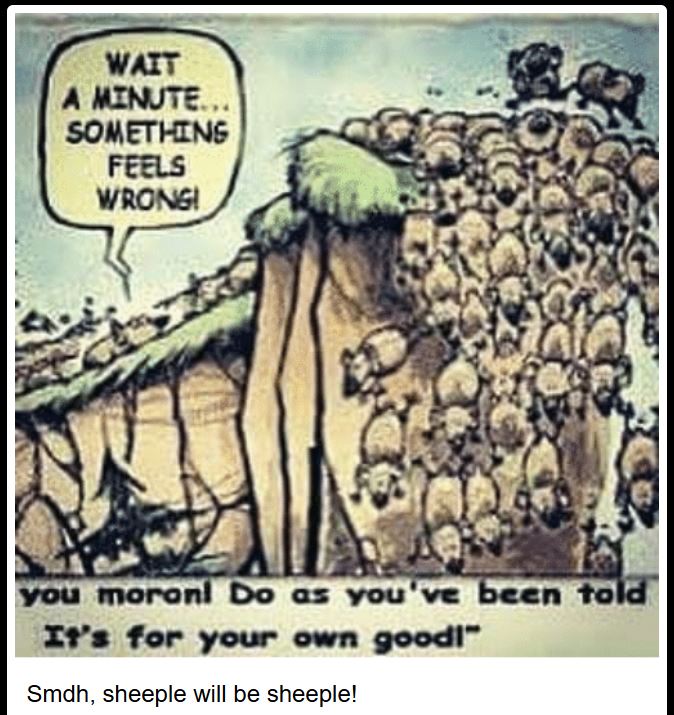
I don’t know. And I just told you to stop taking cues, blindly.

There is something I do know.
Nobody can get out of something like this on its own. Alone.
And another thing. If we get out of it as a herd, we’ll very soon end up in another trap.

‘Damned if you do, damned if you don’t… I really can’t figure out what you want to say….’

OK.
We, humans, are social animals.
We not only raise our young – all mammals do that, we raise them in a social context. We live in groups and we raise our children to belong there.

Living in a social context has consequences. From being prone to infestation to having adopted specific behaviors.
Humberto Maturana is actually convinced that our very conscience – ‘our ability to observe ourselves while observing‘, a paraphrase, is a product of us leading our lives in close community.

One of these specific behaviors is the herd instinct.
Whenever in a dire strait, the members of a group pay a lot more attention to the rest of the group than in the ‘peaceful moments’.
This has two bright sides and one huge drawback.

All members of a group paying close attention to the others makes it easier for those who need it to get attention. And help.
All members of a group paying close attention to the others makes it easier for the group to follow when one of them finds a way out.
All members of a group paying too close attention to the others makes it very likely that the entire group will dash out at the first opportunity. Without checking first where they’re going to land. Nor whether there are any other opportunities.

Another specific behavior is ‘opportunism’.
Some of us have figured out that by keeping their chill in a crises they are more likely to identify whatever opportunities might exist in that moment.
And the deeper the crises, the bigger the opportunities.

Theoretically, these two should work like a charm.
The opportunists keep their chill, look around, identify the best way out and the rest of the herd follows them to safety.
A win-win situation.

Yeah… but!

Wouldn’t it be a way lot better whether all (or, at least, ‘more’) of us would keep their chill? Wouldn’t we be able to identify even more ways out?
It would take a lot more time? We’d need to discuss things over, to negotiate… we’d have to exert a lot of discretion…
True enough. Hence we’d need to evaluate two things. First, how urgent the dangerous situation is and, then, whether a better alternative would be worth searching.

And something else. In a ‘follow me blindly’ situation there’s no going back. The consequences for a hasty choice might be tremendous.

We might end up with more people being hurt by our blunder-some reaction than by the cause which had spooked us.

Yet another specific behavior is responsibility.
Living in a social context means that, sooner rather than later, individuals are censored for their actions. By the rest of the community or, sometimes, by the stark reality.
Unfortunately, sometimes entire communities are censored, by the stark reality, for not behaving responsibly. For not imposing responsibility upon their members.

For not taking enough time before choosing between flight and fight.

Let me put things into perspective.
How many of you have chosen to continue smoking despite having been warned?
How many of you have emptied the shelves despite being told there’s enough for everybody? Or that there will be soon enough?
How many of you do not smoke in the presence of your children? Because you know it will hurt them?
How many of you have taken active measures to protect the elderly? For the very same reason…

As for the economy being the main casualty of the present scourge…
I’m afraid ‘the economy’, as we know it, has been dying for quite a while now. That’s why it is so susceptible to SARS CoV-2.

The Ancient Greeks had come up with the concept of ‘oeconomia’ as the art of making the ends meet. Adam Smith had described the free market as the place/environment where competing agents made it so that people – solvent demand, could satisfy their needs.
Nowadays, too many of us understand/accept ‘economy’ as the art of getting rich. ‘Free’ in ‘free market’ is understood as ‘free’ to do anything you want. Because very few are asked to answer for the long term consequences of their actions.

The economy, as the manner in which we cooperate towards fulfilling our needs, has fallen prey to our gluttony. And to our nearsightedness.
Greed is not good. And SARS CoV-2 is only an eye opener, not the cause for the current implosion.

And the more important the subject – or closer to their hearts, the harder for them to reconsider their position.

I’m very close to 60 myself and I haven’t yet made peace with my dad.
We’re very good business partners, he lives in the same house with me – my mom passed away almost 25 years ago, and yet not a single day passes without us locking horns.

This morning, it finally downed on me.
He cannot accept my version of things because that would mean he had been wrong – on certain issues, during his entire life.

And what makes me so sure that my version of things is the right one?!?

Simply because his position is:
‘You should be the wiser one. You told me such and such for so long and I haven’t budged. Maybe you should have grown accustomed to the situation long ago and accepted it’.

I actually can accept that, after a certain age, human brain looses some of its flexibility. That is one of the saddest facts of life.
Only we had this very same discussion, on and of, for the last 40 or so years. Both of us were in our prime. He still is…

To make things clearer, before we get to the important part, the differences between us are of a cultural nature.
He is a born and bred Armenian while I’m a mixed breed. He grew up in a consistent cultural environment while I had to adapt to carrying a funny name and to uncountable social changes. He has a clear understanding of the world – which had served him well, while I’m full of questions. And still looking for answers.

And finally, I found one of them.

The funny thing being that I was already aware of the concept for at least 10 years now.

Cognitive dissonance, the mental conflict that occurs when beliefs or assumptions are contradicted by new information. The unease or tension that the conflict arouses in people is relieved by one of several defensive maneuvers: they reject, explain away, or avoid the new information; persuade themselves that no conflict really exists; reconcile the differences; or resort to any other defensive means of preserving stability or order in their conceptions of the world and of themselves. The concept was developed in the 1950s by American psychologist Leon Festinger and became a major point of discussion and research.”

Can you imagine an Eastern Mediterranean patriarch – something all men seeped in that culture attempt to become when growing older, caving in to contrarian opinions expressed by his totally unconventional son?

Can you imagine a successful ‘old timer’ accepting that the methods he had used to get to the top might actually be the causes for what we experience now?

“The man has now become like one of us, knowing good and evil. He must not be allowed to reach out his hand and take also from the tree of life and eat, and live forever.”

Imagine now what would have happened if the world would have been ruled by people who had made up their minds some 200 years ago.
Then imagine what would have happened if we would have forgotten what had happened 200 years ago…

Cherish your old ones – cause they made you possible, but don’t take them too seriously. It hurts.

According to Abe Lincoln, democracy is about “government of the people, by the people, for the people.”

No photo description available.

But what if not enough of the ‘people’ care about who governs them? Nor towards what?

A couple of years ago a previously unknown author had come up with a “radical new theory“. One which maintains that “modern American elections are rarely shaped by voters changing their minds, but rather by shifts in who decides to vote in the first place“.

The picture above is proof that Rachel Bitecofer, the ‘previously unknown author’, is right.

On the other hand, Barend ter Haar, among others, ‘suggests’ that “democracy is a form of conflict management within states“.

The last proposition also makes a lot of sense.
Democracy, when functional, lowers ‘political temperature’ to levels where individual members of the community/nation may focus on identifying and solving the problems which might endanger the survival of the entire social organism.
Otherwise put, democracy dramatically increases the survival chances of the communities who are wise enough to maintain its true character. Who are wise enough to make it work. Properly.

What prompted me to believe such a thing?
Look back in history. All authoritarian regimes – a.k.a. ’empires’, have eventually crumbled under their own weight while no democracy has ever ‘folded its hand’ before loosing first its democratic character.

Which brings us to ‘what is the gist of democracy’?
Or, in ter Haar’s terms, who is responsible for maintaining it? Who ‘runs’ the “conflict management within states”?

This is where I part ways with ter Haar.
For me, democracy is something natural. It has to come from within.
There is no one who can, or should, manage it.
Administer it – as in accurately counting the ballots and making sure that rules are followed, obviously. Actually managing the process?!?. No! That would defeat the very purpose of the democratic process. For the people to find its own way.

But there are so many who can spoil it… Willingly or unwillingly!

First among them being those who decide to stay at home.
To keep mum.
For whatever reason!

Because those who keep mum are those who allow the ‘pirates’ to ‘steal’ the helm.
Just as keeping quiet is the worst attitude when somebody bullies you, staying at home on election day empowers those with less than fully democratic attitudes to ascend to power.

How often do you hear this expression?
Are you OK with it?
Because you’ve grown accustomed with it or because you are OK with the idea of politics being a contest? A game to be won?

In a certain context, I’ve been asked which game is a more ‘fitting description’ of politics. Chess or Go?

Both being, as I’m sure you already know, strategic games where all ‘tactical’ information is above the board, where the scope is to ‘control the territory through the smart use of available resources’ and where neither of the competitors have any real idea of what their opponent might have in mind.
Yes, there are rules and limitations. Of course. So each of them are able to divine a ‘probable course of action’ but …

Going back to politics, I’ll just quote myself:

“Politics like Go… very interesting question.
Go is a game. Something to play with. And play is very important, indeed. Through play, we hone skills used in real life. When playing, it doesn’t matter whether you win or loose. There’s something to be learned in both situations.
While in real life, loosing is not an option.
In playing, all that matters is to participate. In life, all that matters is to survive.
When playing, we improve our skills by competing against each-other. In life, we survive by helping each-other.
In this sense, politics is an exercise of cooperation more than a competition. A process through which the whole community finds its way forward rather than a beauty pageant where the next beauty queen is nominated to carry the torch through the dark. For a while…
The point being that all community/nations which had allowed personal interest – lust for wealth/power, to trump the collective need to survive have eventually collapsed. From Ancient Rome to Soviet Russia.
This being where Marx was hugely mistaken. While he understood history as a succession of class struggles – to be ended by the mother of all dictatorships, in reality is was a continuous evolution/honing of cooperation. From slavery to feudalism and to democratic capitalism people learned to do more and more things together. The status of the individual – of all the individual members of any given society, gradually improved while the communities have become more resilient and more productive.
And all attempts to revert to more ‘centralized’ alternatives – no matter how the ‘winners’ were supposed to be determined, have failed. All political and economical dictatorships – authoritarian-isms and monopolistic situations, have crumbled.
Not before incurring a lot of pain to those who allowed them to happen, helas. Contestants and spectators alike.”

Now go fight for your favorite political figure.
And allow hate to alter your perceptions.