
Some people attribute this quote to the Apache Leader known as Geronimo.
Quoteinvestigator.com says it is highly probable that it belongs to a guy called Alanis Obomsawin.
But what is more important?
Who said it or what we make of it?

Some people attribute this quote to the Apache Leader known as Geronimo.
Quoteinvestigator.com says it is highly probable that it belongs to a guy called Alanis Obomsawin.
But what is more important?
Who said it or what we make of it?
I recently shared this meme on my FB wall:
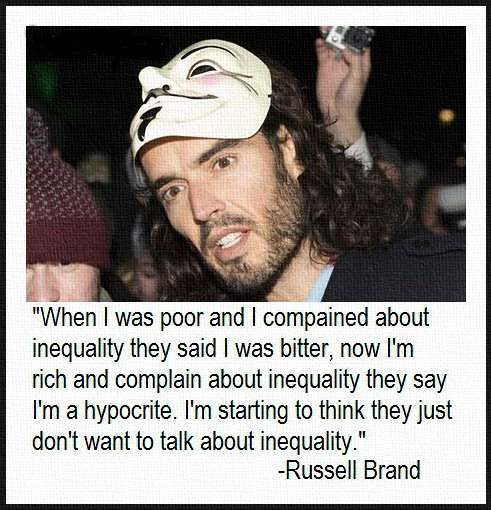
This is what happened next:
“No two people are the same.“”That’s why I prefer equal opportunities instead of equality.”
“No two opportunities are the same. What you might consider an opportunity I might pass up. It’s a very diverse world we live in, a wide one in which hopefully everyone can be accommodated.”
‘Can be’ or ‘will be’?
And who is the real looser here?
Let’s see what the broad picture looks like:
Meanwhile

And what’s wrong with that?!?
Everyone has the right to do what ever he wants with his money and why should anyone expect to be educated for free?!?
OK, let me put it differently.
Every society is like a big community, even if its members do not share an intimate knowledge of each-other.
At least theoretically an overwhelming majority of any nation share the same set of values and the same goal – the long term survival of both the population and the afore mentioned set of values.
Now please consider which society would be better at the game of survival:
One which would make it easier for as many of its members to develop as much of their individual potential as possible or one that would make it easier for a small number of its members to spirit away so much wealth that the rest would remain crippled?
One which would use the very concept of a ‘free market’ as broadly as possible – make sure that as many as possible of its members enjoy the widest possible autonomy – or one that would allow the ‘never as free as advertised’ market to degenerate into the ‘winner takes it all‘ situation we are bound to reach if we continue on our present course?
How could enough people afford to ‘wander around’ for long enough to find the opportunities that would fit them if they are saddled at birth with a huge burden – the ever burgeoning national debt?
Would enough people risk to take on any additional debt (in order to prepare themselves to make better use of the opportunities they might find) if too many of those opportunities, even if met diligently, do not pay enough to ‘eat’ AND pay back the debt?
How is a society going to survive, let alone thrive, if a lot of ‘opportunities’ (social needs) end up being ‘plugged’ by unfitting/under-skilled/’less than enthusiastic’ individuals? Or not at all?
On the ‘supply side’, what do you think of those who choose to dodge paying taxes?
On the ‘demand side’, what do you think of those who squander public money as if there is no tomorrow?
So what should we be talking about? Equality or Equal Breadth of Opportunity?
About the Bed of Procrustes or about a ‘Free Market’ where all participants are simultaneously autonomous and fully aware of their responsibility for their children’s future?
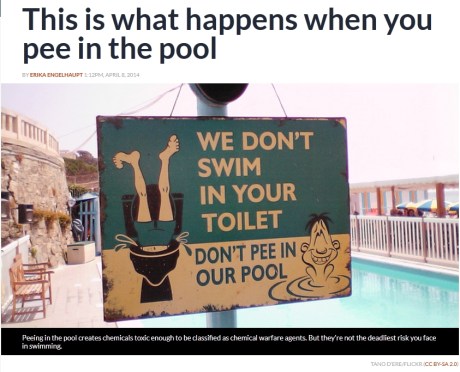
First things first. Click on the picture and read the article.
It is interesting enough, even if it doesn’t say anything you didn’t already know – or at least presumed. That if enough people pee in the pool, the mixture of uric acid and chlorine, which produces some nasty chemicals, could become ‘powerful’ enough to affect a susceptible person.
The really interesting part being the fact that the scientists who have studied the matter do not seem to agree on how dangerous it is and what exactly, if anything, should be done about it.
But do we really need a scientist to tell us that we simply shouldn’t pee in the pool?
Regardless of whether the issuing chemicals would be powerful enough to harm us or not?
Then why do we hide behind slogans like ‘Global Warming is the New Religion’ when we discuss the subject of carbon dioxide being spewed into the atmosphere by the tens of billions of tonnes each year?
OK, I can understand that some of us are not convinced by the data put forward by the ‘alarmists’, specially after some of the scientists studying the matter have changed tack and have become ‘skeptical’ about the whole thing.
“I would say that the global warming is basically a non-problem. Just leave it alone and it will take care of itself. It is almost very hard for me to understand why almost every government in Europe — except for Polish government — is worried about global warming. It must be politics.”
“So far we have left the world in better shape than when we arrived, and this will continue with one exception — we have to stop wasting huge, I mean huge amounts of money on global warming. We have to do that or that may take us backwards. People think that is sustainable but it is not sustainable.” Ivar Giaever, 1973 Nobel Prize for Physics, speaking in July 2015.
So. Cutting down the tropical jungle to make room for palm trees grown for their oil and burning during the last two centuries fossil fuels that have been accumulated during God only knows how many millennia is ‘sustainable’! Yeah, right.
Do you remember the smog that used to hang over Los Angeles until some of us wised up to the matter?
Is it a matter of politics?!?
And money?!?
And what’s new about that? Or is it that some of those who have to gain from us continuing to burn fossil fuels, indiscriminately, have not understood, yet, that we are all together in this? That the atmosphere is nothing but the huge ‘pool’ where we all live?
And breathe…
To me it doesn’t really matter what ‘science’ has to say about this. In fact ‘science’ cannot speak, it’s the scientists who speak on its behalf.
Now, since they don’t seem to agree on this subject we’d better realize that ‘This is too important a matter to be left to the scientists’ and remember the Hippocratic principle which teaches us ‘primum non nocere’: ‘Above all, do no harm!’
If ‘it’s a matter of politics’ how about us telling the politicians how we wanted it solved instead of letting them scheme on it?
And then let the business people take care of the money part?
One other thing and I’ll wrap it up.
I can already see my libertarian friends frowning:
‘He had jumped on the big government bandwagon’.
Not so fast.
In fact this is not a decision that should be made by the government, be it big or small.
We are the ones who should make up our minds about this matter.
We are the ones who should close the faucets, use more efficient cars, collect the trash selectively, etc, etc, etc… and maybe even walk a little.
We are the ones who should instruct the governments we have elected to use some of our tax money to finance some honest research into renewable power sources instead of allowing them to transform the whole issue into another ‘pork barrel bonanza’…


For some time now I’ve been wondering how come so many people who define themselves as being Christians – “Again I tell you, it is easier for a camel to go through the eye of a needle than for a rich person to enter the kingdom of God.“, Matt 19:24 – are so passionately defending the very concept of (private)”property”.
Could it be that Marx was right after all: “Private property is the result of alienated labor.” ?!? And so many of us have been wrong for so long?
Trying to understand the source of this dichotomy I adopted a two pronged strategy. First I looked up the word itself and then I tried to deepen my understanding of the entire concept.
It’s absolutely obvious that ‘property’ comes from ‘proper’.
‘Proper’, in its turn, has two basic meanings: ‘fit for use‘ and ‘pertaining to one individual‘. The first one has evolved into ‘propriety’, “the state or quality of being correct and proper” while the second has become ‘property’, “thing owned“.
So, do all these etymological arguments make it any easier for us to accept that respecting each others’ right to private property is what introduced a certain degree of functionality in the human society?
‘But aren’t you contradicting yourself?
At the beginning of your post you suggested that ‘property’ might not be as good as advertised and now you say that the ‘right to private property’ is ‘good for you’?
Will you make up your mind, for Christ’s sake?’
Now, that I’ve reached the conceptual stage of my analyses, I must bring to your attention the fact that a right is nothing but an opportunity while each (piece of) property is a thing – even those which are not of a ‘substantial’ nature. ‘Intellectual property’, for instance, is a ‘measurable thing’ even if you cannot put your finger on it while the ‘right to intellectual (or any other kind of) property’ is (an infinite) something which patiently waits for (a rightful) somebody to make (proper) use of it.
Maybe this is what Christ tried to tell us in the first place. That it’s not property itself that stands between us and our salvation but our (improper) attitude towards it. That it’s not the object of our property that is the problem but how we make use of our right to private property.
After all Christ told the “young rich man” “If you would be perfect, go, sell what you possess and give to the poor, and you will have treasure in heaven; and come, follow me.” (Matt 19:21). ‘Go sell, give and THEN follow me’, not ‘come help me ABOLISH the very right to private property’, as Marx used to preach to his followers.
To understand the difference between what Christ and Marx said about this subject let’s see how these two relate to the notion of ‘Man’.
In Christ’s book God took a lump of dirt and ‘made Man in His own image’ while in Marx’s narrow materialistic vision “it is not the consciousness of men that determines their existence, but, on the contrary, their social existence that determines their consciousness.”
Basically both of them start with the same ‘materiel’ – the mundane ‘star dust’ that Mendeleev distributed throughout his table – but what a difference at the end of the ‘assembly line’!
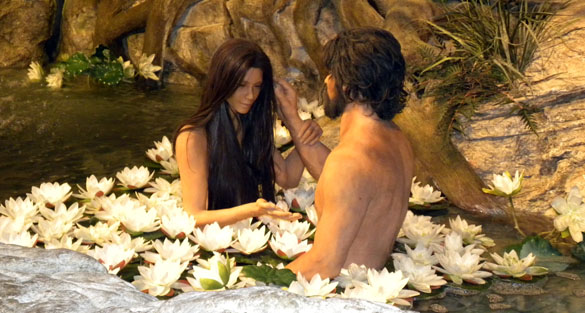
Being made ‘in His Own image’ not only means that all Men (and Women) are created equal but also that each of them shares in His Divine Nature. Hence the origin of our free will, of our ability (‘right’, opportunity) to be saved. Compare this to how Marx described the human society:
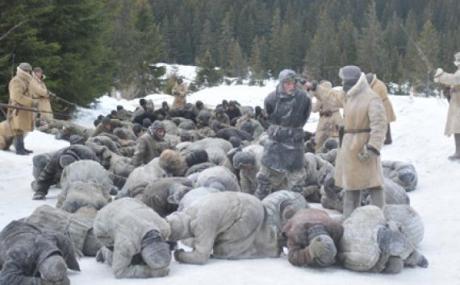
As somebody who has lived for 30 years under communist rule let me translate this from ‘Newspeak‘ into plain English:
‘History suggests that those who figure out the inner workings of this world have, from time to time, the opportunity to take over the show. Now is one of those moments. The ‘fat cats’ have been so greedy lately that the regular people are growling under the very heavy yoke that has been placed on their shoulders. That’s why we have the opportunity to unsettle the ‘old’ from their positions and to plant our fat asses in their comfortable chairs.
And the first thing we must do in order to achieve that goal is to abolish the right to private property. People are so fed up with what was going on lately that they’ll go along. They have grown to hate so much the ‘greedy plutocrats’ that most of them won’t notice that in the (revolutionary) process they’ll lose the very last shrouds of personal autonomy they still have. Without the right to dispose of the results of their own labor they’ll be at our mercy’.
Who was right between the two?
Well… Both, unfortunately.
The communists did run the show, at least for a while. And we all know to which results.
On the other hand it seems that in the longer run miss-using the right to private property is indeed a powerful drawback. The already too long sequence of economic crises caused, ultimately, by nothing else but our own greed has indeed given birth to a generalized state of psychological malaise.
I don’t know about what’s gonna happen in the next world – or if it exists at all – but I’m sure that if we don’t learn, fast, how to use, properly, the right to private property things will become too hot for our own good in this one.
The only one we are sure about.
Further reading.
During my research for this post I found this very interesting take on the same subject:

As a teenager I’ve been reading a lot of detective novels. It was then that I learned the phrase that gives the title of this post.
It seems that nowadays people have given up chasing women and started to ‘follow the money’ trek.
Russia says Turkey ‘shot down plane for IS oil’.
The secret bribes of big tobacco.
Coruption in sport: Nebiolo named in ISL bribes scandal.
FIFA: A timeline of corruption.
Volkswagen: The scandal explained.
Cash, visas and talks: key points of EU-Turkey pact on refugees.
Some people might say that corruption has reached an unacceptable level.
Right and wrong. Right in the sense that corruption has indeed reached an unacceptable level and wrong in the sense that NO amount of corruption is ever acceptable, but this is beyond the point of this post.
To some other people the recent developments might suggest that there is no way out of the current situation, where corruption “is no longer a practice but has become a pervasive culture”.
On the contrary. The fact that more and more corruption cases are continuously brought to the surface is not, in any way, a proof that corruption has reached new ‘heights’ but a powerful suggestion that more and more people have become fed up with this phenomenon and no longer disposed to turn a blind eye to what is happening in their presence.


globalnews.ca Storms flood roads, cause train derailment in Texas, which awaits remnants of Patricia
Some people maintain that we are in a middle of a ‘Global Warming’ and that, at least partially, we have brought this on our own heads.
Some others say that this is nothing but bullshit while a third group says that yes, it might be possible that the Earth is slowly heating up but that there is no way to demonstrate that ‘we did it’.
When it comes to what to do about it people are divided among totally different lines.
Some say we need to go on burning fossil fuel because it’s the most cost efficient way of producing energy, some-others that ‘we are sorry but we really need to close the economic gap there is between us and the developed nations’ and a few try to convince the rest that the Earth is the only home we’ve got and that we should do everything in our power to keep it as close to habitable as we can.
Where do I stand on this matter?
I’m not going to enter the dispute that tries to convince us that weather and climate are two different things.
I’m not going to pretend that ‘we did all of it’. Not even the most rabid treehuggers go that far.
All I’m going to do is ask this: Are you aware of the fact that burning things produces CO2 and that is a very effective green-house gas?
Do you know that “Currently, humans are emitting around 29 billion tonnes of carbon dioxide into the atmosphere per year.”? OK, some of it, about half according to some, is absorbed by the so called ‘carbon sinks’. But the rest? And how long before those sinks become saturated?
Furthermore, determining how much CO2 has been added to the atmosphere – or if any at all – is a rather murky business. Simply because of the seasonality of the plant life, volcanic eruptions and a lot of other variables.
That’s why I’m going to take another tack.
During billions of years in Earth’s history plants and animals have transformed atmospheric CO2 into coal, oil, natural gas and limestone. During this period, climate – and the Earth itself – have suffered huge transformations. Do we really think we can undo, even in part, this process – at a very rapid pace – without bearing at least some consequences?
Even some of those who, until very recently, kept saying that they need to close the development gap are having second thoughts and look for alternative methods.

www.chinatoday.com, A wedding ceremony held during heavy pollution in Beijing (20141021)
OK, VW couldn’t figure out how to balance the ever stricter polution norms with the public demand for simultaneously more powerfull and cheaper to run/cleaner diesel engines so they decided to fake it. And it seems they were not the only ones to do that.
This development poses some questions.
– What were they hoping for? Did they really think that something like this could have gone unnoticed for ever?
– What were the regulators thinking? That it’s possible to solve pollution by simply changing some norms?
“Moore’s Law” (“overall processing power for computers will double every two years” has been valid, for a while, in a very young technological field.
Internal combustion engines have been around for more than a century, they are rather old. Everybody knows that it is hard to teach new tricks to an old horse yet we tried to clean exhaust gases well beyond the reasonable instead of radically changing the technology. Computers seemed to be able to help, but only for a while…
Could this be just another ‘application’ of the Peter Principle? “Managers rise to the level of their incompetence?” GM was, sometime ago, the No. 1 Automobile Company. It recently went through a painful bailout. Toyota, the next champion – its methods were studied at the most prestigious management schools – was hugely embarrassed lately by a technological failure.
OK, you might argue that what went on at VW was an ‘upfront’ fraud, not at all an ‘honest’ mistake. Indeed but still a mistake, even if a potentially catastrophic one. Mainly for the shareholders, of course, but also for the rest of us.
A certain dose of distrust towards established authority is healthy for the society, as a whole, while too many proofs of the established figureheads behaving callously generate a diffused disrespect for the law which is really bad for everybody.
In fact what happened at VW is exactly what people tend to do when they do not see any way out of a certain situation.
When they don’t really think that anything bad can happen to them, regardless of whatever they do.
Or both.
So. Is there anything to be learned from here? Except for the oldest lesson history keeps teaching us: ‘reaching the top is easy, staying there is the really tough job’?
Maybe.
Toyota says that transparency, “both inside and outside the company“, is a good way towards avoiding this kind of mistakes. “You have to be able to listen to your customers, not just hear them.“


Photo: Associated Press
““He has been a proponent of using eminent domain to take property from small property owners and use it to make business and make money for himself,” Paul said. “There was a case of a woman who had lived in a house for 30 years. He built a casino next door and when she wouldn’t sell, he used the government to take it from her.”” Rand Paul, quoted by BostonHerald.com
You may also want to check what Snopes.com has to say about the matter.

Some 30 years ago I stumbled upon a book by Desmond Morris.
I read it overnight because next day it had to be returned to its owner. Books published in their original languages were hard to come by in communist Romania…
Little did I know at that time that my interests will slowly shift from Mechanical Engineering to Sociology and then on to decision making… Anyway…
In that book Morris tries to convince us that women have so many periods because in this way they are a lot readier to receive their mates, thus ensuring a tighter bond inside the couple. In turn this is beneficial in an evolutionary sense because a tightly knit couple is better suited for raising the kind of slow growing children that is characteristic for the human species.
In short Morris proposes that monogamy was a step forward in human evolution.
I tend to agree with him and I even have a further argument. Imagine what would happen if a small number of alpha males would ‘corral’ – one way or another – most of the available nubile women, as it’s the case with the chimps or the gorillas. Do you think the rest of the males would be able to cooperate in any way towards the survival of the community they belong to or they’d be constantly obsessing about how to get laid?
Which brings me to my subject.
Emile Durkheim used suicide as a pretext to introduce us to his theory about social solidarity and the social function played by what we consider to be a crime.
Durkheim’s research had led him to see suicide as an individual decision but one which is heavily influenced by the cultural medium to which the decision maker belongs. More over, the same line of thinking produced his conclusion that a society must keep a fine balance between ‘solidarity/intolerance’ and ‘laisez-faire’. One that is too intolerant drastically reduces its own ability to adapt to changes that occur in its ‘environment’ while those that do not care about the fate of their members will eventually auto-dissolve.
What if incidence of rape was to be studied in the same light?
Bill Cosby – a man who, let’s face it, could have had legions of willing women – is accused to have drugged and raped some 40 women in more than 30 years before anything came to public notice.
Jimmy Savile, a British “larger-than-life character”, used “his celebrity status and fund-raising activity to gain uncontrolled access to vulnerable people across six decades” and to unabashedly rape them.
Rape not only occurs randomly in war time but has also been used as a weapon:
“Sexual violence is also used to destabilize communities and sow terror”.
Meanwhile France – Durkheim’s own Motherland – has become the stage for some 7000 ‘tournantes’ every year. The English term for ‘tournant’ being gang rape.
As Durkheim said more than a hundred years ago suicide is indeed an individual act/decision but it’s incidence is heavily influenced by what happens around that person.
Same thing is valid for rape. A rape appears at the intersection between the history/experience/upbringing of the rapist, the social/cultural milieu in which he lives and his ‘on the spot’ decision.
Sex sells.
“It’s been said that as human beings, we have a lizard or reptilian brain that responds to certain primal urges. Food is one. Sex and reproduction is definitely another. This underlying, pre-programmed disposition to respond to sexual imagery is so strong, it has been used for over 100 years in advertising. And the industry, while abusing it more and more, would be foolish to ignore the draw of sexual and erotic messaging.”
How far are we willing to go in order to make a sale? As far as Dolce and Gabbana went when they published the picture above?
Morris said that our first step towards humanity was to change our very physiology in order to promote (at least an apparent) monogamy. It seems that we are now altering our culture in order to sell more…

Gang Rape taken to the next level… Manipulation went wild…
 nicichiarasa