Archives for category: man as a measure for all things

I’ve always been fascinated by quotes which are ambiguous enough to be simultaneously wrong and right.

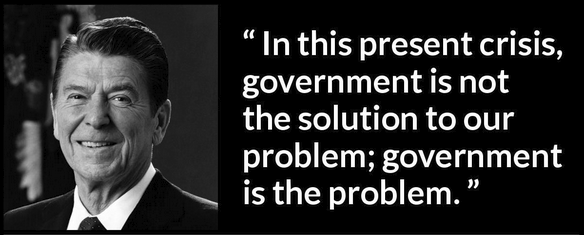
In this situation, the ambiguity comes from ‘government’ covering three ‘patches of ground’.

‘Method of running a place/country’. (Self)Organized versus chaotic.
‘System in place’ which is used in running a country.
A particular group of people who man, at any given moment, the above mentioned ‘system in place’.

Now, which of the three meanings was at the top of Reagan’s mind when he was uttering those ‘famous’ words?

All governments suffer a recurring problem: Power attracts pathological personalities. It is not that power corrupts but that it is magnetic to the corruptable(sic). Such people have a tendency to become drunk on violence, a condition to which they are quickly addicted.

Frank Herbert

The way I see it, government ‘as a manner of running things’ is a very powerful method. Which had served us rather well, on aggregate. Only it is not fail-proof. Or, more exactly, fool-proof.
Government as a ‘system in place’ is a work in progress. We’ve been improving it since we’ve invented government as an alternative to chaos. Only we need to be very careful. As a man made system it will always be far from perfect. It has not been perfect in the past and, no matter how much effort we’ll put into it, it will always remain perfectible.
Finally, government as ‘the team temporarily in charge’ ‘suffers’ mainly from being composed of humans. Hence both corruptible and attracted to power. Hence liable to do everything to maintain their positions.

‘Liable to do everything to remain in power’.
Which means that it’s our job to keep them on the straight and narrow.
We, The People, are the first to experience the consequences of their decisions. Hence we, all of us, are those who need to keep Government – ‘the team in charge’, on a short leash.
If they want to remain in power, they need to keep us ‘alive’.
They need to keep the system in shape. Working good enough for the vast majority, not for just a few of us. For a few of them, to be more precise.

Otherwise ‘government as a manner of keeping chaos at bay’ would have failed.


War has been the subject of many books. From war novels to ‘how to’ treaties.
When the subject is mentioned, two stand up high. Sun Zu’s “The Art of War” and Clausewitz’s “On War“.

I’m not going to discuss the relative merits of the two treaties. Only to point out a few parallels.
The authors had been involved in wars. Wars between states inhabited by more or less the same people. Sharing more or less the same culture. Wars which had ended when the warring parties had coalesced into what we call nations. China and Germany, respectively.

Yet we currently refer to those two treaties when we consider war between totally different nations/cultures.

Furthermore, we consider those two as being the pinnacles of strategic thinking. In a sense, that would be right. After all, both had been written by the winners of those respective wars.

But what happened next?

What major war had China won after becoming an united nation? WWII? When her enemy had been first beaten to a pulp, literally, by the US?
What major war had Germany won after becoming an united nation? The one against France in 1870? OK. And afterwards?

And what is the real meaning of ‘Si vis pacem, parabellum’?

‘If you want peace, prepare to wage war’ or ‘if you want peace, make your self resilient to war‘?

What if our self awareness, otherwise known as conscience, has evolved in order to understand, accept and mitigate randomness?

There’s no evolution – hence no life, without randomness.
Yet life, anyway you look at it, is about maintaining a certain degree of order.

Whenever there’s so much randomness that life can no longer adapt to it… evolution stops.
Whenever structures become so big/rigid that they find it harder and harder to evolve, they eventually succumb to an otherwise survivable amount of randomness. Dinosaurs and too big to fail corporations versus mice and flexible operators.

In a nutshell, self-awareness is about not being ‘fooled by randomness‘.

And to avoid the deepest pitfall we’ll encounter during this never ending journey – randomness will always be wider than our individual ability to encompass it, we must keep remembering that conscience is selfish. Untrained, it is more about protecting itself than about helping the entire ‘individual’ to survive.

‘What?!?’

Yes, it’s hard to believe!
But what other explanation is there for so many of us continuing to smoke after finding out, the hard way, that this habit might actually kill us?
I use this example simply because I still remember the cigarette I smoked when I last visited the grave where rests a woman I loved dearly. And who is no longer with us because of lung cancer.

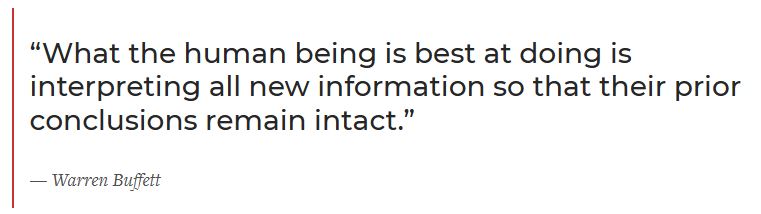
Too often our conscience will prefer to rationalize away new information than accept that past choices could have been better.

I’m certain all of you are already too familiar with ‘confirmation bias‘.

This being the most convincing argument that we really need to quit ‘smoking’.

Just think of it.
Inhale, exhale.
Inhale, exhale.
Inhale, exhale…

I know you can do this, breathe, without thinking.
You’ve actually done it since your birth. And you’ll continue doing it after you’ll have reached the end of this post.
But right now you should be fully aware that your lungs have only one opening.

What has to come out – what doesn’t belong in there, needs to exit from where it came in in the first place. Which is rather hard for anything which isn’t air.
That’s why dust, tar, or even microbes, should not go in there at all.

Quit smoking. And quit belching smoke into the atmosphere.

Let’s get to the second part of the post. Presumably, the more interesting one.
Click on the image and read the whole thing.
Now tell me why would somebody attempt to ‘debunk’ such a lie in the first place? Is smoking something worth arguing for?

The anti-smoking industry is happy to carry on misleading people on this subject because that is how they make their money. I would guess that the reason many people who know better do nothing to correct this misconception is simply that they think that if people stop smoking as a result of a little white lie then so be it!
Yes it is myth that smokers have black lungs! They would probably all be very dead long before they could become an organ donor.

Oops… so the whole thing revolves, again, around money…
And, if I understand correctly the point proposed by the author quoted above, a certain Fredrik Eich, there isn’t much of a difference between being duped into giving up and starting/continuing to smoke.

No, I don’t like being duped myself.
That’s why I’m telling it straight.
Lungs have only one opening. Don’t let yourselves be duped into believing that smoking isn’t that bad for you. That some smog is inevitable for a thriving economy.
After all, this is how ‘they’ make ‘their’ money.

Now, after proof-reading this, I wonder.
What do the dupers breathe?
Do they have their, private, atmosphere?
Have they duped themselves into believing everything is as pink as a pair of healthy lungs?

As a species, I mean…

We’ve ‘invented’ mutual respect.
Based on it, we created the two institutions which allowed us to get where we are now. Democracy and free market capitalism.

I’ll make a short detour for those who are not ‘convinced’.

Democracy, the functional kind, starts from the premise that it is impossible for an individual to know everything. And that together we know much more than each of us. This being the reason for any democratic process starting with an intense discussion. Whoever has something to say, takes the stand and whoever is interested in the well being of the community pays attention. To learn where to cast their votes.

Free market capitalism starts, too, from the premise that it is impossible for an individual to know everything. That nobody, be it an individual or a group of people, might be smart enough to call all the economic shots needed for entire society to ‘feed itself’ on the long run.

These two fundamental institutions operate on the basis of mutual respect between those who live within them. The people exchange ideas and goods on the principle that the transactions are done voluntarily and in good faith. That deception is just an exception.

These two institutions made it possible for us to cooperate into building the present reality. We have developed enough technology that we are able to produce enough food for everybody.
We went to the moon
We have enough weapons to destroy the entire planet.
Each of us can communicate, almost instantly, with almost anyone on the planet.

And? What do we do in these conditions?
Although there still are many of us who are starving, we throw away food. For various reasons.
Most satellites are used (and) for military purposes.
Although we could not have ‘arrived’ if we hadn’t ‘invented’ mutual respect, we currently use information technology mainly to spread fake news and ‘consume’ pornography.

Is this really okay?
How much longer is this going to last?

Messages which are knowingly incomplete, false or both at the same time.

Why?

Because they have no alternative, want to achieve something or need to survive.

As soon as a person achieves a certain level of self-awareness – read consciousness, they realize that no ‘communication event’ will ever be complete. That nobody will ever be able to communicate everything they know, about the most insignificant subject, to anybody else.

Then what? Stop talking?
Or assume personal responsibility for everything that leaves your lips?

As soon as a person achieves a certain level of self-awareness, they realize there’s more in life than mere survival.
As soon as their consciences bloom – in concert with the accrued influence exercised by the ‘environment’, individuals set goals for themselves. Which goals become integral part of the ‘ongoing project’. Of the self-actualizing conscience. Achieving, or failing, each of those goals leaves an indelible mark on the conscience itself. On the manner in which each individual relates to their environment.
Since achieving is far more ‘satisfying’ than failing, conscience is naturally biased towards ‘achieving’. If the ‘environment’ ‘allows’ it, the bias becomes more and more ‘slanted’.
The messages used by the individuals – by their conscience, to be more precise, will increasingly serve the purpose of achieving goals rather than the purpose of ‘honest communication’.

As soon as a person achieves a certain level of self-awareness, that conscience wants to survive.
Mind you, not the person but the conscience.

‘?!?
Conscience cannot exist without the mind/body which supports it….’

OK, tell that to people who believe their souls are going places after their mortal bodies expire. Then try to demonstrate to yourself, honestly, that those people are wrong. That there’s no chance for their belief to be ‘true’.

But metaphysics are hard.
Let me give you a far lighter example.
Smoking. Or drinking. Driving fast. Eating that extra piece of chocolate…
Don’t tell me you never did anything ‘foolish’. That you never lied to yourself: ‘This cannot happen to me. Chances are so small that … Only this time….’

‘But otherwise nobody would ever be able to ‘leave their houses’. We’d be all completely paralyzed with fear…’

Yeap! That’s exactly what I mean. Conscience needs to lie to herself in order to remain functional. Otherwise she would not allow the physical body who sustains her to assume any risk.
They would both suffocate.

Practical reason:
“All the forms of rationality so far considered involve proceeding from one belief to another. But sometimes people proceed from belief to action. Here desire as well as belief is relevant, since successful rational action is action that satisfies one’s desires.” Encyclopaedia Britannica.

On behaving reasonably:
The standard of behaviour is external. Generally, the law examines only conduct, not the excitability, ignorance, or stupidity that may cause it. The courts determine what the hypothetical “reasonable person” would have done in the situation. Such standards also demand a degree of foresight in anticipating the negligence of others—especially of special groups such as children.
The reasonable-person test presumes certain knowledge—e.g., that fire burns, water may cause drowning, and cars may skid on wet pavement. Community custom will influence such presumptions, such as the practice of driving on a certain side of the road even on private roads, a situation in which laws do not apply.

The Supreme Court on Monday (June, 2018) ruled in favor of a Colorado baker who had refused to create a wedding cake for a gay couple. The court’s decision was narrow, and it left open the larger question of whether a business can discriminate against gay men and lesbians based on rights protected by the First Amendment.

““Why aren’t you wearing the mask?” Jesse asked the customer on a recent day at a store in Rancho Palos Verdes, Calif. “I am not here to question what you believe in. These are the rules. I am just asking you kindly to wear the mask.”
The customer, Genevieve Peters, who was recording the entire exchange, refused. “We are in America here,” she said, “Land of the free.” Then she turned her camera on other shoppers, who were less than amused: “Look at all of these sheep that are here, all wearing this mask that is actually dangerous for them.”
Jesse, identified only by his first name in the video, telephoned the police, who did not arrive. Finally, when Ms. Peters left the store, others customers burst into applause.” (https://www.nytimes.com/2020/05/15/us/coronavirus-masks-violence.html?action=click&module=Top%20Stories&pgtype=Homepage)

‘The reasonable person test presumes certain knowledge’ … that businesses are allowed to ‘weed out’ customers based on the Bill of Rights… and that Covid-19 is a hoax…

‘Sheeple’…

Regulations don’t really work unless they reflect the mindset of the majority…

And here’s how it works.

The rule about driving on the ‘right’ side of the road is observed without much need for enforcement.
Because the consequences are clear. And consistent, unless you drive a tank.

People had the same problem with condoms.
Until HIV came along…
Nowadays very few people engage in casual sex without one.

Give us time and … if SARS-CoV 2 will be around for long enough…

SARS-CoV 2 lock-downs have intensified the already heated discussion about ‘rights’. About “our rights”. Which have to be defended “at all costs”.

The way I see it, rights can be evaluated from two directions.
As ‘gifts’. Either gifted to us by ‘higher authorities’ or conquered for us by our ancestors.
Or as ‘procedures’. Elaborated in time by society and coined into law by our wise predecessors. Who had duly noticed that societies which respect certain rights work way better than those who don’t.

After all, societies are nothing but meta-organisms. Which, like all other organisms, function for only as long as the components interact according to certain, and very specific, rules. The ‘better’ the rules, the better the organism works.

In this sense, ‘rights’ are the code we use when interacting among ourselves. The rules we use when cooperating towards the well being of the society.

You don’t care about the society? Only about ‘your rights’?

OK, but if the society, as a whole, doesn’t work properly, who’s going to respect ‘your rights’?
Who’s going to help you when a bully will try to snatch ‘your rights’ away from you?
And bullies trying to separate you from ‘your rights’ are the most certain occurrence whenever societies cease to function properly.
Whenever the individual members of a society no longer respect each-other enough to collectively uphold their rights. Their rights.

Our rights.

Knowledge is being constantly (re)generated by us.

Everything we know, individually and collectively, has been first felt, then interpreted and finally communicated by us.

For something which has happened inside our sensorial sphere to become a piece of information we have to first notice it, then evaluate it and, finally, deem it important enough to remember. To codify it as information.

For something to make sense – whatever that means, the information we have about that something has to fit in to the rest of information we already have.

These three premises, which I hold to be self evident, lead me to the conclusion that:

Individual human beings will always have but a limited knowledge/understanding about/of the world.
A group of people are able to develop an aggregate understanding of the world which might be wider than those belonging to the individual members.
In time, a community of people will cobble together an even more complex weltanschauung. But still an incomplete one. For no other reason than the fact that the sum of a finite number of finite quantities will always be finite.

Consequences.

Since our understanding of the world is finite, determinism doesn’t make sense.
This being the reason for all authoritarian regimes/monopolistic arrangements caving in sooner rather than later. For the simple reason that those regimes/monopolies use but the brain power of those in power and waste the rest.
Our understanding of the world being finite, there is no way to demonstrate or refute God.

Which God is, anyway, nothing but a figment of our imagination.
Because of the very reasons I mentioned above.
Even if God itself would appear right now in a public square and on all the TV monitors in the world, the impression/understanding of him we would be left with after the experience would be of our own making.

Incomplete and inexact. Heavily dependent on everything else we already know.