Archives for category: effective communication

Maybe it’s to early… I’ll take my chances though.

Germany has weathered this crises a lot better than most of her neighbors.

There are no toll- booths on the German highways. Not that I know of, anyway.

And what has this to do with anything?!?

Well, does your heart bill you for its services?
Your lungs? Your gut? Brain?
The immune system?
Even if each of them works at a cost… for the whole organism!

The health care system is the social equivalent of the immune system.

We, each cultural community around the world, might treat it as an industry. Fine tuned to maximize profit.
Or as a social service. Meant to protect the society from the consequence of disease. And run as efficiently as possible, of course. But sized to be able to cope with reasonably estimated ‘loads’.

There is a fine balance to be held here, of course. A multi-dimensional equilibrium, actually.

It depends on us, as individual members of the brain, to fine tune that equilibrium.

Or else…

All outcome depends on inputs.
When humans are involved, ‘intent’ can be found among inputs.

What do we want, in the present situation?

Basically, to survive! Right?

For as long as possible… as individuals…

The fact that the sum of our individual survivals results in the survival of our species/cultures is a truism. And, maybe, not so important for some of those struggling to survive as individuals.

The point I’m trying to make here being that how we attempt to survive will decisively influence the general outcome.

We might try to survive against the others.
Or we might try to survive with the others. In close – even if ‘distant’, cooperation with the other members of our community/culture/species.

And while surviving we might try to amass whatever we want. Of whatever we’ve always wanted. Doesn’t matter what ‘that’ is. Money, power, prestige… you name it.

Or we might learn something. We might turn Maslow’s Pyramid on its head.
We might use this crises as an opportunity to understand that we’re stronger together.
That cooperation among autonomous individuals generates a lot more chances of survival than attempting to pass through as individuals.
As a lonely individual or as an individual hiding in the middle of a crowd, doesn’t matter.

And we should bear in mind that surviving the crises will be only the first step.
How we do it will shape the stepping stone for how we’ll rebuild our livelihoods.

Any attempt to learn something, to increase your knowledge about a certain subject, is nothing more and nothing less than an attempt to become intimate with it.

Students have two open roads ahead of them.

One which implies a lot of wooing, patience and a certain degree of self appeasement.
The other asks for a direct, almost blunt, approach.
While the first is more like the student dancing around the subject, the second is akin to a hands on combat.

The results are, obviously, different.
Not exactly different. Only fundamentally.

The difference is very much like the difference between courtship and rape.
The end result might be a child. But…

Same thing with art and science.

It is true that in order to have sex, both partners need to be, at least somewhat, naked.
But there is all the difference in the world between having sex and making love!

The end result is only apparently the same!

Where S stands for Sociological.

So. Let me present you with a sociologically fictitious scenario.

We have an intelligent observer and and a trans-galactic vehicle.

There are no details available about the observer except for the fact that it has access to a comprehensive real time stream of data about what is going on inside – or, more exactly, on the surface, of the trans-galactic vehicle.

And here’s what the observer had recorded.

The vehicle is being continuously transformed by its passengers.
In fact, there are two manners in which the passengers change their vehicle.
By interacting directly with it.
And as unintended consequences of the interactions which take place between the passengers themselves.

The passengers are evolving.
During the observation period, some of them had become dominant.
But no matter whether they had become dominant or not, most of the passengers had disappeared. Both as individuals and as species.

The current dominant species is the most intriguing ever.

It displays a strange mix of intelligent behaviors and suicidal tendencies.

It is composed of rather autonomous individuals who are adept at finding ingenious solutions to almost intractable problems.
But, strangely enough, they haven’t yet been able to figure out two basic things:
The limited nature of the vehicle on which they live. In both time and space.
Nor how to balance their individual functional autonomy with their need to cooperate towards their natural goal. The survival of their own species.

If the whole ‘project’ were a SF movie, the text above would have been the opening.
Followed by:

Currently, the dominant passengers are being taught a lesson by the apparently most insignificant amongst those transported by the vehicle. By a virus, as the dominants refer to it.
The virus – like all of its kind, is able to hijack other organisms and somehow convince them to work for him. At a very high cost for the hijacked organisms.
In this case, the hijacked organisms belong to the dominant species.

And what have the individuals belonging to the dominant species chosen to do?
Inform each-other promptly and cooperate earnestly towards the common goal?

Not exactly. Not yet, anyway.

Homework:
What would the intelligent outside observer think about the whole situation?
Would He consider to lend a helping hand?

We’ve been told to go on as usual.

I’m not pointing fingers here.
I just try to convince you how hard it is to make the right decisions. ‘Going forward’ as opposed to ‘looking back’.
I just try to convince as many of you as possible to stop for a moment and think about it. As dispassionately as possible.

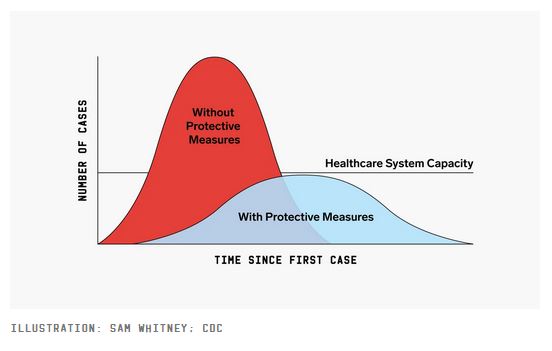
We’ve also been told that we need to flatten the curve.
That our systems were not prepared enough for the onslaught that was going to happen.

Some people continued ‘as they were’ while others tried to ‘flatten the curve’.

For a while.
Now, after some time, people from both categories have started to entertain second thoughts.

Trying to figure out what’s going on here, I’ve asked my self a couple of questions.

Who had chosen to go on as usual and who had chosen to distance themselves from the rest of the society?

‘Go on as usual’ first:
– Those who don’t trust the government.
– Those who are convinced nothing can happen to them.
– Those who felt they had no alternative. Who live paycheck to paycheck or who provide essential services to the society. Like healthcare for instance. Or those who bake our daily bread. Pump the water we drink. Tend the generators who lighten our bulbs and power the computer I use to write this post.

Now those who attempt to ‘flatten the curve’:
– People who tend to trust the authorities.
– Those who understand they should really protect themselves. Who are older and/or already sick.
– Those can work from home.
– And people who are otherwise fine but afford to distance themselves from the fray. Those who have enough resources to do it.

Am I imagining things or the picture is already a lot clearer?

And the other question now.
Why the second thoughts?

Because things have unfolded more or less as the government said they were going to.
Because things have started to happen. If not to them, directly, at least to some of those living around them.
Because there still is no alternative in sight. And because there is nothing much to convince them that their efforts are appreciated by the rest of the society.

Because the government might have been right to tell them to ‘lie down’. But because the same government has failed to do enough in the meantime. Not to mention what it had failed to do before.
Because staying put allows you to start thinking. ‘What next? For how long can we go on like this?’

So.
What next?
What are we doing to convince those who actually keep us going to continue doing so?
What are we doing to convince those who have chosen to restrict their lives to a barren minimum that their efforts are worth it?

What are we doing to convince everybody that there will be a life worth living at the end of all this?

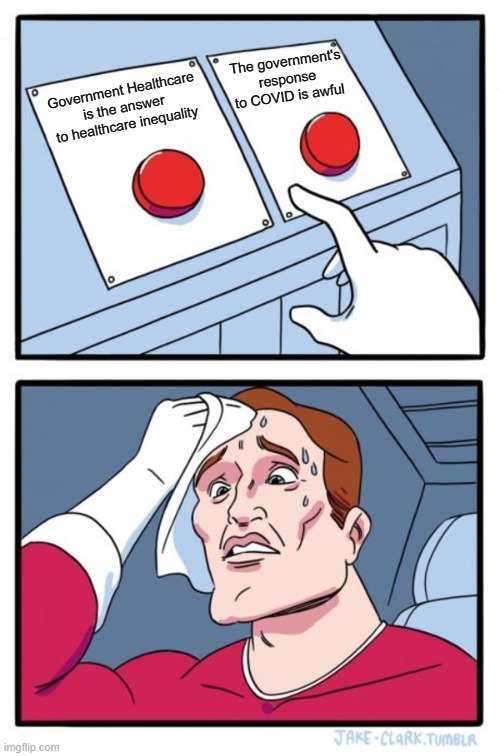
https://i.imgflip.com/3ua749.jpg

Well, we must remember that solutions came a lot easier when we refuse to think inside a box. Inside any box. No matter how large or how nice.

Every time I understand/notice that somebody tries to frame my thinking process, I go ‘ballistic’.

I try to raise my mind perpendicularly above the frame. So that I may observe the limits.

Every time when somebody is presented with an ‘either/or’ option there is a strong likelihood that the situation merits a more nuanced approach.
As in ‘yes, the government was terrible at handling COVID-19’ and ‘yes, the government – as our servant, should be mandated by us, the people, to coordinate the help we need in our hour of need’.

How can we reconcile these two?
Simple.
Hire a better government and keep a keen eye on it!

And, if I’m not mistaken, wasn’t democracy meant to do exactly this?

About half of our manufactured goods come from China. From half-way around the world. A shipping container needs about a month to arrive to Rotterdam from Shanghai. While ordering the merchandise takes some five minutes over the internet.

Shanghai is in China. A country so far away that hourly wages are a fraction of those in Europe. Or in the US. That being the reason for so many of our manufactured goods coming from there.

China is a country so far away that it took more than a month for the rest of the world to find out that a pandemic was brewing in Wuhan.
China is a country so far away that the CDC expert embedded in China’s Disease Control Agency was deemed useless by the current American Administration.

China is a country close enough for the Chinese tourists to had been a staple for the Italian hospitality industry. “5.3 million overnight stays in 2018
China is a country far enough for an “official opening ceremony” to had been “held at the Auditorium Parco della Musica, a multicultural complex, in the Italian capital on Tuesday, at the presence of Italian Minister of Cultural Heritage, Activities and Tourism Dario Franceschini and Chinese Minister of Culture and Tourism Luo Shugang.”

The ceremony was held because “2020 has been designated the China-Italy year of culture and tourism, as the year marks the 50th anniversary of China-Italy diplomatic ties.
“Tuesday” was the 21st of January 2020.

The same day

  • United States confirms its first case in Washington state, a man who traveled to the Wuhan area.
  • China confirms two additional deaths, a sixty-six-year-old man and a forty-eight-year-old woman
  • New cases are announced in China, including in Beijing, Shenzhen, and Shanghai.
  • Chinese state media raises number of confirmed cases to 291 and confirms 15 medical workers in Wuhan have been diagnosed with pneumonia.
  • Hong Kong confirms its first case, a person in their thirties.
  • Taiwan confirms its first case, a woman in her fifties.

The above timeline was ‘borrowed’ – through the Internet, of course, yet another example for how close we are of eachother, from https://www.thinkglobalhealth.org/article/updated-timeline-coronavirus on 3/28/2020, 12:30 GMT
Which Internet pulls us together by pooling information/data while simultaneously rips us apart by feeding us a constant stream of fake news.

We are so close together that you can send/receive almost everything (from) almost everywhere.
We are so close together that everybody who has a smart phone can see their similarly equipped buddies halfway across the world.

We’re so far apart that we still have to make up our collective mind about which comes first. The Economy or the People.
We’re so far apart that we haven’t figured out yet that there’s no such thing as a running economy without enough able bodied and mentally sane people. To produce, transport, distribute and buy the things we need.
We’re so far apart that we haven’t yet figured out that the present number of people cannot survive – let alone maintain a decent living standard, without a running economy.

Life, in general, is a matter of calibrating the intercourse between the inside of the organism and the environment in which it tries to survive. Or thrive…

Social life, both in general and in particular, is a matter of calibrating social intercourse between the members of a society in such a manner that, statistically speaking, the individual members would find it easier to survive/thrive in the given physical environment.
Simply because each surviving/thriving individual adds resilience to the social organism/network.

COVID-19 is nothing but yet another test.
For now – for as long a so many of us are still in ‘surviving mode’, it doesn’t matter “how” or “why”.
All that matter is ‘what’.

“What WE do about it!”

Distance ourselves from the others and allow the pandemic to cool down?
Distance ourselves from the others and allow each of our individual minds to think for itself?

While keeping in mind that long term survival requires the physical presence of as many of us as possible? That our own long term well being requires us to cooperate towards that common goal? As Adam Smith taught us?

Then things will eventually cool down.

And we will have been learned yet another thing.

Both individually and as a cultured species.

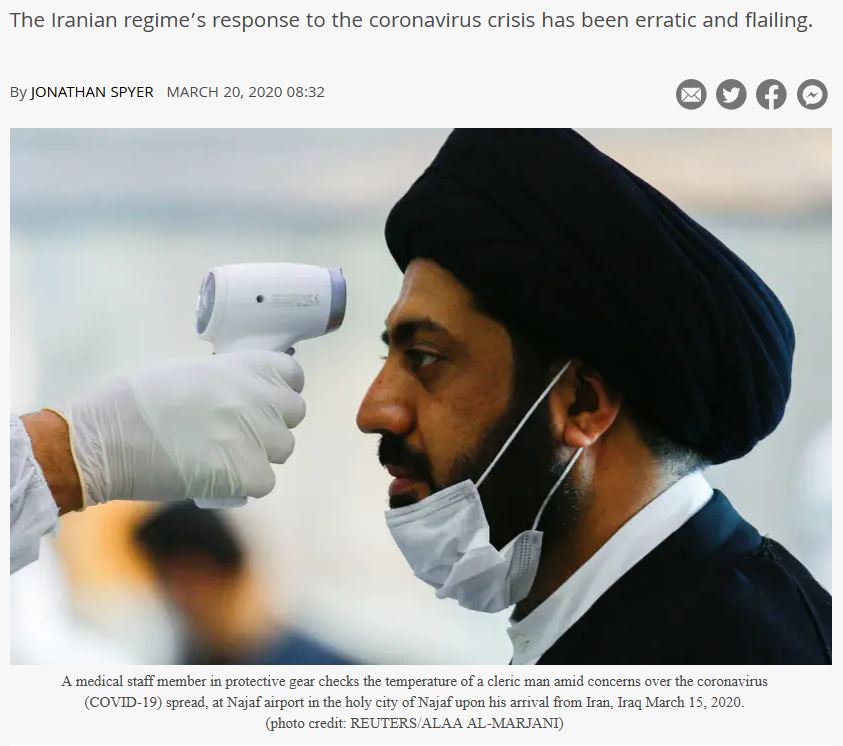
If you live on the Moon, or if enough time had passed since I’ve written this, click on the picture to read Jonathan Spyer’s excellent rendition of the facts which have driven me to post this.

Or you may proceed.

For me, there is a striking resemblance between what’s going on in Iran and what would happen in a hardcore libertarian society.

The mullahs are concerned only with spreading/enforcing their faith and consider everything else will take care of itself.

The extreme libertarians are concerned exclusively with upholding their understanding of liberty and consider that everything else would take care of itself. By itself.

And I’m convinced that everything will indeed take of itself!
After all, life has continued after communism had failed.
The communist leaders had been professedly concerned exclusively with enforcing their understanding of equality. And convinced that everything else would had taken care of itself. If only that equality could have been instated…

Yet I don’t think communism will be missed.
By those who had experienced it hard enough to understand it…

Let me make something clear.
Crystal clear!

Money, and its ‘derivatives’ – from ‘capital’ to ‘financial market’ and ‘stock exchange’, are the tools we used to get where we are now.
Without them we would be still foraging in the woods.

Only something rather insidious has started to eat the whole scaffolding from inside.
Same process has been happening with weapons. We invented them for hunting. Then used them for self protection. Against large beasts and fellow humans.
Finally, after using them to conquer and defend our liberty, we used them to subjugate others. To impose our will upon some other people.

In other words, we used guns to shoot ourselves in the foot.
Unwittingly.
Both as hapless individuals and as a cultural species.

Money – and its derivatives, have suffered the same degradation.
We used it, at first, to coordinate our efforts.
The Stock Exchange had been an excellent way to coordinate otherwise disparate means. Very few of the corporations who have changed the world into what it is now – for good and for bad, wouldn’t have come to life without the money which fuel them.
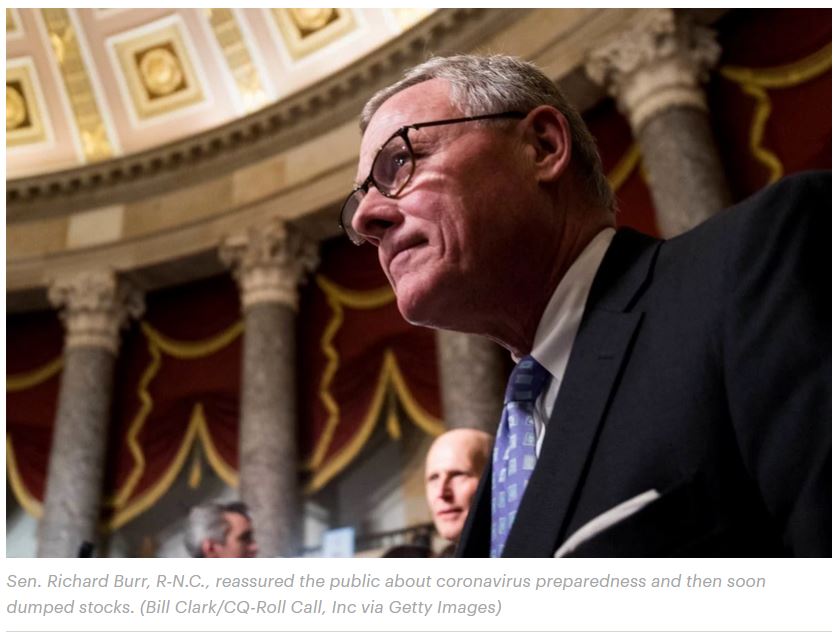
Nowadays, too many of those who trade on the Stock Market do it in a ‘barren’ manner.

They do not contribute anything but extract value.
The inside traders being only the visible part of the iceberg.
Which iceberg might tank the whole contemporary ‘arrangement’.

If we keep sleeping during our watch.
And there’s no one else on deck…