Archives for category: Culture

Some people believe that “racial prejudice” is “the natural human inclination … to identity (sic) with members of one’s own tribe, race or ethnic group” and “Post-racial multiculturalism is the exact but equally extreme and insane opposite of Nazi racial ideology“.

Compare this to “Religion, which should foster sisterhood and brotherhood, which should encourage tolerance, respect, compassion, peace, reconciliation, caring and sharing, has far too frequently — perversely — done the opposite. Religion has fueled alienation and conflict and has exacerbated intolerance and injustice and oppression. Some of the ghastliest atrocities have happened and are happening in the name of religion. It need not be so if we can learn the obvious: that no religion can hope to have a monopoly on God, on goodness and virtue and truth“.

What’s going on here?

Where does all this ‘confusion’ come from?

Let me start from the ‘bottom’ of it.

“No religion can hope to have a monopoly on God, on goodness and virtue and truth”.

While I fully agree with Desmond Tutu on the gist of his words I must contradict him on something very important.

Religions cannot hope at all. About anything. Anyway you look at them. No matter which definition you use, religion – all of them – is something that people do together. A common effort.
It is the individuals who are the actual doers. Who love and hate. Or hope, in this case.
Who pretend that their religion is the only true one. Or understand, as Desmond Tutu did, that each religion is yet another manifestation of God.

“Religion has fueled alienation and conflict and has exacerbated intolerance and injustice and oppression.”

Again, it was individual ‘religious’ people who have done all of those things, not religion per se.
All sacred texts have been written by human people. I can even accept that the first manuscript of each religion was directly inspired by God. Only each of them have been copied a thousand times over. And heavily editated.
Then came the individual human people who have read those texts, interpreted them, passed them on and acted upon those interpretations. Upon their convictions, actually.

And this is how “Some of the ghastliest atrocities have happened and are happening in the name of religion”. Not because of ‘religion’ but ‘in the name of religion’.
Simply as a consequence of how certain people have chosen to interpret/use religious teachings.

And not only ‘religious’ teachings.

People are able to interpret – and use in their own (perceived) advantage, every bit of information that comes their way. And now, that we have started to understand more and more about how our brain is working, the manners in which we use that information have become more and more ‘convoluted’.

“Post-racial multiculturalism … began as an understandable overreaction to Nazi racial ideology…before being consolidated by academics into an instrument of socio-political intimidation, rewards, punishments, manipulation and control, a modern, secular replacement for the power-political role of medieval church ideology.”

So.
It was the academics/priests who have done the damage. Not their religion nor the information they had at their disposal.

But why?
How come people whose religions – all of them do this – are adamant about ‘respect your neighbor’ become involved in wars?  Sometimes even in ‘religious’ wars ….
How come academics, whose very job are to teach their students to think autonomously, use their ‘rank’ in order to subdue ‘their’ file?

Could the religious warriors have something in common with the intransigent academics?

How them sharing the unbreakable conviction that they own the truth?
Forged inside the ‘echo-chambers’ where they have grouped themselves according to their specific beliefs? (No matter whether those beliefs are of a religious or ‘rational’ nature…)

Only after I had reached this point in my discourse I was able to fully appreciate Desmond Tutu’s words: ‘Religion … should encourage tolerance, respect, compassion, peace, reconciliation, caring and sharing’.

He doesn’t say anything about giving up on your own kind.
Or about leaving your roots behind.

All he actually says is ‘Be very careful. If all of you will accept to see only the same side of things you will become a herd. And while there is indeed ‘safety in numbers’ all herd members are ultimately headed for the abattoir’.

Diversity isn’t something to be forcefully, hence falsely, celebrated. Or imposed on others.

What we need to preserve, and celebrate, is our ability to ‘walk around’ the things that we encounter. To entertain, and discuss among ourselves, different – even conflictingly different – versions of what we see around us. This ability would only enhance our chances to solve the problems we’ll certainly be faced with.

‘Culture’ is nothing but layer upon layer of place-specific information which have accumulated in time while ‘religion’ is how a certain group of people have learned, again in time, to cooperate in a certain environment.
It doesn’t matter whether that ‘environment’ has been created by a God, has evolved according to Darwin’s theory or both.
What really matters is how we react – conditioned by our cultures and by our religious upbringing – to what is happening to us. Both individually and collectively.

In this sense, each culture we manage to preserve will only add to our chances of long term survival. As long as we’ll learn to sincerely respect each-other, of course.
Again, both individually and collectively.

PS.
A comment on my FB wall, “True religion is God entering history and the lives of humans and revealing Himself. All other religions are man’s attempt to explain the world around him in terms of god or attempts to control lots of other people in the name of some god“, helped me to understand that “There is ‘religion’ – the shared attitude that helps us to cooperate, and there are religions – specific ways that individual communities have traveled in order to attain that attitude.
And something else. What if ‘God entering history’ and enough of us reaching the shared understanding that it is far better to cooperate amongst us – love thy neighbor – than to fight each-other are the same thing?
How to put this understanding into practice? In the various, and continuously changing, circumstances we have to face?

How about this being the very reason for us having so many religions/cultures?

donald-trump-andy-borowitz

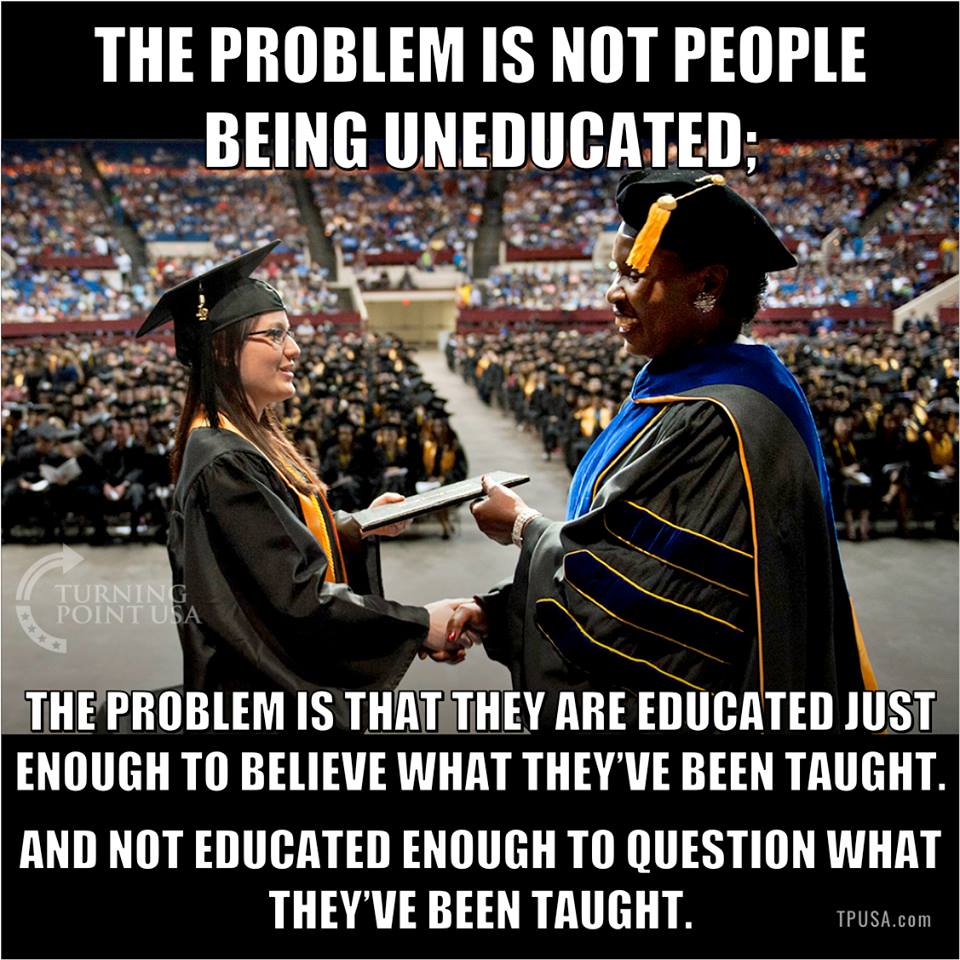
Besides the fact that calling someone an “ignorant” is a very ‘Trump’ thing to do in the first place, what if the real problem is that we have allowed ‘it’ to become a ‘system’ in the first place?

This way, after the process of learning and teaching has become a ‘system’, the ‘open market’ for ideas has become a very well – actually very badly – controlled oligopoly.
Learning means seeing and understanding the world around us. Teaching means passing around, and forward, the above mentioned knowledge and the meaning we’ve made out of it. Which ‘passed around knowledge and meaning’ shapes the way the ‘students’ go further. Deepen the knowledge and build future meaning.
In fact the very breadth of our species future depends on how past learned knowledge and built meaning had been passed around.
And what we have today, the current ‘social unease’, is the product of the manner in which we have been taught to see the world. Of the meaning we find in it.

Trump, as a social phenomenon, is nothing but yet another symptom of the current ‘malaise’. The incapacity of the contemporary society to make room for everybody is, simply put, a consequence of  information no longer flowing freely around. Of information being, tighter and tighter, controlled by the ‘system’.
The simple fact that Trump, if elected, has promised to put his stamp on the ‘system’ only proves this point…

Coming back to the ‘system’, the only way to fix it is to open it up, widely. If we continue to allow ‘it’ to divide us into ‘insiders’ and ‘outsiders’ (read ‘properly educated’ and ‘ignorant’) we will actually perpetuate ‘the problem’.

chded7au4aadm5

“The purpose of Halacha is to disturb. To disturb a world that cannot wake up from its slumber because it thinks that it is right.”
Rabbi Dr. Nathan Lopes Cardozo

What is currently known as the ‘North Atlantic Civilization’ is a construction whose blue prints have been initiated in the Middle East, on the Banks of Jordan.

The Jews, those who had started the process and one of the very few peoples/cultures who have survived since that era, have reached a very interesting stage in their development.
Rabbi Dr. Nathan Lopes Cardozo discusses, in a series of articles, some very important ‘contemporary issues’.
For those of you who are unfamiliar with the context:
“The word “halakhah” is usually translated as “Jewish Law,” although a more literal (and more appropriate) translation might be “the path that one walks.” The word is derived from the Hebrew root Hei-Lamed-Kaf, meaning to go, to walk or to travel.”
Yigal Amir had killed Yitzhak Rabin in an attempt to halt the Oslo Peace process and
Baruch Goldstein had killed 29 and wounded 125 in “the Muslim prayer hall at the Tomb of the Patriarchs in Hebron.

When reading Dr. Cardozo’s considerations please engage yourself in a mental experiment. Try to identify at least one aspect of those mentioned here that doesn’t fit the rest of the North Atlantic cultural space.
I encourage you to use the links and read Dr. Cardozo’s articles in full. I have selected some of his words trying to suggest something, there is a lot more to be learned there.

“One of the greatest tragedies of Judaism in modern times is that certain halachic authorities, as well as people like Yigal Amir and Baruch Goldstein, forgot to study the first book of the Torah. They have become so dedicated to the letter of the law that they have done the inconceivable and have caused the degradation of Halacha.”

http://www.cardozoacademy.org/thoughts-to-ponder/the-desecration-of-halacha/

“It is for this reason that Halacha has always developed on the basis of case law, and not because of overall well-worked-out ideologies. It is sui generis. Much depends on circumstances, the kind of person we are dealing with, local customs, human feelings, and sometimes trivialities. God, as Abraham Joshua Heschel explains, is concerned with everydayness. It is the common deed—with all of its often trivial and contradictory dimensions— that claims His attention. People do not come before God as actors in a play that has been planned down to the minutest detail. If they did, they would be robots and life would be a farce.”

http://www.cardozoacademy.org/thoughts-to-ponder/chaos-theory-halacha-part-1-3/

“Not only do we see a considerable amount of chaotic halachic literature, published by numerous authorities, which seems to lack consistency and order, but we may even find contradictions in the various writings of one halachist. This doesn’t mean that the writer lacks a particular line of thought and some basic principles; it just means that within these norms almost everything is an open market.

I believe this is the reason why the Conservative movement, with all its good intentions and great scholarship, was unable to grasp the imagination of many halachic authorities. It is not the lack of knowledge, but rather the over-systematization that is responsible for this. Once there is too much of a unified weltanschauung and agenda, Halacha loses its vitality. The multitude of attitudes, worldviews, chaotic thinking and sometime wild ideas, through which the greatest halachic authorities freely expressed their opinions, is what kept the Orthodox halachic world alive. In some sense, and even almost paradoxically, Orthodox Halacha is less fundamentalist than Halacha in other movements within Judaism.

None of this should surprise anyone. When looking into the Talmud, which is the very source of Halacha, we find a range of opinions so wide, and often radical, that it is almost impossible to find any sense of order. There’s a reason why the Talmud is compared to a sea in which storms create unpredictable waves and turbulence. The revealed beauty of this natural phenomenon is what attracts people to gaze at the sea for hours on end. It reflects their inner world, which thrives only in the presence of tension, paradox and chaos.”

http://www.cardozoacademy.org/thoughts-to-ponder/chaos-theory-halacha-part-2-3/

“In my opinion, Halacha is in need of more “chaos.” It must allow for many ways to live a halachic life unbound by too many restrictions of conformity and codification. It must make room for autonomy on the part of individuals, to choose their own way once they have undertaken to observe the foundations of Halacha. Acceptance of minority opinions will have to become a real option, and some rabbinical laws must be relaxed so that a more living Judaism will emerge. While some people need more structure than others, in this day and age we must create halachic options that the codes such as the Mishneh Torah of Maimonides and the Shulchan Aruch of Rabbi Yosef Karo do not provide.

Surely those who prefer to live by the strict rules of the codes should continue to do so. For some, these rules are actually a necessity – even a religious obligation – since this may be the only way they can experience God. But they should never become an obstacle to those who are unable to adhere to them. Labeling these new approaches “non-Orthodox,” or “heresy,” is entirely missing the point.

I wish to be clear: I am not advocating Reform or Conservative Judaism which, as I stated earlier, have paradoxically become overly structured and agenda-driven. They lack sufficient “chaos” to make them vigorous.

While there is great beauty in attending synagogue three times a day to pray, we clearly see that much of it has become mechanic – going through the motions, but no religious experience. Yes, it’s better than not being involved in any prayer at all, but the price we pay is increasing by leaps and bounds. It is pushing many away. Codification is the best way to strangle Judaism. By now, Orthodox Judaism has been over-codified and is on its way to becoming more and more irrelevant.

I believe that one of Halacha’s main functions is to protest against a world that is becoming ever more complacent, self-indulgent, insensitive, and egocentric. Many people are unhappy and apathetic. They no longer live a really inspiring life, even though they are surrounded by luxuries, which no one would have even dreamed of only one generation ago.

The purpose of Halacha is to disturb. To disturb a world that cannot wake up from its slumber because it thinks that it is right. The great tragedy is that the halachic community itself has been overcome by exactly those obstacles against which the Halacha has protested and for which it was created. Halachic living has become the victim of Halacha. The religious community has succumbed to the daily grind of halachic living while being disconnected from the spirit of Halacha, which often clashes with halachic conformity for the sake of conformity. Many religious people convince themselves that they are religious because they are “frum.” They are conformists, not because they are religious but because they are often self-pleasers, or are pleasing the communities in which they live.

Large numbers of religious Jews live in self-assurance and ease. The same is true of the secular community. Both live in contentment. But as Rabbi Dr. Louis Jacobs notes: “Who wants a life of contentment? Religion throughout the ages has been used to comfort the troubled. We should now use it to trouble the comfortable…” ”

http://www.cardozoacademy.org/thoughts-to-ponder/chaos-theory-halacha-part-3-3/

truck-nice

When facing an uncertain future, people are hard wired to search their past.
Some look for things that have gone well and hope that reenacting them will bring back a measure of order in their lives.
Some others look for clues pointing to things that went bad, hoping that making them right will change their prospects.

In this respect I remember how fascinated I was when I first heard about Malraux’s “The XXI-st Century will be religious or will not be at all“.
When trying to understand what Malraux wanted to convey we must remember that he started as a left wing intellectual who, at some point, felt an admiration for Stalin. Later, after he found out what Stalin was really up to, Malraux had given up on Stalinism but never on his atheism. So?

Looking even further back in time we arrive at Emile Durkheim’s Suicide.

Written at the end of the XIX-ht century the book teaches us that while suicide remains a profoundly individual decision those who consider it are deeply influenced, when making the call – one way or another, by the strength and nature of the social ties that connect him to the community to which each of them belongs.
Further into the book Durkheim also discusses the fate of the communities themselves, arguing that a society needs to keep a dynamic balance between social control – that keeps a community together – and a healthy dose of deviance – which might pull at the seams of a society but simultaneously allows it to change when it has to do that in order to survive.

OK, all these are very nice but will you come back to our present? You promised us something about the future and you are leading us further and further into the past. Into a ‘mythological’ past, no less…

One of the most pressing issues that we must face today is the advent of ‘lone wolf’ terrorism. The kind that not only scares us the most but also the one that is hardest to prevent.
Some even try to make us accept the idea that we’ll have to learn to live with it.
“No revelations come from the massacre in Nice. There is nothing to be learned. This is what we live with, what we are getting used to living with. None of it is surprising—that’s the most frightening thing of all.” (George Packer, The Tragic and Unsurprising News from Nice, the New Yorker, July 15 2016)

Well, I strongly disagree with this line of thinking.

What happened in Nice, where a lunatic drove a truck through people gathered to watch fire-works celebrating Bastille Day and killed 86 of them, is proving that both Malraux and Durkheim were spot on. Each in his own right.

In the last twenty or so years, terrorist acts have doubled as suicides. Some perpetrated by ‘simple minded’ youngsters driven to desperation by perceived socio-economic inequities and primed by callous so called religious leaders while others were carefully planned and cold-bloodedly executed by apparently sophisticated members of the middle class.

If we interpret these acts according to Durkheim’s theories we might reach the conclusion that the communities that harbor the terrorists do not function properly. Either the individuals feel so constraint by the existing rules that they cannot find enough breathing space – and snap – or that they cannot find enough social support – and go out ‘with a bang’.

Or both, at the same time.

Let’s remember that those who comited most recent terrorist acts, in Europe and in the Middle East – if we count those who joined ISIS coming from the Western Europe, are second generation Muslim immigrants or new Islamic converts.
I’ll deal with these two categories separately.
The second generation immigrants had a very frustrating experience.
Their parents came from abject poverty, worked hard and, most of the time, fared a lot better in their new countries than any of them even dreamed of on arrival – specially when comparing to the situation in their countries of origin. The youngsters went to school alongside the natives, watched the same television programs and read the same books and magazines. And grew to have the same expectations. But had a lot more difficulties when tried to fulfill them. Because of their skin color, religion, etc., etc. Add to that the nefarious propaganda coming from the Wahhabi preachers and you have an already primed keg of gun-powder waiting for a spark.
But let’s not forget that these people live in otherwise closely knit communities.
And that preparations for terrorist acts do take some time and effort.
How come these preparations go unnoticed and, even more important, unreported?

Can we conclude that whole communities have went past the ‘I don’t care anymore’ point?

A situation for which Durkheim used the term ‘Anomie‘?

Could we consider that not only the immigrant Islamic communities are in an anomic state but also the larger, host ones? For letting the whole situation degrade to such an extent? Not only at home but also at the door steps of Europe?
And please remember the new converts to Islam. What happened to those youngsters – most of them are young people –  that they became so estranged to their native society that emigrated to a totally different realm, not to a different country? A few of them might be explained away by individual ‘deviance’ but such a large number becomes a social phenomenon that begs a different explanation.

Should we accept the situation – and the degradation that would inevitably follow if nothing is done – or should we heed to Malraux’s advice and do our best to find new, and more efficient, communication channels so that we’ll be able to built some much needed trust amongst us? Based on mutual respect, not on MAD force?

About 8 years ago a girl meets a guy and they get married.

After four months her family intervenes and helps her get out of a dysfunctional relationship.

He starts another one, has a son, and later kills 50 people in a gay bar some time after a gay couple kissed each-other in front of his child.
“They were kissing each other and touching each other and he said, ‘Look at that. In front of my son they are doing that.”

Isn’t this whole thing very descriptive of the situation we are facing now?

Her family noticed something was wrong – he was abusing her – and helped her out.

Eight years later – after having another relationship, after being investigated by the FBI and issued a gun permit – he snaps and kills 50 people.

Where was his family? His friends? His neighbors? His co-workers?

“In other words, Mateen who according to preliminary reports, had been on a terrorist watchlist, and who still managed to obtain weapons thanks to his various licenses and permits just last week, was employed by one of the world’s largest security companies”.

More than 100 years ago, Emile Durkheim, a French sociologist, discovered that suicide, while being a very personal decision, is heavily influenced by the strength and quality of  the social relations that connect the concerned individual to the rest of the society.

I’m not going to argue now that most acts of terrorism, specially the ones perpetrated in the last 20 or 30 years, are of a suicidal nature. They are but this is a somewhat different problem from what I have in mind right now.

What I’m afraid of is that we, in the West, are killing ourselves.

As a society.

We have stopped caring about the guy next door to the tune of no longer being able to notice that he has become crazy and is about to start shooting.

Left and right.

Us.

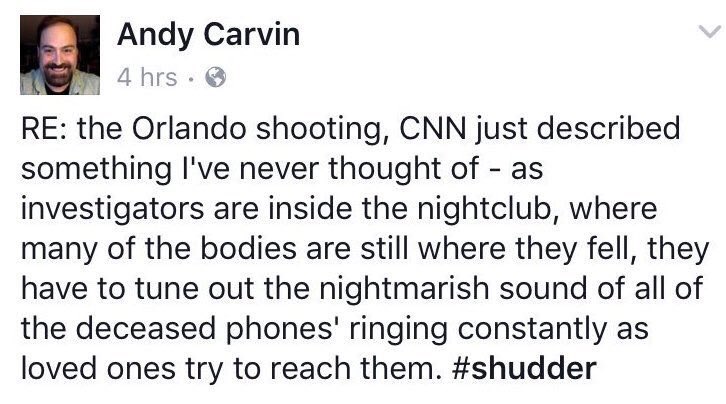
Let’s wake up, before there will be no one left to answer the phones.

phones ringing

Shortly after becoming aware of his own awareness Man figured out that, from then on, his real job will be to attach meaning to everything that was, is and will be happening around him.

The very same moment He freaked out – because of the enormous responsibility that had just fallen upon his head – and invented god to help Him.

There is, of course, no way of knowing for certain whether a real God had interfered, in any way, shape or form, in our evolution.
The fact that so many of us think the world can be explained ‘through itself’ – that there is enough information available to construct a plausible narrative about what went on since the Big Bang – is the real proof of nothing more but the huge cockiness harbored by our inflated egos.
OK, nothing more but a long held tradition suggests that God exists for real only this is no factual demonstration about the nonexistence of God.

On the contrary. The very fact that the tradition held for so long means that God had a real contribution to our life.

It doesn’t really matter whether that God was real or contrived by us.

And the fact that so many of us use their respective gods as pretexts to commit heinous acts sends no other message than that those who commit such crimes have no real understanding about what God really means.

ouroboros

Ever since people have become aware of their own awareness philosophers have entertained opposing views as to what is more important: matter or soul.

The materialists point out that everything, including us, is made of matter and, hence, nothing would be possible without it while the idealists maintain that everything that exists is nothing but a projection of our own thoughts.

As an engineer who had designed (material) objects before actually building them I find it strangely rewarding that both these fiercely opposing sides are, simultaneously, right.

Just as we are simultaneously made of flesh and animated by souls.

If you disagree, just pinch yourself.
Now tell me, ‘did it hurt?’.
Who felt it? Your flesh or your soul?
And who’s able to meditate about the whole experience? How come are we not only able to feel things but also to think about them? Then to communicate, efficiently, among ourselves about our relatively different experiences?
Surely, there must be something shared amongst us, something that constitutes not only a medium for our communication but also a common base for our experiences.

I’m going to use ‘reality’ to designate that commonality, irrespective of the fact that reality is a two tiered thing.

A material reality, something that exists per se – according to its own, natural, set of laws, and a social reality, something that we, the people, have agreed upon – either willingly or by omission to protest, efficiently, against it.

These two tiers of reality are no longer independent.

In fact they have never been. The social reality has grown, as a bud, ‘on top’ of the material reality. And this has happened according to an opportunity enshrined in the natural laws that govern the very existence of the material reality.

Now, after its birth, social reality has started to alter the material one.
In two ways.
By developing an ever more sophisticated understanding of the inner workings we gradually discover inside the material realm and, subsequently, by using various aspects of that (inherently limited) understanding in order to effect voluntary change.

I’m going to make a brief pause here.
Social reality is a human construct, one that came to life fueled by our own volition and shaped by the sum of the choices we’ve made during our entire history.
The mere fact that we are also ‘animals’ – and have changed the world around us by our mere, and long time unwitting, existence, is something else. Related to our social existence but nevertheless different from it.

What I’m trying to say is that by coming of age – by becoming aware of our own awareness, we are currently adding a third dimension to that Ouroboros thing.
The ‘serpent’ has been ‘eating its tail’ from the very beginning of the world. New stars have been born from the dust left after the older ones have exploded and decaying organic matter is what used to feed our crops until a few short years ago – and still does for the organic farmers.
But now, that we’ve become aware of the entire process – and of our contribution to it, we are in a position to influence its direction.

We can turn it into a vicious or a virtuous circle.

Which will it be?

who needs what

And please, please, don’t make this confusion.
People do, as for now at least, need ‘nature’ in order to lead what we call/feel to be a normal life.
But nature also somehow needs us. Otherwise it wouldn’t have allowed us to become what we are today.

Until now, during our development, we haven’t broken, not significantly at least, any natural laws. Otherwise we wouldn’t have reached this stage – according to Ernst Mayr’s interpretation of  Darwin’s teachings, anyway.
Evolution is not about the survival of the fittest but about the demise of the unfit.
We’re not dead yet, are we?

Let’s keep it that way, lest we’re gonna be replaced.

Fast.


sex education

“Last week, we heard the story of a West Texas high school that plans to expand its sex-ed program after its abstinence-only policy resulted in a mass outbreak of chlamydia amongst its students.”

Let me ask you something.

Could it be that most of the ‘modern’ children live in ‘bubbles’?
That they have (meaningful) contact almost exclusively among themselves and seldom with older/younger generations?
This being the reason for which ‘sensitive’ information passes so hardly from one generation to the other.
And this is valid for way more subjects than just ‘mere’ sex!
“It’s not the kids who aren’t mature enough to learn about sex, it’s their parents who aren’t mature enough to let them.”


Somebody shared a picture on FB and I finally understood the strange relationship between the American People and their Government.

“One of the things taken out of the curriculum was civics,” Zappa went on to explain. “Civics was a class that used to be required before you could graduate from high school. You were taught what was in the U.S. Constitution. And after all the student rebellions in the Sixties, civics was banished from the student curriculum and was replaced by something called social studies. Here we live in a country that has a fabulous constitution and all these guarantees, a contract between the citizens and the government – nobody knows what’s in it…And so, if you don’t know what your rights are, how can you stand up for them? And furthermore, if you don’t know what’s in the document, how can you care if someone is shredding it?”

The quote belongs to, obviously, Frank Zappa. I found it in an article written by Kevin Courrier and published in CriticsAtLarge.com.

What grabbed my attention was not the fact that a musician is so passionate about politics but the huge confusion that sits at the bottom of his political weltanschauung.
The American Constitution, any constitution for that matter, is not at all a contract between the government and the people but a contract that binds together the citizens that inhabit a country. The government, any government, is ulterior to the signing of that contract so it cannot be a part of that contract.

OK, I can understand how that confusion came to be only I cannot understand how it could survive for so long.
For more than two centuries, that is.
As we all know the US were, at first, British colonies. For the last nine centuries or so Britain was run more or less according to Magna Charta – which is indeed a sort of contract between the Monarchy and the British people. But that is valid for Britain. It is the Great Britain that traces its ‘essence’ back to the idea of a divinely sanctioned Monarch who owned, entirelly, the whole country and who autocratically ruled over all the aspects of its life. And that at a certain point in history the Monarch agreed to sign a contract with his subjects, promising to treat them fairly.

But at an ulterior point in the history of the British Empire the American people had decided that they didn’t want anymore to be subjected to any worldly authority so they had sent the British Governor packing. From there on the essence of the American state was no longer the persona of the Monarch but ‘We, the People’.

That’s why the American Government is, by right, nothing more than an employee of the American People while the British one is a servant – or an employee – of the Monarch.

Let me put it a little differently. America is like a huge corporation while the citizens are its shareholders. The people own the country and the Government who runs it is the Board of Trustees. The people are the employers and the members of the government are the employees.
In Britain the Monarch is the ‘owner’, the people are ‘tenants’ and the government is the administrator of the whole business. The government is employed by the owner and payed by the tenants – who have a say because they are paying the rent, otherwise known as ‘taxes’.

Then how come, two hundred years after the Constitution that settles the conditions of ‘incorporation’ was adopted so many Americans still see the Government as being different from the ‘people’? Could it be that Zappa is right? That too few people have understood that “this nation, under God, shall have a new birth of freedom—and that government of the people, by the people, for the people, shall not perish from the earth.”?

I know, I know… These words are not from the American Constitution – they are widely attributed to Lincoln. But they describe perfectly its spirit, even if some people accuse Lincoln for being a dictator – because he didn’t allow the South to seccede, as if this decision was his to make… You see, the confusion is deep indeed. When people are passionate about something they tend to pick up from the entire picture only the pixels that fit their view of the world…

We the People of the United States, in Order to form a more perfect Union, establish Justice, insure domestic Tranquility, provide for the common defense, promote the general Welfare, and secure the Blessings of Liberty to ourselves and our Posterity, do ordain and establish this Constitution for the United States of America.”

Then why so many of the ‘we the people’ still believe that the constitution is a contract between them and their Government?
Or maybe Zappa was (half) right after-all? Civics should indeed be brought back …

PS
Coming back to ‘Government of the people, by the people, for the people’ some people attribute these words to John Wycliffe and still others to Thomas Cooper.

Does he have any ‘right to exert his authority, inside the limits that have been delineated for him’?

Somebody who has real authority enjoys a certain degree of autonomy, if not outright independence. ‘Authority’ is almost never clearly delineated, there is always a gray area where the discretion of the individual in charge is the one that calls the shots.
More over if we, the ‘subjects’, consider that he has ‘the right’ to exercise that authority then it’s us who are in deep trouble.
‘Exertion of authority’ ‘smacks’ of the situation  when the ‘authority man’ had conquered his position against the wish of his subjects – like the emperors of the old. (Or like the communist dictators of not so long ago, only they pretended to exercise their authority for the benefit of the people while the emperors of the old were more straightforward and declared themselves ‘gods’)
Nowadays, at least in the democratic states, authority is, theoretically, used as a tool, towards the accomplishment of what the person in charge is supposed to achieve, not as a right enjoyed by that person.
In fact the notion of a right to exert authority inside some limits is akin to what has been described as ‘feudalism’, a social arrangement not that different from the Athenian democracy. The people were divided in two categories, just as in the previous situation – the ‘imperiums’ of the Antiquity, the difference being that in an imperium the top class was inhabited by a single individual – the emperor/dictator, while in feudalism/Athenian democracy the top class was inhabited by the free people, whose authority/freedom extended only as far as it started to encroach the authority of the equivalent individuals. I have to remark here that in many circumstances feudalism has very quickly degenerated back to imperium – for instance in absolutist France, ‘L’etat c’est moi’, or in tsarist Russia, while England successfully avoided that due to the spirit enshrined in Magna Charta.
The difference between feudalism/Athenian democracy and the modern democracy being that currently we can no longer speak of individual authority simply because nowadays no one has the “right” to own slaves – as the Athenian ‘democrats’ had, nor even enjoy extensive authority (bar the right of life and death) over other people – the serfs, as the feudal barons did not so long ago.