Attempting to value individualism over collectivism is similar to trying to establish which came first, the chicken or the egg.
Having experienced both – collectivism and individualism put in practice as political principles, I have noticed that neither extreme is capable of working in a sustainable manner.
Communist regimes had fallen one after another. Fascist regimes did the very same thing. Pirate republics could never resist for long.
Coming back to what is happening in the US, I’m afraid very few people are aware of how much collective thinking had been embedded in the American Psyche. The good kind of collective thinking… Americans go to church. A place where you go to to be together, not alone. Americans used to help each-other. Charity used to be a big thing. Slowly, it had become a dirty word. And so on.
Individuals can not exist on their own. They need each other to survive. And to thrive. Collectives can not last for long unless the individuals who constitute them do respect each-other. Help each-other maintain and develop their individuality.
Imagine having a festering boil. On your ass, for good measure. You may take to the doctor, for treatment. Or you may wait, hoping your organism will be strong enough to heal itself. This being your call. Nobody else but you has anything to say about this situation. Let’s say you have chosen to go to the hospital. Once there, the matter has gotten somewhat ‘out of your hands’. You still have the last word but the doctor calls the more important shots. Pun indended, of course. He can simply open up the boil, put you on a course of antibiotics and send you home. He might decide to check you up and see whether the boil is a symptom of something deeper. He might attempt to rip you off by ordering, all at once, a host of complex tests and of fancy treatments. Or all at once. Cut up your boil, set you on a course of antibiotics, order a decent set of tests and still rip you off. ‘Is there a point to all these?’ Yep! How the ‘good’ doctor will choose to treat you is the consequence of how you have chosen him. And of how the community you belong to had chosen to organise its health system. But the more consequential decision, whether to go to the doctor in the first place, is yours. I’m not going to analyse the factors you have to balance – we’d go back to how the community you belong to had chosen to organise its health system. I’m only going to parade the possible outcomes. A nice scar on your butt and a decent tab for you – or for your insurer, to pick up on your way out. Acompanied, hopefully, by an otherwise clean bill of health. A nice scar, and a clean bill of health, accompanied by an outrageous invoice. These being the ‘good’ outcomes. The doctor might find out, after reading the test results, that you also have, say, a blood disease. One perfectly treatable by modern medicine. But which would have easily killed you if you had waited much longer. The doctor might also find out, after reading the test results, that the boil is the symptom of an incurable disease. One which will kill you for sure. Only now you’ll die in the relative comfort of the available paliative treatment you can afford. Or you might choose to nurse your boil at home. Get out fine. And a lot cheaper! Die of an apparently unrelated disease six months later. Or pass out because of a sepsis which had eventually became untreatable. Due to your own prevarications…. ‘And what has the boil on my ass to do with Covid?!?’ Covid is a boil on our collective ass. We might decide to treat it ‘on the go’, hoping that on the ‘other side’ our lives will return to normal. Or we might decide to use it as an opportunity! An opportunity to clean up our act….
“The Texas educational system inundates the children with the almost mythical stories of Sam Houston, Stephen F. Austin, and other Texan heroes. This perpetuates the feeling that Texans are superior to others. Social Identity Theory claims that in-group biases are a direct need to feel superior to another group. By reinforcing such ideals of Texas history at an early age, they are indirectly making Texans feel superior to other states.”
In fact, Texans are so proud of their state, and so confident in themselves, that their power grid, run by ERCOT – Electric Reliability Council of Texas, has no connections linking it to the outside world. Yes, your eyes are OK. Texas – most of it, anyway, cannot import electric energy. No matter what!
For those who know anything about power management, this is insane. For the rest of the people, this sounds like gibberish.
Who cares where the power comes from?!?
Until it stops coming… exactly when you need it most!
‘OK. But surely, there are also other systems which are independent. And isolated. What about Hawai’i? It’s too far away to connect itself with anybody else and it’s doing just fine.’
True enough. And I can name a few more, easily. Only most of them are independent because they are isolated, not by design. And, exactly because they are isolated, they are run with utmost care. More precautions are taken than in ‘normal’ situations.
‘Precaution’ meaning, in this case, spare capacity. The responsible people running those systems make sure that, when push comes to shove, somebody is there to deliver the goods. The megawatts of power.
Maybe we need to reconsider our infatuation with ‘just in time management’. While ‘just in time management’ maximizes profits by streamlining inventory, it works its magic only when everything goes according to plan. And the stricter the streamlining, the harsher the consequences of anything not going according to plan!
And no, I’m not making fun of the ordinary people who suffer the consequences! This being the moment when I feel the need to remind you that the author of this blog – that’s me, tries to asses the consequences of our limited consciousness. Of the fact that none of us knows much. And, furthermore, that very few of us admit that! Which consequences might be – as too often are, tragic.
Specially when those who are not aware that their knowledge is limited happen to be invested with critical decision power.
‘Handicap’ has become a dirty word… Somewhat strange, given the breadth of its meaning. Horses get handicapped in order to even their chances to win a race. Yachts get handicapped so that different makes might participate in the same race… In these situations, its an ‘honor’ to be handicapped…
Then why has this concept, ‘political correctness’, become so ‘popular’?
You might already be familiar with the ‘upfront’ explanation.
“political correctness has reset the standards for civility and respect in people’s day-to-day interactions.”
I’m convinced there was something more. Civility and respect haven’t been invented yesterday. We’ve been polite for quite a while now.
Yeah, only politeness had been invented, and polished, when society was way more hierarchical than in is now. In those times, when a ‘superior’ told somebody ‘you idiot’ that somebody paused to think. The ‘idiot’ could not dismiss what the ‘superior’ had just told him. The ‘idiot’ really had to make amends. He was so busy trying to correct himself that he couldn’t allow himself to feel offended. If anything, he was grateful. The ‘superior’ had made the effort to help the ‘idiot’ improve himself instead of dispatching him altogether. In modern times, even before PC had become fashionable, calling someone’s attention about how idiotic he was behaving only made him angry. Hence dismissive and unresponsive. In an era when all people had become peers, a new ‘manner of speaking’ had to be invented in order for ‘information’ to be made ‘palatable’.
The process had been successful. So successful that the same approach had been used when dealing with other ‘hot’ subjects. Race, gender… ‘inclusion’ in general…
In fact, the process had become too successful for its own good!
Some of the ‘enthusiasts’ have reached the conclusion that ‘everything’ is open for reconsideration. That ‘everything’ should be closely reexamined. According to the ideological lenses worn by the examiners, of course…
Unfortunately, the end result is rather messy.
Instead of facilitating the dialog, the stiffer and stiffer set of ‘appropriate’ ‘rules of engagement’ has almost stifled any transfer of meaningful information.
“Despite this obvious progress, the authors’ research has shown that political correctness is a double-edged sword. While it has helped many employees feel unlimited by their race, gender, or religion, the PC rule book can hinder people’s ability to develop effective relationships across race, gender, and religious lines.”
Ibid.
Not only that people find it harder and harder to understand each-other, ‘things’ themselves become blurry.
Now, do the statues of these two people stand for the same thing? And no, I’m not trying to discern between two villains!
Each of them had done an immense amount of harm and had produced endless suffering. People are still smarting to this day because of what both of them had done. Only there are some differences between them. One had also done some good in his life. While the other had been used, after his death and without his consent, as a symbol. After he had, directly, kept people in slavery he had also been used to further the sufferings of black people.
Are we capable of seeing any of these differences? Or are we too angry to differentiate?
Do you remember why we had invented political correctness in the first place?
“The popularity of authors like Deutsch, Sandbrook and Foote – men of very different calibre in many different ways, but all wordsmiths who form history into desirably unchallenging packages for certain kinds of audience – is undeniable. It points to a conclusion that the wider historical profession, from schoolteachers to internationally renowned critical scholars, struggles to overcome. People, and specially people from priviledged groups, do not want historians to tell them bad things about their tresured identities. They will, indeed, forcefully react against such challenges, when given the political rallying-calls that allow them to do so. In that sense, it must be said, they do not want history. They want what they are increasingly getting: a cosy blanket of half remembering and convenient forgetting that is cushioning their slide down the slope to full-blown cultural dementia.”
Descartes was the first who had introduced a ‘pecking order’ into this mess.
Dubito ergo cogito. Cogito ergo sum.
You’re free to translate this any way you want. Mine goes like this:
My existence is certified only by my doubts.
My existence as a human being, of course. As a conscious human!
The ‘pecking order’ being, as far as I figure it out:
I need to exist, as an animal, in order to become conscious. And I need to gain consciousness in order to learn about my existence.
Complicated? Let me elaborate.
Our understanding of the world is incomplete. First of all, there are so many things we don’t know about.
For example, we have no idea what goes on between Mars and Jupiter. We think we know that there’s no major planet hidden in between those two orbits. No object with an important enough mass to disturb either Mars or Jupiter and no object with an albedo big enough to be noticed. To be noticed by us… Other than that… we have no clue about what’s going on there. In fact, we don’t know much about what’s going on in the middle of our own planet… or on the floor of ‘our’ oceans…
But the fact that we don’t know about their existence doesn’t preclude the actual existence of whatever ‘objects’ and/or organisms might happen to be there.
Secondly, there are so many things we don’t fully understand. Not yet, anyway. We are aware of their existence – because we’ve been confronted with some ‘consequences’ of the aforementioned things, but we haven’t yet figured out, exactly, how those consequences have been produced. For example, we’re still learning about viruses. About their ability to bypass our defenses. About how they infect us. About how we might improve our chances of avoiding/surviving infection.
But the fact that we don’t fully understand them doesn’t preclude us – well, some of us, from believing those viruses to be real.
My point being that ‘existence’ is far wider than ‘reality’. There’s no need for us to know about it for something to exist. But for something to be considered ‘real’, by us, that something needs to exist first.
‘But aren’t you contradicting yourself? In a previous post, you argued that ‘the Flat Earth’ was real?!?’
Confusing, isn’t it? I’m sorry if I misled you. All I was trying to say was that ‘the Flat Earth’, as a concept, is ‘real’. In the sense that so many people discussing it – either for or against, make it real. Those very discussions, a direct consequence of the concept’s very existence – albeit only in the virtual space, give consistency to its reality. Don’t get me wrong. The Earth – as I ‘know’ it, continues to be round. The Earth – that we live on, is not ‘Flat’. The Earth doesn’t exist as a flat object.
We are confronted with two facts here. 1. All that we’ve so far learned about it leads us to the conclusion that the Earth is, more or less, round. 2. There still are people who believe – or pretend to, that the Earth is flat.
The second fact exists. The belief which made it possible is false. As far as we know. As far as the scientific community is convinced. Yet the fact still remains. Those people believing in it provide it with ‘existence’. Those people believing in it make it ‘real’.
I challenge you to try an experiment. Click the illustration bellow, copy the link and post it to your favorite social media. Then observe the likes you’ll get. I wasn’t surprised to notice that many people on the right side of the political divide were quite fond of it’s spirit…
That there’s not much real difference between the radicals. Between the radical members of both parties. Both are so convinced that they ‘know better’ that neither have any qualms trying to impose their vision upon everybody else. Both are so convinced that they are right that they ‘hate’ all other authority but their own. And they hate each-other’s guts… only that comes with the territory…
Let me start with the beginning.
I grew up under a communist regime. Drowning in propaganda. The education system was finely tuned to raise us, children, as ‘the New Man’. All cultural effort – culture was ‘sponsored’ by the communist state and heavily censored, was meant to achieve the same goal. Immediately after the communist regime had grabbed the absolute political power, the legislation had been altered to reflect the ‘new reality’. And then used to convince the people to change their behavior according to the new rules. According to whatever the new masters had in mind … So that they could control everything. That nobody else could have exerted any authority. That nobody else could have had any real influence over anything.
And, as you might know, the communist regime – most of them, anyway, had eventually crumbled. Under its own weight.
Which teaches us two things.
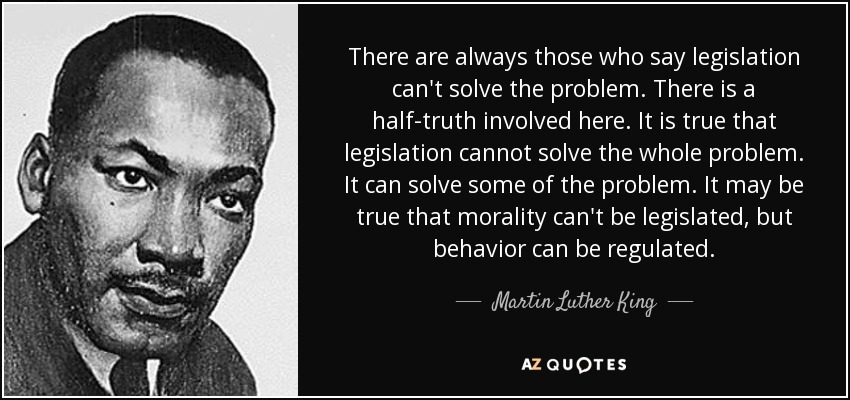
That whenever a system is run in an authoritarian manner, mistakes keep piling. One on top of the previous one. Constituting the dead-weight which will eventually sink the ship. That no artificial ‘New Man’ will ever survive for long. Yes, you may ‘legislate behavior’ – even against the true wishes of the general population, only the ‘new’ arrangement will not last for long. For a ‘legislation’ to be able to survive for any substantial amount of time it has to reflect the ‘true heart’ of those called to put it into practice. To ‘follow the rules’. That you ‘can restrain the heartless’ but for only as long as the ‘heartless’ remain a small minority.
Want to ‘change’ something? Then open people’s eyes first. Only that way they’ll eventually open up their hearts.
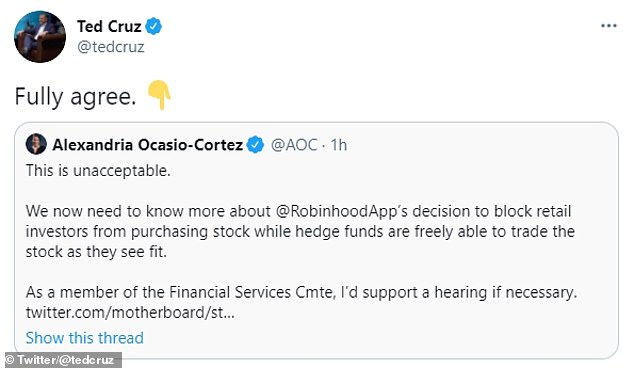
‘What about the spat between AOC and Ted Cruise? Where’s the link between what happened with GameStop and MLK’s attempt to regulate behavior?’
Both AOC and Ted Cruise hate the fact that there are independent agents. Besides them, of course. That there still are people who call their own shots. Private companies they cannot control, media venues, independent authorities… The ‘AOC’-s and the ‘Ted Cruise’-s of this world hate each-others guts but have more or less the same convictions.
That they are right – and everybody else is wrong. And that there must be a way! That there must be a way, a ‘rational’ way, in which their righteousness may be imposed upon the rest of the world.
That ‘rational’ way implying two things. Control over the ‘material’ resources and control over people’s minds.
That’s why the communists had ‘abolished’ private property. That’s why the (no longer free market) contemporary capitalists are OK with extreme wealth polarization. As long as they on the right side of the ‘in-equation’, of course… That’s why education has become such a hot subject. That’s why control over the legislative process has become so important. Why controlling the markets – controlling them, not preserving their freedom, is paramount…
The only bright thing in this whole mess being that the two sides still hate each-other’s guts. Which gives us some more lee-way.
Time to understand that for progress to be possible we need to take care of our roots. To ‘conserve’ them! Time to remember that ‘pruning’ needs to be done carefully.
That we have to ‘cut’ only what’s ‘wrong’, not everything we don’t like.
How to tell those two apart? ‘Humility’ comes very handy in these moments…. Freedom isn’t for free. Nobody is free by itself, only together. Those who really want to be free must start by respecting each-other. That’s how mistakes are avoided. By asking for a second-opinion. By listening to what others have to say on the matter. That’s how normalcy is being defined. And preserved. How we learn what’s ‘wrong’. How to tell what works from what needs to be pruned.
I cannot wrap this up before giving you a fine example of how ‘propaganda’ works. It starts with cutting up the truth. By actually pruning it to fit the purpose. Then let’s our already primed brains to do the rest.
“Crows are the hominins of the bird kingdom,” “Like our own ancestors, they evolved proportionally massive brains by increasing both their body size and brain size at the same time, with the brain size increase happening even more rapidly.” Dr. Jeroen Smaers
Crows have also witnessed our evolution.
All life transforms its habitat. Living things actually pass ‘segments’ of their habitat through their digestive systems. Digest them. Consume the useful components and discard the rest. And, finally, excrete whatever their metabolism had turned the useful components into. Urea and carbon dioxide, to name but a couple. For us, mammals. Other living creatures contribute something else to their environments.
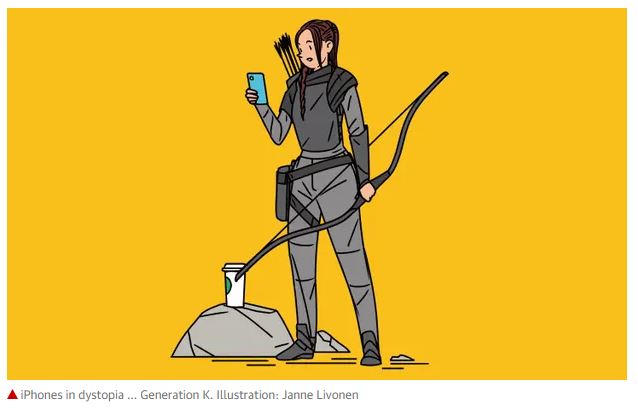
“The most common name this group is given is Gen Z; I call them Generation K, after Katniss Everdeen, the determined heroine of the Hunger Games. Like Katniss, they feel the world they inhabit is one of perpetual struggle – dystopian, unequal and harsh.”
Each successive generation has to make do with the situation they had inherited from the old one. And whatever it ‘builds’ on top of that will constitute the starting point for the next one.
We – those born between the early 50-ies and the middle 70-ies, and who constitute the vast majority of today’s significant decision makers, have had a ‘once in the entire history’ opportunity. The fall of the communist regimes almost all over the world had lifted many of the ‘practical’ hurdles left around from the previous generations. We had been freed from all limitations but those we’ve imposed – willingly and/or unwittingly, upon ourselves. So much so that Francis Fukuyama had described the situation as ‘the end of history’.
We’ve been, indeed, the first generation in modern history – or ‘contemporary’?!?, which didn’t start a ‘wholesale’ war… if we discard the ‘war on terror’! Or that ‘on drugs’…
The point being that we’ve failed. To use the huge opportunity presented to us. By Lady Luck… our fathers had done nothing but continued the traditions imposed upon them by their fathers…
We, on our turn, don’t have that excuse. We didn’t have had to continue anything… Conditions had been perfect for a fresh start! Yet we had ‘preferred’ to ‘carry on’… As if we had learned nothing from what had just happened!
Fukuyama himself, after having been lionized by his peers and then contradicted by Clio, had ‘relapsed’. After prophesying that ‘liberalism uber alles’ he had recently attempted to explain away his failure using ‘the need for recognition‘.
In fact, he wasn’t exactly wrong in 1989 – we did have a chance to move in that direction, nor is he totally off the mark now. ‘The need for recognition’ did play a role in our failure. Fukuyama – along with the rest of us, had made the capital error of over-trusting his own intellect. Of convincing himself that ‘the world’ can be understood.
Hence predicted.
And who has to make do in the present situation? To deal with our failure?
As always, the next generation! Our children…
For the first time in 100 years, Britons are dying earlier.
“How absurd to imagine that something we can make could actually deliver us from problems we could not free ourselves from!” Dr. Allen Ross, Dead Idols or the Living God
According to Abraham Maslow, people’s lives are ‘staged’. During the first four, each individual ‘must’ – ‘inside’ whatever circumstances Mother Luck had granted them, provide for their ‘needs’. Only after they had reached the fifth stage, individuals have the opportunity – but no ‘obligation’ other than that each of them impose upon themselves, to ‘reinvent’ their own personae. Maslow had used ‘self-actualization’ to describe the process.
In religious terms, the whole thing is known as ‘coming to peace with oneself’.
No more ‘absurdity’ here! There’s so much each of us can do in order to move ‘forward’…
‘And where is this famous ‘forward’?!? How are we, individually and/or collectively, to determine which is the ‘good’ direction?!?’
Is our ‘imagination’ good enough to come up with a solution for the “problems we could not free ourselves from”?
Is ‘induction’ a comprehensive enough solution? Or ‘too much of a good thing’ will never fail to become ‘bad for you’?
Confused?
Let me put it another way.
‘One size fits all’. How many times have you been really satisfied by such a ‘solution’? Do you really think an ‘idol’ fashioned by a carpenter – by the most talented carpenter, even, will ever satisfy the needs of at least one blacksmith?
‘But how about the idols fashioned by Plato’s king-priests?’
To answer this question – this excellent question, if I may say so myself, we must turn back to Dr. Allen Ross’ Dead Idols. To the difference between the Dead Idols and the Living God, to be more precise.
‘Criterion for what?’
If you pay close enough attention to what’s written above, you’ll notice that not passing the falsifiability test doesn’t mean than an assertion is false! Far from it, actually! Not passing the falsifiability test – ‘if a claim is compatible with all and any states of affairs’, only means that that claim is both ‘true’ and unscientific! Simultaneously true and not scientific!
‘And what has any of these to do with God?!? With the Living God or with any of the Dead Idols humankind has built for itself? And later discarded?’
I’m afraid you’ll have to come back for the answers. Or, to put it differently, I’ll gladly welcome you back!