
The sole difference between the living and the non-living is the fact that only the living is able to die.
Which death is the prerequisite for evolution!
The sole difference between the living and the non-living is the fact that only the living is able to die.
Which death is the prerequisite for evolution!

Get a vaccine, wear a mask…
“You can’t deprive others of their liberty without forfeiting your own. Liberty is lost with every person seeking to control others for their comfort and sentiment.”
Getting a vaccine and wearing a mask are sensible things to do, right?
Establishing a free environment, where all individuals might enjoy their liberties, is also a sensible thing!
For the simple reason that even a casual examination of history provides ample proof that freer societies fare far better than those which curtail individual freedoms.
Simpler said than done…
Mention the mandatory mask and the imperative advice to get vaccinated to those passionate about individual liberty and you have a hornets’ nest on your hands.
Or maybe this is an excellent occasion to discuss the ‘gap’ we constantly need to bridge between individual freedoms and a free society?
Can you have a free society composed of slaves?
The answer depends on who gives it to you.
I’d spent the first 30 years of my life under communist rule.
My country, Romania, was declared, by those who were ruling it at that time, as being free. Both domestically and internationally.
The only free individual was the ruler. Nicolae Ceausescu. He was the only guy who could do as he pleased. And only for a while… Until 25 December 1989…
In the end, the regime had crumbled and the only ‘free’ individual had met with the consequences of how he had chosen to use his freedom.
So no, you cannot have a free society when one individual, or a group of individuals, impose their will on everybody else.
‘Your liberty to swing your fist ends where my nose begins’
Otherwise put, if you refuse to get vaccinated/wear a mask you might be instrumental in getting me sick. Or dead.
‘Might’! It’s the ‘might’ part which troubles you!
Why should you shoulder a minimal risk/discomfort for my safety? Specially when you’re not convinced that my safety is in danger… Or, maybe, you’re thinking ‘let him take whatever precautionary measures he considers to be necessary!’
Because of India, that’s why!
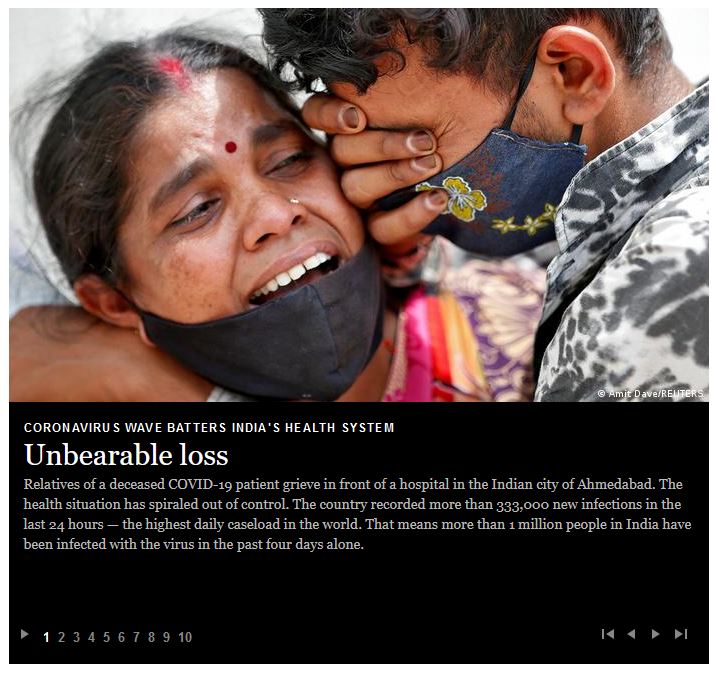
Do you consider present day India to be a free society?
Do you consider that people currently living in India are truly enjoying their freedom? Today?!?
And no, I’m not going to contrast what’s going on in India with what the Chinese government had done.
First pretend nothing had happened then lock up the entire population.
No!
I’m going to contrast what’s going on in India with how the ‘other’ China had reacted to the Covid pandemic. Or with the South Korean response.
Different economic realities… Different cultures…
Maybe!
But also different levels of economic and social disruption!
Don’t tell me that what’s going on in today’s India won’t have repercussions!
For a while, after WWII, many in the Eastern part of Europe were convinced that, soon, ‘the Americans will come’.
And save them from communism.
At the end of the Korean war, most of those hopes were dying away.
Whichever were still alive had been buried at the end of 1956. When the Soviets had occupied Budapest. And nobody lifted a finger…
The erstwhile hopeful had adapted to the new reality. Changed tack …
Instead of hoping that America will eventually deliver them from communism, they saved themselves. One way or another, they left their countries and pursued the American Dream in America proper.
They somehow reached those shores – welcoming shores, in those times, set to work and made it.
You see, in those times the American Dream was not as much about becoming rich as it was about becoming ‘your own man’. Being rich was considered useful, indeed, only it wasn’t seen as a goal in itself.
As to how to do it, things were crystal clear. Luck was optional while hard work was deemed essential. And, often enough for people to become convinced, things went on as expected!
‘Find what you’re good at, work hard and, sooner rather than later, your dream will come true’.
And it did. For many enough so that achieving the American Dream was considered to be the norm rather than an exception.
Maybe not for everybody. But for many enough so that Regular Joe was convinced that hard work and determination will take you places.
Is this assumption still valid today?
When so many of the well paying jobs have been exported?
When it’s far easier to make money by investing already owned capital than it is to work your way up the socio-economic ladder?
A lot of people point their finger at those who prefer to take hand-outs instead of accepting minimum wage jobs.
On the face of it, it doesn’t make much sense, does it?
No matter how generous, hand-outs will never be large enough for a comfortable life. While hard work will, eventually, take you there.
Are you sure about that? About hard work eventually taking you ‘there’? In the present conditions?
Furthermore, the former American Dream was about about giving your best before expecting Fate to reward your efforts.
Today’s mantra, ‘greed is good’, had completely altered the premises.
‘Get as much as you can, give as little as possible’ has become the new modus operandi.
What?!?
Maybe put in this way it will be easier to recognize.
Buy low, sell high.
‘Profit maximization’.
You see, using fancier words, those who prefer hand-outs to hard work do nothing but obey, intuitively, the law of the diminishing returns.
Then hand-outs should be drastically reduced!
That’s, indeed, one way of solving the problem…
Except for another ‘rule’.
You catch more flies with honey than vinegar!
But this is about ‘flies’, not ‘people’!
Yeah, right… as if people were less intelligent than flies…
You see, Henry Ford had found a way out. By dramatically increasing the ‘benefits’ extended to his workers he had managed to retain a stable work force. And, an unforeseen consequence, he had set in motion the wheels of the consumer society. The very economic set up which had made possible the fulfillment of the American Dream.
Currently, solvent demand is drying up.
Unnoticeably, for now.
For as long as credit will take up the slack, the evidence will remain under the radar.
But ‘evidence’ has the bad habit of hitting the fan.
Exactly at the worst possible moment…
Meredith Turits, Is extreme working culture worth the big rewards?
BBC Worklife, 27th April 2021
‘Japanese’ logic:
If somebody can do it, I can too.
If nobody could do it, I will.
‘Romanian’ logic:
If somebody can do it, let them do it!
If nobody could do it, why should I?
These two capture rather accurately the respective Weltanschauungs.
There are two things which bother me, though.
Once a Romanian determines that something must be done, they will find a way. No matter how unconventional…
It’s not any lack of individual self-confidence which keeps Romania back…
Secondly – but, to me, far more important,
who gets to determine whether ‘it’ is worth doing?
The doers themselves or somebody else?
And what governs the relationship between the two?
Is any mutual respect involved there?
For some reason, this whole thing made me remember Oscar Hoffman’s words.
‘Logical correctness isn’t enough. For a sentence to be actually true, it also has to make epistemological sense’.

This book represents Djuvara’s thesis for his 1974 Doctorat d’Etat.
There are two main ideas which are to be pointed out here.
A first one hidden under the distinction he identifies between ‘culture’ and ‘civilization’.
The second being the bread and butter of his thesis. That civilizations are initiated in one place, diffused/exported for a while and then replaced – or led further, depending on how one chooses to interpret the facts, by people until then living somewhere on the fringes of the civilization they are replacing/refurbishing.
Nothing really new, right?
‘Cyclical History’ wasn’t invented yesterday. And certainly not by Neagu Djuvara.
Well, Djuvara’s ideas – like everybody else’s, are nothing but ‘overgrowth’. Things which sprung in people’s minds ‘on top’ of what those people had already learned. Found out. Or, of course, both.
In a sense, what I’ve said in the previous sentence is the very condensed abstract of Djuvara’s second ‘main idea’.
The first, the ‘hidden’ one, – again, in an extremely abridged version, being that ‘history, as a narrative, is nothing more and nothing less than what historians choose to make of the facts they had learned about’.
Too blunt?
Well, first and foremost, I’m an engineer. Not a fancy pen-pusher…
OK. Let’s go further.
I’m going to illustrate, briefly, Djuvara’s main thesis by presenting his version of what had happened in Europe. What had started as an European phenomenon, more precisely.
The Roman civilization had grown at the periphery of the Ancient Greece. And, eventually, took over more ‘space’ than the Ancient Greeks.
The Russian civilization had grown at the periphery of the Byzantine/Orthodox one and eventually took over. Or, at least, attempted to…
The Holy Roman Empire of German Nation ‘recycled’ – or, at least, attempted to, the ‘ancient’ values and traditions.
Great Britain had grown at the periphery of Europe until it took over the whole world. At least for a while…
The US, which had started as a British colony, had grown into the most powerful nation known to man.
‘OK, I understand what you meant by trailers and trailblazers. Some of those who trail might end up trailblazing.
Do you want to add anything?
Is there an actual point to your post?’
Yep.
As they say about the market, ‘past performance is no guarantee about the future’.
The fact that things have happened as they did is no guarantee that they’ll keep unfolding in the same manner.
In a sense, Fukuyama was right, after all…
Even if not in the sense he thought it!
According to “The end of history” people – all over the World, had realized the relative merits of ‘liberal democracy’ and ‘capitalism’. Which were going to be put in practice, effectively marking ‘the end of history’.
Thirty years past that moment, it seems that things aren’t going in that direction.
I’m I contradicting myself? Who’s right, after all?
Djuvara? Since history doesn’t seem to have stopped?
Or Fukuyama, but for some other reason? Than the one advertised by him?
‘History, as a narrative, is nothing more and nothing less than what historians choose to make of the facts they had learned about’
Then, if history is ‘man made’, what about the future?
Can we really make it? Predict it?
‘Make it’, for sure!
If not us, then who?!?
‘Predict it’… that’s something totally different!
There are signs, though.
First of all, Djuvara had described something which can be compared with fire burning in a savannah. It starts in one place, burns for a while… and then starts up some place else. Until now, no fire – no fire known to man, had burned any savannah so thoroughly that nothing was left for a ‘second’ fire.
Secondly, Fukuyama said that history will end when all humankind will sync. When all ‘civilizations’ will be run according to the same paradigm. According to the liberal democratic and capitalist paradigm, in Fukuyama’s vision.
We’re still far from that.
Only there is one paradigm which is willing to play that role! To fill those shoes…
The ‘greed is good’ paradigm!
Or, if you don’t like to think in ‘monetary’ terms, the ‘my version is the only right one’ paradigm.
The problem being that these two work in concert.
They are two facets of something called ‘intellectual arrogance’.
I’ll come back to this notion sometime in the future.
Now I’ll end up telling that there’s not much left of the ‘savannah’.
When things were unfolding as Djuvara described them, the planet itself was more or less ‘virgin’. Unexploited. Unoccupied.
Human culture used to be diverse. Ideas were developing. Traded. From one place to the other. From one culture to the other.
Nowadays, much of the planet – our home, is occupied by the, more or less, same civilization. And by an increasingly similar culture.
Nothing inherently good nor bad here, mind you!
If we still have no definitive history, then the future hasn’t been written yet.
It’s up to us to choose the right trail.
For no other reason than the fact that there are very few trails left for us to burn!

Attempting to value individualism over collectivism is similar to trying to establish which came first, the chicken or the egg.
Having experienced both – collectivism and individualism put in practice as political principles, I have noticed that neither extreme is capable of working in a sustainable manner.
Communist regimes had fallen one after another.
Fascist regimes did the very same thing.
Pirate republics could never resist for long.
Coming back to what is happening in the US, I’m afraid very few people are aware of how much collective thinking had been embedded in the American Psyche. The good kind of collective thinking…
Americans go to church. A place where you go to to be together, not alone.
Americans used to help each-other. Charity used to be a big thing. Slowly, it had become a dirty word.
And so on.
Individuals can not exist on their own. They need each other to survive. And to thrive.
Collectives can not last for long unless the individuals who constitute them do respect each-other. Help each-other maintain and develop their individuality.
As simple as that.
Imagine having a festering boil. On your ass, for good measure.
You may take to the doctor, for treatment.
Or you may wait, hoping your organism will be strong enough to heal itself.
This being your call.
Nobody else but you has anything to say about this situation.
Let’s say you have chosen to go to the hospital.
Once there, the matter has gotten somewhat ‘out of your hands’. You still have the last word but the doctor calls the more important shots. Pun indended, of course.
He can simply open up the boil, put you on a course of antibiotics and send you home.
He might decide to check you up and see whether the boil is a symptom of something deeper.
He might attempt to rip you off by ordering, all at once, a host of complex tests and of fancy treatments.
Or all at once.
Cut up your boil, set you on a course of antibiotics, order a decent set of tests and still rip you off.
‘Is there a point to all these?’
Yep!
How the ‘good’ doctor will choose to treat you is the consequence of how you have chosen him. And of how the community you belong to had chosen to organise its health system.
But the more consequential decision, whether to go to the doctor in the first place, is yours.
I’m not going to analyse the factors you have to balance – we’d go back to how the community you belong to had chosen to organise its health system.
I’m only going to parade the possible outcomes.
A nice scar on your butt and a decent tab for you – or for your insurer, to pick up on your way out.
Acompanied, hopefully, by an otherwise clean bill of health.
A nice scar, and a clean bill of health, accompanied by an outrageous invoice.
These being the ‘good’ outcomes.
The doctor might find out, after reading the test results, that you also have, say, a blood disease. One perfectly treatable by modern medicine. But which would have easily killed you if you had waited much longer.
The doctor might also find out, after reading the test results, that the boil is the symptom of an incurable disease. One which will kill you for sure. Only now you’ll die in the relative comfort of the available paliative treatment you can afford.
Or you might choose to nurse your boil at home.
Get out fine. And a lot cheaper!
Die of an apparently unrelated disease six months later.
Or pass out because of a sepsis which had eventually became untreatable. Due to your own prevarications….
‘And what has the boil on my ass to do with Covid?!?’
Covid is a boil on our collective ass.
We might decide to treat it ‘on the go’, hoping that on the ‘other side’ our lives will return to normal.
Or we might decide to use it as an opportunity!
An opportunity to clean up our act….

“The Texas educational system inundates the children with the almost mythical stories of Sam Houston, Stephen F. Austin, and other Texan heroes. This perpetuates the feeling that Texans are superior to others. Social Identity Theory claims that in-group biases are a direct need to feel superior to another group. By reinforcing such ideals of Texas history at an early age, they are indirectly making Texans feel superior to other states.”
Don’t mess with Texas, Justin R.Erenkranz, retrieved on February 18, 2021
In fact, Texans are so proud of their state, and so confident in themselves, that their power grid, run by ERCOT – Electric Reliability Council of Texas, has no connections linking it to the outside world.
Yes, your eyes are OK. Texas – most of it, anyway, cannot import electric energy. No matter what!
For those who know anything about power management, this is insane.
For the rest of the people, this sounds like gibberish.
Who cares where the power comes from?!?
Until it stops coming… exactly when you need it most!
‘OK. But surely, there are also other systems which are independent. And isolated. What about Hawai’i? It’s too far away to connect itself with anybody else and it’s doing just fine.’
True enough. And I can name a few more, easily. Only most of them are independent because they are isolated, not by design.
And, exactly because they are isolated, they are run with utmost care. More precautions are taken than in ‘normal’ situations.
‘Precaution’ meaning, in this case, spare capacity.
The responsible people running those systems make sure that, when push comes to shove, somebody is there to deliver the goods. The megawatts of power.
NERC stands for North American Electric Reliability Corporation. Which corporation, in December 2020, had released “a long term reliability study” maintaining that “ERCOT’s market and system operations have been successful over the last several years even as demand has continued to rise in Texas“. It was the same study which had mentioned that the grid was becoming “less flexible“….
Oops…
Reality is an Acquired Taste.
Past performance is not… John Brown, Forbes, 2016
Maybe we need to reconsider our infatuation with ‘just in time management’.
While ‘just in time management’ maximizes profits by streamlining inventory, it works its magic only when everything goes according to plan. And the stricter the streamlining, the harsher the consequences of anything not going according to plan!
As people in Texas have just learned.
And there’s something else which bothers me ever since I’ve started writing this post.
How much sense does it make to be able to pipe oil all the way down from Canada to the refineries lining the Gulf of Texas when you end up freezing to death because you don’t have enough electricity to operate those refineries?!?
And no, I’m not making fun of the ordinary people who suffer the consequences!
This being the moment when I feel the need to remind you that the author of this blog – that’s me, tries to asses the consequences of our limited consciousness. Of the fact that none of us knows much. And, furthermore, that very few of us admit that!
Which consequences might be – as too often are, tragic.
Specially when those who are not aware that their knowledge is limited happen to be invested with critical decision power.
‘Handicap’ has become a dirty word…
Somewhat strange, given the breadth of its meaning. Horses get handicapped in order to even their chances to win a race. Yachts get handicapped so that different makes might participate in the same race… In these situations, its an ‘honor’ to be handicapped…
Then why has this concept, ‘political correctness’, become so ‘popular’?
You might already be familiar with the ‘upfront’ explanation.
“political correctness has reset the standards for civility and respect in people’s day-to-day interactions.”
Rethinking Political Correctness, Robin J. Ely et all, HBR Magazine, 2006
I’m convinced there was something more.
Civility and respect haven’t been invented yesterday. We’ve been polite for quite a while now.
Yeah, only politeness had been invented, and polished, when society was way more hierarchical than in is now.
In those times, when a ‘superior’ told somebody ‘you idiot’ that somebody paused to think. The ‘idiot’ could not dismiss what the ‘superior’ had just told him. The ‘idiot’ really had to make amends. He was so busy trying to correct himself that he couldn’t allow himself to feel offended. If anything, he was grateful. The ‘superior’ had made the effort to help the ‘idiot’ improve himself instead of dispatching him altogether.
In modern times, even before PC had become fashionable, calling someone’s attention about how idiotic he was behaving only made him angry. Hence dismissive and unresponsive. In an era when all people had become peers, a new ‘manner of speaking’ had to be invented in order for ‘information’ to be made ‘palatable’.
The process had been successful.
So successful that the same approach had been used when dealing with other ‘hot’ subjects. Race, gender… ‘inclusion’ in general…
In fact, the process had become too successful for its own good!
Some of the ‘enthusiasts’ have reached the conclusion that ‘everything’ is open for reconsideration.
That ‘everything’ should be closely reexamined.
According to the ideological lenses worn by the examiners, of course…
Unfortunately, the end result is rather messy.
Instead of facilitating the dialog, the stiffer and stiffer set of ‘appropriate’ ‘rules of engagement’ has almost stifled any transfer of meaningful information.
“Despite this obvious progress, the authors’ research has shown that political correctness is a double-edged sword. While it has helped many employees feel unlimited by their race, gender, or religion, the PC rule book can hinder people’s ability to develop effective relationships across race, gender, and religious lines.”
Ibid.
Not only that people find it harder and harder to understand each-other, ‘things’ themselves become blurry.
Let me give you a recent example.
In the US, many of the ex-confederated States have started to reconsider the statues commemorating ‘famous Southern figures’.
The vast majority of which had been built between 1890 and 1950, during the Jim Crow era.
Simultaneously, like minded activists have recently toppled Edward Colton’s statue in Bristol, England.
Are these two ‘developments’ similar, as PC would mandate us to understand?
Jefferson Davies – a very ‘familiar statue’ in the US, had been the President of the Confederate States of America. A slave owner himself, he was a “champion of the unrestricted expansion of slavery into the territories.” And the statues glorifying him had been erected, during the Jim Crow era, as a reminder to the fact that the Confederation may had lost the war but things hadn’t change that much.
Edward Colston, on the other side of the Atlantic, had not been a slave owner per se. In the sense that he didn’t put slaves to work for him. He was ‘only’ a purveyor of slaves. He had ‘only’ kidnapped African people and then sold them, as slaves, on the other side of the Atlantic. 10 to 20% of which had died, in horrible conditions, during the voyage. As a consequence of his ‘efforts’, Colston had become a very rich man. He had ended his involvement in the slave trading business some 30 years before his death – 1721, and used much of his wealth for charity. His statue had been built in 1895 and many of the buildings which had been raised with the money bequeathed by him bear his name. Some of those buildings are used to house schools, others as almshouses.
Now, do the statues of these two people stand for the same thing?
And no, I’m not trying to discern between two villains!
Each of them had done an immense amount of harm and had produced endless suffering. People are still smarting to this day because of what both of them had done.
Only there are some differences between them. One had also done some good in his life. While the other had been used, after his death and without his consent, as a symbol. After he had, directly, kept people in slavery he had also been used to further the sufferings of black people.
Are we capable of seeing any of these differences?
Or are we too angry to differentiate?
Do you remember why we had invented political correctness in the first place?
 nicichiarasa