Archives for category: authoritarianism

donald-trump-andy-borowitz

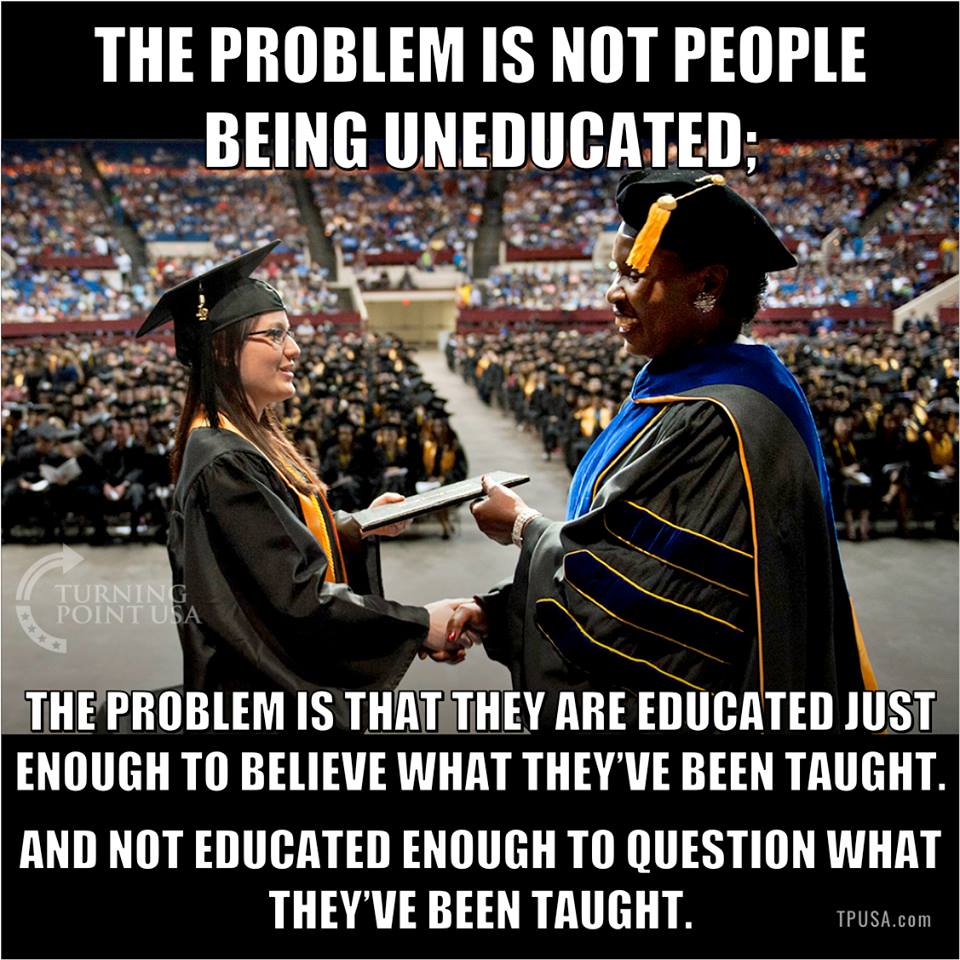
Besides the fact that calling someone an “ignorant” is a very ‘Trump’ thing to do in the first place, what if the real problem is that we have allowed ‘it’ to become a ‘system’ in the first place?

This way, after the process of learning and teaching has become a ‘system’, the ‘open market’ for ideas has become a very well – actually very badly – controlled oligopoly.
Learning means seeing and understanding the world around us. Teaching means passing around, and forward, the above mentioned knowledge and the meaning we’ve made out of it. Which ‘passed around knowledge and meaning’ shapes the way the ‘students’ go further. Deepen the knowledge and build future meaning.
In fact the very breadth of our species future depends on how past learned knowledge and built meaning had been passed around.
And what we have today, the current ‘social unease’, is the product of the manner in which we have been taught to see the world. Of the meaning we find in it.

Trump, as a social phenomenon, is nothing but yet another symptom of the current ‘malaise’. The incapacity of the contemporary society to make room for everybody is, simply put, a consequence of  information no longer flowing freely around. Of information being, tighter and tighter, controlled by the ‘system’.
The simple fact that Trump, if elected, has promised to put his stamp on the ‘system’ only proves this point…

Coming back to the ‘system’, the only way to fix it is to open it up, widely. If we continue to allow ‘it’ to divide us into ‘insiders’ and ‘outsiders’ (read ‘properly educated’ and ‘ignorant’) we will actually perpetuate ‘the problem’.

chded7au4aadm5

From time to time certain ideologies spread far enough to produce noticeable results.

“Trump: ….You know, I’m automatically attracted to beautiful — I just start kissing them. It’s like a magnet. Just kiss. I don’t even wait. And when you’re a star, they let you do it. You can do anything.

Bush: Whatever you want.

Trump: Grab ’em by the pussy. You can do anything.”

After the recordings had been ‘miraculously’ unearthed the ‘divide’ has moved considerably.

“Republicans Desert Trump in Droves” but he still enjoys a lot of support:

“Donald Trump can easily convince most objective observers of both parties that what he has said and done in relation to women on a personal level is not as objectionable as what Bill and Hillary Clinton have said and done in relation to women on a personal level.

Although it is true that Trump is not running against Bill but against Hillary, what Bill said and did as president is relevant since Trump is running for the office once occupied by Bill, who set the bar for presidential relationships with women lower than any other president (with possible competition from Franklin D. Roosevelt and John F. Kennedy before the advent of the Internet).”

“Keeping in mind that the Democratic Party has imposed Hillary on the electorate as its choice for the highest office in the land, we must also take note of how Hillary and Donald dealt with their spouse’s respective but disrespectful dalliances. When Trump found out about the alleged infidelity of his second wife, he didn’t maintain the relationship for ulterior motives,  but divorced her. When Hillary found out about the dalliances of her husband, she not only:


Historical facts do suggest that a certain number of ‘powerful figures’ did have an excess of testosterone which manifested itself in a less than an ‘elegant’ manner.

From Julius Caesar (who, according to Suetonius, was described by Curio as “Every woman’s husband and every man’s wife”) to Bill Clinton we have a huge list of ‘powerful’ public figures who couldn’t ‘keep it’ in their pants.

And not all of them have been involved in politics.
Jimmy Saville, Bing Cosby and Jeffrey Epstein are just a few names that came to my mind.

Only there is a small but fundamental difference between all these and “The Donald”.

Their ‘indiscretions’ were perpetrated more or less secretively and no more than a finite number of people – women or men – were abused by each of them.

Meanwhile Trump not only has no qualms when bragging about his habits in an almost public manner – the tape was recorded in the context of a TV show – but he would also extend his ‘greetings’ (“grab ‘hem by the pussy”) to all “beautiful” women that would happen to come close to him!

He actually acts as a standard bearer for what is currently known as “rape culture“!
Effectively offering ‘theoretical background’ for future ‘transgressions’.

In this respect there is no real difference between those who maintain that Trump’s words are not so bad as Bill Clinton’s actions – simply because they want to keep Hillary Clinton from returning to the White House – and Hillary Clinton herself – who supported her husband in order to remain there.

evangelicals-support-trump

And this is the second connection between Trump’s words and extremist positions.

“All women since Eve, the world’s first sinner, were born in sin and sinners by birth became more or less sinners by practice.” (Luke 7:36-50) but also “Somalia is in the grip of famine and chaos but officials there are inspecting bras”

You see, the first rule of extremism is to ‘herd’ people together according to one obvious characteristic and settle their fate according to that characteristic – without paying any attention to the individual circumstances of any of those involved.

Hence all Muslims must be vetted, all immigrants must be deported, all beautiful women ‘grabbed by their pussies’…

Small wonder that we are now living in a world where ‘gang rape’ has become such a common occurrence…

rs_560x373-150317085235-1024-dolce-gabbana-gang-bang

“Finally, let me say that religious extremism is the other face of political despotism. We cannot get rid of the extremism before we end the despotism.

Democracy is the solution.”   (Alaa Al Aswany, When women are sinners in the eyes of extremists, The Independent, 2009)

Recent riots in the US and the need to respond in force to the ever growing number of terrorist acts happening in the Western Europe has prompted some to worry about the specter of a potential ‘police state’ that might be lurking somewhere in the future.

Those who have first-handedly witnessed what it means to live in a real police state have a dissenting view on this subject:

“I live in a bona fide, real world, living, breathing police state: the People’s Republic of China. I live, in short, in the real thing, not in the cartoonish caricature of a police state that people have in mind when they hear the term. . . . The role of the police in a police state isn’t to control citizens’ lives. That’s a myth that’s almost laughable. . . . The role of the police in a police state is to protect the power structure from change. That is it in its entirety. Anything which doesn’t endanger the powers that be is unimportant to the police. Anything which does endanger the powers that be is brutally suppressed. . . . I have more direct, personal freedoms here in China than I ever had in Canada. So do most Chinese people. The only freedom they (we) lack is the freedom to criticize the government in public. . . . A competent, stable, secure police state doesn’t need brutality to keep itself in power. It’s insecure states (of any kind!) that find the need to brutalize their citizens to ensure compliance.” Michael Richter courageously posting on his FB wall.

Having myself lived for 30 years in a real police state – one that was insecure enough to terrorize its citizens – I can vouch for what Michael Richter tells us.

On the other hand police, in every society, acts like an ‘immune system’. Its job is to maintain the status quo. Basically it tries to maintain the entire ‘organism’ in ‘working order’. And here come the differences.
If that society is a normal one the police tries to maintain an ‘unbiased’ order.
If the society itself is biased the police will favor one side of the society.
Those who are favored by the police will consider this to be ‘normal’. Those who feel the brunt of the police action will reach the conclusion that they live in a ‘police state’.

Evolutionary theory teaches us that living things are able to maintain, for quite long time, a certain level of in-balance. For instance, warm blooded animals are, for most of their lives, either hotter or colder than their environment. And yet they manage to survive.

If the balance is not tilted too much, in either direction.

Same thing with the ‘police state’.

Basically all societies are biased. And all police forces in the world have to guard an in-balance or other.

As I mentioned before, as long as that in-balance is manageable – and the population at large is OK with it – the police can do its job without stepping over too many toes.

But if the in-balance that the police has to maintain becomes unmanageable, more and more people will consider they live in a police state and, at a certain point, something will break. The people’s acceptance of the police, the police-men’s willingness to impose that in-balance over their fellow citizens or even both at the same time.

This is so obvious that even the Ancient Romans issued a stern warning on the subject.

In reality ‘Fiat justitia, ruat caelum’ doesn’t mean “Let justice be done though the heavens fall.” but ‘Let justice be just, otherwise the heaven will fall upon your (collective) head’.

takes-a-village-quote

I’ve spent the first 30 years of my life under communist rule.

One of their many ‘mantras’ was: ‘Children are the future of mankind’.

Communist rule had brought about so much happiness in Romania that people had stopped making children.
Concerned about the future the communists had decreed that from then on abortion was to be considered a crime – after it was freely available until that time,  October 1, 1966.
As a consequence more than 10 000 women died after botched abortion attempts – all other methods for birth control had been banned also.
Add to those deaths the individuals, mostly youngsters, killed while attempting to flee communism by sneaking across the borders.

But there was one good thing that communist rule had brought to the people. Not that much because the communists really cared about the fate of the individuals but because they needed skilled laborers in order to put their plans into practice.

Schooling was free.
You could learn as much as you wanted without having to pay a dime.
One had to pass some exams, positions were limited for higher education, but if you were smart enough and diligent enough you could go really high. Specially in the area that is currently known as ‘STEM’. ‘Humanities’ were somewhat off limits, because one could get ‘funny’ ideas when delving too deep in that area but STEM was OK.

Fast forward to our days.

Half of my University mates – I have a MSc in Mechanical Engineering – have emigrated right after Ceausescu was toppled while political power in Romania has fallen under the constant grip of a small coterie which doesn’t really care about what’s going on and/or has not enough intellectual flexibility to understand that we are currently running towards a dead end.

In the end the ‘good’ thing has proved to be a poisoned apple. By tuning the schooling system towards their own goals the communists had created many generations of  superb engineers – who were welcomed by the ‘greedy capitalists’ – but also had completely discouraged independent thinking – the kind needed to breed honest politicians and effective public figures, if you can accept those concepts as anything more than empty words.

Gazing over the borders I became even more despondent.

Forget, for a minute, about child pornography, sweat-shops and so on. These are absolutely horrible but we might console ourselves with the thought that those who are involved in them are either mentally disturbed or blinded by greed.

But something like this?

rape threats

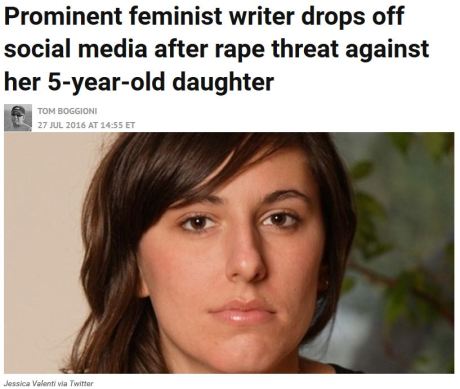
Supposedly a feminist writer is followed by either like-minded people or opponents of her ideas only both categories belong to the wider category of ‘intellectuals’ – people concerned with ideas, human rights, philosophical thinking, etc., etc….
In this context to threat a mother that you are planning to rape her child is way above anything that was imaginable until this moment.
It’s as if being able of sophisticated thinking is no longer one of the venues towards becoming a better person – by simply being able to understand how much pain is produced by evil or careless behaviour.

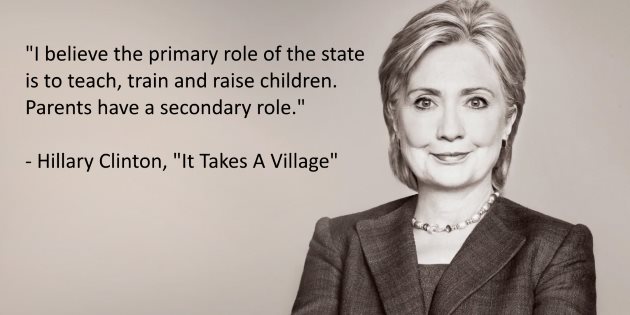
Then I came across the meme at the top of my post.

I must confess that I don’t like her. For various reasons that do not fit here. Enough to say that while watching the DNC 2016 I had the distinct impression of being transported back in time to one of the congresses organized by the Romanian Communist Party.
Because of my dislike of her I had the tendency to believe that she had actually wrote that.

trust-but-verify-quote-2

So I did that.

false

“While it’s true that Hillary Clinton published a book in 1996 called It Takes a Village: And Other Lessons Children Teach Us, it does not include the above-displayed quote, and Clinton (a parent herself) has not said at any point that she believes that children should be raised by the state with parents taking a secondary role.


OK, some of you will tell me that Snopes is leaning towards the left and that you cannot always trust its findings.

I can agree with that. Sometimes you should not believe your own eyes, let alone what you read over the Internet.

But my argument still stands.
What has happened to us?
Why are we so willing to involve even our children in our political lies? It doesn’t matter here who lied – Snopes or those who ‘cooked’ this meme…

What are politics for if not for securing a future for our children?

What kind of future can be build on lies?
On this kind of lies and on this kind of threats…

When are we going to understand that the state which side-lines the parents is a fascist one – fascism and communism are close authoritarian cousins, that no one can survive for long outside a community and that the community, as a whole and each of its members, fare better if all its members have a real chance to develop their potential?

Education and health care should not be treated as ‘individual rights’.
It is obvious to the naked eye that societies who take good care of their members while simultaneously respect their freedom fare better than those who let their members fend for themselves without helping them train for today’s job market and without extending them any safety net.
We keep saying that we need better skilled individuals and do nothing about it. We keep saying that in a free market there are risks that have to be taken yet we step back when a risk taker who happened to have failed, honestly, asks for our help.

OK, I understand. The communists dissuaded their children from studying ‘humanities’. Simply because they might have started to ask the very same questions that I’m asking today.

But what happened to the rest of the world?

Who is thinking about the future, beyond planning for future cash-flows (extremely unreliable in the first place), anyway?

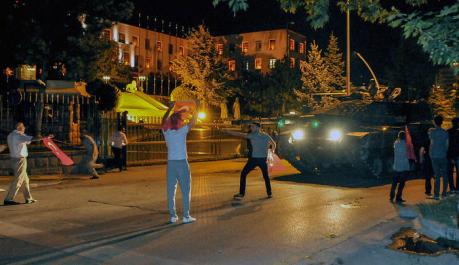
Recep Tayyip Erdogan saved his political ass last week-end by urging his “supporters to take to streets in protest of coup”
gettyimages-576527614

Supporters of Turkish President Recep Tayyip Erdogan react to a Turkish military tank in front of the Turkish Parliament July 15, 2016 in Istanbul, Turkey.

Which they did and the coup eventually failed.

Leading some observers to salute the maturity of the Turkish democracy:
“The most valuable outcome of last night’s events is that many people who are not AKP supporters stood up for democratic values despite the recent crackdowns on the opposition, and despite the tension and the polarization of the country.” (Erol Önderoglu, Turkey’s Reporters Without Borders representative who is currently on trial on terrorist propaganda charges after participating in a solidarity campaign with a pro-Kurdish newspaper.)

“These people do not support Erdoğan, but they oppose the idea of a military coup. Turkey has a history of very painful, traumatic military interventions, so I was not surprised to see such united opposition to this attempt.” (an academic who wished to remain anonymous)

But ‘not everybody is happy in paradise’.
“Everyone spoke out against the coup last night and that gave me hope” … watching events unfold today this hope has shrunk quickly. Last night there was the possibility that the government would use this to return to a more unifying language, to return to the peace talks, to unite the country. But today it looks like they will use [the coup attempt] simply to consolidate power.” (the same anonymous academic)

What’s going on there? Is Turkey a real democracy?
Or, if we dare to look from the other side, ‘what’s wrong with contemporary democracy’?

Is it enough for elections to be held regularly and the votes duly counted for a country to be called ‘democratic’?

I’m afraid not.
Communist Romania did have regular elections, where a huge proportion of the people rubber-stamped the party line.
Putin is currently serving a third mandate as Russian president, after paying lip service to the Russian constitution and letting Dmitry Medvedev fill in between 2008 and 2012.
No major irregularities were noted at the time of the voting in Russia when Putin was reelected but somehow I cannot consider the process fully democratic.

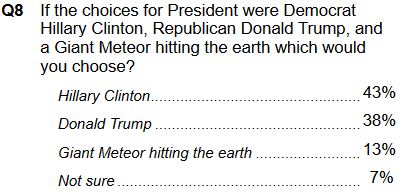
Even in the United States things are no longer what they used to be. Both major parties have put forth candidates that are seen unfavorably by a majority of the people. So unfavorably in fact that 13 % of the registered voters would rather see the Earth being hit by a giant meteor than any of the two as President.

unfavorable trump clinton

Clinton trump unfavorable

clinton meteor

Public Policy  Polling, June, 13, 2016, Raleigh


So, again, what’s going on here?

I’m afraid that what has been known as ‘democracy’ is being slowly eroded to ‘mob-rule’.

You see, in a really democratic situation you get the ‘real deal’ with ‘all the trimmings’ while when having to deal with ‘mob rule’ all you get is some ‘window dressing’.
Or, as the Romanian saying goes, on the outside you are greeted by a white picket fence but once inside you’ll have to deal with a white fanged tiger.

Let me explain myself.
Theoretically democracy is a situation where everybody has some, even if minute, influence over the fate of the community to which he is a part.Practically it means “government by the people; especially :  rule of the majority”.

I’m almost sure that by now most of you have already figured out what I’m driving at.

‘Rule of majority’ can be more dangerous than a regular dictatorship if that majority has been improperly led into voting the way they did.
A ‘dictator’ might be wise enough to know that if he drives the situation way beyond the plausible something will eventually snap but someone callous enough to lie to an entire society doesn’t have such qualms. In fact this is the explanation for why not all authoritarian regimes end up in complete failures.

On the other hand most of them do exactly that while no democracy has failed yet, as long as it maintained its democratic character.

Why? Simple.

Running a complex system – and a country is a very complex system, is a matter of setting goals and avoiding making mistakes.

And while setting goals is important, avoiding mistakes – specially catastrophic ones, is paramount.

If goals are chosen improperly – not bold enough, for instance, or even misguided, that society will experience a ‘hiccup’ but if that society is led into a dead-end then it might never recover. The ‘funny’ thing here being that in many instances the authoritarian leaders were quite good at setting goals but almost always sooner or later ended up in a ditch because they were very poor at avoiding potholes.

But how come democracies are better at avoiding grave mistakes than centralized administrations?
‘Four eyes see more than two’, specially if they look in different directions.
Every authoritarian regime follows the cue of the authoritarian leader and tends to down-play, or even ignore, the rest of the problems. This tendency is accentuated by the fact that those positioned higher on the roster tend to be better insulated from the immediate effects of their decisions. So relatively small mistakes keep piling one atop the other until the heap cannot be balanced any longer.
On the contrary, in a functional democracy – where everybody has a real chance to bring his concerns to the attention of others, mistakes are not only easier to spot but also easier to avoid.
Only this cannot happen as advertised unless the members of a society have a healthy dose of mutual respect. Nobody is going to pay any attention to what is being said by a ‘pariah’. No matter how interesting, or important, that might be.

And this is exactly what happens in a ‘mob-rule’ environment. Nobody listens anymore to what ‘the other’ has to say. People allow themselves to be driven into separate herds and, once there, pay no attention to anybody else but their ‘own’ cattle-driver. Who not only that doesn’t have any respect for ‘his’ herd but usually doesn’t care for anything else but their votes. Reason would ask that he should pay close attention to the well being of his herd but since he is convinced that he can always attract new followers he will usually go for the ‘cheapest’ alternative – taking good care of a flock being more ‘expensive’ than luring some new ‘green horns’.

That’s how people become estranged from one another and end up with their eyes glued to the whip of the cattle driver. That’s how democracy becomes an empty concept.

That’s why an honest count of the ballots doesn’t mean much if the public discussion which preceded the voting wasn’t both free and meaningful.
That’s why reducing democracy to ‘rule of the majority’ is akin to putting the cart before the horse.

The real scope of the whole process being to openly examine as much information as humanly possible before starting to make decisions (vote), not to (artificially) build majorities around (charismatic?!?) political figures. Or should I rather call them by their rightful name? Con men?

I recently read an excellent article about how the ever-growing lack of trust in public institutions, governments and experts included, is generating aberrations like Donald Trump becoming the darling of a sizable proportion of the American Republicans.

collapse of trust in institutions

I’m afraid that all of us have contributed to this.

People who get elected to power use it to fulfill  their own goals yet continue to get elected despite the fact that many of those goals do not add anything to – and too many times even subtract from – the general well being.
People who, for various reasons, vote for those mentioned above.
Media pundits who fill the airtime with their versions of the reality, purposefully crafted to fit their own goals instead of honestly trying to present to the public what they have seen/understood of what had happened.

What’s bothering me most is that all of them are behaving in an absolutely ‘rational’ manner.
In the sense that all of them are convinced they are following the current mantra.
“Make the best of the opportunities at hand”

Given the current ethos – that only the pussies do not grab everything within their reach – each of those in places where they might be given things would act foolishly not to accept those ‘gifts’. If they might find a ‘legal’ way to do it.
And the Supreme Court of the US concurs.

“In a unanimous decision, the U.S. Supreme Court threw out the corruption conviction of former Virginia Gov. Bob McDonnell.

“There is no doubt that this case is distasteful; it may be worse than that,” Chief Justice John Roberts wrote for the court. “But our concern is not with tawdry tales of Ferraris, Rolexes, and ball gowns. It is instead with the broader legal implications of the Government’s boundless interpretation of the federal bribery statute.””

What happened was that former Gov. Bob Mc Donnell had accepted various gifts from a certain business man called Williams and then (because of them?) ‘set up meetings, hosted parties and called Virginia officials to discuss  a series of meetings to discuss aspects   related to William’s businesses.

Now, is this an example of corrupt behavior or not?

According to the Government and to the lower courts that have sat on this matter, it is.
According to the Supreme Court, it is ‘distasteful and even possibly more than that’ but not yet corruption. Or, at least, not in the way the Government has presented its case.

“But conscientious public officials arrange meetings for constituents, contact other officials on their behalf, and include them in events all the time. The basic compact underlying representative government assumes that public officials will hear from their constituents and act appropriately on their concerns — whether it is the union official worried about a plant closing or the homeowners who wonder why it took five days to restore power to their neighborhood after a storm. The Government’s position could cast a pall of potential prosecution over these relationships if the union had given a campaign contribution in the past or the homeowners invited the official to join them on their annual outing to the ballgame. Officials might wonder whether they could respond to even the most commonplace requests for assistance, and citizens with legitimate concerns might shrink from participating in democratic discourse.” Chief Justice John Roberts writing on behalf of the court.

The way I see it this is nothing but ‘hiding behind technicalities’.
From a formal point of view the Supreme Court’s decision is absolutely correct.
On the other hand almost everybody speaks out, some very vehemently, against ‘pork barrel politics’.

Yet nobody does anything when occasion arises. Forgetting that this is exactly what we, humans, are supposed to do. Make decisions and assume responsibility for them. Otherwise, if we only look out for pretexts to do nothing when those around us keep making ‘good’ use of whatever opportunities they identify, the whole world will soon become, again, encased in the kind of straight jacket Hitler and Stalin were trying to put on us.

Here’s another example.

Less than a fortnight from now the Republican and the Democratic conventions will likely nominate Trump and Clinton as their respective presidential candidates. Each passionately defended by their followers and viciously attacked by their adversaries.
Yet both almost equally disdained by the general public.

“More time on the campaign trail isn’t improving the image of either major-party presidential candidate, Hillary Clinton or Donald Trump, a new Wall Street Journal/NBC News poll finds.
Some 60% of registered voters held a negative view of Mr. Trump, the presumptive GOP nominee, compared with 58% in May. Some 29% viewed Mr. Trump positively this month.
Mrs. Clinton, the former secretary of state and presumed Democratic nominee, fared somewhat better, with 55% viewing her in a negative light, compared with 54% in May. One-third of registered voters held a positive view of her.” (Peter Nicholas in Wall Street Journal, June 27 2016)

What’s going on here?
Why has any of them been picked up as candidate in the first place?

And why none of their detractors mentions the trait of character that both of them have in common?

The complete disrespect both of them have for ‘comme il faut’.
You see, ‘properly’ doesn’t necessarily mean ‘being a stickler for the word of the law’ but certainly means following the ‘spirit of the law’.
You’d expect as much from the two contenders for the Oval Office, don’t you?

Yet Donald Trump has a history of trying to use the law in order to drive an old woman out of her house so that he could have build a parking lot for one of his casinos while Clinton is being currently investigated for the highly irregular manner in which she used to manage  her e-mails when she served as Secretary of State.

To me this is a pertinent enough explanation for why a majority of the people do not trust that any of them would have ‘the better interests of the country’ in mind if and when any of them will be elected to office.

Making a step further people might soon develop a distrust for the whole concept of democracy – simply because the system was unable to deliver better candidates/alternatives. Not only in America.

And since the idea of democracy starts with trusting your fellow citizen to be able to make pertinent decisions – even if they happen to be contrary to your own ideas on the matter – it is highly likely that we’ll soon live in a very untruthful world.

tainted vote

“It was a fair vote. They may not like the outcome but nobody’s saying that the vote was tainted. Maybe by the misinformation ahead of it … but the actual voting process…”

If there is something to be learned from the current debacle is that democracy is about way more than honestly counting the votes.

In fact, if we resume ourselves to that, we’ll end up tied down in a cage known as ‘mob rule’. Who ever succeeds to stir up more efficiently the public sentiment will rule the day and ‘apres nous, le deluge‘.

In order for the democratic process to be efficient – actually democratic, that is – the electorate must have at its disposal all the pertinent information that is available at that moment. If the electorate doesn’t really care and doesn’t mind that information… that’s it. But the information has to be readily available.

And there’s the catch.

If those ‘in charge’ use the media to spur up public sentiment instead of honestly informing the people about the  situation at hand then we’ll have a beauty pageant instead of a democratic election. Or referendum.

What we really need to remember, fast, is that for a democracy to maintain its function – weed up the really bad leaders/ideas proposed in the public square – we need to add two things to ‘honestly counting the votes’.

‘Mutual respect’ among all members of a given society and a keen enough interest of a majority of the members of that society in the well being of their community.

‘Democracy’ won’t work properly unless the voters respect each-others, and the government they had, themselves, elected. Simultaneously  the government has to treat ‘the people’ with utmost respect, not as if they were hapless children in dire need of close guidance.

At the same time no democracy ever successfully maintained its character unless the ‘leaders’ were constantly remembered of their ‘mortal’ status.

“And the Lord God said, “The man has now become like one of us, knowing good and evil. He must not be allowed to reach out his hand and take also from the tree of life and eat, and live forever.”” Genesis, 3:22

The point being that those who think they can make the difference between good and evil need their feet constantly brought back to the Earth.

In Heaven it was God who did that. Here on Earth God works through the hands of Man. Hence we have to take good care of our own fate.
We won’t be able to do that efficiently unless we start respecting each-others, and each-others’ opinions – because none of us will ever be able to know the entire truth so we’ll be better off collectively if we share our knowledge.
For the very same reason – no one can master all the information that floats around us – all those who try to grab too much power must be treated with ‘extreme caution’. Again, this can be done more efficiently in a collaborative, and respectful, manner.

That’s why I’m convinced that the EU needs to be remodeled, not bulldozed.

they keep telling us.

As if it would always be obvious where ‘up’ and ‘down’ are…

In his efforts to figure up how society works Max Weber has introduced the concept of “ideal type”:

“Ideal type, a common mental construct in the social sciences derived from observable reality although not conforming to it in detail because of deliberate simplification and exaggeration. It is not ideal in the sense that it is excellent, nor is it an average; it is, rather, a constructed ideal used to approximate reality by selecting and accentuating certain elements.”

In other words, Weber proposed that in order to better understand social interactions we should first divest everything we consider unimportant from whatever we are studying and then concentrate our attention on what, in our opinion,  ‘makes the world go round’.

Key words here, in my opinion, being “our opinion”.

Common lore, somewhat older than organized ‘science’, used to speak about ‘put yourself in his shoes’.

To me this way of putting it shows two different things.
Commoners are more humble than scientists – none of them pretends to know which are the aspects that have to be taken into account and which are those that should be discarded –  and, maybe even more important, a lot more ‘democratically minded’ – ‘put yourself in his shoes’ plainly states that both opinions, ‘his’ and ‘yours’, have equal value.

In this sense ‘look from above’ seems a rather ‘scientific’ attitude, don’t you think?
By telling somebody that he should search a vantage point and then examine the situation from there actually suggests him to construct one of Weber’s ideal types.

Now, please, don’t get me wrong.
Of course this is exactly how human minds work.
Whenever we look at something – no matter how open minded we believe ourselves to be about it – we do it from a personal point of view. There’s no way that we can reasonably pretend otherwise.

The real problem is what we do next.

When ever we try to put ourselves in somebody else’s shoes we have to make a choice.

We can either try to understand/feel what we would have understood/felt if those things would have happened to us or we can try to imagine what the original owner of the shoes understood/felt then, when things were actually happening to him, in ‘real time’.

I’m sure you all see the difference.

This is why, whenever I’m asked ‘please look at this situation from above and tell me your conclusion’, I always start with ‘all I can do is offer my opinion on this, accompanied by a stern warning: My opinion is just that, an opinion. It can happen to be more accurate than yours but it can also be wrong. If you still want it I’ll gladly put it on the table and let us all discuss it.’

On the practical level Nicholas Nassim Taleb proposes that we should shift our focus from trying to determine which is the best option in a given situation to doing our best to avoid choosing the obviously wrong ones.

‘Obvious’ to those who do not allow themselves to become mesmerized by the illusion that ‘best’ can be identified, o course.

Shortly after becoming aware of his own awareness Man figured out that, from then on, his real job will be to attach meaning to everything that was, is and will be happening around him.

The very same moment He freaked out – because of the enormous responsibility that had just fallen upon his head – and invented god to help Him.

There is, of course, no way of knowing for certain whether a real God had interfered, in any way, shape or form, in our evolution.
The fact that so many of us think the world can be explained ‘through itself’ – that there is enough information available to construct a plausible narrative about what went on since the Big Bang – is the real proof of nothing more but the huge cockiness harbored by our inflated egos.
OK, nothing more but a long held tradition suggests that God exists for real only this is no factual demonstration about the nonexistence of God.

On the contrary. The very fact that the tradition held for so long means that God had a real contribution to our life.

It doesn’t really matter whether that God was real or contrived by us.

And the fact that so many of us use their respective gods as pretexts to commit heinous acts sends no other message than that those who commit such crimes have no real understanding about what God really means.

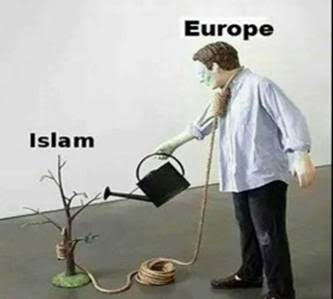
Islam Europe

I’ve just found this cartoon in my e-mail.
It was captioned: “The Winning cartoon in an organized competition.”

I instantly remembered some very wise words I’ve read long time ago:

“Do not be deceived: God cannot be mocked. A man reaps what he sows.
Whoever sows to please their flesh, from the flesh will reap destruction; whoever sows to please the Spirit, from the Spirit will reap eternal life.
Let us not become weary in doing good, for at the proper time we will reap a harvest if we do not give up.
Therefore, as we have opportunity, let us do good to all people, especially to those who belong to the family of believers.”

“Beware! Whoever is cruel and hard on a non-Muslim minority, or curtails their rights, or burdens them with more than they can bear, or takes anything from them against their free will, I (Prophet Muhammad) will complain against that person on the Day of Judgment.”

All religious teachings, all of them, maintain that ‘a man reaps what he sows’. It doesn’t really matter if the ‘result’ will come as a sentence delivered by a divine judge or if it will be just another bead in the string representing the life story of an individual.
I, for one, don’t see much difference between ‘fate’ and ‘karma’.

Then how come we keep acting as if we’ve never been warned?

“In my two visits to Auschwitz, the Nazi concentration camp in Poland, I learned that holocausts and genocides do not occur in a vacuum. Rather, there is almost always a vicious campaign of incitement directed against the target group preceding them. What is troubling today, with the recent uptick in anti-Semitic and Islamophobic incidents worldwide, is that extremists and zealots are not the only ones inciting their followers. In a number of Arab countries, Muslim children are taught ideas that distort the true meaning of the Quran and hadith too.”

o-gay-prophet-570

Love, more powerful than hate.