Archives for category: authoritarianism

Theoretically it means “from each according to their abilities, to each according to their needs”.

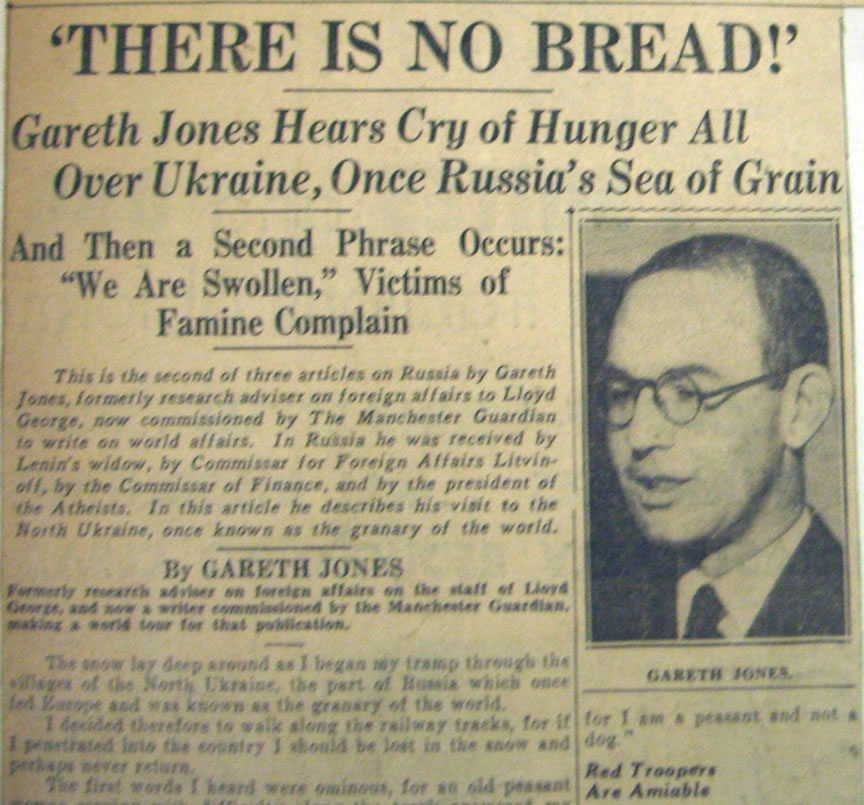
Practically it looks like this.

famine-in-ucraine

In fact real life communism still is, and always was, about a whole country kow-towing to a dictator who pretends to care for nothing else but for the welfare of the people. His people!

The point being that each resource allocation game needs a referee. Otherwise all rational people would take as much as they could carry from the communal reserve – because it is free – and bring back as little as possible, hence nothing if not coerced to – because it implies some effort.

OK, any reasonable five years old would tell you that the communal reserve would very soon become empty if things would go like this – hence that presumably ‘rational’ behavior would be anything but – only it would be very rational to at least try, wouldn’t it? For how long it would work, no matter how short that interval…

And something else.
You are most likely familiar with ‘bad money drives out good’. There have been a lot of examples to prove this, one of them being Christ driving the money changers out of the Temple.
Some of you might not be familiar with how money worked in those days so here is it.
A coin was a simple ‘slab’ of precious metal, of somewhat constant weight, approximately round, which had been ‘stamped’ with the face of the local ruler. At first, in the minting shop, all coins belonging to the same edition were more or less of the same weight. But, since the edges of the coins were not ridged, ‘smart’ people started to ‘shave’ the coins.
And, after the first guy had started to shave them, each individual who got a coin would have been foolish not to shave it, just a little bit. Maybe the next guy would be foolish enough to accept it, after being shaved. To contest it the recipient would have had to go to the money changers and pay for their expertise. And this is how the coins became smaller and smaller…
Only the priests at the temple didn’t want to be fooled. So they hired some money-changers to vet the coins the believers brought to the Temple. The very money-changers that Christ had driven away. “God doesn’t need this kind of guardians. If we keep them here it would mean that we expect people to cheat. Even here, at the Temple. And if we expect them to cheat, they will surely do so!”

Only some people do cheat. And since some cheat, the rest will have to do something about it. Either make cheating the rule, which would lead nowhere, or make it so hard to cheat as to become impractical. Hence the ridges at the edges of the modern coins. Which can no longer be shaved because the ridges would make it obvious.

Coming back to our ‘communal reserve’ you would have to employ a guardian to make it sure that no one would take any more than they really need and that everyone periodically brings back stuff according to their abilities.
But how would that guardian determine what are the real needs and the real abilities of each of those individual members of the community?
And, even more importantly, what would stop the guardian from taking the whole ‘communal’ reserve into his private possession? As in acting like a communist dictator? Simply because ‘he needs it’?

The only alternative that worked was the free market. That where you sold your abilities and where you could buy things to fulfill your needs. Where prices were set at the meeting point between ask and demand.
But the same principle, bad money drive out the good, acts even here.
‘Smart’ people try to organize ‘monopolies’. Which, basically, is the same thing as they attempting to become the owners of the ‘communal reserve’.

This whole thing looks like an intractable vicious circle?
Take heart, that’s what ‘reeds’ are for.
We invented those, when we realized that we needed them, didn’t we?

reeded-coins

You still wondering what to use in order to transform that vicious circle into a virtuous one?
How about individual freedom coupled with a healthy dose of mutual respect?

gambit noun [C] (CLEVER ACTION)

– a clever action in a game or other situation that is intended to achieve an advantage and usually involves taking a risk:

 – specialized games a way of beginning a game of chess, in which you intentionally lose a pawn (= game piece) in order to win some other form of advantage later

I borrowed this definition from Cambridge Dictionary, the on-line version.
You have already noticed, I’m sure, the accent on cleverness, the ‘intent to achieve an advantage’ and the relative downplay of the risk that is only ‘usually’ involved.

A more nuanced definition of the concept would mention that the person who uses this tactical maneuver has to get out of their psychological  comfort zone in order to perform it properly.
The whole thing involves offering a valuable bait which, once taken, might produce consequences favorable to the party that is ‘spending’ it.
Since the favorable consequences are not sure – otherwise it would have been a bribe, not a gambit – but the expenditure is certain the guy who initiates this has to thread very carefully. Hence the need for the bait to be really valuable. Valuable enough for the taker to take it and valuable enough so the giver would be really careful when performing the maneuver.

We have witnessed three gambits in close succession.

Britain’s David Cameron promised a Brexit referendum in an attempt to win the 2015 general election. He won the election but lost the referendum.

Quite a large number of Americans, fed up with what has been going on in their country, have pinched their noses and elected Trump into the Oval Office. The deal is not going exactly as they have planned it – Clinton is not going to be charged, the ‘swamp’ is more likely being repopulated rather than drained in earnest – but the jury is still out on this one.

Italy’s Matteo Renzi tried to cash in on his popularity and stream-line the constitution – a move which would have given more powers to the central administration. He has just lost the referendum, is about to resign – as promised and his losing the gambit has opened a wide venue for the opposition 5 Stars Movement led by a comedian – Beppe Grillo.

Need a moral to this?
Gambit works fine when playing chess. That’s a special kind of game where all the pertinent information is out there on the table and the sole variable is the opponent’s mind/will.

Real life, a.k.a. politics, is a completely different game. There are lots of stakeholders, instead of the two chess players, while most of the pertinent information is jealously guarded by each of the stake-holders – along with most of their real intentions.

If we add here the ‘detachment’ of the players – Trump and Cameron are both independently wealthy while Renzi is rather inexperienced – we’ll soon arrive at the conclusion that we’d be better off with some unadventurous, bland even, politicians.

The essence of spin doctoring is to present a sequence of true facts in such a manner that will compel the audience to reach the conclusion desired by the ‘good-doctor’. The really skilled ones don’t even need to lie in order to achieve their goals. At most they ‘shave’ some of the rough edges so that the truths they choose to mention fit smoother into their narrative
In fact it doesn’t matter much whether the conclusion they mesmerize their audience into is ‘true’ or not – truth is relative, anyway. The only thing that’s important here is that ‘the’ conclusion fits the intentions of the spin doctor.
Also, it even doesn’t matter what those intentions are. Good, bad… the end is always the same.

Because of the manner in which all this works.

The principle involved here is the same as that used by the magicians who entertain the crowds of circus goers.
They first concentrate the attention of their audience to a single point and then direct it in such a way that the people are no longer able to see anything but what they are allowed to by the magician.
Or by the spin-doctor.

Unfortunately the similarities between magicians and spin-doctors end here.
While most of the circus goers have a nice experience, albeit a relatively short one, most victims of the spin-doctors have to endure long lasting trauma and/or substantial material loss.

Again, irrespective of the spin doctors’ intentions. It doesn’t matter whether the method is used by a (well wishing socialist) utopian or by a callous Nazi.  In my previous post I mentioned how ‘political hyenas’ spring up and monopolize all the situations in which their ‘dark talents’ cannot be kept in check by the rest of the society.
Here we have the explanation for why the otherwise reasonable members of the society are unable to perceive the mortal danger they find themselves in.

Because the spin doctor had skilfully overloaded their attention.
Because after living for so long ‘under the spell’, too many people have become accustomed to let others think for them and in their name.

Was that clear enough?
The spin doctor doesn’t have to be malefic in order for the tragedy to take place. It is enough that they have occupied the attention of the people and have exhausted the ability of too many of the individuals involved to think with their own heads.
In these conditions the ‘political hyenas’ will undoubtedly make their appearance and attempt to gain control over the society.

And, undoubtedly again, those attempts will be extremely detrimental for the entire society.

Apparently these two have nothing in common.

The first appears to be a pleonasm while the second sounds like an oxymoron.
The first was a window dressing for a kind of dictatorship that managed to survive for sometime while the second, if ever attempted, would be so volatile that it would ‘evolve’ almost instantly into a ‘dog eats dog’ situation soon to be followed by the most horrid authoritarianism ever known to man.

But there is something that binds them together.

Both had first appeared in the minds of well intended people who were fed up with and trying to do something about what was going around them.

Socialism, the predecessor of ‘popular democracy’ (a.k.a. communism) had grown as a consequence of the excesses committed by some of the ‘savage capitalists’ during the late XIIIV-th and early XIX-th centuries while libertarianism, the reasonable predecessor of libertarian anarchism, as a reaction to the prevailing statism of the late XX-th and early XXI-st ones.

Let me first explain, briefly, why the concept of ‘popular democracy’ is only apparently pleonastic while in reality this wording covers a sheer impossibility. Then I’ll try to extend my practical experience of living under such a regime into a prediction about what would happen if a group of people would ever have to face a truly anarchic situation.

First things first. Democracy means a situation where everybody can voice their concerns about what is going on and where decisions are made in a collective manner, after anyone who cared to had access to all information pertinent to the decisions that had to be made.
In this, theoretic, context ‘popular’ adds absolutely nothing.
In reality ‘popular’ was a window dressing for ‘the population doesn’t know what’s good for it so we, the communists, have to guide it’. Exactly as Marx had explained in the Communist Manifesto. “The Communists, therefore, are on the one hand, practically, the most advanced and resolute section of the working-class parties of every country, that section which pushes forward all others; on the other hand, theoretically, they have over the great mass of the proletariat the advantage of clearly understanding the line of march, the conditions, and the ultimate general results of the proletarian movement.”

Secondly, but not a iota less important, liberty and anarchy are antithetic terms.
Anarchy is absolutely natural. As natural as water boiling in a kettle. It is impossible to say which drop would ‘burst’ first in a bubble and which would be the last to transition from liquid to gas. OK, if you have a mixture of water and alcohol the latter will boil first and the water later but this would happen only if the sill is heated gradually. If the heat source is too strong, a.k.a. ‘uncontrolled’, the process of distillation becomes ‘anarchic’ and the result is lousy – to say the least. In ‘human terms’ this would translate into a ‘dog eats dog’ situation where things become very quickly aligned along a uni-dimensional criterion – usually ‘brute’ force used in a most callous way.
By the way, this is a second ‘connection’ between these two concepts.
‘Popular democracies’, and dictatorships in general, are eroded by the same dissolving force that would cause any anarchic situation to implode – the most callous and less principled members of the group eventually gain absolute control over the rest, only the process takes longer in a dictatorship.

My point being that dictators are constantly being challenged. Both from within and from outside. It is seldom that a dictatorship passes through all its fazes – like Romania’s communist regime did, or Cambodia’s. Usually at some point a group of people understands what’s going on and try to do something about it. For instance what happened in Russia during Perestroika.
Yes, that could have had better results but just imagine Russia going down to the same depths Romania has probed almost 30 years ago. When most (actually non)public offices were held by incompetent nincompoops whose only goal was to prolong their survival by serving their demented master. Could you have slept at night knowing that Russia’s nuclear arsenal was being managed by such idiots?

Most dictatorships are being ‘weighted down’ by tradition and cultural norms. A dictator needs some time before they can do what they want and they can almost never accomplish all that they would like to. Good or bad.

On the contrary, in a truly anarchic situation – when no rules are observed anymore, except for ‘he who has the biggest fist prevails’, of course – things degenerate very fast. And need a lot more time to get back on track.
Like what happened during the French Revolution. When “the Revolutionary government (the ‘big fisted’ guys of the moment) decided to make “Terror” the order of the day (September 5 decree) and to take harsh measures against those suspected of being enemies of the Revolution (nobles, priests, hoarders). In Paris a wave of executions followed. In the provinces, representatives on mission and surveillance committees instituted local terrors. The Terror had an economic side embodied in the Maximum, a price-control measure demanded by the lower classes of Paris, and a religious side that was embodied in the program of de-Christianization pursued by the followers of Jacques Hébert.”

You might be wondering how come that such a generous concept like ‘let’s treat the workers fairly’ was high jacked into the horrors of communism and whether the same rationale could be extended to predict what a libertarian-anarchist society might (d)evolve into.
The way I see it people’s imagination is huge. A lot of things that might seem bland to ordinary eyes are perceived as resources by ‘crafty’ people and a lot of situations that seem helpless, or even desperate, to normal human beings are seen as very good opportunities by those adept at fishing in troubled waters.

It’s exactly the individuals where this kind of ‘craftsmanship’ is associated with ‘moral lassitude’ who would spare no effort in their attempt to make the’ best’ of the opportunities present in a country being run in an authoritarian manner or during an anarchic situation.

For this kind of guys it doesn’t matter whether the ancient regime was toppled by some socialist utopian (for instance Kerensky in Russia or Dr. Sun Yat-sen in China) or by a bona fide dictator (like, for example, Jorge Rafael Videla of Argentina under whose regime some 10 000 to 30 000 people have been ‘disappeared’ by the authorities). Or whether the anarchic situation has been a consequence of regimes imploding from within (pre-revolutionary France, communist Russia, yesterday day Libya) or being unsettled by  sloppy outside interventions  (Afghanistan and Iraq)

All these situations, and many others, are the perfect breeding and hunting ground for  ‘political hyenas’, callous ‘operatives who would eventually ‘denature ‘even the most well intended dictatorship or ‘well organized’ libertarian anarchy.

I’ve already experienced one of this situation.

I really don’t want to experience the other. No matter how appealing it might seem to the libertarian ‘fundamentalists’.

‘He just says what he has to say in order to get himself elected. Once he will get there he will do like all the others, he will mellow down. Besides that, the system of checks and balances is too strong for one man to upset it.’

The first, and most obvious, problem with this line of reasoning is ‘why on Earth have we grown so accustomed with being lied that we find it acceptable’? Why do we brush aside so easily the lies professed by ‘our’ candidate – along with many other indiscretions, while we meticulously and vehemently point out those committed by the ‘opposition’? Weren’t we supposed to be making ‘rational choices’ when it comes to who governs the country?

The sad fact that there isn’t much to choose from doesn’t exonerate us from the consequences of our mistakes.

But our laziness has yet another – and even more malignant, ‘after-growth’.

By voting for a candidate who promises rather ‘unsavory’ things in order to get elected we not only encourage him to ‘make good’ those promises but we actually ask him, imperatively ( 😉 ), to do his ‘best’ in order to achieve as many of those promises as he possibly can.

Hoping that once elected he will ‘forget’ about (some of) them is both near-sighted and ‘double-standard’.

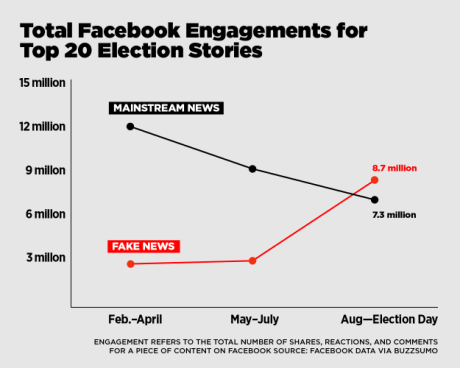
fake-vs-real-news

“When Silverman (the author of the study that produced the chart quoted above) confronted Facebook with this data, the social media giant argued that…”

Why would anyone confront Facebook with something like that?

Facebook is happy that we, the users, share anything at all on our walls for others to read.

This is how Facebook makes its living. They sell add space on top on whatever we choose to share on our walls. From a mercantile point of view Facebook shouldn’t really care whether what is shared by its users is legit or not, they simply must enforce the rules – no pornography, no open incitement to hate, no bullying, etc., etc…

We do the sharing, we bear the responsibility for our acts.
And it is we who will, eventually, experience the full consequences.

shark2-625x352

Over reliance on ‘tradition’ and over reliance on ‘science’ (a.k.a. rational thinking).

The individual prone to falling victim to the first method is convinced that:

– They has adequately framed the problem.
– The answer, to that particular problem or to one close enough so that the old answer is still usable,  has already been found and recorded in the collective archive currently known as ‘tradition’.
– They is smart enough to identify the correct answer inside that huge wealth of  rather haphazardly accumulated knowledge.

The individual prone to falling victim to the second method is convinced that:

– They has adequately framed the problem.
– The answer to that particular problem can be reached scientifically.
– They is smart enough to identify the correct answer using the scientific tools currently at their disposal or to develop new ones, if necessary.

If, on top of all this, that individual, in no matter which of the two situations described above, is so convinced of the adequacy of “their” answer as to be prepared to impose it on others, even against their will – or without telling them before starting the implementation of “the answer”, then all hell will break loose – sooner or later.

By now you have probably figured out why these two methods are ‘only apparently different’.

In fact both of them are nothing but variations of the ‘inflated ego syndrome’.
This theory has been proven by the fact that all the dictators that have ever ‘ruled the Earth’ have always been convinced they were ‘rational people’, regardless of all of them either pretending to had been ‘blessed by God’ or explaining their ‘arrival’ as a ‘natural consequence’ of Marx’s scientific/dialectic materialism and/or Nietzsche’s Will to Power.

The people suffering from this syndrome can be identified by the manner in which they react to every input they receive. If their response is either ‘No, you’re wrong about this’ or ‘Yes, I was thinking along the same lines’ but never ‘Thank you for this fresh and very interesting perspective’ then you are dealing with someone harboring a very ‘inflated’ – and usually also very jealous – ego.

This kind of people are usually very good at spearheading change but allowing any of them  to acquire any considerable amount of power is, to say the least, suicidal.


trump-nbc-favorability-trump

trump-temperament-nbc

1478656414_trump_treatment_of_women

womens-votes

evangelicals-votes

white_catholics-votes

clinton-honesty-nbc

whether-to-continue

direction-of-the-country

trump-wins

New York Times, Elections 2016

Like always, the dispirited enough to stay at home have given a carte blanche to the  desperate enough to ‘jump into the unknown’!

And no, this is not exclusively about the ordinary voters!
They’ve already sent plenty messages stating clearly that they’ve had enough.
But those whose job was to make things work had chosen not to hear.
Then, when it had become plenty obvious that the boil had been festering for long enough, most of them had stepped aside – leaving at the forefront of the ‘operating table’ a ‘surgeon’ whose long resume was anything but capable of generating trust and a ‘willing’ and ‘enthusiastic’ ‘wannabe’ with no experience.

And now they are trying desperately to find an ‘honorable way out’…


the-final-countdown


“We’re leaving together,
But still it’s farewell.
And maybe we’ll come back
To earth, who can tell?
I guess there is no one to blame
We’re leaving ground (leaving ground)
Will things ever be the same again?

It’s the final countdown.
The final countdown.”

the-final-countdown-2


quote-the-philosophers-have-only-interpreted-the-world-in-various-ways-the-point-however-is-to-change-karl-marx-250986

Change it into what? And on what grounds?

I had spent the first 30 years of my life under communist rule and I’ve witnessed, first hand, the debacle produced by a bunch of people trying to transform the world according to their own liking. And it’s not only that they had brought a lot of misery to an awful lot of people but they also brought it upon their own heads. They, and their families, have been indeed living a lot better than the rest of the people but a lot worse than the ordinary people living in the free world. Not to mention the fact that many of them ended up really bad, some of them at the hands of their own insatiable, Minotaur-like, leaders and some others during and immediately after the regime change.

I’m writing this post after watching Jon Haidt’s excellent lecture “Two incompatible sacred values in American universities“, delivered at Duke’s Departement of Political Science on October 6, 2016.

The point of Haidt’s conference being that each university should clearly declare its ‘telos’ as belonging to one of these two clear cut options:

the-point-of-a-university_dxo

Don’t bother to search the quote attributed to John Stuart Mill.

It is only an interpretation belonging to Haidt himself, who had inferred it from one of Mill’s famous quotes excerpted from  “On Liberty”:
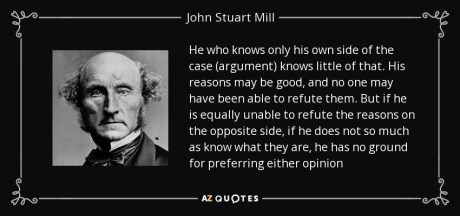
quote-he-who-knows-only-his-own-side-of-the-case-argument-knows-little-of-that-his-reasons-john-stuart-mill-125-0-0981

So, what should it be?

Change or Truth?

Before proceeding any further I strongly suggest that you take some time and listen to Haidt’s excellent arguments.

Now I’d like to discuss a little about ‘Change’ and ‘Truth’.

What both Marx and Haidt have in mind when they speak about ‘change’ is both ‘purposeful’ and ‘centralized’.
When they say ‘change’ they mean an ‘effort towards increased social justice’, effort whose parameters would be determined by the wise men (and women) delving in the depths of the University’s libraries and which would be implemented without fail, preferably with a sanction from the higher authority.

I had already mentioned, at the beginning of my post, where such ‘change’ would lead anyone  attempting to put it into practice.
And Haidt gives us an excellent explanation for why anybody who will ever attempt such a thing would eventually fail. (I told you to watch his conference…It may be long but every minute of it is packed with very interesting things!)

So why is Haidt challenging us to make this choice instead of giving us a clearer piece of advice?

Well… maybe you should ask him that… I’d hate to believe that he, in his own words, ‘has become afraid of that too many of his students might feel that he is so distanced from what is generally accepted that too few of them would follow him’.

So what should we do?
Some of us should embark on a ‘sterile’ search for the (absolute) truth and then, after eventually finding it, nurse it quietly in our lap but refrain from an even minutely more drastic action while others should attempt to implement change based on already ‘over the hill’ principles?

I’m afraid that would be a dangerous road to follow.

There is no such thing as an ‘absolute’ truth that might be nursed in our lap and even if there was such a thing we are not able to find it – individually or even as a group. There’s plenty evidence about that in Haidt’s discourse.
And then what would be the use of the whole enterprise if we are not planning to use the results of our quest, whatever those might be?

And here lies the crux of the matter.

I’m sure Haidt knows what I’m going to tell you now and I’m very sorry that most of your teachers have never mentioned at class this very interesting story.

Marx was not the first revolutionary thinker of his time.
OK, you already know that. There were a certain number of French intellectuals whose writings have set the stage for the 1789 Revolution.
What is less known is that John Stuart Mill himself had been groomed by his father “as the future leader of this radical movement”, whose aim was supposed to be “social reform based on utilitarianism” with the goal of attaining “the greatest happiness of the greatest number“.

The only difference between James Mill (the father) and Karl Marx being that Mill didn’t advocate the the forceful confiscation of the ‘means of production’.
Otherwise both were faithfully following Plato’s dictum:
“Until philosophers are kings, or the kings and princes of this world have the spirit and power of philosophy, and political greatness and wisdom meet in one, and those commoner natures who pursue either to the exclusion of the other are compelled to stand aside, cities will never have rest from their evils, –nor the human race, as I believe, –and then only will this our State have a possibility of life and behold the light of day. Such was the thought, my dear Glaucon, which I would fain have uttered if it had not seemed too extravagant; for to be convinced that in no other State can there be happiness private or public is indeed a hard thing“.

Well, the problem with this line of thought is that it doesn’t work.
Again, Haidt has already presented a solid case about this and I’m not going to re-count his arguments.

So, since there is no such thing as an absolute truth to be discovered, one way or another, and no priest-kings on any white stallions that might come to our rescue, what shall we do?

Simple.
Follow Haidt’s, and John Stuart Mill’s, advice and take it one small step further.

“The point of a university is to understand the world because only if you commit to truth, I believe, can you actually achieve justice.”

We need to understand, and accept, two things:
Change has to be allowed to come naturally, not pushed forward simply because we are momentarily convinced that ‘The Truth’ had downed on us,
And that (social)justice is a process which has to be implemented on an ‘as needed’ basis, not an independent goal?

In fact Mill’s personal destiny is eloquent enough for what happens when somebody tries to breed a ‘perfect’ Priest-King.
“But in 1826, Mill began to suffer from a severe depression, which he attributed to his excessive analytical training and the resulting impairment of his emotional capacities. Reading the romantic poetry of Wordsworth and Coleridge helped Mill to overcome this mental crisis. It also inspired him to form a more complex view on human flourishing than the Benthamite utilitarianism of his father’s generation, with its dogmatic rationalism and unidimensional concept of pleasure.”

And this is why Haidt is absolutely right when he tells us that we need to expose ourselves to a lot more than what we are already familiar, and comfortable, with.
And this is why Heidegger kept warning us that truth as conformity between our words, or even our understanding, and the reality of the fact that we try to understand, and describe to others, is a Fata Morgana which consistently eludes us and that the only way to get any closer to her is ‘unhidennes’.

In this sense there is nothing better than an open mind, both towards our innermost thoughts and to the people living, and thinking, around us.

A mind open enough as to be able to simultaneously attempt to implement whatever changes become necessary in the light of the newly discovered truths AND accept the possibility that those ‘newly discovered truths’ might be incomplete or even altogether false.

Does all this seem rather schizophrenic?

Then let me rephrase the question I started with.

What’s the use of ever trying to understand anything if we’re not going, ever, to change our behavior as a consequence of anything we might come to figure out and on what basis is anyone to attempt any change if he never tried to understand anything above what he already knew long before he even started to think about any change?

As I was ready to close this post I stumbled upon the thought that maybe Haidt meant to apply in the academic world a principle that has been proved invaluable in the political life.

‘Separation of powers’.

Some universities would busy themselves with finding ‘the truth’ while others would attempt to find ways to put ‘it’ into practice.

Leaving aside the fact that this would smack too much of Marxism for my taste I’ll have to remind you that the separation of powers has become necessary in the political realm only because the government has an effective monopoly on power and we need to make it so that it cannot abuse this situation.

No university has any monopoly on truth and/or change.
Furthermore, not even the Academia, as a system, has been able to implement such a monopoly. Not for lack of trying, but that’s another subject.

So, instead of acquiescing to such efforts – by accepting certain universities as official ‘truth seekers’ and others as ‘path finders’/’change implementers’, we’d better ask each and all of them to clean up their acts.

And open up their collective minds.


If you are not aware of at least some of the many ‘forces’ which attempt to control your mind, at least in part, you are just as ‘out of your mind’ as those who believe their minds are successfully and consistently controlled by outside agents.

And those who are convinced they are in control of other people’s minds.