
Lucrurile astea nu se bat de loc cap in cap.
Libertatea este ‘absoluta’ sau nu este deloc doar ca ‘absolut’ nu inseamna nelimitat.
Este absoluta pentru ca singurul care poate lua decizia este chiar cel in cauza si este limitata pentru ca decidentul este atat ‘fragil’ cat si pentru ca ar trebui sa tina cont de faptul ca nu are la dispozitie toate informatiile cu privire la ‘obiectul deciziei’. Acea ‘fragilitate’ il poate face pe decident sa ia o anumita hotarare de frica si nu dupa cum il sfatuieste ‘constiinta’. Asta inseamna autocenzura si nu are nimic in comun cu ‘bunul simt’.
Constiinta faptului ca nu este detinatorul adevarului absolut, in schimb, il poate face pe decident sa-si respecte semenii si sa nu faca lucruri jignitoare pentru cei din jurul sau. Adica sa aibe bun simt!
Iar omorul este cel mai jignitor lucru pe care cineva il poate face asupra altcuiva. Dupa aceea vin, la egalitate, bataia de joc fata o intreaga comunitate sau fata de o intreaga generatie.
Libertatea, asa absoluta si totusi limitata cum e ea, trebuie sa fie aparata si reconstruita tot timpul, de catre noi toti. Noi suntem cei chemati sa-i reconfirmam caracterul absolut si tot noi suntem cei care trebuie sa-i stabilim limitele.
Mai degraba cu ajutorul bunului simt decat de frica.
Yesterday I went to the French embassy in Bucharest and lighted a candle in mourning for the people killed during the Charlie Hebdo terrorist attack.
I, an agnostic, using a religious symbol in remembrance of a group of people killed by a couple of (intolerant self proclaimed) defenders of religious values for poking tasteless fun at some religious symbols.
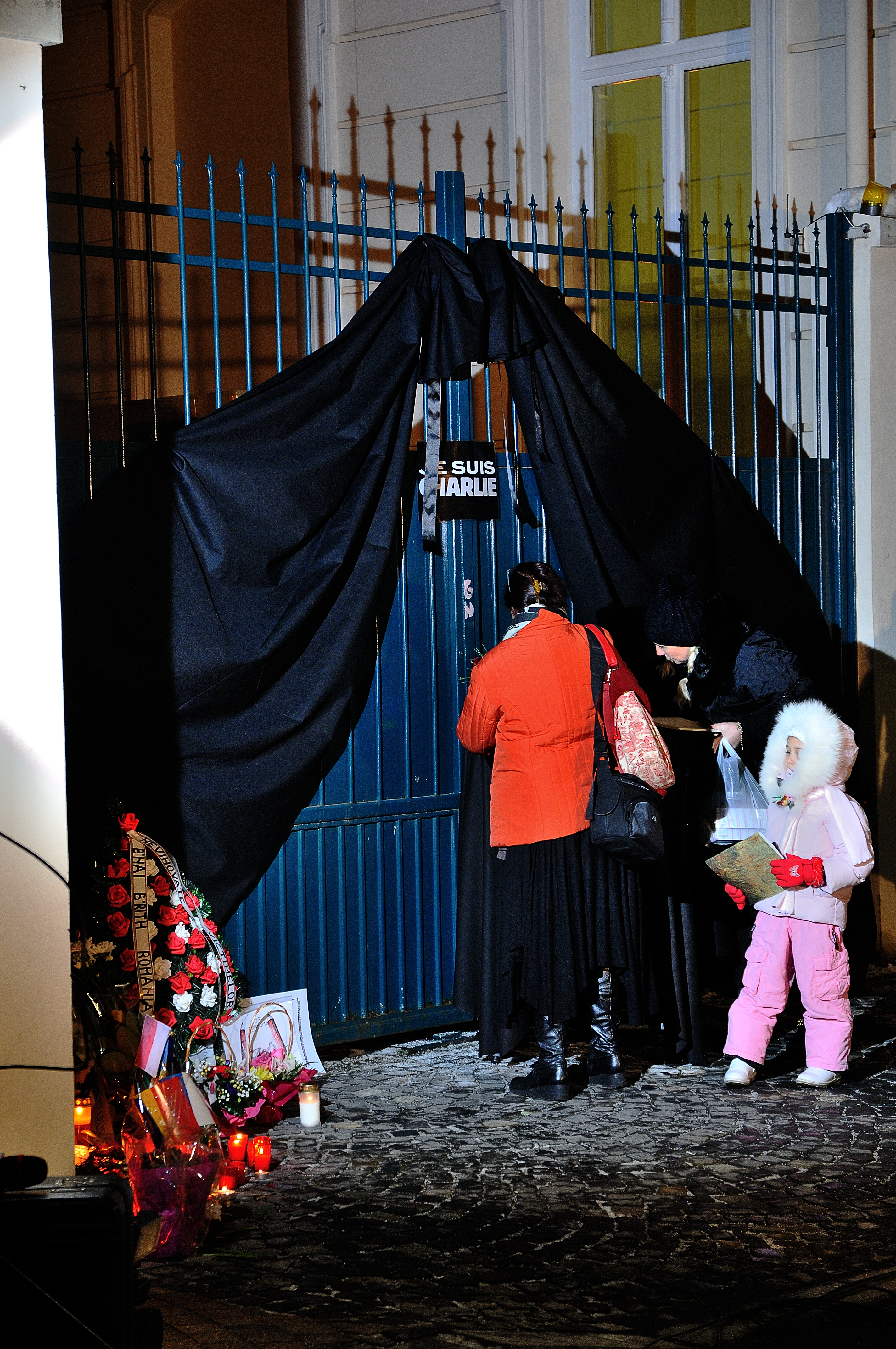
While there I noticed a mother who brought her very small child to a ‘shrine’ build in the memory of people who authored such extreme works of art that some of them cannot be shown, under any circumstances, to underage audiences.
(I really do consider that what those people created were indeed works of art. Only not all art is contemporary with the moment of time when it was created so, maybe, it should be saved for ulterior audience… and, hence, shown to a very limited selection of the people currently roaming the Earth.)

proaspat primite pe mail:
– Nu inteleg de ce te enervezi, draga mea. Tu ai vorbit si eu am tacut.
– Da, dar ai tacut intr-un mod foarte provocator.
Doua tinere domnisoare:
– Am impresia ca barbatii astia nu au nici un pic de logica.
– De ce?
– Spre exemplu: a trebuit de 20 de ori sa-i explic agentului de
circulatie ca ieri eram in alte sandale, de aia am uitat permisul in
alta geanta.
Două blonde povestesc după noaptea de Revelion:
– La mulţi ani! Cum ai petrecut anul nou?
– Ca de obicei, în pat.
– Ş a fost multă lume?
Doi băieţei care se jucau pe stradă au intrat din întâmplare într-o
galerie de artă modernă. Câteva minute au privit înmărmuriţi picturile
şi sculpturile expuse, apoi unul dintre ai a ţipat:
– Repede! Să fugim înainte să spună că noi le-am stricat!
Arta abstractă este adesea greu de înţeles, aşa cum au păţit şi doi
vizitatori ai unei expoziţii de gen, buni prieteni şi pasionaţi de
artă. S-au oprit în faţa unei pânze, un amestec de culori şi forme,
iar unul dintre ei a întrebat:
– Ce e asta?
Celălalt i-a răspuns:
– Ar trebui să fie un cowboy pe cal!
După câteva momente de tăcere, a venit şi replica:
– Şi de ce nu este?
Uşa se deschide brusc şi băiatul intră în casă:
– Bună ziua, tată!
Tatăl, fără să-şi ia ochii de la monitor:
– Pe unde ai umblat?
– Am fost în armată!
– Dle doctor, îmi tremură mâinile tot timpul!
– Bei mult?
– Nu, mai mult dau pe jos!
– Domnişoară, de câte ori îmi surâdeţi, îmi vine să vă invit la mine!
– Vai, sunteţi un seducător!
– Nu. Sunt dentist!
Există asemănări între sutien şi istorie?
Desigur! Ambele deformează realitatea!
– Marie, tu crezi in reincarnare?
– Da, Ioane.
– Adica… eu dupa ce mor m-as putea reincarna intr-un bou?
– Nu, Ioane…nu se poate de doua ori la rand…
Viata e ca ardeiul iute..
Ceeace faci azi , ti-ar putea arde fundu’ maine…
Ca sa vinzi un lucru greu vandabil , spune-i unei femei ca e
un chilipir si unui barbat ca e deductibil…
Dovada că există civilizaţii extratereste inteligente e faptul că nu
ne-au contactat!
Azi-dimineata, nevasta-mea a inceput sa urle la mine:
-E numai vina ta!
-Dar ce am facut?
-Lasa-ma un minut sa ma gandesc, ……………abia m-am trezit!
*Un smecher de Dorobanti cu ultimul racnet de Lamborghini este oprit de
politia rutiera. Bineinteles acesta se foloseste de tupeul specific
si incepe conversatia cu un ton amenintator :
– Ce faci frate ? Pe mine te-ai gasit sa ma opresti ? Tu stii cine
este taica-meu ?
Politistul, in timp ce completeaza procesul verbal:
– De ce ? Ma-ta nu ti-a spus ?!?
Asta parca suna altfel, nu? Dar tot nu justifica actiunea in sine. Dupa cum simplul fapt ca putem, fizic, lua jucariile unui copil nu justifica, cu nimic, gestul.
Respectul persoanei celuilalt, despre care vorbeam mai sus, este singurul punct de plecare care nu trebuie sa fie validat de vreo valoare superioara si ca atare ar putea fi acceptabil tuturor, indiferent de convingerile fiecaruia. Religioase sau de alta natura. Iar de la respectul reciproc la ‘primum non nocere’, “in primul rand sa nu faci rau”, si astfel la adevarata libertate – aceea pe care ne-o aflam impreuna cu toti cei aflati in jurul nostru si nu impotriva tuturor acestora – mai este doar un singur pas.

In 1914 WWI started just because European countries had backed themselves into so tight corners that they weren’t able to ‘leave them behind’ and ‘come up into the open space where some mutual ground could have been found’ while the entire ‘house’ ‘went up in flames’.
So what do we do now, a century later?
Some people heap ‘fun’ (?!?) on the ‘others’ and ‘the others’ reply with bullets.
Regardless on which side of the many divides that crisscross our society (societies) each of us belongs to we all try to find explanations, and culprits, for what is happening. Only none of the explanations that have been proposed until now has been found acceptable ‘for the other side’.
I propose something else.
If we look closer all this can be boiled down to (mutual) ignorance intensified by intolerance and arrogance.
While real people bleed in the streets some callous puppeteers/mindless ‘activists’, from all sides, laugh contentedly in their hideouts and plan new ways to prod the rest of us into even more reckless extreme actions.
There are two ways out of here.
We can fight it off, like the Germans and the French did. But they needed 150 years of gruesome warfare (from the Napoleonic wars to the end of WWII) to understand that there were no insurmountable differences between them.
Or we could try something new.
All we need is some mutual respect. The rest would come naturally.
Read more: 12 killed in attack on offices of French newspaper | The Times of Israel http://www.timesofisrael.com/10-said-killed-in-attack-on-offices-of-french-newspaper/#ixzz3O96OfXZa
Follow us: @timesofisrael on Twitter | timesofisrael on Facebook

Nature.com tells us that “Mice infected with toxoplasmosis lose their instinctive fear for the smell of cats — and the parasite’s effects may be permanent.”
Now what on Earth… You pretend to be running a blog about how people think and now you come up with wild stories about rats?!?
Well… the problem is that Toxoplasma Gondi, the parasite that is ‘behind’ all this has somehow found a way not only to influence the behavior of the rats it has infected but also to make sure that the alteration remains in place even after the infection was cured.
So what do we care if a bloody parasite manages to twist the simple minds of rodents? Permanently even?
OK, OK, ‘correlation is not causation’, I know that, but don’t you find it ‘fascinating’ that behavioral patterns could be permanently altered from the outside the brain by something having a ‘material’ nature? Learning, acquiring new information, also involves something from outside the brain but ‘information’ doesn’t have a ‘material’ nature, right?
And something else. Don’t you find it rather interesting that so many people post pictures of cats on their FB walls?
http://www.nature.com/news/parasite-makes-mice-lose-fear-of-cats-permanently-1.13777

After returning to my apartment yesterday afternoon, I spent the rest of the day cleaning out the old and making room for the new.
This wasn’t simply taking out the trash and recycling. I went through and cleaned out anything and everything that I haven’t used or that won’t help me reach my goals in some way. I also did a bit of rearranging to get the new year started on a good foot (and to switch things up a bit).
If you need some inspiration, here’s a few things I did:
-Eliminated cosmetics and cleaning products I felt were harmful. I had a few almost empty bottles that I’ve been saving “just in case”. Other things, I offered up to others
-Went through my bookshelf, especially the books I haven’t read yet. Any that I don’t think I’ll read or that I read and did not enjoy, I got…
View original post 215 more words
The recent shift on how both the scientific community and the press relate to cancer is just another proof that we are currently undergoing a subtle change in the way we understand the world.
Yes, we continue to be fascinated with the notion of ‘the primordial cause’ and to go way out into the improbable in search for that cause while we still tend to ‘forget’ – or even actively chose to neglect – that most things, cancer included, usually are the result of a string of events and not of a single occurrence. Identifying only one event in that string as ‘the cause’ is rather ‘dense’, don’t you think?
Yet, despite of all of the above, this development has a bright silver lining. For the third time in the history of science and for the first in the history of popular media lady luck is being presented as a valid scientific explanation of anything. This very fact is a huge step towards a new understanding of how vast the world really is and of what we, mere human beings, might or might not be able to do/understand in/of it.
The first two instances when this has happened – Charles Darwin mentioning the role of hazard in biological evolution and Schrodinger using his famous cat to explain the intricacies of subatomic physics – the general public (and a considerable portion of the scientific community) somehow managed to avoid grasping the huge importance of hazard in nature and, frightened, found solace in the welcoming arms of God.
This is the first time, in my knowledge anyway, that God was not mentioned, yet, in connection with such an important subject for us all.
Good news, isn’t it?
For those who want to find out more about chance and cancer these two recent articles are a good starting point into the matter:
“Majority of cancers occur because of random mutations…” offers a succinct presentation of the development while
“Are two thirds of cancers really due to bad luck” brings welcome clarifications on the limits of the scientific method – statistical analysis – used by the authors of the original study.
 nicichiarasa