” Companies lack the capacity to intelligently analyze the data and they lack the systems and data structures to provide the usable data even though such data exists.”
….
“But Kenexa, which tested 30 million applicants last year for thousands of clients, has found that a lengthy commute raises the risk of attrition in call-center and fast-food jobs. It asks applicants for call-center and fast-food jobs to describe their commute by picking options ranging from “less than 10 minutes” to “more than 45 minutes.” The longer the commute, the lower their recommendation score for these jobs, says Jeff Weekley, who oversees the assessments.”

So they needed to analyze a ton of data to figure out that even the people who (have to) accept relatively low skilled/payed jobs are rational enough to use every opportunity to shorten their commute?!?

Well done, guys!

Read the entire post, Tim Ackermann does a good job at sorting out the current myth about ‘Big Data’.

talentim's avatartalentim

While preparing some presentations for HR and recruitment peers I researched and re-thought the trends (aka buzzwords :-)) which are currently discussed in the HR and online community. I will add my thoughts over the next weeks (hopefully not months) and start with Big Data. Also thanks to @carllsons who included this topic in his presentation at the Social Media in HR Summit a few weeks ago.

Generally speaking, Big Data is…

… a collection of data sets so large and complex that it becomes difficult to process using on-hand database management tools. The challenges include capture, curation, storage, search, sharing, analysis, and visualization. The trend to larger data sets is due to the additional information derivable from analysis of a single large set of related data, as compared to separate smaller sets with the same total amount of data, allowing correlations to be found to “spot business trends, determine…

View original post 728 more words

That was how an old friend of mine – thanks Oache – was treating anyone who complained too much.
And there were plenty reasons to complain about during Ceausescu’s communist rule over Romania.

Five minutes ago I found this in my inbox:

A  young couple moves into a new  neighborhood.
The next morning while they are  eating breakfast,
The young woman sees her  neighbor hanging the wash  outside.
“That  laundry is not very clean,” she said.
“She  doesn’t know how to wash correctly.
Perhaps  she needs better laundry  soap.”
Her  husband looked on, but remained  silent.

Every time her neighbor would  hang her wash to dry,
The young woman would  make the same comments.

About one month  later, the woman was surprised to see a
Nice  clean wash on the line and said to her  husband:
“Look, she has learned how to  wash correctly.
I wonder who taught her  this.”
The husband said, “I got up early  this morning and
Cleaned our  windows.”

And so it is with life.   What we see when watching others
Depends on  the purity of the window through which we  look.
 

I’d go even further than that.
The way we perceive what’s going on around us depends heavily on the ‘filter’ each of us chooses to use when trying to make some sense of this world.
Catalin Zamfir, a Romanian sociologist with a keen interest in the decision making process, has studied how individuals try to assuage the feeling of acute/constant uncertainty experienced by each of them during the constant (social) encounters that constitute ‘daily life’. In one of his early books, unfortunately not yet translated in English, he explains that ‘ideology’ is not only a blue print for future action but also, and maybe even more important, the lens/filter through which we perceive what is going on around us. An interface that translates ‘reality’ into ideas that make sense for each of us.
The interesting thing about ‘ideology’ is that it isn’t fixed. Each of us can choose from whatever is available in his time or even ‘write’ his own.
Granted, the process of selection/rewriting incurs costs/risks. Some obvious, like adopting a contrarian stance, and others very well hidden in plain view, like the dangers that arise from indiscriminately following a herd.
And this is exactly why we should strive to keep our windows/ideological eyes as clean as possible.

‘Democracy’ comes from ‘demos’, the Greek word for ‘people’.
Basically a democratic society is  a social arrangement where the people is in charge. Through representatives, as in most cases, or even directly – the Swiss organize referendums whenever they have something really important to decide.

‘Republic’ comes from Latin. ‘Res publica’ means ‘public matters (=issues)’ so a republic can be seen as a social arrangement where everything is out in the open.

Would it make any sense for the public to know everything that is going on if they don’t have any say in the matter? Could democracy work if people are kept in the dark?

So.
In communism the state (in fact the rulers) decide everything – who does what and who gets what.
In socialism there is not much difference from the previous state. (I can vouch for both propositions, I’ve lived under both regimes)
‘Anarchy’ means no rules. If you happen to have two cows you need to defend them constantly, by your own, against anyone who covets them. Remember, anarchy means ‘no rules’ whatsoever. You cannot cherry-pick. I like this rule (property rights are fundamental for me) so this one stays in place while the the rules that I don’t like will be discarded.
As in ‘I won’t respect but the rules I like and I’ll hold everybody else to respect mine’.
That would be an absolutely one sided anarchy. If you’d be able to enforce such an arrangement it would be perceived by everybody else as the most authoritarian regime ever and Stalin would be jealous of your accomplishments.
As I said before ‘democracy’ means people having their say about how things are settled in a that particular society. If people respect each-other you have real democracy. If people band together to decide, against the will of the owner, about the fate of those fabled two cows we can no longer speak about true democracy. That would be ‘mob rule’, just another form of ‘anarchy/authoritarianism’. One ‘organized’ by a ruler who is a callous spin doctor skilled enough in his trade to make a considerable portion of the population follow him, usually against their better interests.

I was just speaking about the mutual respect that exists among the members of a truly democratic society…. I have a distinct feeling that those who promote this meme think of themselves as being ‘the true democrats’… I’m not a religious person myself, not in the classic sense of the word anyway. But I won’t ever think of a religious person as being ‘ignorant’ based solely on his creed and I’ll never refer to him using such a word, regardless of his level of education. One of the reasons being that if I ‘indulge’ in such a barbarism he’ll never listen to me again.
Why should he? To get some more abuse from me?

Now lets get this straight.
Mutual respect is absolutely essential for democracy.
There can be no such thing as mutual respect among individuals whose goals are mutually exclusive.
This meme actually doesn’t make much sense. No matter how well armed the lamb is, a determined wolf would eventually sink its fangs in the lamb’s sweet flesh so a rational lamb would do his best to shoot the wolf at the first opportunity. What kind of democracy are we speaking about here?

Most governments don’t get this. You can stretch it only that far. At some point, no matter how authoritarian the regime, people will take to the street.
This doesn’t mean that democracy will automatically be installed after a public uprising, far from it. The Arab Spring is only the latest example.
It only means that people have it in themselves to try to improve their lot. If they find a way to do this together then the sky’s the limit.
And this is a fact. Only the democratic America successfully landed a man on the Moon. The Soviet Union was the first to start this game but wasn’t able to keep up.
Yeah? And what are bragging about here?
About not finding a candidate to suit your wishes AND not doing anything about this situation?
How about running yourself? Or at least going there and annulling your ballot…
If you do not vote at all the political establishment will consider that you are either content with what is going on or so despondent as to not care anymore. So why should they even consider your plight? In which direction should they change their behavior in order to suit your needs if you don’t express them when you have the chance?

Really? Is he indeed unable to make distinction between democracy and mob rule?
‘Democracy in and of itself is not necessarily a good thing’…
I’m afraid he didn’t get the gist of it!
Real (=functional, stable over long periods of time) democracy IS good while mob rule IS bad. Period.

So, any chance for this cute fellow to have nailed it?
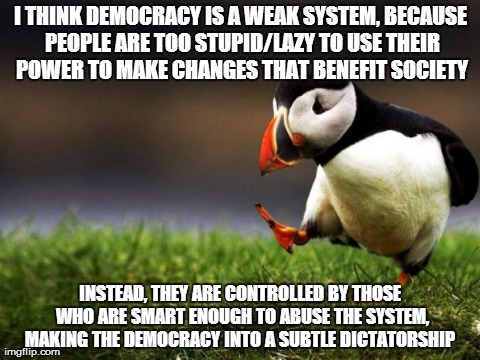
Close but there is space for improvement so I’ll try to rephrase this.
A democratic system invariable becomes weak/unstable if the general public becomes complacent and the power is grabbed by short-sighted but arrogant and callous spin doctors who, by eviscerating the true nature of democracy, transform the concept into an empty shell. This way the democratic process becomes a beauty pageant and an erstwhile democracy becomes a subtle dictatorship.

The strangest part of all this is that exactly those who should have known better – the professional politicians and some members of the academia – are the first to fall into the trap.


Din cand in cand simt nevoia sa ascult ‘Romania, Trezeste-te!’.
De data asta am deschis, pe Youtube, un clip cu mai putine vizualizari. Pur si simplu m-a atras fotografia de intro.

La inceput am ras, apoi m-am intrebat ce vrea sa spuna cel care a facut selectia iar la final mi-am dat seama ca nu voi putea niciodata sti ce gandeste cu adevarat o alta persoana.

In schimb am inteles ca toata tarasenia asta poate fi luata ca un fel de test.
Pe care putem foarte bine sa ni-l administram singuri.
Uitandu-ne la clip, chiar de mai multe ori, si apoi incercand sa clarificam, in cuvinte, ce am simtit.

– Asta isi bate joc de Romania!
– Situatia e complexa.
– Oamenii sunt foarte ‘ingeniosi’ si gasesc rezolvari/utilizari cateodata extrem de neasteptate.

” În opinia mea, analiza suferă prin aceea că ia poate prea mult în serios puterea independentă a ideilor în societate.”
Bineinteles ca ideile in sine nu au nici o putere pana cand nu capata ‘tractiune sociala’ iar asta se intampla tocmai atunci cand din ce in ce mai multi oameni observa care dintre ideile ‘propuse’ se potrivesc mai bine realitatilor sociale ale momentului.
Numai ca alternativa – credinta unora ca stiu ei, sigur, care sunt ideile potrivite unui anumit context social – este cel putin la fel de mioapa ca si credinta in ‘puterea independenta a ideilor in societate’. De fapt ambele sunt cele doua fete ale unei aceleiasi monezi, cea batuta de Platon cu ocazia introducerii pe scena a ‘Regelui Filozof’ cel atoatestiutor.
Iar toata chestia imi aduce aminte cat de nedumeriti erau specialistii in Kremlinologie in 1989, atunci cand s-a prabusit comunismul fara ca ei sa bage de seama.

Andrei Tiut's avatarCivitas Politics

a

Pe situl Centrului de Analiză a Informațiilor și Evaluare a Tendințelor (CAIET) a apărut recent o analiză comparativă care caută să aplice ceea ce am putea învăța din ascensiunea fulminantă a Syriza la realitățile românești. Textul nu este un „caiet al revoluționarului” ci o privire din afară care caută să vadă în ce măsură o mișcare similară ar putea apărea și la noi.

Cu intenție – sau poate fără – documentul pornește de la un cadru conceptual prin care ni se propune să analizăm realitatea pe trei nivele. Eu le numesc:

  • acțiune (engl. agency) – ceea ce fac actorii politici. Autorii numesc asta „voință politică”.

  • context/circumstanțe (engl. contingency) adică … circumstanțele care înconjoară acțiunea. Autorii numesc asta „circumstanțe favorizante” deși, la o adică, ele pot fi și defavorizante sau simplificatoare sau aducătoare de complicații.

  • sistem (engl. structure) adică structura realității pe termen mai lung. Autorii numesc…

View original post 779 more words

PS
I must add here that because the cogs act like levers the handlebar is a lot easier to move than on a normal bike. This compounds the difficulty even further.

“Hope is a mistake. If you can’t fix what’s broken, you’ll go insane.” This muddled piece of dialogue grunted out by Max (Tom Hardy) is a pretty spot on summation of my thoughts on Mad Max: Furious Road. The fact that this film has somehow slipped into the consciousness of the masses, winning the heart of critics and blowing the minds of audiences, is an anomaly to me. With a staggering 98% approval rating on Rotten Tomatoes, I’m still questioning if I happened to miss something or not. I had hoped this would be the heart-thumping action film that others promised. I wanted to bawl over in joy becoming lost in a ridiculous, yet intelligent world created by director George Miller and his fellow screenwriters Brendan McCarthy and Nico Lathouris. But alas, Max was right. Hope is a mistake.” (The Cinephiliac)

OK, so is there anything to be gleaned out from here?

Firstly, hope is a mistake only if not followed through.
Yes, people might get mad if not able to fix what’s broken.
But there are alternatives.
Like next time fail better.
This way even if you don’t succeed at least you end up trying. Way better than locked up in a loony bin, specially so if the cell itself is of your own making.

Secondly, the 98% approval rate on Rotten Tomatoes bears a very clear message.
The audience is fed up. Basically with everything.

I just hope people will find a way to vent their grievances before they flare up and that the powers that be pay attention before the things go too far down the Fury Road.

Scriam cu ceva vreme in urmă că depresia este si o boala a societatii, nu doar a oamenilor. De fapt ideea nu este foarte originală, a fost prezentată pe larg, chiar dacă ușor altfel, de către Durkheim în „Sinuciderea”. N-am menționat acest lucru atunci pentru că mi s-a părut nepotrivit să vorbești despre sinucidere în casa deprimatului.

Numai că viața bate blogul.
La câteva zile după asta tot ce au putut cu adevărat face serviciile de urgență pentru o femeie disperată care amenința că se aruncă de pe bloc a fost să aștepte 35 de ore înainte de a o aduna cu fărașul de pe trotuar.

Foto: Octav Ganea // Mediafax

”Negociatorii Poliţiei Capitalei au ţinut permanent legătura cu femeia, pe terasa blocului, ba chiar au reuşit să o convingă să bea apă şi să mănânce, însă nu au putut să o facă să renunţe, chiar dacă la faţa locului a venit şi soţul femeii, iar cei din bloc s-ar fi oferit să îi plătească datoriile la întreţinere pe care le avea.”

Teoria spune ca cele mai multe tentative de sinucidere sunt de fapt strigăte de ajutor și că pe măsură ce trece timpul și cel în cauză nu trece la fapte cu atât cresc șansele de succes a celor care încearcă să îl salveze.
Pe de altă parte pentru ca această teorie să funcționeze e nevoie de ceea ce spunea Durkheim. Cel care este în situația de a alege să-și învingă depresia și să continue să trăiască să aibe la ce să fie convins să se întoarcă. Legăturile dintre membrii societății din care face parte să fie suficient de puternice pentru a o face atât de funcțională încât cel care se gândea la un moment dat să se sinucidă să aibe motiv să se răzgândească.
Și încă ceva. Salvatorii înșiși vor fi cu atât mai convingători cu cât societatea va fi mai funcțională. Tocmai pentru că și lor înșiși viața le va părea mai frumoasă.

Numai că iată cum descrie poetul Florin Iaru situatia:

„Aşadar, dacă binele e ameninţat atât de rău din ambele părţi, un spectator admirând comédia ar putea spune cu îndreptăţire: „Să piară toţi!“. Comic e faptul că ambele tabere se agită în numele democraţiei, a progresului, a valorilor. Toţi apără un principiu. Şi, în acelaşi timp, sunt surzi la diversitatea fundamentală a naturii umane. Unul e de stânga, altul de dreapta, unul e tradiţionalist, altul, modernist, unul e trist, ultimul, şi mai trist. Sentimentul că fiinţa celuilalt nu te lasă să respiri, să trăieşti, că o conspiraţie a imbecililor, a serviciilor secrete îţi ameninţă viaţa domină România. Nu poate avea cineva o idee a lui, un sentiment, o părere. Nu. E a stăpânului, a mogulului, a ruşilor, a lui Băse, a lui Ponta. Nimic nu e întâmplător. Grupurile se fac şi se desfac şi, mare ciudăţenie – cei care erau duşmani neîmpăcaţi devin prieteni la toartă, iar cei care se pupau în bot la guvernare şi în Parlament şi-au jurat moartea. Dacă iubeşti câinii, vrei să-mi omori pisica.”

Asta să fie oare soluția? O sinucidere colectivă lentă prin marasm socio-economic? Să „pierim” cu toții?

N-ar fi mai bine să-i demonstrăm lui Florin Iaru că se înșală când spune „Crezul meu e că oamenii nu se schimbă niciodată.”?
Eu unul sunt convins că nici măcar el nu crede cu adevărat așa ceva!. Altfel ce rost mai avea să scrie articolul…
Așa că… la treabă! Dacă suficient de mulți dintre noi ne hotărâm că „așa nu mai merge” și ne îndreptăm în primul rând pe noi înșine cercul vicios descris de Iaru va deveni unul virtuos. Nu e nevoie să ieșim cu parul pe stradă pentru a-i pedepsi pe „ceilalți”  – așa cum au făcut minerii in ’90 la chemarea lui Iliescu. Este suficient să nu mai întoarcem, vinovați, capul când lângă noi cineva își bate joc de altcineva, spunându-ne că „n-are rost să mă bag dacă nu mă afectează direct”!
Păi tocmai d-aia trebuie să te bagi, așa cum și cât poți tu, tocmai ca să nu ajungă să te afecteze și pe tine. Ca să mai fie cine să îți sară și ție în ajutor dacă vei avea vreodată nevoie.

Altruismul are o explicație cât se poate de rațională, nu este pur si simplu un moft. Societățile care au grijă de membrii lor – fără să îi sufoce, supraviețuiesc mai mult iar membrii lor sunt mai fericiți decât cele care funcționează după legea junglei.
Iar asta e tot de la Durkheim citire.
Petre Anghel, Bookfest 2014 Bucuresti. Lansarea Istoriei politice a literaturii romane postbelice.

Petre Anghel, Bookfest 2014 Bucuresti.
Lansarea Istoriei politice a literaturii romane postbelice. RAO, 2014

Sunt multe feluri de profesori.

Unii stiu aproape tot dar nu sunt in stare sa comunice cu elevii lor.
Unii sunt atat de convinsi ca le stiu pe toate incat nu sunt in stare sa inteleaga ca asa ceva nu se poate.
Unii au realizat ca nu stiu nimic si se chinuie de o viata intreaga sa ascunda acest lucru.

Altii stiu ca niciodata nu le poti sti pe toate dar ca aceasta imposibilitate nu e nici pe departe un motiv valabil pentru a renunta.
Altii stiu ca singurul lucru pe care il poate face cu adevarat un profesor este sa se imparta, cu generozitate si cu buna credinta, celor din jurul sau.
Altii au inteles ca adevarul iese, mai devreme sau mai tarziu, la iveala si de aceea umbla tot timpul cu sufletul in palma.

Multumesc.