Archives For author

We live in the world of our own making.
Literally!

This is a picture.
A man-made picture.
God is depicted, by Michelangelo, as being very intent while ‘man’ seems to be casual about the whole thing. Disinterested. Somewhat absent.
Let me remind you, in this context, that Michelangelo’s painting was named “The Creation of Adam”.

The world we live in, very much like Michelangelo’s painting, has been made by us.

Unlike his predecessors – those who had painted the walls of Lascaux – Michelangelo had adorned a man made structure. A ceiling.
Unlike his predecessors – who had, most likely, painted on their own volition – Michelangelo was hired, ‘commissioned’ is the PC word to be used in these circumstances, by the pope, to interpret the Genesis Creation Narrative.
Very much like his ancestors, Michelangelo was also made of flesh and bones. Had to breathe, eat, drink and painted using substances ‘borrowed’ from the ‘nature’.

The point I’m trying to make here is both simple. And very hard to swallow.

We live inside ‘something’.
We use ‘reality’, the word, to describe a portion of that ‘something’. The portion we ‘control’. We think we know about and are able to interact with.
Very few of us accept the fact that what we call ‘reality’ is ‘tainted’ by us. That we have a growing contribution in the process of ‘reality’ becoming what it is. And what it’s going to be. To become…

The ‘something’ we inhabit is far wider that what we call ‘reality’.
It’s full of everything we do not know about.
And choke full of everything we have invented and does not fit in what we call ‘reality’. Choke full of gods, spirits, ghosts, ideologies, theories, explanations, narratives and so on and so forth. ‘Metaphysics’, if you know what I mean.

‘Another atheist. I should have known better…’

“It’s full of everything we do not know about”….
I never said there is no God. It might very well be. Or not… All I have to say about this is that what we consider to be ‘our god’ exists nowhere but in our imagination. Beyond the ‘physical’ world.

‘According to what your saying, we’re involved not only in ‘reality’. We’ve also ‘constructed’ a sizeable portion of the ‘netherworld’…’

As a matter of fact, yes. We’ve not only ‘created’ what we call ‘reality’, we’ve also created the ‘netherworld’ itself. Both inside the ‘something’ which encompasses everything.

‘ “Created…” how did we ‘create’ anything?!? Least of all ‘reality’…’

Language is a very powerful tool. And naming is a very powerful feature of that tool!
By naming something, anything, we separate that something. From the rest. We actually establish a barrier, in our collective mind, between that something and the rest of whatever there might exist.
And I leave aside the fact that our language coordinated efforts have drastically altered our portion of ‘something’, our ‘reality’, since the days when Michelangelo’s ancestors, ours, used to paint the walls of the Lascaux cave.

‘Reality’ itself is a very interesting word/concept.
Until not so long ago, Gods were real. And still are, for some of us.
But even in those times, people felt the need to make the difference between the real, hands on, reality and the rest of the things they believed into existence. ‘Metaphysics‘, the word itself, was coined by Aristotle’s editor. A certain Andronicus of Rhodes, sometimes in the first century BC.
As a consequence, everything was real, in those times, but some portion of what was real existed only in people’s minds. “ta metá ta phusiká“…
1500 years later, when science was budding – again, in our Medieval forefathers minds, the ‘tables had been turned’. The scientific state of mind demands that only the factual/physical things can be deemed as belonging to ‘reality’ while all the rest, including the metaphysical realm, belongs someplace else…

Nowadays… things have become rather complicated.
Science tells us we don’t know everything. Worse still, that we’ll never know everything.
On the other hand, everyday life proves, beyond any doubt, that things which exist only in our heads/minds do shape, dramatically, our daily lives.
I’ll give you but two examples.

The church and the traffic light.

People go to the church because they believe. Most of them. Very few people visit churches, ordinary churches, out of touristic curiosity.
People ‘obey’ the traffic light because they actually believe life has been made simpler, and safer, since the traffic lights have been invented/installed. Like churches, we don’t ‘obey’ them because they are there! We install them because we’ve understood our lives have improved since their inception.

Adio dar rămân cu tine…

35 de ani.
Atât a durat.
După care au ajuns la concluzia că ‘așa nu se mai poate’.
‘Fiecare dintre noi are o viață de trăit’!

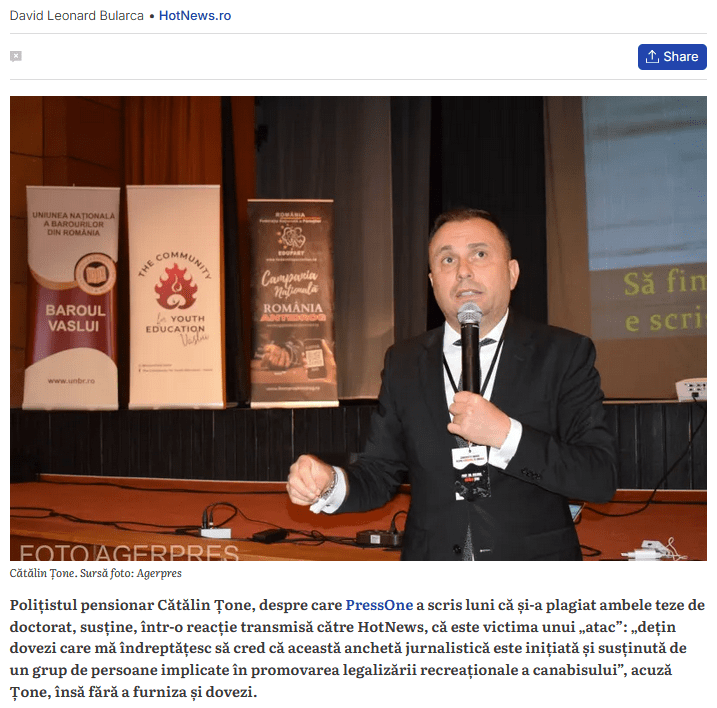
Divorțul – adică desfacerea căsătoriei – a fost simplu. Copiii – o fată – erau majori, amândoi voiau același lucru… o declarație a fost suficientă.
Partajul, în schimb…

Aveau un apartament mare, în centrul orașului. Două masini, ușor de împărțit, și niste bani. Cu atât mai ușor de împărțit. Apartamentul e suficient de mare și de bine amplasat încât din vânzarea lui să poată fi cumpărate altele două, mai mici. Doar că apartamentul are o problemă.

Problema fiind nepoata. Fata fetei lor.
Mama e în Germania. La muncă. Câștigă bine, aproape a terminat de plătit un apartament, mai mic și mai la periferie. Nepoata abia a intrat la liceu. Nu poate să stea singură și ar fi aiurea să tot facă naveta de la unul la altul.
Și cum nici unul dintre ei nu vrea să renunțe la ‘privilegiul’ de a o vedea regulat… sau poate că nici unul nu vrea să-l știe pe celălalt ‘liber ca pasărea cerului’!

Întorcând toate astea pe toate fețele… au înțeles că problemele erau în capetele lor!
Că împreună aduseseră relația în punctul în care erau.
Că de relația dintre ei mai depindeau și alte destine. În afară de ale lor.
Și că, una peste alta, le-a fost mai bine împreună. Decât fiecare separat…

Dacă ar reuși să treacă peste rănile pe care și le-au făcut de-a lungul căsătoriei!

One of the most celebrated personages in the history of the West.
He revolutionized military organization and training;
sponsored the Napoleonic Code, the prototype of later civil-law codes;
reorganized education; and established the long-lived Concordat with the papacy.
He was the moving spirit behind the intertwined series of conflicts known as the Napoleonic Wars, which had revolutionary repercussions, both militarily and politically,
in Europe as well as other parts of the world.
https://www.britannica.com/biography/Napoleon-I

Exasperated, the XIX-th century France had decided to change everything.

Please note that despite the rather inept leadership offered by the last three kings, France was the dominant European power of the moment. Economically, demographically and militarily.
Exasperated people tend to make rather poor decisions.

Napoleon Bonaparte was permitted to rise to power. To absolute power…
He yielded that power in such a way that he had angered most of his neighbors. Most of France’s neighbors… Which had banded together and defeated him. Twice.

Which was a premiere.
A bully put down by an alliance… A bunch of autocrats put off by another who decided they had enough.

The same template was used against Germany’s dictators. Both Wilhelm II and Hitler had been put down by coalitions. By people fed up with their antics.
A somewhat similar thing happened during the Cold War. A bullying regime, the Soviets, was kept in check by an informal ‘coalition of the willing’. ‘Informal’ in the sense that NATO was only the ‘tip of the iceberg. In reality, the Soviet Union had been defeated by the ‘free world’ working in concert.

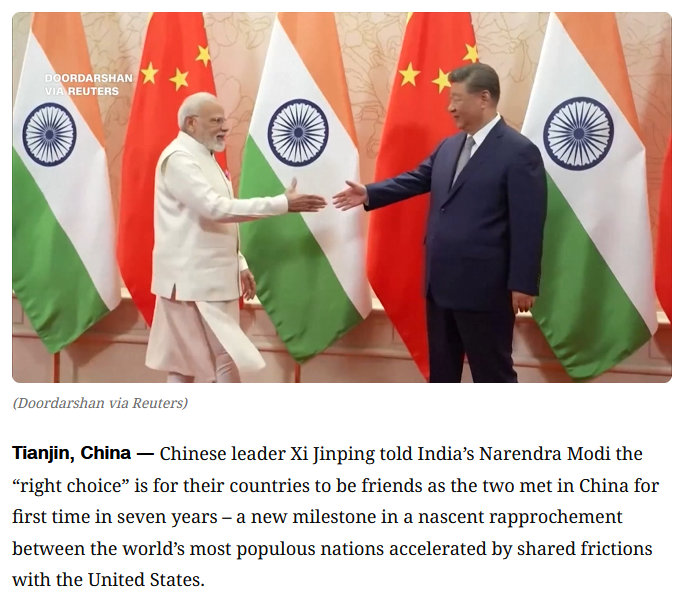
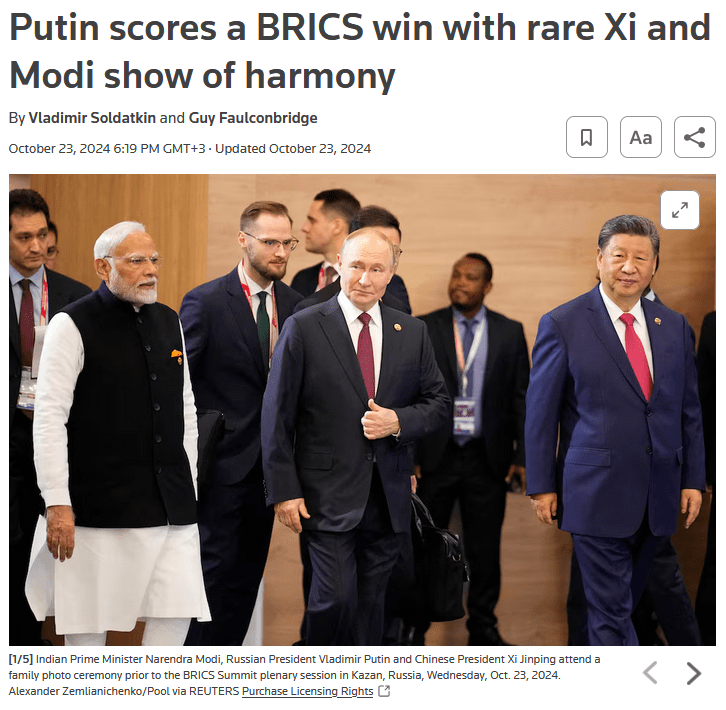
Nowadays, ‘living in interesting times’, we witness another coalition taking shape.
Three authoritarian leaders ‘pushed together’ by a fourth one… By the antics perpetrated by a guy pretending to uphold freedom. Absolute freedom…!

Probably the most important of the ‘solved‘ wars…

Xi needs Putin to remain in power. To keep the Western Europe focused on something else but China.
Trump needs Putin to remain in power. Otherwise the Western Union would stop begging for protection. And stop buying American built ‘defense hardware’…
Meanwhile, various ‘fragments of the world’ pursue their own interests… as perceived by their respective leaders, of course!

In America,
voters don’t pick their politicians.
Politicians pick their voters.”

Wayne Dawkins

America is the land of the free.
‘The people’ can, according to the Constitution, choose among the candidates.
The politicians can, also in ‘certain’ conditions, choose their voters…

And those so inclined can choose their gender!

Do I have a problem with that?

No!
But I find it very interesting that ‘gender-mandering’ is such a divisive subject.
Very revealing, actually.

Let me start with the beginning.
“The word gerrymander (originally written Gerry-mander; a portmanteau of the name Gerry and the animal salamander) was used for the first time in the Boston Gazette[b] on 26 March 1812 in Boston, Massachusetts, United States. This word was created in reaction to a redrawing of Massachusetts Senate election districts under Governor Elbridge Gerry, later Vice President of the United States. Gerry, who personally disapproved of the practice, signed a bill that redistricted Massachusetts for the benefit of the Democratic-Republican Party.” https://en.wikipedia.org/wiki/Gerrymandering.
In this context, it’s worth mentioning that the Democratic-Republican party very soon later divided itself into the present day Republican and Democratic parties…

So, gerrymandering is one of the many common traits shared by both parties…
“The Founders frequently wrote about the dangers of political parties. They often labeled them “factions” that were divisive and rooted in self-interest. In Federalist #10, James Madison wrote that factions were a majority or minority animated by “some common impulse of passion, or of interest” harmful to the rights of others and the common good. They could be a source of unjust laws and a threat to popular self-government. President George Washington concurred and warned in his 1796 Farewell Address that “the baneful effects of the spirit of party” included strong passions, jealousies and revenge, dissention, and despotism.” https://billofrightsinstitute.org/essays/the-history-of-political-parties-in-the-united-states

“Some common impulse of passion, or of interest”

And there is a common impulse of passion. And of interest!
Both parties want power. And in order to get it…

Hence not only gerrymandering – used by both parties – but also ‘gender-mandering’.
Using gender as a bone of contention. A very useful posturing pretext…

Who, but those experiencing gender-dysphoria, is actually interested in the subject?
Maybe those baffled by the insistence with which some trans-women demand to be allowed to participate in professional sports… against cis-women, of course!

On the other hand… as a posturing pretext, the subject is invaluable!
To some, it epitomizes ‘you can be whatever you want to become’. ‘Progress’ in its purest form.
To others, it is anathema. The very notion of ‘against’. Against of nature, defying God’s will, you name it!

Did I make myself clear?

What about those living ‘in hell’?!? ‘Caught in the wrong person’?
Who cares about them?!? They are few enough to be negligible. Except for when a scapegoat is in order…

Evolution is not about ‘survival of the fittest’.
Evolution is about the demise of the unfit.

Ernst Mayr, What Evolution Is, 2001

Well, it actually makes a lot of sense.

Being healthy is relative.
On having a diagnostic hanging over your head.

Here’s another way of looking at things.

Functional versus dysfunctional.
For as long as one is functional, that person is not a burden for anybody. Regardless of any diagnostic.
Even a dysfunctional person can be useful for those around them. Even if that person is completely dependent on those taking care of them. A good word spoken at the right moment makes wonders.

So yes, I would also love to die ‘healthy’. As in trying to do my best to be useful.
At least, to be as light a burden as possible.

On the other hand, health is yet another virtual thing. ‘Virtual’ as in man made…
Until not so long ago, ’cause of death’ for people over a certain age was always ‘old age’.
No longer. No matter how old the deceased, the body is transported to a medical facility and the particular cause of death is forensically determined.
It makes perfect sense. Scientifically speaking. There is no such thing as too much data, specially when it comes to something as precious to us as human life.
And it raises a ‘somewhat’ unreasonable kind of hope. That sometime, somehow, all causes of death will be mitigated. Diagnosed and treated.
That life will become ‘longer’. That we, humans, will live if not forever… then until an accident will happen to shorten our destiny.

Can you imagine something like that?
People living for 3 or 4 hundreds of years?

No retirement.
No risk taken.
No change…

Do your own thinking!

How many times did you came across this message? ‘Do your own thinking!’. ‘Do your own research!’. ‘Don’t believe everything you are told!’

Sounds reasonable, doesn’t it? What’s wrong in googling up a subject before making up your mind? What’s wrong in storming your brain before calling something one way or another?

Let’s examine something else first.
There are ways in which we relate to ‘reality’. ‘Conservatively’ or ‘open-mindedly’.
And no, this has very little to do with our intelligence or with our level of education.

It depends on how important the subject at hand is to our well being and whether we have already made up our mind about it!

How open minded are you when it comes to spending the last money you have in your pocket? With no prospect of getting any in the near future?
How open minded do you remain after you have already declared, publicly, one way or another?

Most of those lavishly spraying their audience with ‘use your own heads’ – in my FB feed – also told their followers to avoid vaccines, at all cost. The one against Covid in particular – ‘it will eventually kill you’, but also those against measles. ‘It might cause autism’.

How this thing works?

Survival bias.
We not only want to survive, physically, but also to ‘feel good’. To preserve the good opinion we have constructed about ourselves.

This being the reason for which those of us who struggle to find their next meal will not take time to consider any philosophical subject. Will gladly accept the more ‘convincingly’ stated opinion and get back to the more important task of ‘foraging’.
And this being the reason for which those of us already entertaining a strong opinion about a subject see the world ‘differently’. Effectively associate different meaning to the same words!

“Do your own thinking” actually means different things to different people.
For those who have already made up their minds it means “feel free to stick to your own opinion”.
While for those who, for whatever reason, are open-minded about the subject at hand it means “please hear me out”.

Take your pick.

“Our measures do not tell us whether philosophy majors
go on to apply their newfound abilities in the service of truth and justice
or, conversely, for personal gain and glory.
Settling that question would require gathering a different kind of evidence.”

Reading it, https://theconversation.com/studying-philosophy-does-make-people-better-thinkers-according-to-new-research-on-more-than-600-000-college-grads-262681, brought back to memory another research subject. Linking a ‘reasonable consumption of alcohol’ to various health benefits.
A quick google search produced this:

The paper I found now, https://www.phcc.org.nz/briefing/glass-half-full-alcohols-health-benefits-cardiovascular-disease-still-controversial-and, is quite thorough.
More importantly, for me, it raises the points which bothered me when I first found out about the claim. On FB, more than five years ago.
I’ll put it in my own words.

Being able to drink for a relatively long time means one had a fairly strong health at the start of the whole process. And at least some degree of self-control.
Otherwise the drinker would have very soon become ill, an alcoholic, suffered some accidents… or any combination thereof.

Same thing regarding the findings of the first study.
Take a number of smart people. One has to be smart in order to be interested in philosophy! And able to graduate…
Train those people’s abilities. Help them develop whatever they’re good at. And like doing…
Then wonder about the good results you’ve achieved!

Writing this post made me realize that it goes far deeper than this.
No, this is not a self-congratulatory study. Far from it.
It’s stark warning!

“Public trust in higher education has hit record lows in recent years, according to polling by the Lumina Foundation and Gallup. Meanwhile, the rapid advance of generative AI has threatened the perceived value of a traditional college degree, as many previously vaunted white-collar skills are at risk of being automated.
Yet now more than ever, students must learn to think clearly and critically. AI promises efficiency, but its algorithms are only as good as the people who steer them and scrutinize their output.
The stakes are more than personal. Without citizens who can reason through complex issues and discern good information from bad, democracy and civic life are at risk.”

This paper is not about the virtues of learning!
It’s about us.
So many of us still have so much more to learn about the virtues of learning…

One possible explanation for what’s going on is that not enough of the learned people “go on to apply their newfound abilities in the service of truth and justice“.
Me starting this post with the distinct feeling that this was a self-congratulatory study is yet another confirmation of the generalized distrust which permeates the whole society.
We’ve reached that stage where we primarily look for reasons to refute.
Some say a little paranoia is good for you. That it keeps you safe.
I’m afraid we’ve reached exactly where ‘they’ want us to be.
Distrusting, paranoiac people cannot do anything together.

Constantly looking over your shoulder will never lead you forward.
Will only make you, us, susceptible to manipulation.
Remember, in this context, how many reasonable posts we get from people supporting various horrendous ideas.
How many ‘think with your own head’ messages we get from those ‘also’ promoting MAGA. How many times Putin says he only makes ‘reasonable’ demands.

How can we build trust?
I don’t know how but I do know we don’t have any alternative.

We either learn to respect each-other, and build trust together, or become subjects.
And I’ve already been a subject. To a communist regime. Don’t want to repeat the experience.

Each situation comes with possibilities.
Which of them happen, and in which order, determine the ‘future’.

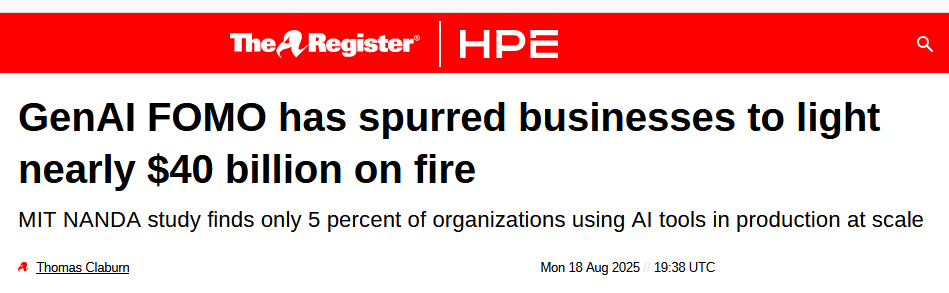
As of now, AI – plain vanilla, generative and even agentic – is nothing but a tool.

A tool used by us to peruse what ever information it has access to. Information already ‘generated’ by us…
A tool used to organize, and present, said information according to algorithms. Algorithms learned from us…
A tool used to solve tasks we have set for it. According to our needs, whims and, above all, our ability to relate with the surrounding reality.

And now we’re scratching our collective head.
Wondering why the result isn’t that different from the one we get when using our own heads…

https://www.theregister.com/2025/08/18/generative_ai_zero_return_95_percent

https://www.theregister.com/2025/08/19/us_government_ai_procurement

Fenomenologia este un curent filozofic care se concentrează pe studiul
structurii experienței, așa cum se manifestă în conștiință,
fără a recurge la explicații cauzale sau la metodele altor discipline.
Se concentrează pe esența lucrurilor, nu pe fapte sau teorii”
AI Overview propusă de Google pentru „fenomenologie definiție”

Teoretic, unu și cu unu fac doi.
Dar asta doar pentru că așa am hotărât noi.
Să dăm câte un nume pentru fiecare chestie încolonată în ceea ce noi considerăm a fi ‘șirul numerelor întregi’.
Și cum ‘chestia’ care îndeplinește condiția =1+1 s-a nimerit să fie cea botezată de noi cu numele doi…

Bat câmpii?
Stați să vedeți ce urmează…

Deci.
Tot teoretic, două doctorate înseamnă de două ori mai multă deșteptăciune confirmată oficial decât un doctorat.
Simplu, nu?
Conceptul cheie din spusa de mai sus fiind „deșteptăciune confirmată oficial”, bineînțeles.

„Tema centrală va fi așadar viața ca încercare, viața ca ispită, idee care prelungește considerațiile heideggeriene anterioare făcute în marginea epistolelor paulinice în privirea îngrijorării, nevoinței vieții.
Heidegger sesizează în textele lui Augustin și o altă tensiune, anume aceea dintre tendințele genuine ale vieții factice (care motivează experiența creștină) și tendințele conceptualizatoare și teoretizante, de proveniență neoplatonică, prin care datul genuin al facticității este deturnat în sensul său originar, și astfel acoperit, obturat, falsificat.
Așadar, cursul lui Heidegger despre Augustin se va construi pe doua fronturi. Pe de o parte, va fi vorba de tensiunea dintre tendințele genuine ale vieții factice creștine și tendințele teoretizante care provin din aluviunile conceptuale pe care le întrebuințează tacit Augustin, idee ce se situază în descendența considerațiilor privind critica primatului teoreticului (fenomenologia ca știință originară pre-teoretică).”

Pe cealaltă parte, cred că am bătut destul câmpii. Că ați înțeles deja ce vreau să spun.
Cristian Ciocan, autorul rândurilor de mai sus (Întruchipări, Studiu de fenomenologie a corporalității, Humanitas, 2013) are și el două doctorate. Tot două doctorate… Universitatea din București, 2006 și Paris IV Sorbona 2009.

OK, sunt câteva diferențe între cele doua situații.
Din păcate, există și o trăsătură de unire. Între ele…
Se justifică una pe celălaltă! Adică se explică între ele. Se ‘normalizează’ dacă vă place mai mult genul ăsta de exprimare.
Privindu-se una pe cealaltă, ca într-un soi de oglindă, cele două situații devin cât se poate de transparente. De inteligibile…

Mă pregăteam să …
Și mi-am dat seama că!

Mai bine închei cu o amintire.
Undeva prin clasa a VII-a am descoperit revista Săptămâna. A lui Eugen Barbu.
Nu eu, ci prietenul meu cel mai bun. Care le avea pe astea cu literatura. Nu mai țin minte ce îi atrăsese atenția, cert este că erau multe lucruri interesante acolo. Chiar pentru niște copii, așa cum eram noi.
În afară de chestiile interesante, erau și unele extrem de hazlii. Din când în când, dădeam peste niște texte scrise în stilul folosit de dl. dr. Ciocan. Râdeam cu hohote. Nu erau la fel de complicate precum exemplul de mai sus, cele mai multe erau din zona criticii literare, dar exprimarea era la fel de pompoasă. Efectul la fel de … hazliu, pentru noi. Pentru noi, niște puști care le citeam cu dicționarul în mână. După care ne întrebam: „Da’ de ce nu vorbește ca oamenii? Cui se adresează? Cei care sunt capabili să înțeleagă cuvintele astea abracadabrante nu au nevoie să le traducă cineva ‘ce a vrut să spună autorul’”.