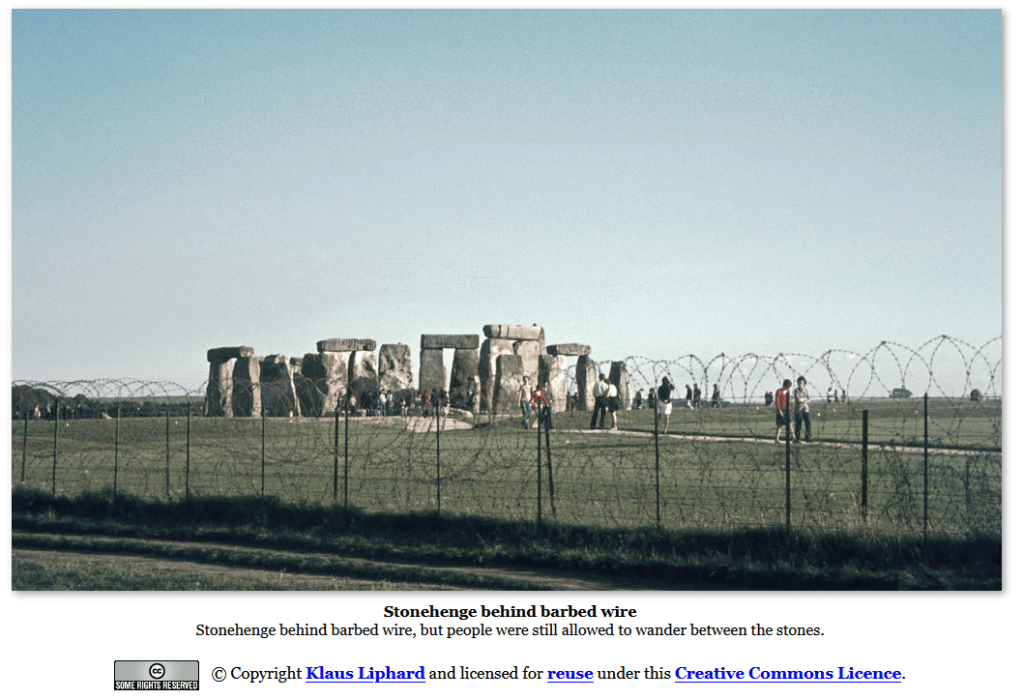
Archives for posts with tag: Stonehenge

Terror management theory is the idea that we create culture
and aspects of our lives that will “outlive” us
because of our knowledge of our own mortality
which is innately terrifying to us.

Self awareness doesn’t come cheap…

Collectively, species-wise, we’ve done OK. We’ve become the dominant species on Earth.
For good and/or for worse…

Individually, on the other hand…

Doubts!
Self-awareness comes with plenty of them:
Will I be able to find enough food tomorrow? For me and for my family?
When will it start to rain?
Will the sun rise again?

The way I see it, ‘The Stonehenge’ has been built for one thing only.
To assuage fear.

According to scientists researching the phenomenon, ‘The Stonehenge’ had been built by the immigrants who brought agriculture into Britain.
Solving the food problem wasn’t enough. Enough to bring peace of mind…
Now, that full bellied people had enough time on their hands, they started to think about ‘the future’:

‘OK, tomorrow will come. The sun will rise. We’ll be able to sow our crops for the next year. But is there an order in all this? How can we be sure?’
‘Let’s build something which will prove “order”. If we could demonstrate that year after year the summer solstice ‘falls’ under the same ‘parameters’ then there’s indeed an ‘order’. Things don’t just happen, they follow a ‘script’ ‘.

And they did exactly that. Built the first scientific instrument. Proved that the sun not only rises each day but also follows a precise path.

Quite a management feat.
And no, I don’t mean the stone stacking part. However remarkable that was…
Their real success was to convince themselves to keep toiling into the future!

If medieval advances in the plough didn’t lift Europe’s peasants out of poverty,
it was largely because their rulers
took the wealth generated by the new gains in output
and used it to build cathedrals instead.

And this has happened many more times across the world/along human history.

The fact that Stonehenge exists is ample proof that those people had been able to generate enough ‘wealth’ to build it.
We’ve been able to find out that the boulders had been sourced from two places. The 20 tons hard-sandstone sarsenes ‘traveled’ about 20 miles while the 2 tons blue-stones had been schlepped for about 220 miles. According to Mark Pitts, writing for the British Museum. And we think we have a fair idea about how the whole thing had been put together. Read the paper.
But we know close to nothing about the people who did it.

The stone ring is all that’s left of them.
Isn’t it strange? For such a technologically sophisticated people – and rich enough to afford such a herculean endeavor – to disappear in the mist of history?

And here’s a selection of other abrupt endings/’hibernations’:

Mohenjo-Daro and Harrapa in Pakistan.
Angkor Wat.
The Great Chinese Wall
The Egyptian pyramids
The Athenian Parthenon
The Roman Coliseum and the roads cris-crossing more than half of Europe
Kuldhara, the ghost-city
Machu Picchu
And, last but not least, the cathedrals mentioned by Reuter’s Mark John.
Europe did take a break after finishing building those cathedrals….

What am I trying to ‘suggest’?

That we, as a cultured species, have a tendency to evolve in fits and starts.
We tend to reach pinnacles only to descend – sometimes temporarily – in abject ‘marasmus’.

Could ‘self-sufficiency’ explain at least some of this?

While the spinning jenny was key to 18th century automation of the textiles industry,
they found it led to longer working hours in harsher conditions.
Mechanical cotton gins facilitated the 19th century expansion of slavery in the American South.

NOTA BENE!

Don’t tell me capitalism is at fault for any of this.
Capitalism is but a way of doing things. A road. Which we followed to where we are now.
How we behaved en-route and what we decide right now was/is our own contribution!

‘For things to work as intended, there must be a rule’.

Errr…

‘For things to work, there must be at least some consistency involved’.

This is a far better starting point!

An example would be fine?

Then imagine an Earth where the gravitational field was haphazard. In space and time. Where two lumps of dirt, a k a mountains, sometimes pulled at each other while some other times pushed. With no rules involved whatsoever.
Or where sometimes wood needed oxygen to burn while some other times – or in some other places, the presence of nitrogen was enough for wood to burst into flames.
Need some more? Then how about a place where dogs breed with cows. And also with butterflies. Only not always. And not in a constant manner.

Have you stopped laughing?
Well, this was how our ancestors imagined the Earth.
Sometimes after a mutation had provided them with the most powerful brain ever, our forefathers had learned to speak. To ‘trade’ information. Soon after they has started to develop something Humberto Maturana called ‘the ability of an observer to observe themselves while making observations’. ‘Self awareness’ for short. Or ‘conscience’ in everyday parlance.

Imagine a self-aware observer watching the sun go down. A rather smart one. One with a vivid enough imagination to ask ‘what if the sun will not come up tomorrow morning’…
Stonehenge has suddenly acquired a new meaning, right?

That was why God had so much traction. Simply because it gave sense to everything. It lend meaning to everything under the sun. And beyond!

In time, under God’s protection, we invented science. And, slowly but surely, we’ve started apportioning meaning ourselves.
Meaning we’ve started to take for granted.
Meaning which no longer depended on any third party!

Only we’ve gradually forgotten what science is really about.

Why we had developed it in the first place.

We had forgotten that science is wrong by definition.
That, by following this path, we’ll be forever able to find new meaning but that we’ll never be able to find ‘the’ meaning.

And now, that we’ve ‘killed’ God – as no longer necessary, we rely solely on the meaning we’ve already affixed to the things we already know.
To the things we consider to know… conveniently forgetting what science taught us….

Faced with unforeseen crises – unforeseen, not unforeseeable, we are left powerless.
Having taken so much for granted – our knowledge about the world and our ability to overcome everything the nature throws at us, above all, we find ourselves bereaved of our erstwhile powers.

Are we going to rediscover intellectual humility? And the ability to take advice? From the most unlikely teacher?

Or else?

What better way to treat depression than visiting some of the great achievements of humankind?

Stonehenge, the Great Pyramids, Machu Pichu, a selection of Europe’s Medieval Castles and Cathedrals, the Taj Mahal, Beijing’s Forbidden City, the Golden Gate, Burj al Khalifa …

I should take my wife along, right?

1324 AED roughly translates into 325 Euros. Not exactly cheap but… one also needs to get there.

Good thing I haven’t bought the tickets for the Lounge yet… I must reschedule…

On the other hand, does any of this make any sense for any of you?

Five hours of traveling over the clouds at almost 1000 kms per hour costs the same as spending an hour and half in a bar half a mile up in the sky? OK, Wizz Air is a low cost company, you have to pay extra if you fancy any refreshments… but still….

I’m not at all sure this trip would do anything good to my depression.

Let me put my feet back on the ground first!