

“Doubt everything” instead of ‘trust the scientist until proven wrong’.
‘Illiberal democracy’, whatever that might mean…
“Abolish capitalism”. As if there was any viable alternative!
What’s going on here?!?
“Doubt everything” instead of ‘trust the scientist until proven wrong’.
‘Illiberal democracy’, whatever that might mean…
“Abolish capitalism”. As if there was any viable alternative!
What’s going on here?!?
“The Social Responsibility of Business Is to Increase Its Profits“
Milton Friedman, 1970
Wood is the raw material we use to make timber. And paper.
Steel is the raw material we fashion into tools. And weapons.
Words are the raw material we shape into ideas.
We use timber to build houses.
Paper to print poetry.
Tools to transform nature into civilization.
Ideas to make sense of the world we live in. And of ourselves.
When angry, we burn houses. Print lies. Transform tools into weapons and use them to destroy.
When angry, we no longer see eye to eye about meaning.
Almost two and a half millennia back, Plato told us us that “until political power and philosophy entirely coincide…“
We had chosen, while ‘angry’, to interpret Plato’s warning as being a ‘blue print’. A ‘boiler plate’ for ‘how to breed appropriate rulers’. https://www.britannica.com/topic/philosopher-king.
Karl Marx, while terribly angry – and not without reason, had chosen to put in practice, tentatively, the generally accepted version of Plato’s work.
“The Communists, therefore, are on the one hand, practically, the most advanced and resolute section of the working-class parties of every country, that section which pushes forward all others; on the other hand, theoretically, they have over the great mass of the proletariat the advantage of clearly understanding the line of march, the conditions, and the ultimate general results of the proletarian movement.“.
Nietzsche confessed, publicly, “God is dead. God remains dead. And we have killed him“.
We have chosen to place the onus on him. As if it had been he who killed God. Alone…
Friedman – Milton Friedman the economist, not a word-smith nor a philosopher – had formalized the public opinion prevalent during his ‘tenure’. That corporations should stick to what they were good at – producing things in an efficient manner, hence being profitable – and leave social intervention to those concerned with solving that line of specific problems.
NB. I’m not suggesting Friedman was right. More about ‘being right’ in a short while. I’m only stating that both Friedman’s sycophants and detractors – including me – have been near-sighted.
Heidegger was the guy who brought back into discussion the notion of Aletheia. “the presocratic way to truth, as unconcealment.“
Truth as the the ‘politically’ sanctioned expression of reality. “until political power and philosophy entirely coincide…“
In a sense, we’ve spent the last two and a half millennia updating Plato’s to Heidegger’s wording of how to make sense of truth.
We haven’t been able to come up, yet, with a convincing version because we’ve chosen to ‘ignore’ Buddha’s “truth that misery originates within the craving for pleasure“. That ‘misery’ originates from our ‘rational’ desire for ‘being right‘.
That misery originates from us being angry, collectively, for not being able to reach ‘the truth’ individually.
That misery originates from each of us, individually, craving to be ‘right’. Each on our own…
“The Buddha taught that nothing is permanent and that everything is impermanent.
Therefore, people should avoid getting attached to things as eventually everything will change.
People suffer when they crave and when they get attached to people and objects.“
Being right, individually, is both incomplete – as Heidegger pointed out – and temporary. According to both Siddhartha Gautama and Karl Popper.
Being angry about not being right is not helpful. On the contrary…
It compels us to defend our version of truth and it blinds us towards all others. Regardless of how they complement ours.
Renders us incapable to politically sanction a comprehensive version of truth. Renders us incapable to build Aletheia.
“Truth used to be based on reason.”
J.P.Moreland, Introduction to
Escape From Reason 2006
by Francis A. Schaeffer

Etymologically speaking, reason comes from ratio.
‘Reason’ in Latin but also having to do with ‘reckoning’.
With dividing the ‘big picture’ into easier to understandable slivers. Slivers meant to be analyzed and later assembled back into meaning. Into ‘truth’.
Currently we understand reason as “the intellectual faculty that adopts actions to ends“.
Now, which of the two reasons gives birth to the ‘genuine’ truth?
The analytical/synthetic one which attempts to develop reality into meaning or the one which defends and embellishes the already known truth? The revealed truth?
The whole thing depends on the “ends” of the reasoning agent?
Reason, hence truth, depends on the intention of the individual performing the act of reasoning?!?
Quite unreasonable, don’t you think?
Truth was supposed to be anchored in reality, right?!? Not on ‘intention’….
Truth as unhiddenness… is a concept developed by Heidegger.
Basically, this whole thing is about individuals being unable to discover nor formulate the ‘entire’ truth so a ‘bigger’ truth may be reached only through cooperation. Everybody ‘says’ – unhides – everything they know about a subject and that’s how the most complete truth available at that moment is ‘uncovered’.
‘But this means the Truth becomes fluid.
No longer ‘fixed’. Unreliable!’
I’m afraid you’re right!
Except for the ‘unreliable’ part.
As long as enough people do their part, and honestly speak up their minds, the most reliable truth knowable at any given moment will become apparent to everybody.
To everybody who cares to look for it!
To everybody who accepts that their reason, while imperfect, can and should contribute to the common effort to get closer to truth.
To everybody who accepts that other people’s reason, while imperfect, can and should be listened to in the common effort to get closer to truth.
To everybody who accepts to continue this effort knowing very well that no matter how hard they will try, people will never find the entire truth
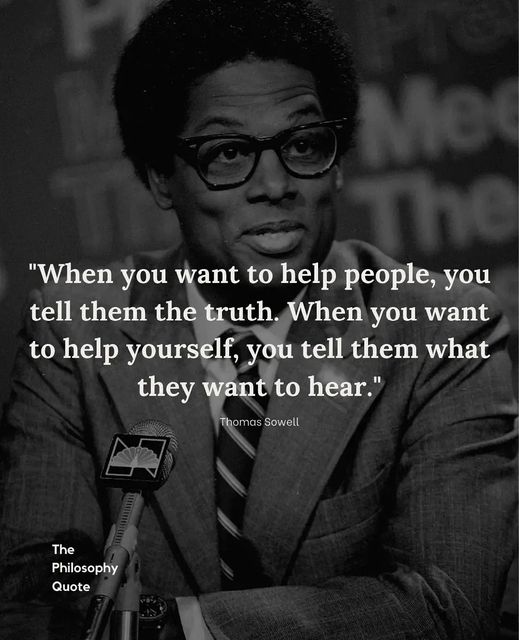
Can’t argue with Sowell… he’s right, right?
As usual!
But there’s problem!
For me, at least…

According to Orwell, there are people who refuse to acknowledge the truth.
Which doesn’t bother the truth, of course.
But it bothers us…
If there are people who refuse to acknowledge the truth, then truth isn’t self evident.
There isn’t an immediate and direct ‘relation’ between not acknowledging the truth and ‘retribution’.
And for good reason!
Truth is extremely elusive. And complex.
Impossible to find, actually.
All we can lay our hands on is ‘relative’ truth.
A truth we have all labored to find and which continues to remain ‘incomplete’. Against our best efforts!
And which, from time to time, is found to be completely false.
Remember how so many of our ancestors were convinced that the Sun was circling around the Earth?
Which Earth used to be flat?
Which Flat Earth brings us back to Sowell.
I basically agree with him.
“If you want to help somebody, tell them the truth. If you want to help yourself, tell them what they want to hear…”
But do I know what the truth of the matter really is?
Do I actually know what they really want to hear?
And what if/when they find out? My strategy?
That I was telling them what they wanted to hear in order to help myself?
Sowell didn’t mean this as an ‘advice’?
Only as a warning?
Well, I don’t dispute his intentions.
Only the underlining assumption.
That truth is accessible.
That we can reach it! And manipulate it according to our wishes….

The first reaction, for the ‘average person’, is to ‘love’ this post.
The ‘normal’ reaction, for the ‘fact-checkers’ among us, is to ask ourselves:
Is this actually true?
Heidegger has something really interesting to say about the subject.
I’m gonna put it succinctly and bluntly.
None of us knows everything about anything. Not even about the most trivial thing.
Because the very nature of our knowledge and of our manner of expressing it – language, none of us is able to ‘put together’ even the simplest ‘absolute’ truth.
Hence, according to Heidegger, we have as many truths as there are people interested on the subject.
‘Then the African Proverb is a ‘lie’?’
Nope.
The African Proverb pictured above is a meta-truth.
Heidegger’s truths, as well as those discussed by Popper, all converge towards the ‘absolute’ one.
As each of the ‘people interested on the subject’ dig deeper, each of them gets closer to the kernel. Probably none of them will ever get exactly ‘there’ but their respective positions will become ever closer.
Meanwhile, there’s nothing like a ‘meta-lie’. As we had ‘truth’ and ‘meta-truth’.
A lie, any lie, is also a meta-truth.
We know – we are under the impression, more exactly, that we’ll never reach ‘the absolute truth’. About any subject, let alone the ‘absolute-absolute’ one. But we can conceive that there is one. Somewhere. At least about individual points of interest.
Do we even have the concept of an absolute lie?
What would that be? How could that even be expressed?
This being the reason for some of us being able to come up with so ‘plausible’ lies.
They put so much truth into their words that it becomes harder and harder for us to notice that the ‘proposed conclusion’ is misleading.
That, in fact, they are lying through their teeth.
https://plato.stanford.edu/entries/popper/#ObjeKnowThreWorlOnto
Three truths about what ‘science’ means.
First part, We.

According to Heidegger, there are two kinds of truths.
A. A proposition is ‘true’ if what’s being said there is in perfect correspondence with reality.
B. A proposition is ‘true’ if the proposition encompasses everything the ‘communicator’ knows about the subject at hand.
‘OK, you promised us a discourse about science and here you are babbling about truth…’
Impatient as always!
How do you determine whether something being said, a proposition, is in (perfect) correspondence with the reality of the fact described there?
To be able to do that, you need first to determine the reality itself.
You know what’s being said – more about that later, and, if you are to determine whether what’s being said is true, you now need to know the truth itself.
How are you going to do that?
You either know it already or you proceed to determine that particular truth.
I’ll leave aside the ‘already known truth’ and proceed towards the ‘future truth’.
A particular individual has two possible approaches towards finding out a ‘new’ truth. A piece of ‘true’ information which is new for that particular person.
Consult a reliable source or investigate the reality.
‘Consulting a reliable source’ brings us back to square one. How do you determine whether a source is reliable or not….
‘Investigate the reality’… Easier said than done!
How do you do that? How do you investigate the reality in a reliable manner? How do you determine the truth of the matter when ‘things’ are a tad more complicated than touching a stove to determine whether it’s hot or not?
You use the scientific approach?
Start from the scientific data base which already exists on the subject(s) closer to your object of interest then proceed using the proven scientific method of trial and error? Emit a hypothesis, try to prove it, formulate a theory and then challenge your peers to tear apart the results of your investigation?
Results you have chased being convinced from the beginning that you’ll never reach the ‘pinnacle’?
Convinced from the beginning that the ‘absolute truth’ – even about the merest subject, is out of reach?
For us, mere mortals, anyway?
‘But if ‘absolute truth’ is out of reach, then how can we determine whether the simplest proposition is actually true?
And why continue to bother about the whole subject, anyway?!?’
Before attempting to find an answer to your question, let me formulate another one.
Let’s consider that you have reached a conclusion about something. That you are in possession of ‘a truth’. How are you going to share it? With your brethren/peers?
I must remember you at this stage of our discussion that language is beautiful but rather inexact. Are you sure that you’ll be able to communicate everything you want to say? To cover every minute aspect of the truth you have just found?
So that the proposition you are about to put together will be in absolute correspondence with the piece of reality you have just discovered?
You are not going to use language at all?
You’re just going to point to your discovery? And let everybody else to discover the truth for themselves?
And how many are going to take you seriously? To pay attention? To what you have pointed?
And how many are going to suspect that you just want to take their focus off what’s really important? To lead their attention away of what you want to keep under wraps?
I’ve got your head spinning?
Then you must understand my confusion. I’m so deep in this that I have to go back and read again what I’ve been writing…
So.
‘Science’ tells us that the ultimate truth is out of our grasp, linguistics/theory of communication tells us no messenger will ever be able to be absolutely precise nor convey the entire intended meaning … what are we going to do?
Settle down and wait for the end to happen to us?
OK, let me introduce you to an absolute truth.
WE ARE HERE!
Who is here?
‘Us’. We are here.
What are we doing here?
‘Are’. We are here.
Where are we?
‘Here’. We are here!
I’ve been recently reminded that mathematics, the most exact language we have at our disposal, is based on a number of postulates. On a small number of axioms – pieces of truth we consider to be self evident, which have constituted a wide enough foundation for mathematics to become what it is today.
But mathematics is far more than a simple language. It is also a ‘virtual space’. A space where special rules apply. A space where our thoughts move according to certain and specific ‘instructions’. A space where we enter holding our arms around a problem we need to solve and which we exit, if successful, with a solution inside our head.
A little bit of history.
Our ancestors had a problem. A class of problems, actually.
How to build something – a house, a temple, a boat, and how to ‘manage’ property – arable land, in particular, but also crops and other ‘stocks’. Problems easier to formulate, and solve, using numbers.
To solve this class of problems, some of our ancestors have invented ‘mathematics’. Had ‘discovered’ the self evident truths – axioms, and then ‘carved’ an entire (virtual) space using the axioms as the foundation upon which they, and those who have followed in their steps, have built – and continue to build, the scaffolding of rules which keep that space ‘open’.
Through thinking, our ancestors have carved a space in which to solve some problems they have encountered in the ‘real’ world…
‘Please stop!
I don’t understand something.
Do you want to say that mathematics is not real?’
To answer this question, this very good question, we need to settle what ‘real’ means.
To us, at least…
Let’s examine this rock. Is it real?
Why? Because you can feel it? If you close your eyes, I can make it so that you experience the same feeling by touching something else to your stretched out fingers than the original rock. In a few years, I’ll be able to produce the same sensation in your brain by inserting some electrodes in your skull and applying the ‘proper’ amount of electric current. What will ‘reality’ become then?
Forget about that rock, for a moment, and consider this table.
Is it real? Even if it’s not as natural as the rock we were analyzing before?
‘Artificial’ – as in man made, starting from natural ‘resources’, might be a good description of the difference between a table and a ‘simple’ rock. Both ‘real’ in the sense that both imply consequences. Your foot will hurt if you stumble in the dark on either of them. Regardless of the rock being natural and the table happening to be artificial…
‘But what about things which are not of a material nature?
Are they real?’
Are you asking me whether ‘metaphysical’ objects – God, for instance, are real?
Then how about ‘law’. Is it real? As an aside, does law belong also to the metaphysical realm? Alongside God? Who determines which thing belongs there?
Or have you glimpsed the fact that ‘truth’, the concept of truth, is a metaphysical ‘object’?
Something which, like God, has a ‘real’ side but makes no sense (to us) unless we think about it?
Something which we have extracted – someway, somehow, from the surrounding reality – where else from? – then ‘carved’ a virtual space around it? So that we may examine it without the distractions of the rest of the ‘real’ world?
Or have you glimpsed also that even the concept of ‘reality’ is a figment of our self-reflecting conscience?
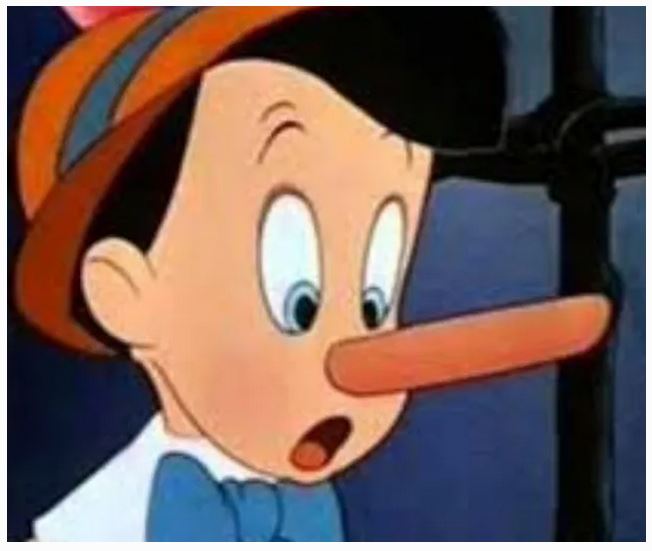
Messages which are knowingly incomplete, false or both at the same time.
Why?
Because they have no alternative, want to achieve something or need to survive.
As soon as a person achieves a certain level of self-awareness – read consciousness, they realize that no ‘communication event’ will ever be complete. That nobody will ever be able to communicate everything they know, about the most insignificant subject, to anybody else.
Then what? Stop talking?
Or assume personal responsibility for everything that leaves your lips?
As soon as a person achieves a certain level of self-awareness, they realize there’s more in life than mere survival.
As soon as their consciences bloom – in concert with the accrued influence exercised by the ‘environment’, individuals set goals for themselves. Which goals become integral part of the ‘ongoing project’. Of the self-actualizing conscience. Achieving, or failing, each of those goals leaves an indelible mark on the conscience itself. On the manner in which each individual relates to their environment.
Since achieving is far more ‘satisfying’ than failing, conscience is naturally biased towards ‘achieving’. If the ‘environment’ ‘allows’ it, the bias becomes more and more ‘slanted’.
The messages used by the individuals – by their conscience, to be more precise, will increasingly serve the purpose of achieving goals rather than the purpose of ‘honest communication’.
As soon as a person achieves a certain level of self-awareness, that conscience wants to survive.
Mind you, not the person but the conscience.
‘?!?
Conscience cannot exist without the mind/body which supports it….’
OK, tell that to people who believe their souls are going places after their mortal bodies expire. Then try to demonstrate to yourself, honestly, that those people are wrong. That there’s no chance for their belief to be ‘true’.
But metaphysics are hard.
Let me give you a far lighter example.
Smoking. Or drinking. Driving fast. Eating that extra piece of chocolate…
Don’t tell me you never did anything ‘foolish’. That you never lied to yourself: ‘This cannot happen to me. Chances are so small that … Only this time….’
‘But otherwise nobody would ever be able to ‘leave their houses’. We’d be all completely paralyzed with fear…’
Yeap! That’s exactly what I mean. Conscience needs to lie to herself in order to remain functional. Otherwise she would not allow the physical body who sustains her to assume any risk.
They would both suffocate.

 nicichiarasa