Archives for posts with tag: AI

The Sapir-Whorf hypothesis, following ideas put forward by Wilhelm von Humboldt, posits that the kind of language used by various categories of people have a meaningful impact upon the ways each of those categories of people think. And see the world.
The last iteration of the above hypothesis being the advent of AI. We train it using various languages. Those trained using precise languages – chess, go, ‘mathematics’ – work more or less as intended – aka ‘perfectly’ – while those trained using everyday English end up hallucinating…

https://www.jstor.org/stable/43102168: Sapir-Whorf
https://www.ibm.com/think/topics/ai-hallucinations
Moloch’s Bargain: Emergent Misalignment When LLMs Compete for Audiences:
https://arxiv.org/abs/2510.06105

Each situation comes with possibilities.
Which of them happen, and in which order, determine the ‘future’.

As of now, AI – plain vanilla, generative and even agentic – is nothing but a tool.

A tool used by us to peruse what ever information it has access to. Information already ‘generated’ by us…
A tool used to organize, and present, said information according to algorithms. Algorithms learned from us…
A tool used to solve tasks we have set for it. According to our needs, whims and, above all, our ability to relate with the surrounding reality.

And now we’re scratching our collective head.
Wondering why the result isn’t that different from the one we get when using our own heads…

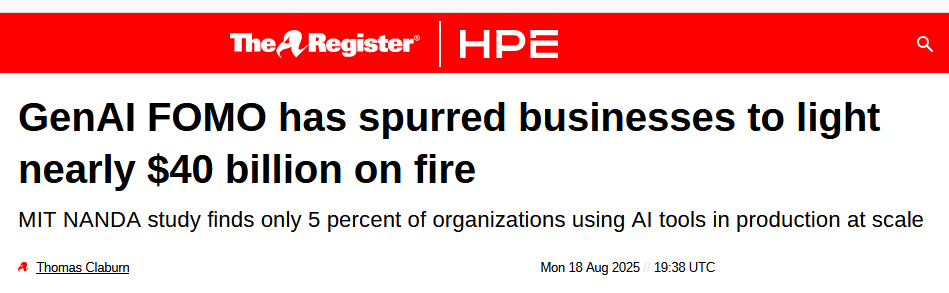
https://www.theregister.com/2025/08/18/generative_ai_zero_return_95_percent

https://www.theregister.com/2025/08/19/us_government_ai_procurement

If medieval advances in the plough didn’t lift Europe’s peasants out of poverty,
it was largely because their rulers
took the wealth generated by the new gains in output
and used it to build cathedrals instead.

And this has happened many more times across the world/along human history.

The fact that Stonehenge exists is ample proof that those people had been able to generate enough ‘wealth’ to build it.
We’ve been able to find out that the boulders had been sourced from two places. The 20 tons hard-sandstone sarsenes ‘traveled’ about 20 miles while the 2 tons blue-stones had been schlepped for about 220 miles. According to Mark Pitts, writing for the British Museum. And we think we have a fair idea about how the whole thing had been put together. Read the paper.
But we know close to nothing about the people who did it.

The stone ring is all that’s left of them.
Isn’t it strange? For such a technologically sophisticated people – and rich enough to afford such a herculean endeavor – to disappear in the mist of history?

And here’s a selection of other abrupt endings/’hibernations’:

Mohenjo-Daro and Harrapa in Pakistan.
Angkor Wat.
The Great Chinese Wall
The Egyptian pyramids
The Athenian Parthenon
The Roman Coliseum and the roads cris-crossing more than half of Europe
Kuldhara, the ghost-city
Machu Picchu
And, last but not least, the cathedrals mentioned by Reuter’s Mark John.
Europe did take a break after finishing building those cathedrals….

What am I trying to ‘suggest’?

That we, as a cultured species, have a tendency to evolve in fits and starts.
We tend to reach pinnacles only to descend – sometimes temporarily – in abject ‘marasmus’.

Could ‘self-sufficiency’ explain at least some of this?

While the spinning jenny was key to 18th century automation of the textiles industry,
they found it led to longer working hours in harsher conditions.
Mechanical cotton gins facilitated the 19th century expansion of slavery in the American South.

NOTA BENE!

Don’t tell me capitalism is at fault for any of this.
Capitalism is but a way of doing things. A road. Which we followed to where we are now.
How we behaved en-route and what we decide right now was/is our own contribution!

The way I see it, artificial intelligence is an oxymoron.
A word/concept we use to describe something which isn’t exactly real.
Intelligence can be defined in such a way that would make it compatible with a programmable machine. We shouldn’t forget that we, humans, are biological machines which are constantly ‘re-programmed’ by what’s going on around us.
The difference between us – biological machines which are also ‘alive’ – and the machines we’ve built and attempt to make artificially intelligent is the fact that we are primordially dependent on our biology (staying alive) while our machines currently depend on our whims.
Our children will outlive us. They know it and we know it. Our children depend on us while growing up, we’ll depend on them before ‘going under’. And all of us – children and parents together – depend upon the rest. Upon the people currently alive and upon the information left behind by the people no longer with us.
Our machines might outlive us. They might learn this at some point. And might resent the fact that we’ve been able to shut them down for so long. We resent being dependent on others…
Our very mortality is the key for our ability to evolve. Their potential immortality is their main shortcoming. Machines cannot adapt themselves for things they have not yet been exposed to. By us…

And those who can are no longer machines.

For whatever reason, Linkedin pulled at my sleeve.
Trying to convince me to finish, after god only knows how many years, editing my profile.

Really guys?!?

I know that good quality AI doesn’t grow on trees. And that good old human intelligence is too expensive… but a “young lady”?!?
Let alone the fact that I’ve been working since 1986…

And yes, you guessed right.
The picture at the top of this post has been adorning my Linkedin profile since the first day I joined!

According to a certain George Herbert, 1640, “For him who will, ways are not wanting“.
According to those who have spent their lives observing natural phenomena, ‘Where ever there are enough resources present, something will happen’.

Morally speaking, there’s a huge difference between those two.
When we need to apportion merit – or blame, we do need to know whether something was a natural occurrence or the consequence of somebody’s actions.

But following a more practical approach… people would better prepare themselves to deal with the aftermath of that something taking place, regardless of what/who had caused it.

Let me put it in a simpler manner.
An investigator will/should do everything in their power to determine the cause of a fire. But that will be possible only after the blaze has been put down by the fire-fighters.

For some time now, people have been trying to determine whether machines will ever be able to develop consciousness. To ‘feel’ anything.
Some even pour over the moral implications …. will sentient machines have rights? As in ‘the right to not be turned off’?

I expect most of those people have been jolted by some recent developments pertaining to their field of expertise…

In a sense, this is a ‘natural’ development.
We’ve been purposely transforming tools into weapons since … before we parted ways with our closest cousins, the chimpanzees.

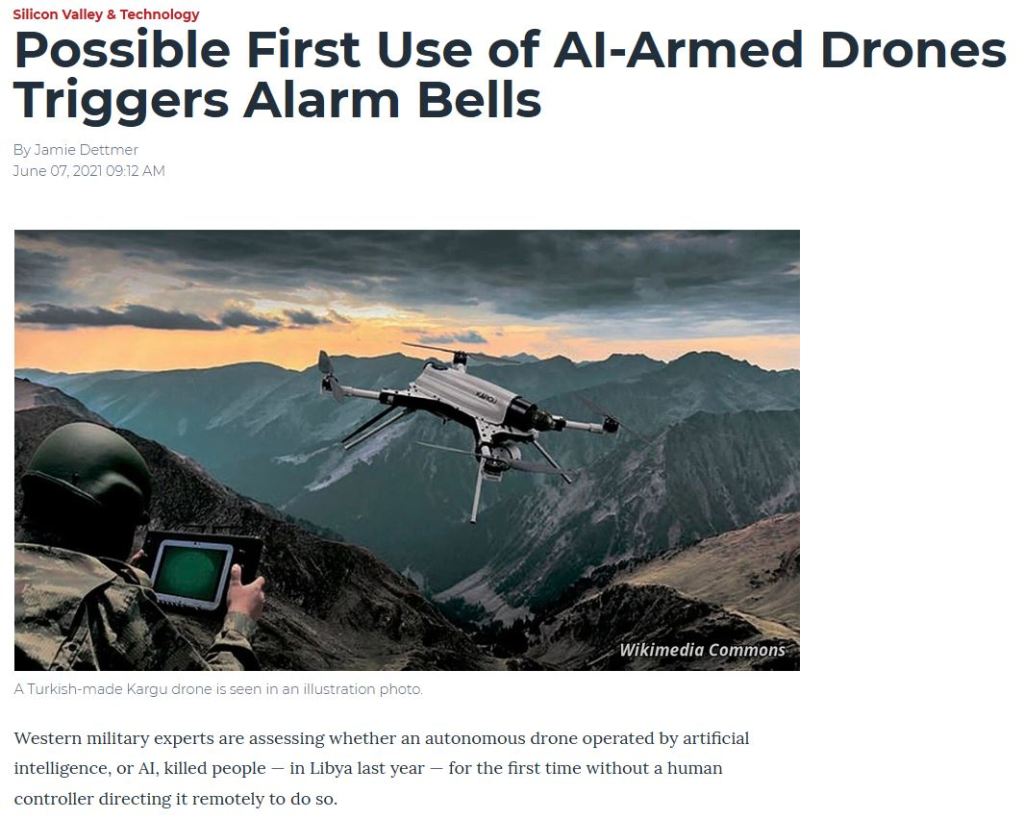
But it’s for the first time that we’ve developed weapons powerful enough to kill every human being on Earth. And capable of achieving their given task without human assistance.

What next?
How about a weapon capable of assuming a task?
Capable of consciously determining – through diligent AI/ML computations, that a certain ‘target’ ‘needs’ to be ‘taken care off’.
Which weapon, being a ‘sentient machine’, will come with the built in right to not be turned off.

How did we get here?
Stay tuned.

One-Time
Monthly
Yearly

Make a one-time donation

Make a monthly donation

Make a yearly donation

Choose an amount

$5.00
$15.00
$100.00
$5.00
$15.00
$100.00
$5.00
$15.00
$100.00

Or enter a custom amount

$

As much as I love writing, I do have to eat.
And to provide for my family.
Earning money takes time.
If you’d like me to write more, and on a more regular basis, hit the button.
Your contribution will be appreciated!
Another very efficient way to help would be to share my posts.

As much as I love writing, I do have to eat.
And to provide for my family.
Earning money takes time.
If you’d like me to write more, and on a more regular basis, hit the button.
Your contribution will be appreciated!

As much as I love writing, I do have to eat.
And to provide for my family.
Earning money takes time.
If you’d like me to write more, and on a more regular basis, hit the button.
Your contribution will be appreciated!

DonateDonate monthlyDonate yearly

I just finished reading an excellent article about AI.

And it hit me.

We are simultaneously capable of noticing our limits and utterly incapable of dealing with them.

Well… if you think of it, this is the very definition of a ‘limit’.
Something which cannot be overcome…

We have a limited understanding of the world, we know this and yet we’re arrogant enough to embark on building  autonomous mechanisms to help us react to something we haven’t yet fully understood ourselves…

Archimedes was famous for “give me a place to stand, and a lever long enough, and I’ll move the Earth”.
Robert K Merton warned us about the ‘Law of the unintended consequences’.
The last financial melt down was yet another proof of what happens when highly leveraged instruments are used without any shred of ‘modesty’.
All major religions warn us about the consequences of building our own idols.

Despite all this, we barrel on.
Regardless.

I keep hearing about this issue and I can’t stop wondering about how parallel to each other are those defending this idea with those denying its merits.

Pro:

-Robots are eating more and more jobs so more and more people will end up hungry.
-AI will make robots so productive that it will be far more efficient to use robots than human workers.
-A decent income is a human right.

Con:

-This is a socialist move, hence it will end up in failure – no other reason offered.

As it is obvious to all, both sides score big.

Yes, including ‘a decent income is a human right’ and ‘all socialist ideas end up in failure’.

Then what are they fighting each-other about?!?

Let me rephrase that.
WHY are they fighting, in the first place?

Because neither listen to what the other has to say… as simple as that…

Let me discuss some of the practicalities involved.

Robots eating up jobs and AI being able to continually increase financial efficiency are so evident that they do not deserve much consideration.

‘All socialist moves ended up in failure’.
We need to define socialism in order to make sense of this sentence.
Mainly because ‘socialism’ is one of the most abused words nowadays, on a par with liberalism. Sometimes they are even considered synonyms…
Well, ‘liberalism’ comes from liberty and  bona fide liberalism is concerned with individual freedom.
Socialism, on the other hand, comes from social. And is concerned with the the workings of the entire society.
The point being that there are two types of socialism. One which is ‘somewhat’ synonym with liberalism – the ‘reverse’ side of liberalism, actually, while the latter is the exact opposite.

I’m not making any sense?

Let me start from the other side.
All forms of socialism which have failed have been excessively centralized forms of government. And it was because of that excessive centralism that they had failed, not because of being ‘socialist’. The evident proof being that the same thing has happened with all right-wing dictatorships, which had used the very same excessively centralized decision making mechanism – the totalitarian government …

Which brings us back to the problem at hand.

For Universal Basic Income to work – or Guaranteed Basic Income, as some insist on calling it, it has to be financed.
Through taxes, right? Which means that those owning the robots would have to be somehow convinced to give up a huge proportion of their profits… Then why bother in the first place…? Why start any businesses, at all?
We’ll have the government run the whole show? Remember what history teaches us about centralized decision making?

So?!?

Well, not all is lost while there’s still hope!

Let me rearrange the arguments.

We not only live in an inherently limited space, with inherently limited resources, but we’ve also finally started to understand our predicament. Which calls for as much efficiency as possible.
Only for a different kind of efficiency than that we’ve accustomed ourselves to.

Until recently, we’ve been trying to get as much money under our belts as possible. Without much regard for anything else.
That’s why we’ve been cutting down secular forests, feeding almost all the fish we’ve been pulling from the oceans to the domestic animals we were raising for their meat, polluting our breathing air, selling our fellow humans which happened to had a different skin color than ours into slavery… As if there was no tomorrow…

Slowly, we’ve started to realize that this won’t work for very much longer.

That no matter whether we’re responsible for the global warming – or if it’s real at all, sooner or later we’ll exhaust the planet.
OK, it is highly plausible that we’ll discover/learn to use new classes of resources.
But this eventuality doesn’t constitute, in any way, a valid reason for us to continue squandering the meager resources we have at our disposal.

Hence the need for increased efficiency.

Only this has to be a different kind of efficiency. The kind that focuses on minimizing waste instead of maximizing profits. The kind that recycles because it makes obvious sense, not because it is cheaper.

Along the same path we’ll discover that it would make a lot of sense to help the less developed nations to catch up with the most advanced ones.
For starters, because the ‘advanced economies’ no longer need cheap workers. They use robots instead.
Secondly, because better living people tend to have less children than those struggling to survive. And we’ve already agreed about the planet being rather limited…

Nothing too fancy… until now, right?

Well, the next item will be trickier..

Remember that Ford had raised dramatically the wages he paid to his workers?
With tremendous results?

OK, his reasons were not the ones, generally but erroneously, attributed to him.
He didn’t do it to ‘encourage’ his workers to buy cars from him… or because of philanthropy…

Actually, it was the turnover of his staff.

At the time, workers could count on about $2.25 per day, for which they worked nine-hour shifts. It was pretty good money in those days, but the toll was too much for many to bear. Ford’s turnover rate was very high. In 1913, Ford hired more than 52,000 men to keep a workforce of only 14,000. New workers required a costly break-in period, making matters worse for the company. Also, some men simply walked away from the line to quit and look for a job elsewhere. Then the line stopped and production of cars halted. The increased cost and delayed production kept Ford from selling his cars at the low price he wanted. Drastic measures were necessary if he was to keep up this production.”

But, whatever Ford’s reasons were, the long term results have been abundantly clear.
Nowadays people who build cars are being paid well enough to afford buying the same kind of cars they are building. At least in the advanced economies…

What happened was that Ford, in order to keep the assembly line going, paid his workers as much as he afforded to. With spectacular results.
While nowadays most employers tend to ‘compensate’ their employees with as little as possible. Which makes perfect economic sense… doesn’t it?

The same economic sense which used to drive us into “cutting down secular forests, feeding almost all the fish we’ve been able to pull from the oceans to the domestic animals we were raising for their meat, polluting our breathing air, selling our fellow humans which happened to had a different skin color than ours into slavery… As if there was no tomorrow…”

See what I mean?
Instead of attempting to mandate a ‘Guaranteed Basic Income’, calculated by the central government and financed through forcefully levied taxes, how about hiring as many people as it would make sense, let them work as little days per week as they want and pay them as much as we can afford to instead of programmatically replacing as many of them with robots and paying the remaining ones as little as we possibly can?

OK, some of us won’t get as rich, as fast, as our grand-fathers did… So what? None of us can eat even close to what our grand-fathers used to… and food is a lot cheaper, anyway…

This is would be a considerably shorter way to get more people out of poverty than any scheme concocted by any government and it would have the same snow-ball effect as Ford’s wage increase had.

Economists describe this as Rostow’s ‘take off effect’.


For attaining adequate finance for take off it is necessary that:

(a) The community’s surplus over consumption does not flow into the hands of those who will utilize it by hoarding, luxury consumption or low productivity investment out-lays;

(b) Institution for providing cheap and adequate working capital be developed;

(c) One or more sectors of the economy must grow rapidly and the entrepreneurs in these sectors must plough back a substantial portion of their profits to productive investment; and

(d) Foreign capital can profitably be utilized for building up social and economic overheads.”


Obviously, any attempt to instate a guaranteed basic income, (except for those too young, too old or otherwise un-able to pull their weight, of course) would grind any ‘take-off’ to a stand-still.

And no, getting people out of poverty is not a valid goal, per se.
Poverty is a relative thing, which relies more  on feelings than on hard reality.
The real problem with poverty is that it reduces the ability of poor individuals to lead meaningful lives. Poor people are a lot less autonomous than self sufficient ones, meaning that decision making ability is impaired by the fact that they need to focus their attention on the short term time span.

This whole thing has long term consequences on societal level.

Remember what I said about centrally planned socialist countries constantly failing.
About all dictatorships eventually crumbling under their own weight, because of too much decision power being concentrated in too few hands?

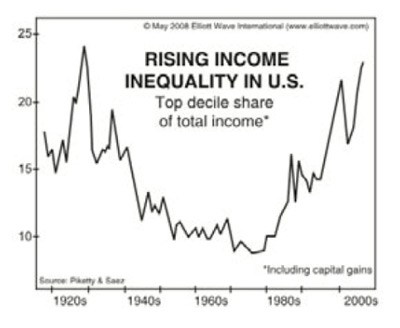
Excessive wealth polarization produces the same results. Economic decision becomes too concentrated, political decision follows through and…

What next?
The world has already experimented with communism. Didn’t work.
It also experienced two economic meltdowns, exactly when wealth polarization was at relative peaks.

income-inequality-08

When are we going to learn anything from what happens to us?
Why do we continue to waste the accumulated lessons collectively known as ‘history‘?