Archives for category: Trust

There are a lot of meanings attached to this concept.

Varying from “Karma is the law of moral causation” to Aaron Hapel’s “Belief in karma is the coward’s revenge.”

Let me add another one.

Karma is about understanding the nature of the link between cause and effect.

Precisely the kind of understanding needed to break the vicious circle described by “The Only Thing We Learn From History Is That We Do Not Learn.”

My point being that history doesn’t play itself, over and over, mindlessly.

In fact “It’s us who play it again and again, until enough of us make enough sense of what has happened to be able to push the whole circus a little further down the road. And sometimes even that is not enough, a whole chapter becomes forgotten and we have to play it one more time….”

Those of you who haven’t done so yet, try reading “The social Construction of Reality” by Peter Berger and Thomas Luckman

“The work introduced the term social construction into the social sciences and was strongly influenced by the work of Alfred Schütz. The central concept of Social Construction of Reality is that persons and groups interacting in a social system create, over time, concepts or mental representations of each other’s actions, and that these concepts eventually become habituated into reciprocal roles played by the actors in relation to each other. When these roles are made available to other members of society to enter into and play out, the reciprocal interactions are said to be institutionalized. In the process of this institutionalization, meaning is embedded in society. Knowledge and people’s conception (and belief) of what reality is becomes embedded in the institutional fabric of society. Reality is therefore said to be socially constructed.”

Yesterday I read an article which stated that ‘when it comes to violin there are a lot of things that are more important than talent‘.

I must confess that I was taken aback.
Not as much by the call itself but by the very fact that someone would actually make a call like that.
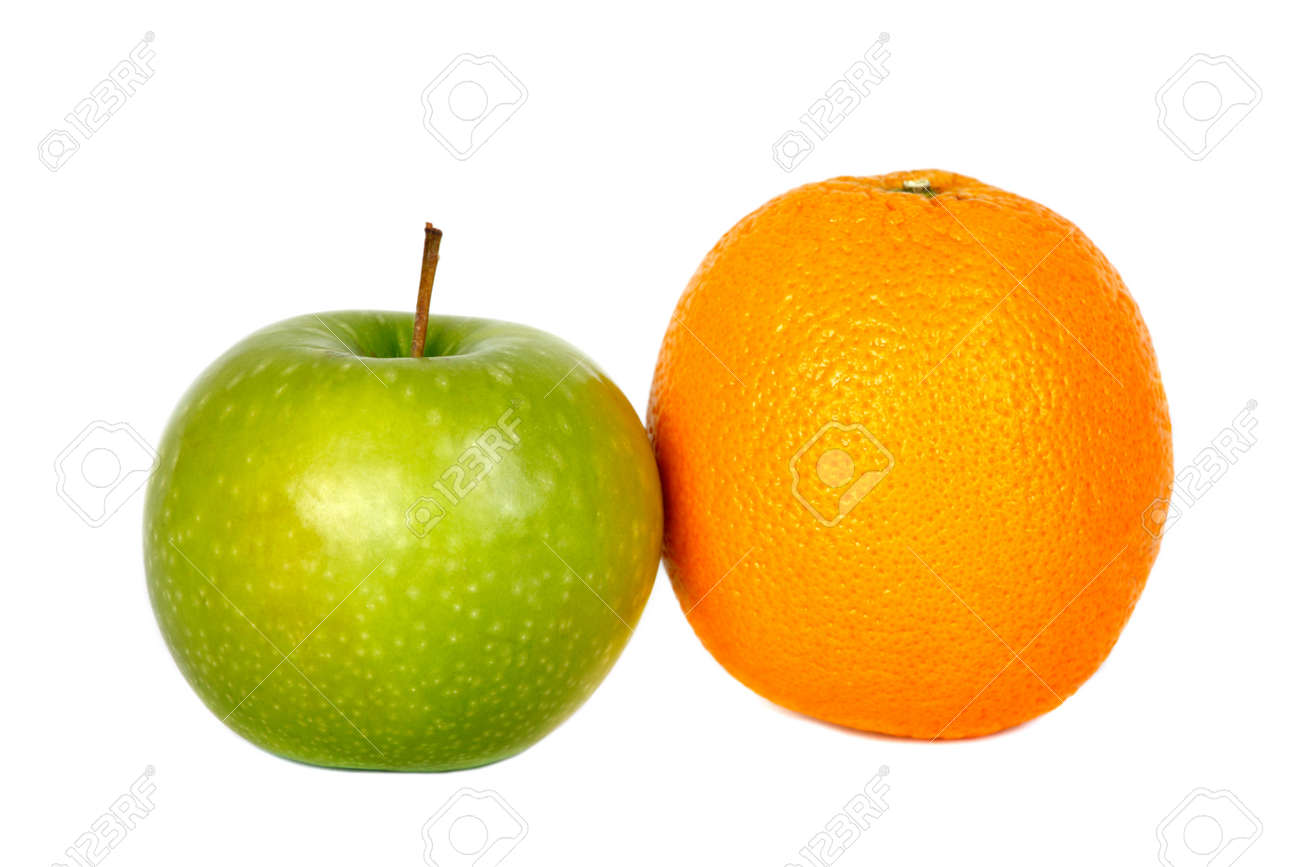
Compare apples and oranges, that is.

OK, both these two can be found in the same department of the grocery store and are somewhat similarly shaped so…

The whole thing made me wonder ‘how is it that we compare things’?

Simply. We choose a standard and then measure the things we want to compare against that standard.
According to our interest in the matter, of course.

That’s why a comparison is not only easier but also less contestable when that standard is actually measurable.
A dimension, for instance. Nobody in his right mind will ever contest a proposition like ‘this orange is larger than this apple’.
Or an evident feature shared by the items being compared. ‘Apples are usually smoother than oranges’.

5989177-comparing-apples-to-oranges-isolated-on-white-stock-photo

In these cases, when the items are easily comparable – sometimes even against the current mantra, we can say that the characteristics used to compare them are ‘parallel’ to each other.

parralel

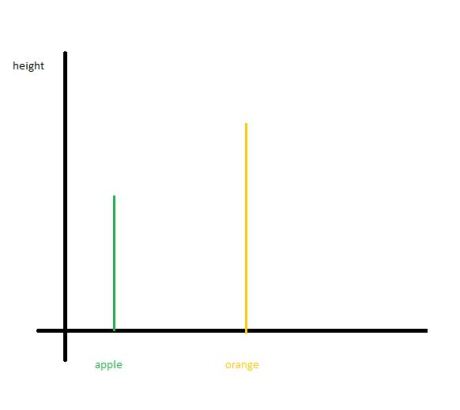
Here we can, easily and undoubtedly, determine that one is ‘taller’ than the other.

parralel 2

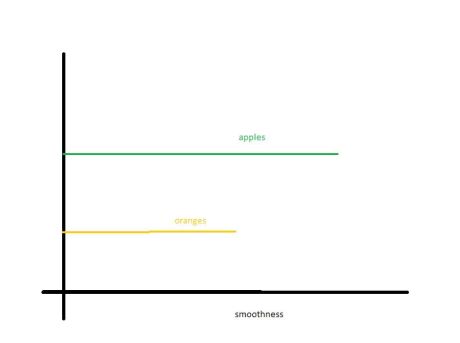
Or we can make that call by measuring the intensity with which a characteristic shared by both categories manifests itself: “Apples are usually smoother than oranges”.

But what if the things we are trying to compare are defined by characteristics which are perpendicular to each other?

Like length and width, for instance.
In fact this particular case is relatively simple. Here we can determine whether one is longer than the other, wider than the other or if the area covered by one is bigger than that covered by the other.
And, for each case, it would be relatively simple to determine which of the two characteristics is more important. According to each individual situation and to our interest in the matter.
After all it doesn’t make much sense to buy a very long and narrow strip of fabric if you want to make a shirt nor to buy a square shaped cloth  if you need some ribbon.

Things are more delicate though if the characteristics are ‘perpendicular’ only in a figurative manner of speaking. For instance talent and dedication. Or opportunity and diligence. In both these situations it’s extremely hard  to make a call as to which member of the pair is the more important. Simply because without any of them the other is utterly useless. Despite our moral biases. Like ‘dedication is more important than talent’. Or ‘Lady Luck will never fail to smile to the really diligent’.

I’m not implying here that preparing yourself for life, like learning and training, is useless. Quite the contrary.
I’m simply saying that you need first to determine what you are really good at.
It doesn’t make much sense to put a lot of effort into something simply because someone tells you that you’ll become better at it if you work really hard.

Yes, the harder you work at something the better you’ll become at it. But what about spending the same amount of effort at something you are talented for?

So go find out what you are really good at.
If you are diligent enough in your search you’ll eventually find out something that you enjoy doing and others find useful.

And that, my friend, is the real happiness.

Or, in Csikszentmihalyi‘s terms, it would mean that you’d have reached the state of ‘Flow‘.


scalia1

It is very rarely that I agree in full with something that I happen to stumble upon over the Internet.

And it’s no wonder that Scalia was absolutely right on the subject.
He had lived for so long in the shadow of the Constitution that at some point it must have downed on him.
The constitution, just as any other legal document, is nothing more, and nothing less, than what we make of it.

After all it was us, citizens, who wrote it in the first place.
Then amended it as we saw fit.
And are now interpreting it. To fit our own purposes, of course.

We don’t seem to agree much, lately, about those very purposes?
So we came up with diverging interpretations of what’s written in the Constitution?

Then the problem is with us, not with the Constitution.

Using it as a weapon, or adjusting it to fit the short term goals of whomever happens to be in power momentarily, won’t solve anything. Actually it will only make things worse.

Just finished reading, again, another excellent post written by John Faithful Hamer on Committingsociology.com

I remember now that something was nagging me after reading it for the first time. I also remember the pangs of helplessness felt almost a year ago, when I couldn’t identify what was nagging me.

Well, this time I nailed it.

“Getting angry isn’t really like releasing the built-up pressure in a steam engine; it’s far more like exercising a muscle group. Every time you give in to the desire to lose it, you strengthen your “anger muscles”; every time you resist the urge, you weaken them.”….
“So perhaps it’s time to stop preaching the gospel of expression, and revisit the much-maligned virtues of repression.”

“Anger” and “getting angry” are not the same thing.
Anger is just a feeling – and, hence, a source of ‘energy’ – while ‘getting angry’ is the manner in which we allow it, consciously or unconsciously, to take us over.
I fully agree that ‘getting angry’ only worsens the situation only I’m afraid that ‘resisting the urge’ isn’t any better. In fact that would be no different from tightening your arse because you don’t want to fart in public.
The problem is not solved, not at all, only postponed. You still need to relieve yourself.
By widening Freud’s concept of repression to encompass more feelings than the simple embarrassment we might find a reason to continue to look for a manner in which to ‘release that built up pressure’.
Only now we are faced with a new problem, since we’ve already agreed that ‘getting angry’ is not the best thing to do.
Freud, again, to the rescue.
How about widening another one of his concepts, sublimation?
How about learning to express, this time consciously, our intense negative feelings in a socially acceptable, and hence a lot more effective, manner?
grandson of sweetie pie

Grandson of TV’s Miss Sweetie Pie gunned down in St. Louis. (AP)

“St. Louis police say they found Andre Montgomery dead at a home Monday night. A second man was taken to a hospital in critical condition with gunshot wounds.
Police say that after someone shot Montgomery, the second man ran upstairs to help him. A third man who was in the home saw the second man carrying a gun and shot that man because he feared for his safety.”

So.
A guy invites some people in his home.
Judging by the way in which they interact they don’t know, or at least don’t trust, each-other.

Somebody – not necessarily from among the invited guests, shots the host.
Somebody else – presumably alerted by the noise, draws a gun and hurries to assist the victim.
A third person, fearing “for his safety”, draws his gun and shots the good Samaritan, simply because he was carrying a weapon.

Is there anything to be learned from here?

OK, by somehow removing all privately owned firearms in America, personal safety, on average, would be somewhat improved. But since something like that would be very unlikely to happen let’s concentrate on something more plausible.

How about taking grater care about who enters your home?

And something else.
Ever since reading about this I cannot stop thinking about the similarity between cars and guns.

Both are tools and both are dangerous. Yet almost everybody has the right to buy one.

But no-one is entitled to use a car without a license while so many people advocate that everybody should be allowed to carry guns, everywhere.

37 000 people dead and 2.35 million people injured or disabled as a consequence of road accidents. Per year.

32 000 people dead by fire arms. Per same year. 60% of them being suicides while roughly 34% are classified as homicides.
On top of this another 67 000 people are injured, per year, by fire arms.

Some could say that there is not any significant difference between the two situations and, as a consequence, a carry permit would not change much.
Are you sure about that?

Currently most guns do not follow their owners when they leave their houses – for various reasons. This is why I’m afraid that if more and more people would chose to carry their weapons, things would become a lot more complicated.

Not because people are bad or ill intended.

Simply because most ‘civilians’ are not trained to asses dangerous situations in an effective manner nor the necessary skills to use their weapons safely.

You see, defending your home – everybody else but you and your family becomes an enemy in this scenario, is very different from trying to help in a complex setting. When people might freak out at the sight of yet another gun.

That’s why not all those who own a gun should ‘drive’ them around without a license.

After all, how safe would you feel when driving in a country where no driver’s license is necessary and where DUI is not forbidden?

I’m not a huge fan of the EU but I have a mostly positive opinion about it.

This morning my stance on this matter was about to change, dramatically.

I had found in my email a link towards a newspaper article, in Romanian, which said ‘the European Court for Human Rights in Strasbourg had ordered that starting with March 1 2016 people in Europe are no longer allowed to baptize their under-aged children‘.

Hard to believe something like that, isn’t it?

Are you really sure about that?

Now try to read articles like this – which are reasonably ‘well’ written, using the right lingo and having enough details thrown in to make them sound credible – through the eyes of a guy already worried by the so much hipped ‘migrant invasion’. Who was already pissed off by the various rules and regulations handed over from Brussels and acquiesced by the local, and supposedly sovereign, governments without any fuss.

Most people do not have the exercise of doubting everything they read, specially if the message comes from somebody they trust – a friend, for instance, or if the site where they read it seems legit.
OK, a certain proportion of them – not all, will exert some discretion if money is involved. That’s why phishing has a limited, yet certain, impact.
But when a particular piece of information apparently confirms an already entrenched stereotype – the bossiness of the EU, for instance – quite a large number of readers will fall for it.

Yesterday evening I was reading a comment added by Nassim Nicholas Taleb on his own Facebook wall:  “What social media finally did: destroy the press. It is more organic to get information from word-of-mouth, which it accelerated.”
Corroborate that comment with a quote from an excellent article published by the same guy on Wired.com: “I am not saying here that there is no information in big data. There is plenty of information. The problem — the central issue — is that the needle comes in an increasingly larger haystack.” (Nassim N. Taleb, Beware the Big Errors of ‘Big Data’, Wired.com, 08.02.2013) and things start to gain some perspective.

What we’re dealing here is the famous lack of symmetry that currently bothers the strategic planners who presumably shape the future of the humankind.

In the ‘good ole’ days’ – when we had writers, publishing houses (newspapers, magazines, you name it) and ‘specialized’ readers, things were a lot simpler.
The writers had a certain notoriety and most of them didn’t want to jeopardize it by publishing bullshit.
Publishing houses didn’t dare to publish bullshit – except for those that did it on purpose, because most of their readers would no longer have bought their papers.
The specialized readers – those who usually bought a certain kind of magazines or books – were able to recognize most bullshit when they saw it, simply because they had some experience in the fields that used to elicit their interest.

Bullshit was being pushed in those days too, for sure. But it was a specialized job, that had to be done carefully.
And in that era, for bullshit to be effective, you had to have very ‘favorable’ circumstances.
Communism didn’t take hold but in very poor countries and fascism only in war torn Italy, Germany and Spain.

Nowadays, “…any simpleminded partisan with a political ax to grind can find an online community of like-minded whack-jobs who’ll be happy to provide him with plenty of ideological ammunition (e.g., bogus stats, pre-fab arguments, etc.). Before long, what was once a more-or-less harmless, single-issue troll has morphed into something far more monstrous and formidable: a veritable Swiss-army knife of bullshit, a perfect storm of bad ideas, a walking Wikipedia of stupid.” (John Faithful Hamer, From Here (2016) )

And since it’s very hard to police the Internet – even harder if we are determined to preserve the ‘freedom of expression’, we are in a very delicate position.

Is there anything to be done about this? Considering that there will never be a real shortage of ‘simpleminded partisans with political axes to grind’?

I think there is.

I started this post by mentioning three related concepts.

Freedom, responsibility and discretion.

We should not tamper with Freedom. Basically this is everything we’ve got, our most precious achievement.

So, we are left with ‘responsibility’ and ‘discretion’.

How is it that most sites manage to stay on line?

They are either sponsored by somebody or they sell advertising space, right?
Who provides that money? Who buys those advertised products? Who spreads around the news about those sites?

Who reads those bullshit laden articles and swallow them hook, line and sinker, simply because some of the (seemingly legit) arguments presented there happen to be consistent with our previously held convictions?

So, if you wish that your kids will be able to live in a better world, stop distributing bullshit through social media, stop buying things advertised on bullshit peddling sites – or, even better, stop going there altogether, and, above all, learn your kids to think with their own heads.

Even if that means they’ll end up contradicting us. As long as they’ll do it in a respectful enough manner – the second most important thing we’ll have to teach them about, all will be OK.


Update. A friend of mine, thanks Lucian, has done some digging over the Internet and found out where all this has started from:

baptising

trump torture

As a young adult I understood that there was no real difference between Hitler and Stalin. It didn’t matter that one of them was considered to come from the left while the other was depicted (by the communists but not exclusively) as a paragon of the right. Both of them had in common the absolute disrespect for everybody else. Each of them was convinced that only their opinions mattered and that all others were absolute morons.

That was when I started to have an inkling about what ‘the elders’ wanted to convey to us, green-horns bucking under the communist rule – which was crippling Romania at that time, when whispering:

‘there isn’t much difference between USSR and America. Their leaders want to rule as much of the world as they can grab while the ordinary people, in both countries, don’t have a clue about what’s going on’.

As I’ve become older I’ve started to figure out that the real difference between various activism-s has nothing to do with the ‘hue’ displayed on their banners. All that counts is the intensity of the sentiment that fuels them and the manner in which the activists relate to the other participants in the game.

At first glance the very notion of ‘conservative activist’ would be an oxymoron, given the fact that (most of the) conservatives define themselves as defenders of the existing order.
Who simply react, within the boundaries of the law and using the tenets of the Constitution, to whatever follies the progressive ‘liberal activists’ are trying to bring upon our heads:

“Like the American people I have watched this process for a number of years, and I fear this empathy standards is another step down the road to a liberal activist, results-oriented and relativistic world where — laws lose their fixed meaning, unelected judges set policy; Americans are seen as members of separate groups rather than simply Americans, and where the constitutional limits on government power are ignored when politicians want to buy out private companies… Call it empathy, call it prejudice, but whatever it is, it is not law. In truth, it is more akin to politics. And politics has no place in the courtroom.” (Senator Jeff Sessions (R-AL), speaking at Sonia Sotomayor’s confirmation hearings)

As usual, practice trumps theory. Regardless of whatever the theory says – and some of the pundits pretend, everybody has an agenda and everybody who has an agenda is actually an activist.

Now that we’ve successfully climbed down to the practical level let’s see what’s the real meaning of Trump backing down from his trumped up stance on torture:

trump defending torture

Hey, wait a minute! So he actually said that ‘we should go tougher than waterboarding’ and he still has such a strong following among the ‘law abiding defenders of the Constitution’?

Well, I’m afraid things are more complicated than that.
Here’s what he says about those who trust him:

trump shooting people

“The people, my people, are so smart…
And you know what else? they say about my people? the polls?
They say I have the most loyal people! Did you ever see that?
Where I could stand in the middle of Fifth Avenue and shoot somebody and I wouldn’t lose any voters.”

Well, if this isn’t ‘activism’ then I don’t know what else is.

But what kind of activism is it?
I’m not asking about where it should be placed in the political spectrum! I’m just wondering how are his proponents, Trump’s people, going to relate with their fellow citizens?
Or with the rest of the world…

And what’s the true meaning of the conservative activists coming out of the closet and assuming such an active stance? So active, in fact, that – as I said before – it is now way outside the realms of typical conservative behavior.

The explanation – as I see it – has little to do with Trump itself and everything with the present situation of the American society as a whole.

First things first.
Trump is nothing but an opportunistic bug, the real problem being how come the American Conservatives have not seen him for what he is and have not thrown him out yet.
I’ll concentrate on this from now on.

The American Conservatives, and not only those ‘loyal’ to Trump, behave as if they have been under a two thronged siege.
‘ The liberals are destroying America from within, the enemies from the outside are growing stronger and stronger yet the American Political Establishment does nothing meaningful about any of these, not even the ‘entrenched’ conservative ‘figureheads’.’

This didn’t start yesterday.

“Whenever you get a group of people together who share certain basic assumptions, there’s a natural tendency for the group to gravitate toward the most uncompromising, extreme, strident, fundamentalist, hard-core positions. Social psychologists call this tendency group polarization. It happens on juries with some regularity. It explains why the Tea Party became so insane, so deeply out of touch with the needs and views of the average American voter. And it explains why the Bush Administration invaded Iraq without an exit strategy (they stopped inviting people who disagreed with their assumptions—people like Colin Powell—to the planning meetings).” (John Faithful Hamer, From Here (2016))

But because of the internet things have gotten even worse:

“These days, any simpleminded partisan with a political ax to grind can find an online community of like-minded whack-jobs who’ll be happy to provide him with plenty of ideological ammunition (e.g., bogus stats, pre-fab arguments, etc.).” John Faithful Hamer, From Here (2016)

“Worse” not because of the ease with which these communities can grow but because too many of the members of these communities tend to give in to the apparent comfort and safety of single-mindedness.

Arguments are no longer able to penetrate the boundaries of this kind of communities.
Walls are erected to keep the odd man out. Then defended fiercely.

And this is why any attempt to cross those walls, be it aggressively or even in good faith, is too often perceived as a mortal threat by those within.

This is the mechanism through which the likes of Hitler and Stalin have managed to dominate for so long their hapless followers, by convincing them that all outsiders, all aliens, are conspiring to destroy ‘Das Vaterland’.

Fortunately the Internet works both ways. It’s true that the members of those communities can chose not to read anything else but the ideas promoted by their insiders but, just as easily, any of them can find out everything that ‘the others’ have to say about the matter.

But what if things are not (yet) as bleak as some of the media venues present them to be?
Not that all the media wants to scare the shit out of us or that all of them are politically biased. No. This happens simply because all of them want to make better ratings and because very few of them understand that ‘he who saws the wind will reap the whirlwind’. (Well, some of them might actually do it on purpose and that’s exactly what activism means but my post is more about those who let themselves be sucked into the whirlwind than about the tempest sowers).

A very short search of the Internet produced two extremely interesting ‘snapshots’.
The first, that the CPAC straw poll placed Trump no higher than the third place, should not surprise us very much. After all most of the participants are either GOP officials or young wannabees and for them Trump is akin to a ragging bull.
The second, though, is rather mind boggling.

gallup, candidates popularity, february 2016

Gallup, daily tracking

Four out of the six still running candidates nomination are perceived more or less unfavorably by the American public?

So what is this? A contest for ‘the least un-liked presidential candidate’ title? (The answer to this question might also explain why Trump has backed down on torture. He figured out that that was too much, even for him. And for ‘his people’.)

We couldn’t blame this on ‘activism’, as such – the remaining two candidates are also ‘active’, but shouldn’t we be asking ourselves about what kind of activism deserves our encouragement?

In any way, shape or form?

Well, before answering this we must consider another issue.
What brought us to the present situation, where both sides of the Political Establishment – and not only in America – are acting as if they want to tear everything apart instead of doing their best to make it all work together?

Lincoln activism

“Abraham Lincoln represented the entire nation, and his most serious actions were aimed at improving the lives of the oppressed and the poor. Lincoln’s values and actions still rank as the greatest period of social activism in the United States. Lincoln’s goal was to create a more perfect union by extending dignity to all — to once and for all end a diabolical, brutal, and oppressive system in which humans were property, mere production instruments.

In other words, Lincoln’s policies were designed for all of the people, not the just the wealthy, the privileged, or vested-interested lobbies.”

Later Edit

‘Conservative activism’ hasn’t been invented yesterday.
Nor by Trump’s supporters!

https://www.everand.com/article/357205089/Surviving-Koch-Nancy-Mac-Lean-Wants-You-To-Ignore-Donald-Trump

https://independentaustralia.net/business/business-display/murdoch-propaganda-machine-catastrophic-for-democracy,18117

Mencken, democracy perfected

Just stumbled upon this meme.

It gave me the creeps.

If such an influential personality like H.L. Mencken had such a warped understanding of the democratic process what can we ask from the proverbial ‘regular guy’?

One question haunts me.
How come so many otherwise bright people fail to grasp the obvious fact that ‘democracy’ is what happens before the voting process?

Voting itself is nothing but logistics, arithmetic and honesty. A process more or less akin to a social survey, one through which the electoral commission determines ‘the will of the people’ at a certain moment. A ‘mechanical’ process that has nothing to do with the living thing encapsulated in the concept of democracy.

…’living thing encapsulated in the concept of democracy’…

Do you think I’m exaggerating?

Then let’s go back to the Agora (the meeting place where the ancient Greeks congregated to discuss the public matters at hand) and watch carefully what happened there before each issue was decided upon.

Everybody who wanted to say something about a subject of interest had the opportunity to make his voice heard.

Yes, that’s the real essence of the democratic process! That’s why the Founding Fathers insisted so much about ‘The Freedom of Expression’. That’s why ‘the right to speak up’ comes First, before all others!

You see, the right to vote has no real meaning if the voters are kept in the dark, if they didn’t had access to all the information available prior to the deciding moment.

People will make a choice regardless of how much information they have, at a given moment, about something, precisely because they think they know everything that is to be known about that something.

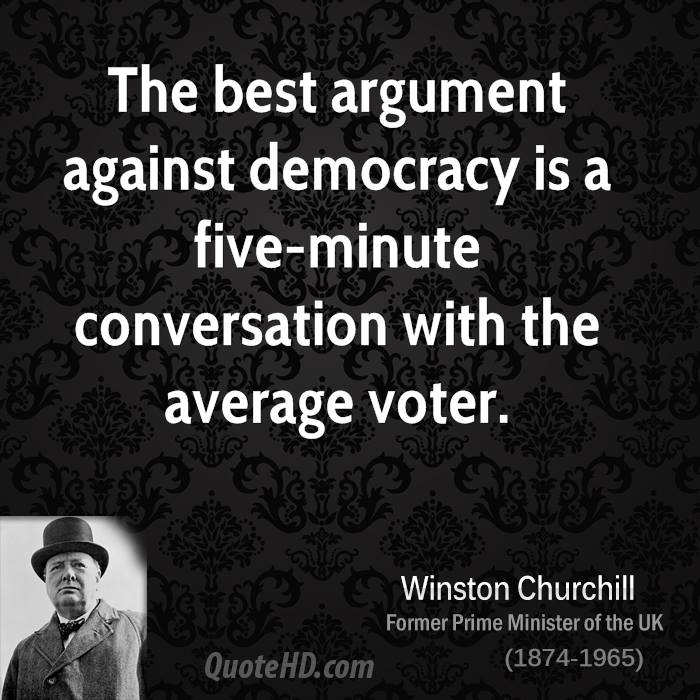
That’s why people privy to more information than the ‘general public’ have come to reach the conclusion that the ‘ordinary voter’ is stupid.

winston-churchill-government-quotes-the-best-argument-against

Because instead of putting everything on the table and letting ‘the people’ decide in earnest, for some time now some of the ‘pundits’ have been playing a dangerous game of  ‘hide and seek’.
One which has resulted in the profound distrust felt by ‘the people’ about the ‘political establishment’. And in the barely masked contempt displayed by the ‘political elite’ towards the rest of the society.

So, instead of having an open discussion about issues and an atmosphere of trust between the various segments  of the social organism we have to pry bits and pieces of information from those who guard it dearly and such mutual distrust that, if we’ll look around carefully, we’ll notice that we’ve been living, for some time now, way inside ‘paranoia land’.

Can we still pretend that our societies are governed in a democratic manner? That each of us tries to shed some light over his area of expertise and by doing so contributes to all of us avoiding as many of the ‘potholes’ as possible?

‘Cause this is the real essence of democracy.
Not finding the best possible solution to every problem but avoiding the known/foreseeable potholes.

No matter how many of us will study a problem we’ll never find the best solution. After five minutes some fresh information will come about and the erstwhile ‘best’ becomes ‘obsolete’.

Compare this situation to somebody stumbling in a pitfall waiting for all of us, coming  back to warn the rest and not one of us heeding to his cries…

vluchtelingen-wegversperring

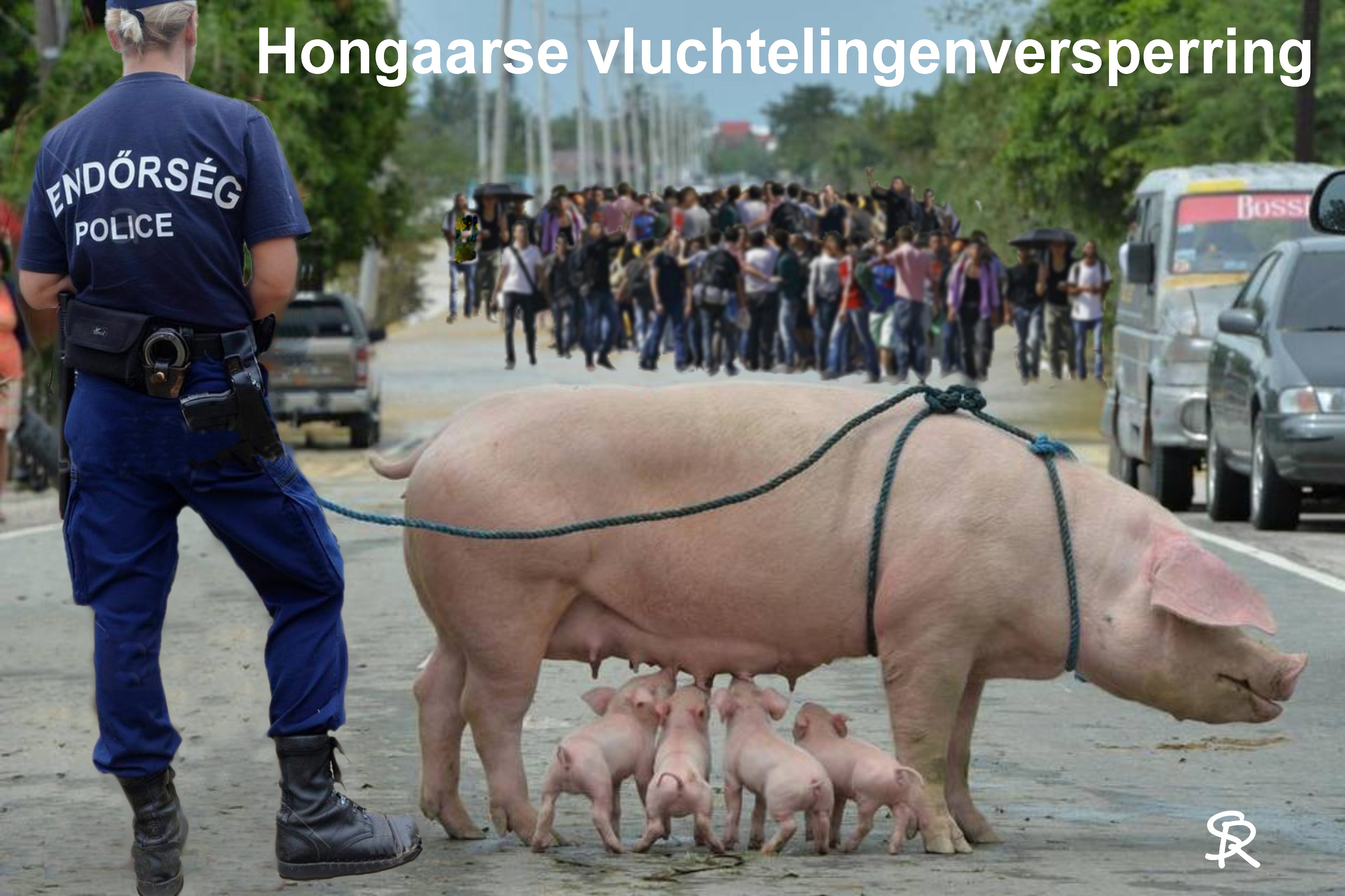
‘Hungarian self-defense’


… must we sink in our own, self induced, decrepitude before we’ll be able to notice the stink we, ourselves, have draped around us?

Before figuring out that it’s us who are ultimately responsible for our own fate?

Before figuring out that by allowing this kind of crap to be traded above our heads, and sometimes even by helping to its distribution, we soil the most precious of our ‘belongings’ – our souls?

This image has probably been ‘Photoshopped’ by somebody.
I’m not going to discuss that person’s motives here. We live in a free world and everybody should be able to express his/her feelings.

What I find extremely interesting – and dangerous – is the fact that this picture has been so widely circulated over the internet that it ended up in my mail. A short Google search confirmed that it comes from somewhere in Holland only the guy who sent it to me, horripilated, lives in Canada…

So, what’s the use for us to clamor virtuously about human rights and then make fun, shamelessly, of people who find themselves in a horrible situation?

And, please, do not make any mistake!
I’m not speaking exclusively about the refugees here.

Some of the manifestly dissatisfied Europeans who are protesting these days are not as much against the refugees themselves as they are against the hapless manner in which the European bureaucracy has been (mis) managing so many things recently.

Just as some of the political leaders who are lambasting the European Commission on this subject are not interested in improving the European Community but in ‘scoring swag’ with the disillusioned (and somewhat naive) electorate.

We need to break this vicious circle!

sex education

“Last week, we heard the story of a West Texas high school that plans to expand its sex-ed program after its abstinence-only policy resulted in a mass outbreak of chlamydia amongst its students.”

Let me ask you something.

Could it be that most of the ‘modern’ children live in ‘bubbles’?
That they have (meaningful) contact almost exclusively among themselves and seldom with older/younger generations?
This being the reason for which ‘sensitive’ information passes so hardly from one generation to the other.
And this is valid for way more subjects than just ‘mere’ sex!
“It’s not the kids who aren’t mature enough to learn about sex, it’s their parents who aren’t mature enough to let them.”